
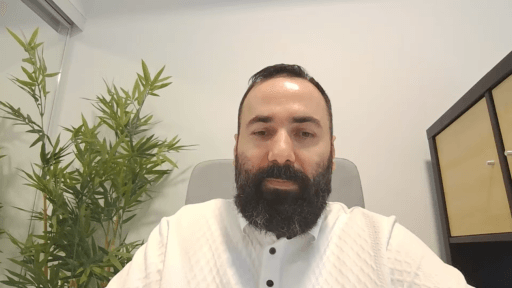
 
Sermon Introduction
Praise be to God, there is no other God except God. That was some country style of praising God.
By the way, I just noticed that there’s about 54 or now it’s 50 or something, 52 submitters in the group chat, which is a nice thing. Usually there’s a little bit like about 20, 10 to 20 percent more submitters than appear in the group chat. The reason is because sometimes people share the phone or the computer when they do the Friday sermon, or it might not work so they go to YouTube. So whatever the reason is, there’s usually more submitters than appear here in the group chat.
Background: The Marriage App Project
What do I want to talk about today? I want to talk about finding a marriage partner, a submitter as a marriage partner.
Let me tell you the backstory. A few months ago, as you all know, I promised that I was working on a marriage app. As they say, there’s a saying which says that it takes 20 percent of the efforts to finish 80 percent of the work, and then the last 20 percent of the work takes 80 percent of the efforts. That’s because usually the complications are left for the end.
Let me inform you what the situation is now. The issue which I encountered was that basically I had to pay a non-submitter who was coding the app, and I was in contact with him. The issue is that, first of all, I paid a very cheap person trying to save money, and then it was a little bit hard to believe that he could do some things which I was planning in the future. That’s one thing.
The other issue was that even if he did everything the way I wanted, I wasn’t sure myself that I could actually finish the app in a way which wouldn’t need updates. I wasn’t sure about some questions, some methods of doing it. So if I had the chance to update them later, then I would probably do it as an app like that.
However, the problem is—and we have some experience with this as people who have worked on the website know this—when you work with a non-submitter, even if they do the work perfectly, when you need them again later, let’s say 10 years, 5 years down the road, what happens is you cannot find them, or they have moved on, they found another job or whatever. So it’s kind of difficult to really rely on them more permanently. That was a risky decision to do the app and then hope that I’m never going to have to update it.
Transition to a Semi-Manual System
Because of that, I decided to do it manually for a while. It’s mostly automatic, but partly manually. This will mean that I’m going to actually see the data which you guys input. God willing, I’m not going to sort of share them or tell anyone about those, and also I’m not going to use them against you or for you or whatever. I’m not interested to use this marriage app, at least not right now, so that you guys can feel free to sort of do it as though I wasn’t seeing it.
What I did is I did pretty much everything that would be in the marriage app and did it more manually through Google Forms, and then God willing, through Excel sheets later. It’s going to be the same thing, except that I don’t have to commit to having it exactly like that forever. Then later on, when I figure out that it’s working, I can actually make the app, finish the app, God willing.
The Importance of Marrying a Submitter
At the same time, thanks for being patient, actually, because I delayed this for quite a while. The other reason why I decided to move ahead with this project even before finishing the app is because I don’t want some people to wait. Some people just want to get married. It’s fine, it’s normal. It’s kind of ironic, especially youngsters who have more time think that they have less time, and then the older people get, the more time they think they have.
Thanks for being patient. I think for whomever was patient, it’s really important that you guys were patient because it’s really important to marry a submitter, a believer. The problems which someone can have down the road if they marry a non-submitter, if they rush and marry a non-submitter or a non-believer, can be huge. So it’s really a great blessing.
Now, I know sometimes people are allowed to marry non-submitters. It depends a lot on the situation. I can understand some of them. I’m not going to make a rule here; I’m just going to pass my principle or my judgment of what I think of someone who marries a submitter and a non-submitter.
Of course, marrying a non-submitter is not a good idea. However, I can see excuses if the person had non-submitting parents, because it’s not easy to marry a submitter when you have non-submitting parents. They don’t support you, they don’t give you enough money. So that’s kind of harder.
However, for someone who also has parents as submitters, I totally don’t understand it. How could they marry a non-submitter? So if your parents are submitters, you are a submitter, if you end up marrying a non-submitter, it’s all on you. It’s all your problem. There’s something wrong with you.
Despite that, even the submitters who have non-submitting parents, I would still even for them recommend a submitter as a marriage partner. However, usually for them to get married, it would have to mean that they have to tolerate some things, maybe not go for the prettiest person or whatever, maybe not the best age. Sometimes they will have to compromise. So yeah, that’s the situation.
I just want to thank you for being patient, and God willing, I hope this system—I’m going to call it a system, not an app yet—this system is going to help people get married.
Frictional vs. Structural Unmarriage
By the way, before I go into that, it’s not going to solve everything. Let’s not have illusions about that.
There’s something which is called in employment, usually in economics, there’s something which is called frictional unemployment, and then there’s structural unemployment. Frictional means that people haven’t found the job, but it’s just in between jobs. They have the qualifications, and there are jobs somewhere, but there’s just friction. Like how do you match the perfect employee with a perfect employer? Then there’s structural unemployment, which means that the whole system doesn’t support employment. If you go to some country, there’s just not enough employment. There’s no way you can have a perfect CV, a perfect college, and if there is structural unemployment, there’s nothing you can do about it.
In the same way, what this is trying to solve is frictional unmarriage, meaning that if there’s guys who would match, it’s probably going to match them. But it’s not going to solve the structural unmarriage. Structural means that the system today just doesn’t support all the people to get married. It is the way it is, unfortunately.
It has to do with the end times, the democracies. Taxes can sort of distort the whole society, then people have to go to college and all of that, but it’s unavoidable. Usually it’s related to the tax level. If the taxes in the world are about 25 percent on average, 25 percent of every dollar you make goes to the government, what that will mean is that about half of that—that’s another issue for another time—about half of that are actually permanently not going to get married because of that, just because of that. Then there’s an additional group who don’t get married because they are not… So basically that will mean that about 15 percent of people just don’t get married, and that’s the government’s fault. You cannot fix that because it’s unavoidable, or if we want to reduce that, they’ll probably end up getting married much later or at the cost of poverty, whichever it is.
Then there’s another group who probably might be too choosy. Some people are too choosy, some people don’t realize how good-looking they are, there’s many reasons. Some people just didn’t get enough luck, like that frictional part.
What I’m saying is it’s not going to solve everything. However, for whatever way it could be solved in a natural way, God willing, it’s going to solve, I think.
Purifying Intentions in the Community
I think the good part about this is that when we have a marriage system, when we meet another time for other reasons, we don’t have this as a problem. What do I mean by this?
We went to Hajj, for example. We went to Hajj about a year ago, if I remember correctly. I don’t know if you guys and girls felt the same thing, but that’s what I felt. I felt like we were really thinking of each other, men and women, as brothers and sisters, and there was no sort of background motives about who could be a good partner for me, who could not be. That was probably really put at the back, and it really didn’t concern anyone. We could actually trust each other. A submitter brother could trust another submitter brother to sort of talk to his sister or something because they knew that there were good intentions and there were no background motives and things like that.
That really helps, because when you know that there’s another way, another place, another time when you have to talk about marriage, then you know that at this time, this specific place, you can focus on something else. Otherwise, if we don’t have some hope or some system, what happens is that people will actually find a way when we go to Hajj, or when we do that, or when we are doing something else, that’s when they will find sort of a way to flirt, if we can say that.
To avoid that, to avoid flirting and all of that, let’s just be direct, have a system. Whoever wants to get married gets married. I mean, whoever wants and is interested and has the possibilities, the capabilities, can get married, maybe later, maybe earlier, maybe never. It’s fine. 15 percent of people might end up not being married; it’s okay. It’s totally okay, by the way.
As I said in one of the days, by the time you get older, it’s kind of the same. Let’s say about 60, when you get about 60, whether you’re married or not married, it’s probably the same value. That’s what matters at the end of the day. The older we get, the closer we get to heaven, to going to heaven, and that’s when we realize what’s important really in life. The most important part is the next life.
How the Website Marriage System Works
Now let me just share how the marriage system, God willing, will work on our website. Let me share the screen.
Before I share it, this is a service which the website is providing. It’s not something which has to be like that; it’s just a service. We’re just trying to help. There’s a verse in the Quran which says to support those who want to get married.
Let me share the screen. Okay, I think you guys are seeing the screen. Can someone help me if the screen is being shown? Can someone write in the group chat? Oh yeah, okay, so people can see the screen.
If we go in our website, where it says Publications, and you scroll down here in the section “Other Publications,” you can find a section which is called “Find a Marriage Partner.” Then you have this, but before we go into the details of this, let me actually repent because I spent so much time talking. Let’s repent.
Praise be to God, there is no other God except God.
In this section which says “Find a Marriage Partner,” I’m going to repeat again where to find it so people can actually find it. If we go to The Submitters, you click Publications, and then you scroll down, you find a section here which says “Find a Marriage Partner.” You click there, and then this shows up. I’m just going to read what it says:
“Find a Marriage Partner. To find a marriage partner, you first have to fill the respective marriage compatibility CV.”
By the way, this is all what would have been in the app. It’s still in the app, but I’m not going to publish it as an app yet.
“To find a marriage partner, you first have to fill the respective marriage compatibility CV. If you’re a man, you click this one: Men’s Marriage Compatibility CV. If you’re a woman, you fill this: Woman’s Marriage Compatibility CV.”
For men, even if you’re married, if you want to fill it, it’s your choice. For women, if you are married, you are not allowed to fill it, of course. Women are not allowed to marry again if they are still married. It’s a man’s choice. I just want to let people know that they actually can do it, even men even if they are married. Now that comes at the cost; they might cause problems with their current marriage and all of that, but that’s their risk and their decision. They can lose the first marriage; it’s their risk.
Then it says:
“Then, God willing, usually in several months, all eligible men will receive access to the women’s responses, and all eligible women will receive access to men’s responses. Afterwards, they can evaluate each profile separately.”
Basically, they check each other’s profile, look at what they put there, input their offers—by offers, I mean dowry, or dowry requests from women—and in the end, through a database, God willing, we will calculate best matches, and the submitters will get access to a list of who their closest matches were, and also if there were any full matches.
Basically, it’s going to tell you, okay, this could be probably your best partner for marriage, but also if it’s not a full match, you haven’t reached an agreement.
This is kind of how this, God willing… I will explain the second part, how it calculates it, because I want people to actually know in another day.
Now, here it says “usually in several months.” Actually, this time we will do it in two weeks. That’s my plan, God willing, in two weeks after you fill this. I’m going to give everyone two weeks to fill the CVs, whoever is interested. Then after two weeks, I’m going to take those data and create another questionnaire which will actually help with calculations. But at this stage, you can just fill the CV, and in two weeks, God willing, I’ll do it. Why did I write here several months? Because after that, I’m not going to do it every two weeks; I’ll probably do it after several months or maybe a year. Basically, it’s only two weeks because I have delayed it for now, and it’s the first time, God willing, so you guys don’t have to wait too long.
The idea is that you fill this. If you’re a man, you fill the Men’s Marriage Compatibility CV; if you’re a woman, you fill this one. Then, God willing, I’m going to give access to the responses of women to the men, and of men to the women. You guys will see the responses, check out, “Oh, I like this female, I don’t like that as much, I like this.” But then what you’ll do is kind of offer a hypothetical dowry, which if it’s a full match, you will actually have to carry out, but if it’s not a full match, I’m just going to inform you that it was close.
Anyway, what I’m saying is that it’s going to be automatic—not fully auto; I’m going to input the data manually, but the system is going to calculate them automatically in this way. By the way, this is important: no one can blame me, “Oh, you chose the wrong person for me.” I’m not choosing anything. You guys will choose it yourself based on your capabilities and based on your interest. At the same time, I don’t want to be blamed for “Oh, this was a bad choice for me.” No, it’s going to be your choice, God willing.
Also, it’s really important to be honest, to fill it the way you truly feel about it.
System Management and Rules
Now let’s only talk about how to fill the marriage compatibility CV.
Because I’m a man, I would fill the men’s… actually, I don’t intend to fill it; I’m just going to show you guys. By the way, God willing, when someone gets married through this system, I might appoint them as the person to sort of manage this system, but I want someone who has already gotten married through this so that they know how it works, plus they don’t have interest to sort of change data or things like that. Because if they are still interested in marriage, they might actually manipulate it. I don’t believe anyone would do it as a submitter; however, we don’t want to leave the chance, we don’t even want to have that option.
So what I’m saying is, for as long as someone is the manager of this, they shouldn’t be allowed to get married through this because then it’s a conflict of interest. We don’t want conflict of interest. Now I’m going to manage this, so that means I’m not allowed to get married through this system for a while.
Men’s Marriage Compatibility CV Walkthrough
Let’s say I click here. If you’re a man, you can click here, and then it’s going to collect your email.
- Click here to collect your email.
The reason why it collects your email is because later on you guys might need each other’s emails to contact if there’s some sort of final touch-ups to conclude the marriage and things like that.
Here’s what you have to fill. It’s a really simple CV.
- You fill the first name here.
I’m going to fill some stuff, some stuff I’m going to leave unfilled.
- You fill your legal last name.
- Gender: let’s say I’m a male.
The system already knows that you’re in the male section; however, this is just to confirm.
- Then you add a photo here.
Let me go off-screen first so I can find a photo, because I don’t know what photos… I don’t want to share personal photos live. Let me reshare the screen again. I hope you guys are seeing it.
Here’s how the photo works: you have to add two photos. I added them just so it allows me to go forward.
- Add first photo: shoulders and above, kind of the way I’m being seen live right now, taken in the last 5 years. No Photoshop, no filters, no AI, and no makeup. This is really important, because it’s not fair if a woman wears makeup and another doesn’t; someone might think that she’s more good-looking. That’s not fair to the other woman who doesn’t wear makeup; it’s just not fair. We have to make a level playing field so that it’s fair to everyone. So no Photoshop, no filters, no AI, and no makeup. You can try to look your best in whatever other way—take a shower, comb your hair, whatever women and men do—but no Photoshop, no filters, no AI, and no makeup, so that the man or the woman can see who you truly are.
- Then you can add the second photo: from any time in your life when you think you looked the best, shoulders and above again, similar to the way I’m appearing right now. No Photoshop again, no filters, no AI, and no makeup. Just don’t change the photos; try to actually take a real photo without makeup. Or if you already have photos, the photos we have on our website, if someone wants to take them, they can use them for themselves; those are quite good.
- Then for the second photo, you will have to explain in which year it was taken. Let’s say I want to post a photo from 10 years ago because I looked the best then. I’m just going to write here when was 10 years ago—2016. Second photo was taken in the year 2016.
Let me change the name to John Smith, which could be any person.
- Year of birth: let’s say he was born in 1970.
- Country of residence: let’s say Spain.
- City of residence: Madrid.
- Now John Smith is going to have to write here what family… to choose these are multiple choices, they can choose all of them, so they can click in more than one square. What does John Smith have as a family? Let’s say he lives with a father, with his mother, with his brother. Maybe he doesn’t have sisters; maybe his sister got married and she’s not there.
- This is important: see, no one should be able to trick anyone. If John Smith has already a wife, and another woman is interested in him, they must know that he has a wife. So if he has a wife, he will select “I have a wife.” If not, then he doesn’t select it. Basically, John Smith selects whatever family he has, or “I have only one child,” “I have more than one child.” Some people want to know whether the person might be divorced and have children. Or “I have no family members.” Basically, you select whichever applies to you.
- Then you select who you currently live with: “I live with my father,” “I live with my mother,” “I live with my brother,” “I live with my sisters,” “I live with my wife,” “I live with my children,” “I live with my non-family members in a shared living space”—this happens more and more these days, especially in the Western world—”I live alone.” Let’s say John has a father, mother, and brother; let’s say he just lives with his mother.
- Native language: let’s say, of course, John is going to speak Spanish.
- English language: how well does John speak English? “I know only a few words or phrases,” “I can manage basic communication in English,” “I can hold everyday conversations in English,” “I can speak clearly in most situations in English,” “I am fully fluent in English.” Let’s say John can speak clearly in most situations in English; let’s select this for him.
- Height: let’s say John is 180 cm. You’ll have to write the full number in centimeters, not in inches or feet or anything else.
- Body type: what body type does John have? Slim body type, athletic body type, average body type, above average body type, full body type, heavy set body type. Above average means a little bit more overweight; it doesn’t mean above average that he’s better. So let’s say John is average body type.
Indicators of Intellect and Belief
Before I go further, let me actually explain the reason behind this questionnaire. What I’m trying to capture with this questionnaire is some basic information so people know where that person lives, who they are, really basic. At the same time, I want to capture a few factors: one is about their belief, but there’s no way to measure belief, and the other one is about their intellectual abilities, which is pretty much how smart they are. Those are important.
In one of the videos on our website, which is titled “How to Find Your Marriage Partner,” I say three things are important:
- Belief,
- how smart you are (or how smart the partner is),
- and the looks, how they look.
The first two are really hard to measure. How do you measure a person’s belief? How do you measure a person’s smartness?
The only way to do it is you can take indicators. What I mean by indicators is that there are things which correlate with smartness, there are things which correlate with belief. They are not for sure; they might tell you only half of the story, they might tell you 40 percent of the story, but I put some of those there so people can know, “Oh wait a minute, this guy seems a little bit smart,” or “This guy seems like he really has strong belief.” So the people can have some clues. It’s just clues, it’s not for sure, because even people themselves don’t know how smart or how much belief they have.
One of the clues about smartness is this: in seventh grade, how well you did in school. Why did I choose seventh grade? Because later on, people get into puberty, or they might choose to get employed, or they just might have other interests. Maybe they are too smart and they kind of are not interested in college anymore or in school because they do better things. Quite often, if they are too young, the parents usually influence them too much, they help them with homework, the child maybe hasn’t developed quite yet, maybe he doesn’t have a good home. But usually, about seventh grade, how you did in school in seventh grade is about probably the best measure of how smart you are.
So I put this as a question. It’s not for sure, it’s not a guarantee that someone is going to be smart just because they were good students in seventh grade, but it’s a good indicator, a green flag for smartness.
- When I was in seventh grade at school, according to the grades which my teachers gave me—not according to you, according to what teachers gave you as grades—did you get straight A’s, did you get straight B’s? In a classroom of about 20 students: “I was a top student in seventh grade,” “I was among the top three students in seventh grade,” “I was among the top five students in seventh grade,” “I was among the top 10 students in seventh grade,” “I was among the top 15 students in seventh grade,” “I was among the top 20 students in seventh grade.” Let’s say John was among the top 10 students, so he was above average. Fill these honestly; of course, we as submitters don’t cheat here.
- Highest education level: let’s say John has a bachelor’s degree. Field of study: let’s say John studied business.
- I became a submitter in… This is an indicator about belief. If someone became a submitter quite early, especially at a young age, they are probably going to be submitters earlier rather than later. Again, a green flag about belief. It’s not going to guarantee that someone is a believer, also it’s not going to guarantee that someone is a disbeliever if they don’t have this quality. Let’s say John became a submitter in 2013.
- Here is a description of what I am currently doing for work/business/study. Let’s say John manages a restaurant. By the way, when you try to find a job or employment, try to present your best version without lying. Feel free to present your best version. So maybe John also owns the restaurant, or maybe part of the restaurant. If that’s true for John, he can say “Part owner and manager of a fancy restaurant.” This makes him look better if this is true. Try to present yourself in the best way without lying: part owner and manager of a fancy restaurant. This is probably what John is doing.
- Quran reading: this is a green flag about belief or a red flag about belief. It’s not for sure, again, it’s just green flags, red flags. It doesn’t mean that this is what actually makes them a good human being or a bad human being automatically. “I read the Quran less than once,” “I read the Quran one time,” “I read the Quran twice,” “I read the Quran about three to five times,” “I read the Quran about six to 10 times,” “I read the Quran about 10 to 20 times,” “I read the Quran more than 20 times.” Let’s say that John read the Quran twice, so he selects that.
- Preference about children: “I prefer to have children in the first two years of marriage,” “I prefer to have children between two and five years of marriage,” “I prefer to have children between five and 10 years of marriage,” “I do not want to have children,” “I have no preferences; I am fully open to both having or not having children.” Let me say that John expects to have children between two and five years of marriage.
- Plastic and cosmetic surgeries…
I was hesitant whether I should put it there, but actually I think it’s fair to make a level playing field for everyone. Why should someone who has cosmetic surgeries get an advantage in front of other women or men who don’t have cosmetic surgeries? I don’t think it’s fair to the others, so I think it’s good to put it there. Even when you buy a car, here in Canada there’s a system called Carfax. When you buy a car, you get a history of whether the car’s engine has been changed, whether the car’s windshield has been changed, whether the car’s wheels have been damaged and changed. When you buy a car, you get the history of that in Canada according to Canadian law, and it’s even more important for human beings. You want to know if they changed something: are they actually the real them, or have they changed something? By the way, this shouldn’t disqualify someone; however, people should have the right to know.
- Plastic/cosmetic surgeries: “I have never had plastic/cosmetic surgeries,” or “I have had plastic/cosmetic surgeries.” He has to be truthful about this. If you select “never,” it just moves on to the next question, but if you did, it’s going to ask you to explain or describe, because not all cosmetic surgeries are the same. Let’s say John has done Botox or lip filler—maybe he’s a man and just wanted to do that, I don’t know, it’s weird, but whatever. Fine, at least we know he hasn’t done the most extreme surgery. Someone who is interested in John can know that he has lip fillers. I’m going to select that he has never had plastic or cosmetic surgery.
- Health question: “I do not have any physical disabilities, serious debilitating diseases, or serious mental disabilities,” or “I have a physical disability or serious debilitating disease or serious mental disability.” Some people might ask which one qualifies as serious. The reason why you don’t really have to know for sure is because if you select it, it’s going to ask you to describe so people can know. Is autism a serious mental disability? It depends, because autism is a spectrum—very light autistic tendencies, or someone might have serious autism. I don’t know all the diseases, however, if you think it qualifies, the best way to know is if the doctor actually diagnosed you. However, diagnosis is not enough; it has to be something serious. A doctor can diagnose you with skin rashes; I’m not going to put skin rashes there, it doesn’t matter much. However, if it’s a physical disability, a serious debilitating disease—something which doesn’t allow you to function as a person in a marriage—or a serious mental disability, you put it there. Let’s say John doesn’t have any of those; most people don’t. Most people do not; some people might. I think it’s important to be honest so that people from the other side of the globe don’t think, because of your photo, that you have no problems. If you do actually have serious problems, I think they should know before they move on.
Then you click next, and then you submit. That’s it. I’m not going to submit it because I don’t want to mess up the database, but you click submit, and that’s it.
Next Steps and Anonymity
You fill this questionnaire. All the men fill the men’s questionnaires, all the women fill the women’s questionnaires, and then later on we put them in a database and you make offers. Of course, they are going to be anonymous, God willing. It’s going to help to be really transparent about what you really want, rather than be afraid that someone is going to judge you. So it’s going to be anonymous later, and then we will use the system to calculate who the best matches are.
God willing, it’s going to work. God designed it through the dowry system. You’ll see, I think it’s going to work well, but you have to fill the questionnaire first. It’s really important that you fill the questionnaire correctly in the best way possible, but correctly without lying.
Does anyone have any question? Important: you have two weeks, God willing, to fill the questionnaire. After two weeks, I’m going to start with the database and all of that. I’m just waiting for some questions.
Questions & Answers
Jad is asking: “What if we wish to go for civil marriage, wouldn’t that cancel the dowry requirement?”
Yeah, but you would have to do it outside of the system. Basically, we are trying here to… what I’m saying is if you want to use this system—and I think it’s the best way to get married in a group of submitters—basically in this system, we imagine that you’re going to give a dowry because this is a religious way of getting married. Of course, you can still add additional whatever ceremonies to the marriage with state and family, whatever that is; that’s on top of it. But we are trying to do it in a religious way. Doing it in a religious way is going to require a dowry, as the Quran says. What I’m saying is that, yes, if someone wants to avoid the dowry, yeah, go ahead, do it. But it’s really a bad idea because you’re going to have to marry a non-submitter very likely anyway.
Guillaume is saying: “Is family members those who are alive?”
Yeah, just put those who are alive. I didn’t specify it there, sorry, but yeah, those who are alive. If someone died, you don’t have to put them there, because what your situation is now is what matters.
This is why I put some issues there of the plastic surgery and all of that, because people do mistakes in the past. However, those are in the past, but some of those are still in the present. The person still looks that way in the present, or still has that disability. So if it’s something which is still in the present, I don’t think we should avoid it.
We try not to judge people’s past. People change, people become better. By the way, this brings me to one more thing: God willing, I’m going to remove anyone who I still think has a boyfriend or a girlfriend. You can fill it, I’m not going to expose anyone here, but if there’s someone who has a girlfriend or a boyfriend and I know about it, and they have not informed that they have changed and become better, they will be excluded. They can fill it, but I will exclude them, I will remove them, God willing.
Adan is asking: “Does an official marriage contract count as dowry?”
I’ve explained that in other videos, plus I’m going to explain it after we fill the questionnaire. The best thing you can do is do the questionnaire, believe that the system will work, and then when I explain it, if you don’t like it, you don’t do the next part. If you like it, you do the next part. I think you should like it if you’re a believer. There’s no reason to try… By the way, it’s a good way to actually guarantee… I’m not even going to go into the topic. It’s in the Quran, so why question it?
If something is unfair… I guess some people are not as good-looking, they think it’s unfair that they are not getting married. Unfairness happens in the world so often in so many different ways. It is what it is.
If anyone is afraid about whether they will not have enough dowry, don’t forget that it’s probably because you’re young and you don’t have enough money. But because you’re young, you have an advantage: you are probably better looking, you look better, and women might like you because you look better.
Anyway, any other question not about the dowry? The dowry I’m going to explain after two weeks, God willing.
Okay, that’s it. Don’t forget, if you’re interested in marriage, try to fill the questionnaire. It’s on the website. God willing, after two weeks, I’m going to move with the next phase about it, which will include this dowry and all of that.
That’s it. For those who have to do the contact prayer, do the contact prayer. The rest of you, peace be upon you.
 
Friday Sermon by: Alban Fejza, Online Congregation Director