[search-in-place-form in_current_page="1"]

What is Dhul Qarnayn (Part 2)


Sermon Introduction

Praise be to God. There is no other god except God.

In the last Friday sermon, we concluded that Dhul-Qarnayn is also the DNA. Before that, we concluded that it was Cyrus the Great. In the last sermon, we concluded that Dhul-Qarnayn, the one with two horns, is DNA. And then I said that there’s more than one meaning into what the one with two horns means. So the Quran mentions the one with two horns, and it has quite a few meanings.

The last meaning I want to talk about—because let me just say that there’s one more meaning which I’m just going to skip, is the DNA of the humans or human-shaped beings, and then there’s another meaning, the DNA of humans—for all of them you can actually learn something, but I’m going to skip because we can include them in the DNA in general.

The Magnetosphere: The One with Two Horns

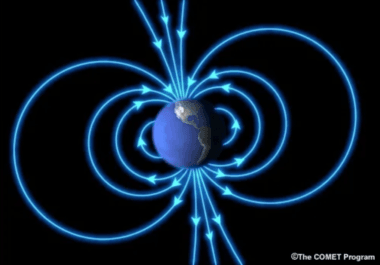
But the one I want to talk about is more different. The one I want to talk about today is that the one with two horns—basically with horns, we concluded, are those like twisted shapes. In this case, another meaning is the magnetosphere. The magnetosphere is one with two horns. It has two poles.

Let me show the photo. So it’s this one.

So basically here we have a representation. It’s not a photo. You cannot take a photo of it. But it’s an illustration of the magnetosphere. What is the magnetosphere? It’s just basically a magnetic field which comes out of the earth, and it has a north pole, one horn, and then it has a south pole, another horn. And the further from the magnetic poles they are, they kind of bend more. So basically there are, there might be actually horns which are straight. As you can see, there’s two horns here. One in the south pole, one in the north pole. So we can understand that the one with two horns is the magnetosphere.

And let’s now read the verses of the Quran and see how it actually makes sense when we read all the verses and we can learn things from it. For those who like science, these sermons are fun in the sense that they learn both religion and science at the same time. Anyway, yeah, let’s read the verses which talk about the one with two horns while trying to understand them as the magnetosphere, the one with two horns.

Surah 18, Verse 83: Establishing the Path Downward

So it says—we’re going to read the same verses as last time, but now slightly differently translated. Again, all meanings are correct. Let’s not focus too much on why it was different last time. In the Arabic, it includes them; in English, we have to choose one specific meaning anyway. So let’s read now the verses in Surah 18, verse 83. It says:

[18:83] They ask you about the one with two poles (magnetosphere).—So it has two poles, magnetosphere—Say, I will tell you about it a lesson to remember. [18:84] We established it on earth—of course, the magnetosphere is established on earth. A lot of other planets don’t have it. Some of them do. We established it on Earth and gave it a path through everything. Why? Because it goes through everything. The magnetic field goes through everything on earth, including us. It goes through us. We established it on earth and gave it a path through everything. [18:85] So it followed a path, [18:86] until it reached the place where the sun disappears. It found the sun disappearing in a spring of black mud (Lava)…

Okay, let’s check how lava looks. Look, lava looks like black mud. So now in this case, we are going—actually, last time we went in the past and the future, one path, another path, but here now we’re going downward and upward. So as it followed one path, let’s say downward where the sun disappears. That’s where the sun disappears. It disappears downward. It found the sun disappearing in a spring of black mud. That’s basically the lowest layer that the sun reaches. I think lava comes from the mantle. I’m not sure, but I think it comes from the mantle of the earth. And the sun doesn’t go beyond the mantle, the sun rays beyond the lava.

…And it found a community of atoms. —In this case, we’re talking about non-organic communities— It found a community of atoms. We said, “O you with two poles (magnetosphere), you either punish (meaning repel them), or treat them good (attract them).” Because what do the magnets do? They either repel, they push away, or they attract, they bring towards you. So either you punish, meaning push it away, or attract it, bring it towards you. [18:87] It said: as for those in darkness, soon we will repel them—there’s magnets which are repelled, they are dark—then they will be returned to their lord and we will punish them with a terrible punishment. [18:88] As for those who believe (basically get attracted, and usually they are not dark like magnets) and did good, for them is a good reward. We will speak to them from our command gently.

And basically this pretty much includes pretty much all the other materials anyway.

Following the Path Upward Beyond the Atmosphere

[18:89] Then it pursued another way, [18:90] until it reached the place where the sun appears.

So now where does the sun appear? High, high, high above the sky. It found the sun appearing on a community of atoms. So basically in this case, let’s not forget we are following the path of the magnetosphere as it goes down through all the way to the earth’s core and then up all the way through the atmosphere and beyond. And then it’s going to follow another way all the way to the earth’s core. Where was I? Let’s continue reading. Okay, let me continue here:

[18:89] Then it pursued another way, [18:90] until it reached the place where the sun appears. It found the sun appearing on a community of atoms—Another way is now up—of atoms for whom we did not create any covering, (magnetic field), from it, (the sun).

So basically once you pass all the way through the atmosphere and beyond there, the magnetic field becomes less and less and there’s no protection from it. Because what does the magnetic field do of the earth? It protects us from the sun rays, from the sun radiation, the bad rays of the sun.

[18:91] Naturally we were aware of it.

Returning to the Middle Altitudes: Atmospheric Barriers

[18:92] It then followed another path, —now all the way down to the earth— [18:93] until it arrived between the two barriers.

Let me see if I actually got this right. Oh yeah, actually it is in the atmosphere still. So now it’s between the highest and the lava. Let me repeat it again, sorry. So first the path which it took was all the way down to the lava. Not all the way down to the core of the earth because it’s going to be mentioned later, you’ll see. And then it went all the way up, and now somewhere in between. Somewhere in between is the atmosphere, like neither too high, neither too low.

[18:93] Until it arrived between the two barriers, (the tropopause and the stratopause)…

Tropopause is basically the place where the troposphere ends, and the stratopause is the place where the stratosphere ends. These are actually important for us not to get UV rays. In the stratosphere, that’s where the ozone layer is and all of that.

… He found beside them a community (of atoms of oxygen) whose language it could barely understand (Paramagnetic).

Basically, oxygen is paramagnetic. What does paramagnetic mean? So as we concluded, there are materials which are non-magnetic, meaning that the magnets do not affect them, including the earth’s magnetic field. I don’t know, plastic—I’m not sure if plastic is non-magnetic, things like that. Because it gets attracted by the magnetosphere, oxygen is in between. It’s barely magnetic, so it’s neither magnetic nor completely non-magnetic, so it’s paramagnetic. But that’s why it’s “whose language could barely understand.” It’s mostly, almost completely non-magnetic, the oxygen, but there’s a tiny bit of pull. The magnets pull the oxygen a tiny bit, just a tiny bit. Anyone can check it with AI: “is oxygen paramagnetic?” and it will tell you, and it will tell you what paramagnetic means. It’s a tiny bit magnetic.

Gog and Magog: Radiation and Particle Threats

[18:94] They said—basically the oxygen atoms which are in the atmosphere—”O you with two poles, (magnetosphere), fast fires (radiation), And where the fast fires are placed (particle radiation)…

By the way, the radiation from the sun comes in two forms: one is in waves, which is let’s say UV rays—I don’t know what type of rays come from the sun, lots of different types of rays, different lengths—and particle radiation, like protons, electrons come from the sun shooting. And if there was no magnetosphere, they would actually reach all the way down to the earth and destroy the atmosphere, first of all. They would just kind of wash away all the atmosphere from the earth gradually, and then they would also destroy us. Those are dangerous radiations, especially the particle radiation, but all types of radiation. Basically, the only safe form of radiation is the one which we see and radio waves partly, but the one which we see is the safest form of radiation, which is the sunray the way we see it with our eyes. Everything we don’t see, including the phone radiation, all of that is a little bit dangerous, but not too much. I’m talking about the radio waves. But when it comes to waves with high energy like UV rays, X-rays, those are really dangerous, very dangerous. And particle radiation is even more dangerous, I’m guessing, it depends on how much there is. So yeah, the magnetosphere is supposed to protect us from that. So let’s go back to the verse.

[18:94] They said, “O you with two poles, (magnetosphere)—The magnetosphere protects the oxygen, meaning the atmosphere, from being washed away, being blown away by the sun radiation. “Fast fires, (in Arabic Gog and Magog), and the place where the fast fires are placed”, because where does the radiation come from? The radiation comes from the atoms. That’s where the radiation is placed. So it can come as radiation or as a particle. So the “fast fires, (meaning radiation), and where the fast fires are placed, (particle radiation), are causing damage on earth.” —And today scientists know that they do damage the earth, if they reach earth. “Can we give you something so that you can create between us and them a barrier?”

Cosmic Iron and Core Discontinuities

[18:95] It said, (The magnetosphere said) “What my lord established me on is better, but help me with strength. I will make between you and between them a barrier. Bring me layers of iron.” As we know, iron came from the cosmos, from up, and it went through the oxygen. And by the way, even in the stars, first it was from hydrogen, it was created into different types of metals, I think carbon and oxygen, and then through silicon, different types of other metals, it became iron. So basically iron was created in the stars, but through oxygen. So oxygen sort of brought the iron, or another way to look at it is that the iron came from space through the oxygen. So basically iron went down, oxygen went up.

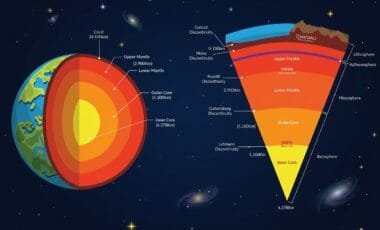
[18:96] “Bring me layers of iron.” Once it filled the gap between the two barriers (that are called in science the Gutenberg discontinuity and Lehmann discontinuity)…

They should have called them barrier, but they call it discontinuity. What does it mean? Okay, let me explain. So, I hope you guys can see.

So, here between the inner core of the earth and the outer core of the earth, we have the Lehmann discontinuity. And here between the outer core and the mantle, we have the Gutenberg discontinuity. That’s basically how scientists know that there is an inner core and an outer core, because when the earthquake waves—or some other types of waves, but mainly earthquake waves—happen, when earthquakes happen, there are waves which spread through the earth from them. Scientists will go in different portions of the earth, different parts of the earth. They never reach down there, so they’ll probably go all the way to the other side of the earth. They have instruments which measure those waves, the waves from earthquakes. And what they noticed—and those waves will pretty much tell them what’s inside the earth with advanced models, of course, not just looking by detecting them—so what they detected is that there’s some discontinuity at this level and at this level, meaning that the waves bounce or they deflect or they go faster or whatever that means. So there’s a discontinuity there, which means there’s a barrier. You can think of it as a barrier where the waves bounce back or deflect or change direction.

So here, these discontinuities, we can call them barriers. Let’s continue reading them, which are down in the earth’s core. So basically now we are learning where the magnetosphere comes from. Where does the earth’s magnetic field come from? It comes from the earth’s core. And let’s see how it happens. So, I’m going to repeat some of the readings so I don’t skip anything.

[18:94] They said, “O you with two poles, (magnetosphere), fast fires (radiation) and where the fast fires are placed, (particle radiation), are causing damage on earth. Can we give you something so that you can create between us and them a barrier?” [18:95] It said, “What my lord established me on is better, but help me with strength. I will make between you and between them a barrier.

The Planetary Dynamo: Solid and Liquid Cores

[18:96] Bring me layers of iron.” Once it filled the gap between—by the way, layers again. In the earth’s core, the iron exists in what they call crystallized form, meaning that all the atoms are layered in exact specific rows. So they are layered—usually the iron which we find doesn’t have the exact layer in a crystallized core, they are kind of more disordered, but in the core, because of all that pressure, they have to be ordered in order to take minimum space. So they get sort of a perfect order which you can see as layers, either vertical layers or horizontal layers. [18:96] …“Bring me layers of iron.” Once it filled the gap between the two barriers, (which we saw what the barriers are), it said, “Blow until it made it fire.”…

So basically, what is it? Iron which is fire at the same time. We know that the earth’s core is iron, almost all iron and some other heavy metals, but mostly iron, and it’s in fire form because of all that pressure. The pressure heats it. “Bring me so that I can put on it molten metal.” And now we have—see,

…“bring me so that I can put on it, (meaning on top of it), molten metal”, —and that’s the outer core. The outer core is liquid metal. The inner core, ironically, someone would think because it’s hotter, it would be actually gas or liquid, but it’s actually solid. It’s even hotter, but it’s solid. That’s why they are distinguished. The inner core is solid metal. The outer core is liquid metal. And the difference between these two, as the outer core which is liquid rotates around the solid one, sort of moves—imagine them like rivers moving around it—that’s where the magnetic field comes from. That’s where the protection from radiation in the end comes from. Isn’t it interesting, at the depths of the earth we get our protection from the radiation from the sky?

[18:96] Then it said, “Bring me layers of fire. Once it filled the gap between the two barriers, it said, ‘Blow until it made it fire. Bring me so that I can put on it molten metal.’” (This is the outer core). [18:97] Thus they, (the radiation), could not go over it or penetrate it. We can understand this two ways: either it cannot go through the earth’s core, or it cannot go through the magnetosphere, because now the earth’s core is helping maintain the magnetosphere, and the magnetosphere is protecting us from radiation.

The End of the Protective Barrier

[18:98] It said, “This is mercy from my lord, but when the promise of my lord comes, he will cause it to crumble. The promise of my lord is inevitable.” [18:99] At that time, we will let them, (the two types of radiation), invade with one another. Then the horn will be blown. —Maybe invade here I think in Arabic it also says goes on top of each other because they are waves. We’ll let them go on top or through each other. The literal meaning in Arabic is wave, kind of like the wave goes on top. [18:99] …Go on top or through each other. Then the horn will be blown and we will summon them all together to create life again. [18:100] We will present hell on that day to the disbelievers. [18:101] They are the ones whose eyes were too blind to see my message, nor could they hear.

So basically, again, in this case we can understand it as the magnetosphere which has two poles, two horns. Let’s repent. Toubou ila Allah.

Understanding Multiple-Meaning Verses

Praise be to God. There is no other God except God.

I think what’s more important than what we’ve spoken so far in the last three days is to understand that all those meanings are correct. Honestly, it’s not that important that we’re talking about the magnetosphere or the DNA because all of them fit with those verses of the Quran, or Cyrus the Great. What’s more important is that the Quran says—let me say the verse first and then understand why it’s important. In the Quran, there’s a verse which says that the Quran has single-meaning verses, straightforward verses, and multiple-meaning verses. Those who believe, they say all the meanings come from God. As for those who disbelieve, they will try to choose one specific meaning.

Basically, what’s important, the most important part is that we don’t say, “Oh, it’s DNA and nothing else.” Well, if Dhul Qarnayn meant DNA and nothing else, God would say DNA. God would be straightforward. Or let say it’s legs and nothing else. Well, if God wanted to say legs, he would say legs. Legs are mentioned in the Quran. He didn’t use that word here. If God wanted to tell us legs, he would tell us legs. But here it’s a multiple-meaning verse. The one with two horns, which means many things, which means that we should be open-minded. And that’s what a believer is with multiple-meaning verses. So basically, believers are more open-minded with multiple-meaning verses. They say, “Okay, this meaning seems true, that also seems true. This seems a bit more true.” So all of them are correct. Now, not every—of course, the one with two horns doesn’t talk about legs because legs are mentioned in the Quran and they are specified what they are, but it does mean it does have more than one meaning. We sort of spoke about three meanings so far.

The Danger of Intellectual Dogma

And probably even more important than that is that we never fight over these, and especially especially when someone finds something themselves, if you’ve thought of this yourself. So, last time, kind of I helped a lot, but whatever. Last time when I asked you guys to guess, I think Adam guessed that it sort of had to do with chromosomes or whatever, the DNA. By the way, it was not a coincidence that he guessed it. I think Adam, just so you guys know, he studied in Harvard—is it Harvard or Oxford? Adam, can you tell us where you studied? Oxford or Harvard? Which one was it? Oh, Cambridge. Okay, sorry, Cambridge. One of those. One of those. Okay. So yeah, I don’t think it’s a coincidence that he found it. We have nerds in our community who know this stuff. Anyway, I’m joking, Adam. I’m joking. So yeah, I think it’s good that he found it.

What I’m saying is, especially when someone finds it themselves—let’s say if you read something in the Quran and you’re like, “Oh, wait a minute. This could be DNA, or this could be that, or this could be that”—what happens is your opinion looks so much more in a better fit, a better opinion than the others. And then it can close your mind to other things. So it’s dangerous. It can close your mind to the idea that maybe it’s something else as well. And unfortunately, a lot of communities, including let’s say the Sunnis and the Shias, because Muhammad might have told them one meaning. So let say someone said, “Oh, what does this verse mean here? What does the middle prayer mean, for example?” and Muhammad probably said ‘Asr, like the afternoon prayer. So now they are stuck into it because that’s the first thing they knew. That’s the only way they want to understand it. The middle prayer in the Quran means more than one thing. It means the afternoon prayer if you measure it from let’s say from the first prayer when you wake up: dawn, noon, afternoon, that’s the middle prayer. Or it can also be—I think it’s more accurate, but both of them are correct—is the noon prayer, because the Quran mentions the night and the day, the night comes before the day, so the first should be the night prayer, then the dawn prayer, then the noon prayer. So now the middle prayer is the noon prayer. And both of them, by the way, are correct, and you can reach the conclusion about the five prayers, or four, or three, whatever is the situation in your location, with both understandings. You can reach the correct conclusion. That’s why God kind of mentioned it as the middle prayer.

And unfortunately, even let’s say the Quranists or whatever different communities, they only stick to one understanding. They just don’t want to change. It’s ideology rather than belief. When you just stick to one understanding, it’s ideology, it’s dogma. It’s not really belief. And this applies to verses with multiple meanings. When it comes to verses with one single meaning, which are the straightforward verses, of course we don’t keep our mind open to, “Oh, maybe this, maybe that.” There’s, for example, we know that there is only one god. There’s no other god except god. We’re not open to, “Oh, maybe there’s some half gods, maybe maybe Jesus is god, maybe he’s not.” We are not open to those ideas because it’s straightforward. The Quran is straightforward about that. But there other things, like Dhul Qarnayn. If you didn’t ask them probably they would, or if we didn’t inform them about this, they would probably never know. So it’s soft information. It’s information which has multiple meanings, and especially because it’s multiple meanings, that means that God put many meanings into one. So when you tell them one of the meanings, it’s never fully convincing. It’s quite convincing, but it’s never fully convincing because it’s only part of the meaning.

Partially Accepting the Text

Do you see the point? Like especially because it is multiple meanings, when I say Dhul-Qarnayn is Cyrus the Great, of course it’s not going to be 100% convincing. I know that. But it’s true. However, it’s not 100% convincing because it’s not 100% of the truth. It’s just whatever—if you whatever I don’t know divide it by 7, 12% whatever it is, 15% I have no idea, 15% maybe, something percent of the truth. So you’re just telling them part of the truth. Of course, it’s not going to be absolutely convincing. And by the way, for those who insist on only understanding one specific meaning, one specific way of understanding those verses or any other multiple-meaning verses, what they are actually doing is they are rejecting most of the Quran when it comes to those verses. Because let say you understood 1/7th of the Quran for those verses and you reject all the other meanings, what are you doing? You’re rejecting most of the Quran. And then there’s a verse in the Quran which says that the disbelievers are those who accept the Quran partially. So they accept part of it, but they reject the other parts. And that’s what people do. By sort of sticking to only one meaning, they accept one part but they reject the other one. And that’s a feature of disbelievers, not a feature of believers. Believers have it clear: straightforward verses, we are not open-minded to other meanings, there’s only one meaning; multiple-meaning verses, we are open to more than one meaning so that we can accept all the Quran, not only a part of the Quran. Someone might say, “Oh, which verses are multiple meaning verses, which are single meaning?” whatever, God willing I’ll make a video about it, but also it’s kind of very natural. You can understand. If the Quran says Dhul Qarnayn, the one with two horns, it’s not easy to understand, it probably has more than one meaning. God didn’t make it vague on purpose so that you don’t understand, it was because it has multiple meanings.

Q&A Section: Atoms as Communities

Anyway does anyone have any questions? And let’s keep it short today.

So, Faisal is saying, “Is 18:88 a prophecy of some sort? How does it attract believers only?” I’ll have to think about it. But where is 18:88? “As for those who believe, basically get attracted, and did good, for them is a good reward.” We are talking here about atoms, not really believers in this way of understanding it. It says, “how does it attract believers only?” So here we’re talking about—think of them as atoms, not humans, because all of these are the communities, are communities of atoms, not communities of humans. Does that answer your question? Okay, so yeah, it does answer your question. Anyway, because the whole time you were talking about atoms as communities or molecules, however you want to understand them.

One more question. I think Jad is about to ask something or say something, and then we’ll finish, God willing. So the Quran does mention the word community, but the word community doesn’t say community of people, any type of group of things. There’s a community of birds mentioned in the Quran, different communities.

Q&A Section: Translating for Multiple Meanings

So Jad is saying, “When understanding a specific meaning of a verse, should the rest of the Quran be translated to be related to that meaning, or it doesn’t need to be?” Okay, I would say yes. Generally yes. The answer is generally yes. That’s why we have to have many, many versions of the Quran translated, God willing. We don’t have to because we don’t have to understand the multiple meaning verses absolutely completely, but the more the better. That’s why, God willing, we’ll have many translations of the Quran. God willing, I’ll make more than one translation of the Quran. We’ve already done some Surahs. Because then now if we understand it in this meaning, as you can see, if we think of the communities as atoms rather than people, then we have to translate the next verse in a way where it makes sense, where we would have to say it or instead of he and things like that. So yeah, generally yes. In some cases, it might be the same—let say verses can fit, the same way of translating it can fit for both cases. So it depends, but for most cases, yes.

Closing Remarks

Okay, we have to go now. Sorry guys, because I don’t want to delay—whatever question you have, maybe we can talk another day. Because I’ve been holding very long Friday sermons recently, I want to sort of try to stick to approximately half an hour.

Okay. So, for those who have to do the contact prayer, do the contact prayer. The rest of you, peace be upon you.


Friday Sermon by: Alban Fejza, Online Congregation Director
What is Dhul Qarnayn


I praise God. Praise be to God; there is no other god except God.

In the last Friday sermon, I spoke about Dhul Qarnayn, and we concluded that Dhul Qarnayn was Cyrus the Great—I think he is also called Cyrus II. We concluded that from the Bible and pretty much from the Quran as well, a little bit. We used the Quran as a framework, and then we found the details in the Bible.

Just a second, someone is saying they cannot access the site in Turkey or something. You can go to YouTube, I guess. If you cannot access it on The Submitters, you can go straight to YouTube Live. You just go to the channel, The Submitters, on YouTube, and then it should be there as a live video. I am just going to wait a little bit to see if it gets solved. Okay, thanks, Faisal. Faisal sent the link. I don’t know if they are going to see the link if they don’t have access to the site, but anyway, someone might help them somehow with other chats.

It is important to actually be in this chat for most of you because I might make this a little bit more interactive this time, mostly because I am actually not fully ready for this sermon. Maybe you can help; we can discover it as we go, sort of.

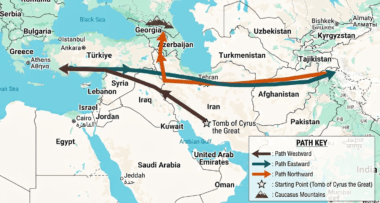
Let me go back to the topic. The topic is: who was Dhul Qarnayn? Dhul Qarnayn is mentioned in the Quran. It means “the one with the two horns,” and we concluded that it was Cyrus the Great, one of the people who helped the Jews. He traveled on one side of the earth, on the other side of the earth, then another side. We know that.

According to Arabic, but many other languages as well, when God says “he”—even in Albanian—it does not automatically mean a gender like a male. Sometimes in a lot of languages, actually in most languages except for English and a few others, “he” is used for objects as well. For example, in Albanian, the TV is a “he” and the microwave is a “she.” I don’t know how they came up with this, but it is just grammar. That is why in the Quran, when God says “he,” it does not automatically mean that He has male organs; it just means “it.” Those two languages have only two genders, and those genders are sometimes used for objects as well, for things. In Albanian, for example, a mountain, mali, is a “he,” while a hill is a “she.” We can go deep into the psychology of why people decided to call some objects “he” and some objects “she.” Psychologically, I think it has to do with the fact that things which do things to others are usually called “he”—kind of like the more dominant things which act on others. Things to whom things are done are usually perceived as female, psychologically, and that is why they use those different genders. Let’s say a river in Albanian is a “he,” lumi, because it can do things to you. But a tool, you do things to it, so it is a “she.” A stick in Albanian is a “she.” This is also in Arabic, sort of; it uses those gendered nouns for things, as do most languages. What that means is that when God says “he” about it, it does not necessarily mean it is a human male. First of all, it never says it is a human. Second of all, when it says “he,” we can literally translate it as “it” in English as well. God willing, when I read the translation, I can use the word “it” as well, because, again, we haven’t concluded necessarily that it is always talking about a human.

How do we know it is not necessarily talking about a human? First of all, why would God tell us about Dhul Qarnayn, the one with two horns who is Cyrus the Great, and not just say Cyrus the Great? God could have just said Cyrus the Great. People knew the name of Cyrus during that time, in whatever the Iranian or Arabic version was; they knew the name. God could have just used his name, but God didn’t. The reason for that is because the Quran is revealed for all times, and therefore, for our times, we can learn more from those verses, not just about Cyrus the Great. We learned the history of Cyrus the Great, but at the same time, using the same language which the Quran uses, we can conclude other things. At the end of the day, Cyrus the Great doesn’t really concern us; he was important for the Jews, for the believers of that time, for the Children of Israel of that time. He was important for that, but he is not really important for us. Do we even care if Cyrus the Great existed or not? Yeah, we know who he is, but it doesn’t matter to us much. That is why God uses double meanings, many meanings, in those verses. Those verses which mention the one with two horns have many meanings. The one with two horns has many meanings: some meanings refer to the past, and other meanings refer to our time so we can understand other things.

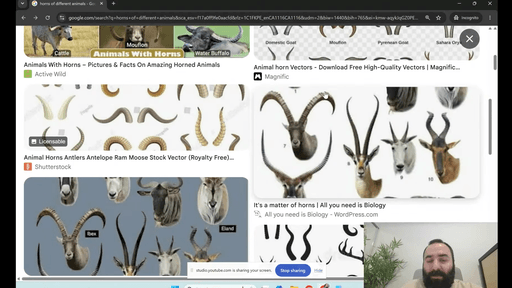
Let’s try to find out together what the one with two horns is. Before we find out what it is, first of all, let’s define what a horn is. What is a horn? I am going to share the screen. Okay, I am sharing the screen. Here I searched for “horns of ram twisted.” This is a horn; these are two horns. Let’s search for maybe “horns of bulls”—again, two horns. Or let’s just say “horns of different animals.” Where can we find a collection? How about here? I don’t know if I can make this larger; it’s on Facebook. But you guys get the idea. I am going to make this larger. These are horns. What do they have in common? What do they have in common? Let’s define what a horn is. A horn, first of all—what can we conclude? They always come in two. A horn comes in two, so horns are two… I don’t want to use the word “pairs” because it is a repetition, but maybe I have to use it in English, I guess: two pairs, or a pair, let’s just say two. But what are they made of, by the way? They are made of organic material. All horns are made of some specific stuff. Also, they usually have bones inside, so that is organic material. So, two organic materials which mirror each other, meaning that, as we can see, the left horn is always almost the same—not exactly the same, but almost the same—as the right one. We can say they mirror each other. So far, we have defined it this much: horns are two organic materials which mirror each other, useful for living creatures.

What are they useful for? What is the function of the horns? Biologists—the people who study these things—I don’t think they have fully reached a conclusion. They have reached a conclusion for the most part, but let me explain. I don’t think they fully understood the depth of why animals have horns, why some animals have horns and others don’t. If you ask a lot of them, they will either say sexual selection, meaning that they are used to show the females which male is stronger or has more protective strength, or they say to protect against predators. For example, the horns of the bull might be used to protect against predators. Guys, can you please not chat about other things during the Friday sermon? I am just going to delete the messages which have nothing to do with the topic. I am deleting them, and please delete each other’s if it has nothing to do with the topic. Just delete it unless it is helping with the Friday sermon, to listen to the Friday sermon. Feel free to delete each other’s topics. Believers listen; only one believer speaks at a time, we don’t speak over each other.

Again, we are trying to define what horns are. Horns are two organic materials—I’m defining it right now as we go. Horns are two organic materials which mirror each other, useful… I’m just going to put a comma here… useful for living creatures to do what? This is what I want to explain. If horns were only for protection—let’s say if the bull used the horns only for protection—it would be easier for the bull to invest all that energy which goes into growing new horns, because it takes energy to grow them, and it also takes energy to have them because they are heavy, so it is going to take lots of energy. It would be better for the bull to actually just use that energy for strength to run away. It would be much better for the bull to run away from the wolf than to actually fight it. Then why does the bull, why do some creatures have horns and others don’t? A rabbit, for example, a rabbit doesn’t have horns. When a wolf chases a rabbit, what does the rabbit do? It runs. It invested all its energy into having fast muscles, and it is going to run away. But the bull doesn’t do that, or it might try to run away, but it also has horns. Why do some creatures have horns? The reason is to protect their offspring. Basically, what they use the horns for… because the bull can run away, but if the bull has a pregnant mate, let’s say a cow, and if a cow is pregnant, the cow cannot run away. If the bull runs away when the wolf comes, the wolf is going to eat the cow. When she is pregnant, she cannot run. If she has just given birth, the calf—the young cow or the young bull—cannot run either. It cannot run as fast. It can run a little bit, but not as fast. So, there is a period of time when the offspring of the bull, which could be inside the pregnant mother or just very young, is vulnerable. During that time, the best thing for the bull to do is to fight the wolf. In this way, it protects the offspring, the child, rather than running. If the bull runs, the child is going to be eaten.

What we have concluded is that the horns are useful for the protection of the offspring. The bull doesn’t need the horns for itself, because rabbits, which don’t have horns, have small offspring that can hide in holes and dens, so they don’t need horns. Other creatures can run, or they don’t have vulnerable times. I am talking about mammals which have vulnerable times, like cows or sheep. I think sheep produce only once a year, and it might be during that time when the wolves will try to eat the lambs. The ram technically has the horns mostly to protect the lamb, not for himself. Himself, he could have run; it would be better for the ram, the male sheep, to run from the wolf than to try to fight it. The only reason why he chooses to fight it is because he is trying to protect the lamb and the female partner. The horns are two organic materials which mirror each other, useful for living creatures to ensure the continuation of their offspring, basically their children. I don’t know if the word “children” can be used for animals—to ensure the continuation of their offspring.

This is the time, actually, when I want you guys to chat. When I ask, I want you to chat. Now, can someone tell me—let’s see who finds it first—what else fits this definition? Let’s delete the word “horns” because we have the definition now. This is the definition of horns. I am going to put a blank here. This is the definition. Can we fill in the blank here with something else? What are two organic materials… “mitosis,” okay, close enough. What are two organic materials which mirror each other, useful for living creatures to ensure the continuation of their offspring? I think you guys can get it. No, not legs; legs are not to ensure the continuation of the offspring. Legs are to ensure the continuation of you; legs are for you. What passes from the parent to the offspring? “Male and female,” no. Adam Fraser is saying “chromosomes.” Very close, Adam. What are they made of? Chromosomes, genomes, yes. Trevor said “genomes,” Adam said “chromosomes.” I think Adam got it first, and then Trevor a little bit. What I want to say is DNA.

Maybe I should have divided it more. Horns are two organic materials of helical shape, shaped like helixes, shaped like a helix. We saw the shapes of the horns; they are shaped like a helix, and they mirror each other. So, it’s the DNA we’re talking about. The two horns—it’s talking about the DNA, because the DNA… let’s go to the DNA shape. Look at the shape of DNA. It’s like two horns: one horn and then another horn, and they mirror each other. Technically, these are all microscopic two horns, two horns which are very small. That’s what the DNA is: two horns.

How I came to discover this is because, years ago, I remembered that in my biology class in the US, in my fourth year in high school—biology was never actually my favorite subject—but I do remember the teacher showing us something about how they discovered the DNA. I think it was a photo of DNA, this photo. I was amazed at how they found it out, because it’s not actually about biology; it’s more about math and physics. This is the photo which a woman scientist took; it’s called Photo 51. Basically, it’s just X-rays passing through what is supposed to be DNA. This is Photo 51. There are many other photos which don’t necessarily have this shape, but this one was interesting because it was from a specific angle which showed this shape. Including all the other photos and all the other shapes, the people who discovered that DNA is a double helix used really advanced math and a real-life model to try to figure out which shape would give this shade, because this is technically just a shade through crystals. I don’t know exactly what the method is, but basically, this is an X-ray. They had to imagine, using math as well, what shape would be the cause, because with X-rays we only see the shadow, a 2D shadow. Imagine that this is the shadow of the DNA. They discovered it without ever having seen it; they had never seen it, they had never taken a photo of the DNA, but through this shadow and other shadows from other angles, they managed to discover that only a double helix—a helix is this twisting thing—only a double helix will create that shadow. That’s amazing. That’s why I remembered it, because it had to do with math. I was like, “Wow, they must have been geniuses.” They discovered from the shade what the shape of the DNA is.

What I mostly remembered is not just DNA, but that it is called a double helix. Technically, DNA is a double helix; that’s the informal name, double helix. It means two twisted shapes, which is pretty much two horns, because horns are helixes; horns are twisted shapes. We saw how horns look; they look like twisted shapes. Basically, we can replace the words “two horns” in the Quran with the words “double helix,” because it’s the same thing: two horns, double helix. Let’s see what we have. Once we do that, we realize that the Quran is actually telling us the story of the DNA, the story of the double helix.

Before we do that, God willing, we’ll read the story of Dhul Qarnayn again, but instead of thinking of him as Cyrus the Great, we’ll think of it as the double helix. God willing, in one of the future translations, instead of saying “two horns,” it will say “double helix,” meaning two twisted shapes which are horns—a horn is a twisted shape—and which mirror each other, of course. Before we do that, let’s first of all repent.

Praise be to God; there is no other god except God. Let’s read the Quran now. Let’s go to the Quran, and instead of saying “two horns,” which is the literal meaning… oh, by the way, it makes sense. That’s why in the Quran, when we go to the Quran glossary, Surah 18, verse 83, I think that’s where it’s mentioned. It says, “They ask you about Dhul Qarnayn.” If I click here on Qarnayn, it means horn, but it also means generations. By the way, the word “generation” has the same root word as “genes.” “Generations” is just like “gene”; it’s the same word in English. Generations means the next offspring, and the next offspring, and the next offspring. It’s the same word in English: genes and generations come from the same word. The root word is also telling us that it’s talking about genes, not only about horns, but also about genes which pass on from generation to generation. That’s what genes do: they pass from generation to generation. It’s pretty much the only thing which passes from one generation to another generation. All the other materials in the human body, or the body of living things, are different, but the genes pass from one generation to another.

Now let’s read this surah knowing that we are talking about the double helix, which also means genes. Let’s read the whole section and try to understand, actually for the first time, what it can teach us. Most of it is already discovered, but it can teach us the journey of the DNA. Let’s read that part of the surah with this other understanding. I’m going to go to Surah 18, verse 83. This is how I translated it, and this might be one of the translations for this part of the surah. It says:

“They ask you about the one with the double helix, basically DNA, the one with two horns, the one with two generations, two genes. They ask you about the one with a double helix, DNA. Say, ‘I will tell you something about its history.'”

It is actually telling us the history of the DNA, how the DNA travels from the beginning until the end, because DNA has been here pretty much almost from the beginning of the earth, and it’s going to be here until the end of the earth. It’s telling us the journey of the DNA. Then it says:

“We established and created safety for it on earth and gave it instructions for everything.”

What does the DNA do? It has the instructions for life.

“So it followed the path.”

Of course, DNA traveled from generation to generation throughout history.

“Until it reached the place where the sun disappears.”

Here we’re not talking about the sunset; here we’re talking about when the sun ends at the end of times, when the sun basically gets destroyed.

“It found the sun disappearing in a pupil of black material.”

In Arabic, it means spring, but it also means pupil; it means the part of the eye, the retina, the circular part of the eye. It says, “in a pupil of black material,” which is like the black part of the eye, but this is the same thing which happens in a black hole. A black hole is just a spring where materials go in and they never come back. Why are they the same, the pupil of the eye and a black hole? They have pretty much the same concept because the reason why the pupil, the most central part of our eye, is black is because the light goes in and it never comes back; it gets absorbed by our eye. Then, as a chemical or electrical reaction, it goes into our brain. I don’t know exactly what kind of reaction, but basically, the light disappears there; it gets absorbed in the eye. Just like in a black hole, when the light goes in, it disappears and never comes back out. When light hits our skin, for example, part of it comes back, it goes back. When it hits any part of our body, part of it goes back. But when light hits the black part of our eye, the part which sees, it never comes back. That’s why it’s black. It’s the same thing with black holes, and that’s why the word “spring” is used in the Quran. It says it is setting in a spring of dark mud. When you look at the word “spring” in Arabic, ayn, it also means eye. The root word means eye, spring, eye. The word spring and eye come from the same root in Arabic. The reason is because springs in the desert typically have a circular shape like an eye, and usually, they have some kind of color and a darkness in the middle where it’s deep. That’s why they use the same word. What’s more amazing is that whatever happens in the eye is exactly what happens in black holes: light enters and it never comes back. That’s the most important part.

Now, this is telling us how the sun will end. It says, “until it reaches the place where the sun disappears,” meaning at the end of times, “it found the sun disappearing in a pupil of black material, a black hole.” I explained in the video about the end times that the way the world will end is that all the stars will be put together, and physicists know that when you put a lot of material together—let alone all the stars, but if you just put a million stars together, not even all of them, just a million is enough—they are going to create a black hole. There is so much material in one space that it creates a black hole; it bends space, and then when light enters, it never comes back, which is why it’s dark. That’s why they call them black holes; they should have called them dark holes rather than black holes, anyway, it doesn’t matter.

Basically, it’s telling us that when the DNA reaches the end of time—by the way, this also tells us that there is going to be DNA at the end of time, which means that there will be people, animals, and creatures until the end of time. When they reach that end of time, the Quran says that the stars will be all put together and thrown into hell. As the stars are put together, they will create a black hole. So basically, the sun—and the sun is one of the stars—will end up in a black hole as they are being put together.

Then it says that when the DNA reached the end of history, basically the end of times, it found the sun disappearing in a black hole, and it found a community there, people. We said:

“O you with a double helix, you may either punish or treat them good.”

It said:

“As for the one who wronged, soon we will punish him.”

DNA might be used because the Quran says that that is the day when God will make the skins talk and the fingers talk. DNA might be used, meaning… I don’t know, are the bad people going to be created a bit more ugly? I don’t know how the DNA will be used, but probably they might turn out more ugly. DNA will be like, “Oh, I’m not going to be nice to you this time; how about you’re ugly this time?” You know what I mean. Anyway, it’s going to be used just like the skin will be used, our tongues will be used, our eyes will be used against us if we are disbelievers. If people are disbelievers, their organs will be used against them, and also their DNA.

Then it says:

“It said, ‘As for the one who wronged, soon we will punish him. Then he will be returned to his Lord, and He will punish him with a terrible punishment. As for him who believed and did good, for him is a good reward. We will speak to him from our command gently.'”

“Then it pursued another way.”

The DNA, we are imagining, traveled all the way to the future, and now it’s pursuing another way, all the way to the past.

“Then it pursued another way until it reached the place where the sun became apparent.”

This means the start, the beginning of times. By the way, this is important to explain: what the Quran calls the sun, moon, and stars is the way we perceive them, meaning the 2D shape, not what the astronomers call the sun. When the Quran says “sun,” it means as we see it, meaning the 2D shape. Astronomers call it the sun disc or the moon disc—basically what we see in the sky as a disc, as a ball. That’s why the Quran says the moon becomes like an old, curved sheath; it changes shape. It actually doesn’t happen to the 3D moon; it happens to the 2D moon. It’s like the way we use the word “profile” today. When we say to someone, “Send me a profile,” what we mean is the 2D picture; we don’t mean the full 3D face or 3D body. The actual, real face is us, but when we say profile, we mean the 2D representation of that. In the same way, the Quran speaks to us from our perspective. So when it says sun, moon, and stars, it’s talking about the way we see them. That’s why the sun disappears; the 3D sun doesn’t actually set, it’s still there, but the Quran says that the sun does set, meaning that it’s talking about the 2D appearance, what we see in the sky.

What this means is that when it says “when the sun became apparent,” it’s talking about when the sun became apparent on earth, not when the sun was created. It’s the first time when the sun became apparent on earth. You can sort of see this in the video clarification which has to do with the seven days of creation. There you can see that the sun appeared and disappeared, and things like that, because of the atmosphere. There were gases and things which covered the sun, so it was not fully seen on earth. But here it’s talking about the beginning—not the beginning of the sun, but the first time the sun appeared on top of the DNA.

“The DNA found the sun appearing on a community of cells.”

Of course, because then there were no creatures, just a community of cells.

“For whom we did not create any covering from it.”

In the beginning, when the simple cells were created, there were no complex organisms; it was just separate cells. At that time, before plants existed, there was no oxygen and no protective atmosphere. It’s basically through plants that most of the atmosphere was created, most of the oxygen, which forms the ozone layer that protects from the sun. So they had no protection. Basically, in the beginning, the cells which had the DNA didn’t have much protection from the sun, and this actually tells us a lot because this helped with mutations, meaning that it helped DNA change faster so that things could be created. Once you hit the DNA with sun rays, ultraviolet light, and all types of light when there’s no atmosphere, it creates more mutations. It makes evolution faster and harsher—meaning that some creatures will be created faster, but it’s also going to be harsher on other creatures, and they will die faster.

Let’s go back to reading this part.

“Then it pursued another way until it reached the place where the sun became apparent. It found the sun appearing on a community of cells for whom we did not create any covering from it.”

We know how the situation was from the video clarification where I talk about the seven days of creation.

“Naturally, we encompassed the genetic information with him.”

The Arabic text only says “information”; I added “genetic.” We encompassed the information with it, so basically, God and the angels knew what information was inside the DNA.

“Then it followed another path.”

This is interesting; it tells us a lot about cells.

“Then it followed another path until it arrived between the two barriers.”

The two barriers are the membranes of the nucleus. The nucleus of the cell has two membranes, one on top of the other, and this is interesting because this membrane did not exist in the beginning. Cells did not have nucleuses in the beginning; there was no nucleus. Later on, it created this protective barrier where the DNA is protected, which was not there in the beginning. It’s telling us that at some point, the DNA reached a place where there were nucleus membranes inside the cell.

“He found besides them a community.”

Why a community? Later we’ll see why mitochondria are that community. Mitochondria are just organelles inside the cell. There are about 100 to 2,000 mitochondria in each cell. Since there’s about a thousand mitochondria in each cell, we can call them a community. Then it says:

“Whose language, meaning genetic code, it could barely understand.”

This is what’s amazing, how this shows that it’s really talking about the DNA, because mitochondria are the only part of the cell which has its own DNA. The whole living cell uses the DNA which is found in the nucleus, in the center, but mitochondria have their own DNA. Mitochondria are just small parts in a cell—a community, the Quran calls them—but they have their own DNA. Because it’s different, it’s not exactly the same DNA as the one in the nucleus, it says, “whose language, meaning genetic code, it could barely understand,” meaning that they have their own language. It’s amazing, right? We’ll see why it’s talking about mitochondria, because it fits completely. First of all, they have their own genetic code, meaning their own language, which is not really understood well by the DNA in the nucleus.

“They said…”

The mitochondria said to the double helix, to the DNA, “O you with two horns,” or “O double helix…” They said this to the double helix when they were created at some point in time. Scientists probably know approximately at what time cells started to have mitochondria; they didn’t have mitochondria before, but at some point, they started to have them. The mitochondria said:

“O double helix, the fast fires…”

In the Quran, it says Yajuj and Majuj. In English, they assume that it’s Gog and Magog, but in Arabic, the words Yajuj and Majuj literally mean “fast fire.” It’s really not talking about Gog and Magog necessarily; it’s talking about fast fire. Yajuj means fast fire, and in Arabic, when you add the letter ‘m’ to the beginning of a word, it means the place where that thing exists. For example, sajda is prostration; you add the ‘m’ in the beginning and it becomes masjid, the place of prostration. This happens with a lot of these things; adding the ‘m’ in the beginning creates a place. Probably even Mecca means some kind of place. Basically, Yajuj and Majuj are the fast fires and the place where that fast fire is placed, the place where that fast fire exists.

What is a fast fire inside a cell? It represents enzymes, which speed up chemical reactions. Basically, the enzymes in the cell take chemical reactions which would happen slowly and speed them up. Chemical reactions are the fires, so they speed up the fires. The fast fires mean enzymes, and the place where the fires are placed represents different types of proteins where those enzymes are attached and things like that.

“…are causing corruption on earth.”

These enzymes can also damage the genetic code in the mitochondria. Basically, mitochondria are not protected from that, and the mitochondria are telling the DNA in the nucleus, “Can you protect us from these fast fires, from these enzymes? Can we give you something so that you can create a barrier between us and them?” This tells us that initially, the mitochondria didn’t have any protection, and then we’ll see how DNA created the protection for them.

“It said, ‘What my Lord established me on is better, but help me with energy, O mitochondria.'”

Anyone who really knows this stuff—if we have a biologist here—can tell you that the mitochondrion is where energy is stored. “But help me with energy”—basically, the DNA is telling the mitochondria, “Just help me with the energy.” That’s what mitochondria do: they produce the energy. Then it says:

“I will make between you and between them a barrier. Bring me layers of iron.”

Where is the iron stored in the cell? In the mitochondria. Mitochondria use iron to produce energy.

“Once he filled the gap between the two cliffs…”

These are the membranes of the mitochondria.

“…it said, ‘Blow,’ meaning the oxygen. ‘Once it was fire,’ meaning oxidized.”

In chemistry, “fire” just means oxidized. When chemists say fire, they mean oxidized.

“Once it was fire, oxidized, it said, ‘Bring me copper to pour on it to help with iron metabolism.'”

Basically, copper in the cell—even doctors know this—helps metabolize iron faster or better, and iron is used by the cells to produce energy. These are in our bodies. Basically, the DNA helped structure where the iron is going to be, and it helped the mitochondria with that.

“Thus, the enzymes, they could not go over it or penetrate it.”

Because of these irons and coppers, which help the mitochondria produce energy, and the membranes which surround them, the enzymes which would be damaging to them could not go over it or penetrate it; they couldn’t go and damage the mitochondria. Then the DNA, the one with the double helix, said:

“It said, ‘This is mercy from my Lord, but when the promise of my Lord, programmed cell death, comes…'”

Cells die in two ways. In quite a few verses in the Quran, when it says “the promise of God,” it refers to death. When the promise of God comes, quite often in the Quran—not only about cells but about humans as well—it means death; we can see that in other verses. But here it’s talking about the death of the cell. Cells can die in two ways: one is by accident, like if you damage it—if I pinch my skin here, some cells will die, which is accidental. The other way is programmed, and almost all cells have a programmed death. What it means is that the DNA tells the cell when to die so that the cell can free up space for a new cell. It dies, it gets degraded, it’s chopped up by different molecules in our body, and then it is flushed out. All our cells die pretty much; I don’t know about neurons, you can check it out, it doesn’t matter, they also die in the end when we die. Here it is telling us that the death of the cell has been pre-programmed. It says:

“This is mercy from my Lord, but when the promise of my Lord, programmed cell death, comes, He will cause it to crumble.”

The barrier between the mitochondria and the enzymes is going to crumble, and the enzymes will rush in and destroy everything, meaning that it’s just going to become a mess. That’s pretty much how cells die.

“The prophecy of my Lord is inevitable, pre-programmed.”

“Inevitable” is the word used in the Quran.

“At that time, we will let them, the dangerous chemicals, invade one another.”

The cell is just going to become a bunch of dangerous chemicals invading one another.

“Then the horn will be blown, and we will summon them all together to create life again.”

Basically, those chemicals are going to be reassembled, and then life will be created again.

“We will present hell on that day to the disbelievers. They are the ones whose eyes were too veiled to see my message, nor could they hear.”

The Quran is telling us the story of the double helix, which is the story of the DNA, and all the verses fit. We can learn a lot about the cell: how it was in the beginning, how it will be in the end, and how it was in the middle of what we call evolution. It also sort of confirms partially what scientists know about evolution. Of course, this is a better way to teach evolution because it’s saying that God did it; it’s saying that God did it through DNA, but it’s also not denying that the DNA traveled through all those creatures.

This is another way to understand it. I don’t know if next Friday I might come up with more, because there are two more things the two horns can refer to. Let me just say it quickly. One other thing it can refer to is the DNA of humanoids, meaning Neanderthals and creatures which looked like humans; you can learn a lot from that as well. It also refers to the earth’s magnetic field, the two poles—North Pole and South Pole—the magnetic field of the earth which protects us from the fast fires. Honestly, I think we spent too much time on this; I might talk about it someday, or I might not. Just know that the two horns refer to Cyrus the Great, it refers to the double helix which is the DNA, and it also refers to the magnetic field, the two poles of the earth which protect from the fast fires. Basically, we can translate the whole thing again and use the magnetic poles of the earth and see that it all fits again, and it’s going to tell us a whole new thing. Maybe I can just use that in a translation and you guys can realize what it means. I might not do another Friday sermon with it, or I might, I don’t know, I’ll see, God willing.

Does anyone have any questions? But quick, because it’s almost an hour. It’s kind of hard to explain these long topics in a short time.

Adam Fraser is saying, “Did DNA evolve on Earth or was it created as is?” It pretty much… I wouldn’t call it evolved, but yeah, it did change; let’s call it it did change, yeah. There were mutations. Good that you asked this question because here I translated it as enzymes, but another thing those barriers protect from is radiation from outer space, and that radiation actually has changed the DNA. So yeah, if you use scientific terminology, you can say DNA evolved, but there are really exceptions, though, like humans were created from scratch. Our DNA started pure. The Quran says that the human was created in the best form, then we turned them sort of into monkeys, meaning that there was mixing of humans with Neanderthals and other creatures around the world which were human-shaped. So yeah, it’s confirming most of evolution, but there are so many things which it does not extend to, like the creation of humans. I think that there was intervention in the creation of animals versus plants, so there was a specific intervention there, but most of it was just kind of like evolution, which Rashad calls creation. It’s actually God’s way of creating things, creating the living bodies in this world.

Let me read the questions one by one. Jad is saying the word for misery here can also be translated as dust, i.e., being dark, so maybe yeah, they will be resurrected ugly, yeah, okay, very likely. Faisal is saying, “So when transcription and translation happens, does it count as the barrier being broken?” I don’t know about that. You can think of it like that, but basically, the DNA is passing to another cell. You can say that the barrier is broken, but it’s just passing to another cell. Is the barrier broken necessarily? I don’t know. A biologist will know. I don’t know enough about how the splitting of cells happens, but do they actually die or do they… I think they just split, they don’t die anyway.

Adam is saying, “Thank you for this clear explanation.”

“Bring the iron—is it set by the mitochondria or DNA?” Okay, so I think it’s set by the DNA, sorry. Where is the verse? The DNA says… so basically, the DNA is telling the instructions to the mitochondria, but the mitochondria are doing it. Here in the Quran, it says, “Bring me layers of iron,” so the DNA is telling the mitochondria what to bring. By the way, this is also one interesting thing: it doesn’t say iron, it says layers of iron. This is very interesting because iron on earth always exists as it gets oxidized, what they call iron ores, meaning that iron cannot really exist on earth in a pure form; oxygen always attaches to it. That’s why you see the red rust on the iron unless you split it into layers, and those layers happen naturally on what they call iron crystals, I think. I don’t know exactly, but they do happen in places with lots of pressure. Also, when iron is absorbed in the body, it is not exactly iron; it’s actually created into layered shapes so the oxygen is not allowed to attach to it. I think they have a name; I probably can find it. Let me search it. What is the organelle or whatever which transports iron called? Ferritin or something, I don’t know. I think they have some kind of name like that. Whoever knows biology might know it. It’s kind of like a protective shell around the iron, and it has layers of iron in it, so it protects the iron from being oxidized.

Trevor is saying, “Do you plan on making a video about how Adam was put on Earth?” I guess so, yeah, very likely.

Faisal is saying, “From what I remember, the RNA strand goes in and out of the nucleus, and enzymes help transcribe the genome from the DNA strand. So I was curious how this fits with the verses about the barrier.” Yeah, I thought of that because I said, what if the RNA is actually the one with two horns? But actually, the RNA is just one strand, and it exists so that the DNA doesn’t have to go out of the nucleus. Basically, based on what you’re saying, I think it probably doesn’t mean that the barrier is broken; it’s just that the RNA goes in and out. It’s some sort of messenger which transfers the information from inside the nucleus to outside the nucleus. It doesn’t mean that the barrier of the mitochondria was broken. So I would say this answers your previous question: it’s probably not referring to that. Definitely, it’s not talking about RNA; RNA might be the friend of Dhul Qarnayn, I have no idea. Let’s imagine Dhul Qarnayn was a king, so let’s imagine he has a servant who does part of his job, like helps him do stuff, yeah. Faisal is saying RNA does function as a messenger, true.

Okay, so I have to end it here because it’s almost an hour; it’s actually an hour that we spoke. For those who have to do the contact prayer, do the contact prayer. The rest of you, peace be upon you.

Who is Dhul Qarnayn?


Introduction to Dhul Qarnayn

Praise be to God. There is no other god except God.

Today I want to talk about Dhul Qarnayn. As you guys know, Dhul Qarnayn is a person or a thing, but we know him as a person. A person mentioned in the Quran, so I want to just kind of elaborate on it a little bit more. But before I elaborate on it, let me sort of read the verses in the Quran so we can be reminded what I’m talking about. Let me share the screen.

Okay, so here I have put the verses in the Quran. In Surah 18, starting with verse 83, the Quran says:

“They ask you about Dhul Qarnayn; say, ‘I will narrate to you some of his history.’ We gave him authority on earth and provided him with all kinds of means. Then he pursued one way. When he reached the west, he found the sun setting in a vast ocean.”

By the way, this is how Rashad translated it, and technically in Arabic, it’s more literally “in a spring of dark mud.” It’s okay, both of them are correct.

“And found people there. We said, ‘Dhul Qarnayn, you can rule as you wish; either punish or be kind to them.’ He said, ‘As for those who transgress, we will punish them, then they will return to their Lord; he will commit them to more retribution. As for those who believe and lead a righteous life, they receive a good reward; we will treat them kindly.’ Then he pursued another way. When he reached the far east, he found the sun rising on people who had nothing to shelter them from it. Naturally, we were fully aware of everything he found out. He then pursued another way. When he reached the valley between the two palisades,”

Here, technically in the Quran, it can be translated as “the two barriers,” or “the two high lands,” or “the two mountains,” or even “the two continents’ highlands.” It’s like northern lands, two continents, so all of them are correct.

“He found people whose language was barely understandable. They said, ‘Oh Dhul Qarnayn, Gog and Magog are corruptors of the earth; can we pay you to create a barrier between us and them?’ He said, ‘My Lord has given me great bounties; if you cooperate with me, I will build a dam between you and them. Bring to me masses of iron.'”

Once he filled the gap between the two palisades, he said, “Blow.” Once it was red hot, he said, “Help me pour tar on top of it.” Here, “tar” in Arabic is actually also brass or copper. Brass, basically brass is, I think, copper and some other metal. Is it nickel or something? I don’t remember. You guys can search it online. AI these days is really good for these things; just search it on AI—what is brass? Brass is copper and something else, a tiny bit. So basically, copper is too soft. In the past, they would make brass by mixing a tiny bit of another metal to make it stronger.

So he said, “Help me pour tar or brass or copper on top of it. Thus they could not climb it, nor could they bore holes in it. He said, ‘This is mercy from my Lord. When the prophecy of my Lord comes to pass, he will cause the dam to crumble. The prophecy of my Lord is truth.’ At that time, we will let them invade with one another, then the horn will be blown, and we will summon them all together. We will present hell on that day to the disbelievers. They are the ones whose eyes were too veiled to see my message, nor could they hear.”

So these are the verses which pretty much talk about Dhul Qarnayn in the Quran. And I kind of brought this up because there’s so much speculation about who this person is, who is Dhul Qarnayn.

Outlandish Theories and Scholarly Debates

Especially recently, probably like a few months ago, I sometimes receive crazy ideas or outlandish—let me call them outlandish ideas. A guy from India contacted me—he’s not even a submitter. Instead of asking, “How do I join? How do I become a submitter?” instead of asking about the basics, he’s like, “My father knows who Dhul Qarnayn is, and it’s Jesus.” What? Okay, out of nowhere. Okay, we don’t see that in the Bible; we don’t see that in any—it’s not like other sources matter, but it’s kind of too—if it’s too new, then you really better prove it well, and he didn’t really have much, and I didn’t even pay attention to it, to be honest.

Let’s kind of go over some theories of what scholars, so-called scholars, say Dhul Qarnayn is. Recently there are so many crazy online people just saying stuff in chats and things like that; they think they found something, but typically scholars throughout centuries have sort of narrowed it to pretty much two people.

Some scholars said Dhul Qarnayn was Alexander the Great. But here in this verse it says, “We gave him authority on earth,” meaning someone, some important, strong person who was helped by the people and who had influence. So we’re not talking about any sort of non-important person.

The older scholars thought that it’s talking about Alexander. The newer scholars thought that it’s talking about Cyrus II, Cyrus the Great. One of them was king of Macedonia, the other one was king of Persia. Both of them lived before Jesus, about similar times. Cyrus the Great—I don’t know exactly when he lived. Let’s check Cyrus the Great, when did he live? I think around 480 or something. No, actually 480 was pretty much the peak of the Persian Empire, so it should have been earlier.

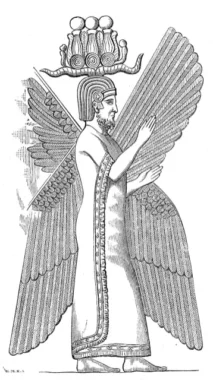
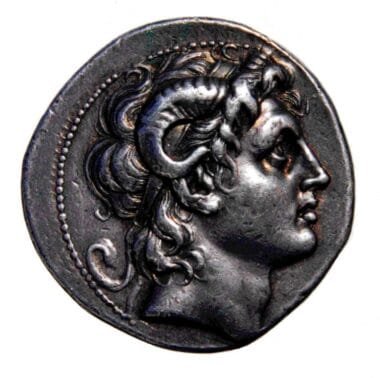
By the way, why do they come up with these ideas, Alexander or Cyrus? Because there are statues or coins where these two people are depicted with horns. Let’s search Cyrus the Great with horns. Okay, so this is a depiction of Cyrus the Great with horns. I hope you guys can see it. Let me get a bigger photo. It’s hard to make it larger. As you can see, there’s this—maybe you can see it better here—this is a drawing of this, if we can call it a 2D statue. So this is how—don’t pay attention to this one, this is just like fake AI and stuff. So this is Cyrus the Great with two horns.

And then we have Alexander the Great with two horns—this is in a coin, I think. So we have here Alexander the Great being depicted with two horns. Based on these two artifacts, this archaeological evidence, scholars disputed, “Oh, he must be Alexander the Great,” or “He must be Cyrus the Great.” But which one is it, if any of them?

As I said before, archaeology is really very unreliable to reach religious conclusions. The reason for that is because if we rely on archaeology, we might as well go and search for other people who have two horns, like Amun, the Egyptian god with two horns. We have Amun with two horns; there are so many other Egyptian idols with two horns.

And then even recently—it’s a copycat, by the way—Alexander the Great was a copycat of Cyrus. And we have the national hero of Albanians, Skanderbeg, which is his Turkish name—his real name is George Kastrioti Skanderbeg. You can see he has two horns, like here for example. Why did he have these? Because the Turkish people—they didn’t really distinguish between Macedonians and Albanians very well—thought this guy was from Macedonia. “Skander” in Turkish means Alexander; it’s the Turkish version of Alexander. So basically, they kind of branded him as the new Alexander. As you can see, when we rely on history and archaeology, it’s really hard to reach the right conclusion, and we go through very wild theories.

The Biblical Context of the Quran

This is mostly because people forget, when they go through these wild theories, they forget that the Quran was revealed within a certain context. And part of that context is that the Quran was revealed while the Bible existed. Actually, I think there’s a verse—I don’t know if I’m saying it exactly word for word—but there’s a verse in the Quran which says to Muhammad, “We did not reveal anything to you which was not revealed before you,” meaning pretty much there’s not much new in the Quran which you cannot find in the Bible unless it has nothing to do with the Jews. If it has anything to do with the Jews and the ancient Israelis, it has to be in the Bible. You cannot just make it up: “Oh, Alexander the Great, because here’s a coin with two horns.” If we go with those theories, we can pretty much make up anything. To know exactly who it is, if we don’t find it in the Quran, we have to look in the Bible.

By the way, we don’t follow the Bible; it’s more like we are informed that the Quran is revealed within a society where the Bible already existed. The Bible already existed when the Quran was revealed, so the Quran is talking within that context, assuming that people already know the Bible. A lot of people didn’t know the Bible when the Quran was revealed in Saudi Arabia, but some people did: the Jews, the Christians, and within that context, the Quran was revealed.

Before we find out from the Bible who Dhul Qarnayn is—the translation of Dhul Qarnayn means literally “the one with two horns”—before we find it out from the Bible, let’s repent.

Praise be to God, there is no other God except God.

Now I’m going to read the verses in the Bible which talk about Dhul Qarnayn. By the way, these two horns which are depicted on those people were sort of inspired by the Bible. Let me share the screen.

The Vision of Daniel

Let’s read the Bible verses which will help us figure out who it is—is it Alexander the Great or is it Cyrus the Great? Daniel lived before Cyrus the Great, and let me actually show the map a little bit.

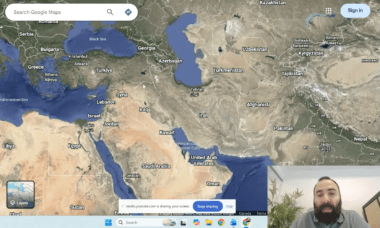
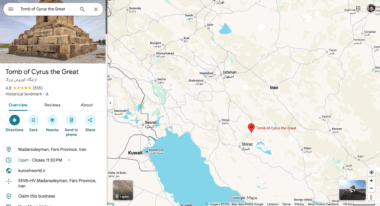
This is the map of the Middle East, and here we have Turkey. At that time, the Turkish people were not here; they were somewhere in Asia. Before this—here we’re talking around the 5th century BC, before Christ—there was a group of people here which were called Lydians. Here, where Iran is today, was a group of people called the Medes and the Persians, two groups of people. And here, where Iraq is, that’s where Babylon was—the Babylonians. The Jews, which included all the way to Israel, had been taken away from their home; basically, they were in exile. The king at that time, the king of Babylon, had decided to take them as slaves from Israel to send them to where Iraq is today, in Babylon. So basically, they were taken away from their home, their temple was destroyed, and this is the context.

Babylon was this bad kingdom which had oppressed the Jews, similar to how Pharaoh had oppressed the Jews in the Quran. The Jews got oppressed again by the Babylonians, and in that environment, there were three other groups of people: the Medes north of Iran, the Persians south of Iran, and the Lydians which were pretty much living where Turkey is today. In that context, God inspired in the Bible a guy named Daniel, who was a messenger and a prophet, to sort of make predictions about what will happen in the future while he was living in Babylon. Basically, he’s one of the Jews who is living in Babylon under Babylonian people. God reveals things which will happen in the future, and here’s what the Bible says. This was told to Daniel through a dream or through a vision—it doesn’t matter, we’ll see, or even through a prophecy. In the past, they didn’t really distinguish sometimes between these words; they didn’t have the words for this—they said “vision,” which sometimes meant dreams, sometimes meant prophecy.

Daniel 8 in the Bible—I’m reading from the Bible now, and this is a subtitle of the Bible, it’s not in the original one, it’s just the translators doing it: “The vision of the ram and goat during the third year of King Belshazar’s reign”—I think this must be a Babylonian king—”I, Daniel, saw a vision after the earlier vision that had appeared to me. As I observed the vision”—by the way, this is before Cyrus the Great and before Alexander the Great, this is before anything happened—”as I observed the vision, I looked around the citadel of Susa in Elam province”—this is in Iran—”while I found myself beside the Ulai Canal.” By the way, all these locations are in Iran, south of Iran, these locations which are mentioned there.

“Then I turned my head to look and to my surprise, a two-horned ram”—I did this in bold on purpose because now we can see where the two-horned one came from—”a two-horned ram was standing beside the canal. The two horns grew long, the first one growing longer than the second, with the longer one springing up last. I watched the ram charging westward, northward, and southward.”

Let’s go back to the map. So here’s this guy who lives in Babylon, which includes Israel, Iraq, and all of these. He’s saying the ram charged westward, northward, and southward. But from Saudi Arabia, it would have been different; it would have been eastward because Saudi Arabia is in the south, so there’s no southward—if he went to Iraq or to Saudi Arabia, like to Mecca, to people in Mecca it would have been north, but to people in Israel it would be west. So anyway, what I’m saying is there are slight differences because Daniel and Muhammad lived in different locations.

Let’s continue to read:

“So I watched the ram charging westward, northward, and southward; no animal could stand before him.”

What does the Quran say? It says, “We provided him with all kinds of means and we gave him authority.” In the Bible, it says:

“Nor was there anyone who could deliver from his control, and this is in a vision what Daniel saw. He did as he pleased and exalted himself. As I watched and wondered, a male goat was coming from the west over the surface of the entire earth without touching the ground. The goat had a distinctive horn between its eyes”—so now it’s only one horn, the second goat has only one horn—”It approached the ram with two horns that I had observed while standing beside the canal and charged at him out of control with rage.”

So basically, a goat with one horn is attacking a ram—a ram, by the way, is a male sheep—is attacking the ram with two horns.

“I saw it approach the ram overflowing with fury at him and ran into him with the full force of his strength. The goat shattered the ram’s two horns and the ram could not oppose it, so the goat threw him to the ground and trampled him; no one could rescue the ram from its control. Then the goat grew extremely great, but when it was strong, its great horn was shattered; in its place, four distinctive horns grew out in all directions.”

Gabriel’s Interpretation

And then here, Gabriel in the Bible helps Daniel interpret what the meaning of the vision is. Gabriel then tells him the meaning, and this is important because in this context, the Quran says, “They ask you about Dhul Qarnayn.” The Jews had asked Muhammad who Dhul Qarnayn is, and that’s when these verses were revealed. Why would the Jews ask Muhammad who Dhul Qarnayn is, who the one with two horns is? Because they thought that unless Muhammad is a prophet, he cannot tell them. Even Daniel, who was a prophet as well, was not able to know unless Gabriel told him.

So basically, this was a test by the Jews to see if Muhammad is a real prophet, by asking him about something which only Gabriel could reveal. Of course, only God through Gabriel could reveal it, which no one would be able to know unless God told them. This was their way of seeing if Prophet Muhammad is a liar or a true prophet. Of course, they didn’t believe him anyway, but this was their way of distinguishing.

Let’s continue to read. It says:

“After I, Daniel, had seen the vision, I tried to understand it. All of a sudden, there was standing in front of me one who appeared to be valiant. I heard the voice of a man calling out from the channel, ‘Gabriel, interpret what that fellow has been seeing.'”

So Gabriel appears to Daniel in the form of a man, telling him what he saw, what was the meaning of the ram with two horns and the goat with one horn.

“As he approached where I was standing, I became terrified and fell on my face, but he told me, ‘Son of man, understand that the vision pertains to the time of the end,’ meaning in the future. While he had been speaking with me, I fainted on my face, but he touched me and enabled me to stand upright on my feet, then he said, ‘Pay attention, I’m going to brief you about what will happen at the end of the period of wrath because its end is appointed. The ram which you saw with two horns are the kings of Media and Persia.'”

So it’s the kings of Media and Persia. By the way, here it says the kings of Media and Persia. Cyrus the Great is the one who united these two kingdoms, so he became the king of Media and Persia both at the same time, and that’s partly the meaning of the two horns: because he was a king of two nations at the same time.

The Legacy of Cyrus the Great

By the way, how did this happen? If you search on AI, you’ll see that Cyrus the Great, when he was young—he was a descendant of the king of Persia, but his mom was the daughter of the king of Media. And the king of Media saw a dream, according to legends, while Cyrus was a child, that Cyrus was going to become the new king. So he became jealous, and he tried to kill him. He ordered someone to kill him, but the person couldn’t do it; they gave Cyrus to a shepherd. Later on, he grew up with that shepherd family. Later on, through some kind of game, they figured out that he is really the descendant of the king of Persia. His grandfather from his mom’s side—basically his mom’s dad, the Median king—tried to attack Persia, but his soldiers defected; they didn’t go along with his plan. In this way, Cyrus was actually able to capture his grandfather. He forgave him, but in this way, he became the king of both Media and Persia. So basically, Cyrus became a king of two kingdoms at the same time.

“The rough goat is”—and here the Bible is telling us—”the king of Greece”—meaning the goat with one horn, not the goat with two horns—”and the great horn between its eyes is its first king,” which was Alexander the Great. “The shattered horn and the four that took its place are four kingdoms that will come from his nation, but they will not have his strength.”

So basically here, before Cyrus the Great and Alexander the Great lived, the Bible told them what will happen through Daniel.

Now let’s just see how that happened. Cyrus the Great was born in the south of Iran—there’s a tomb of Cyrus the Great which is here. He was born about here, and then the Quran says he traveled west. If you look at history, what happened is he attacked Media—I mean, Media attacked him, then he sort of overpowered them, so he became a king of two kingdoms. Then he went all the way to today’s Turkey, which at that time was Lydia, all the way to the west, which is what the Quran says—all the way to the west.

By the way, there’s a couple of things we might talk about another day because today I spent too much time; we can even identify the places where the spring with black water could have been. There’s to this day a part of an island there. So he went all the way to the west—meaning ruling all those places. Then he went all the way to the east, and then he went here to the north, and this is actually the border between Europe and Asia, let’s call it between the two continents.

So basically, that’s what Cyrus did. Alexander, on the other hand, only traveled east to capture the new kingdom. Alexander’s kingdom later on destroyed the Persian kingdom, but he didn’t destroy Cyrus the Great; Cyrus the Great established the kingdom. He was the first king of Persia, and after many bad kings after him, eventually Alexander defeated them. But here the Bible is telling us that the one with two horns is the king of Persia, not the king of Greece.

Let’s look at some more prophecies to see if it fits. Now we have it mentioned in Isaiah, chapter 45, verses 1-7. Isaiah was one of the messengers during the times of the ancient Israelis.

“This is what the Lord says to his chosen Cyrus, whose right hand I have grasped, to subdue nations before him”—what the Quran says: “provided him with all kinds of means”—”to subdue nations before him as I strip kings of their armor to open doors before him and gates that cannot be closed. I myself will go before you and he will make the mountains level”—look, he will make the mountains level; what does the Quran say? That he leveled the place between the two mountains—”I will shatter bronze doors and cut through iron bars”—these are materials which were used to build the dam—”I will give you concealed treasures and riches hidden in secret places so that you’ll know that it is I the Lord, the God of Israel, who calls you by name.”

So here, through Isaiah, God is talking to Cyrus.

“So that you will know that it is I the Lord, the God of Israel, who called you by name for the sake of Jacob my servant, Israel my chosen. I’ve called you and he has established you with a name although you have not acknowledged me.”

And this is important. What God is saying is, “I have supported you,” meaning God supported Cyrus even though Cyrus has not acknowledged God properly. Because if you look at the ancient sources of what Cyrus believed, he actually allowed idols in his kingdom, but he did believe in God; he had another Persian name for God. So basically, he believed in God, he was a good man, but he didn’t have the knowledge of the Bible; he was just a person who believed in God naturally.

“I am the Lord and there is no other; beside me there are no gods. I strengthen you although you have not acknowledged me”—so he didn’t acknowledge that it was the God of the Jews necessarily, he just believed in God in general, the way we say today “God,” not necessarily “Allah”—”so that from the sun’s rising to the west people may know that there is none beside me; I am the Lord and there is no other.”

Let me read another verse, and these are predictions about Cyrus the Great:

“I have aroused him in righteousness and I’ll make all his pathways smooth. It is he who will rebuild my city.”

Rebuilding the Second Temple

By the way, why is Cyrus mentioned in the Bible? Why is it important? It’s because Cyrus, after he did everything which the Quran says about him, actually attacked Babylon after that and did manage to free the Jews from Babylon, send them back to Israel, and build their temple.

The Jews at this time were held as slaves in Babylon after having been purified. Basically, first of all, they became bad, the Babylonians occupied them, they were purified for many decades, and then Cyrus the Great, with God’s permission, freed them again—similar to how Moses freed them from Egypt—and actually built their temple, gave them money to build the temple. This is what is known as the Second Temple in Jerusalem, which was destroyed later on by the Romans after they rejected Jesus.

The Second Temple was technically not really built by the Jews; it was built by a guy who was not even a Jew. And that’s kind of why it makes sense for Jesus to say—because in the Bible four centuries later Jesus says, “Destroy this temple and I will build it in three days.” It wouldn’t make sense for Jesus to say “destroy this temple” if it was built properly by God’s people. This Second Temple was built unofficially, basically not necessarily with the same status as the First Temple, which was built by Solomon with God’s full guidance. This was built just by a righteous man who was not even a prophet. By the way, Dhul Qarnayn was not a prophet or a messenger; he was just a righteous king, an average good king. I mean, he was extraordinary in the sense that he was a very important king, the one who founded the Persian Empire, but spiritually he probably was not better than us.

Let me try to finish now. This part of the Bible is actually just history; it’s not revealed scripture, but it exists in today’s Bibles. I didn’t include it in our version of the Bible, so it’s not revealed, it’s just history which was included in the Bible. This is after Cyrus was a king; this is not a prophecy, it’s just a description of what happened after the fact.

Ezra, who was a scribe, not a prophet, wrote—he added this part in the Bible:

During the first year of Cyrus king of Persia, in fulfillment of the message from the Lord spoken through Jeremiah, the Lord prompted Cyrus king of Persia to make this proclamation throughout his entire kingdom, which was also released in written form, an official statement from Cyrus king of Persia: ‘All of the kingdoms of the earth have been given to me by the Lord God of heaven, and he specifically charged me to build a temple for him in Jerusalem, which is Judah. Therefore, who among the Lord’s people trusts in his God, whoever among this group wishes to do so may travel to Jerusalem of Judah to rebuild the temple of the Lord God of Israel, the God of Jerusalem. Furthermore, everyone who wishes to repatriate from any territory where he now resides is to receive assistance from his fellow residents in the form of silver, gold, equipment, and pack animals, in addition to voluntary offerings for the temple of the God of Jerusalem.'”

So basically, the Second Temple was built even though the Jews fully didn’t deserve it.

Interactive Q&A

Cyrus the Great is Dhul Qarnayn. This is sort of the answer to who was the one with two horns, Dhul Qarnayn. God willing, in the next Friday sermon or the Friday after that, I will explain what is Dhul Qarnayn, the one with two horns. Because here, if you pay attention carefully, we will see that he was not necessarily just a human. Yeah, he was a human based on this interpretation of the Bible, but there’s a way to understand these verses in a deeper version and realize what is Cyrus the Great. God willing, I’ll answer that question in the next sermon—not just who is Dhul Qarnayn, the one with two horns, but what is the one with two horns.

Let me stop sharing, and should I check if there’s any chats? Let me just see. Does anyone have any questions?

Oh, Adam Fraser said zinc. Yeah, so brass is copper and zinc.

Faisal, you’re ruining my next sermon—I’m joking. Faisal is saying, “Can Dhul Qarnayn mean two generations instead of just two horns?” Yeah, it can also mean two generations; both of them are correct, and that’s going to help us a little bit more with understanding what is Dhul Qarnayn. Spoilers! It’s okay. Yeah, but God willing, we’ll use both meanings—the one with two horns and the one with two generations—to understand what is Dhul Qarnayn, what is the one with two horns.

“Where is the barrier he made?” So the barrier he made is between the two continents, which is today’s—and God willing, I’ll explain this more one day when we talk about Gog and Magog—around here: Georgia, Armenia, Dagestan, these countries between the two mountains. There’s a mountain here and a mountain there. By the way, it will never be discovered because the Quran says it will be destroyed in the end times. So basically, people will not be able to discover it until the end times.

And by today, it was probably not some sort of great thing; it was just some local, very small part which they filled with iron, and today it might have been mixed and covered with soil, and it’s probably not very pure iron anyway. If I was an archaeologist—which I don’t think they’ll discover it, so I don’t think they should even try—they should just look for areas with extra iron in one of these mountains. Yeah, it’s not really that important where exactly, but it’s one of these countries, because it’s never going to be discovered until the end of times, like when it gets destroyed when the whole earth gets destroyed, including those mountains and including the barrier.

Officially, this is the border between Europe and Asia.

Let me close this. For those who have to do the contact prayer, you can—oh, sorry, I didn’t share the screen. Let me share the screen again. I don’t need to share it because people actually know where Georgia and Azerbaijan and these countries are.

Okay, so for those who have to do the contact prayer, do the contact prayer. The rest of you, peace be upon you.


Friday Sermon by: Alban Fejza, Online Congregation Director
Commentary on Sura “Romans”


Introduction:

Praise be to God. There is no other God except God. Today I want to actually make a commentary on the surah, the Romans. I’m just going to read some verses and comment on it a little bit.

I seek refuge in God from Satan the rejected. Surah 30 in the Quran is titled: “The Romans”.

[30:0] In the name of God, Most Gracious, Most Merciful
[30:1] A. L. M. —which we know the geometrical value of ALM is 71, so we can also just say 71.
[30:2] Certainly, the Romans will be defeated.
[30:3] In the nearest land. After their defeat, they will rise again and win.
[30:4] Within several years. Such is God’s decision, both in the first prophecy, and the second. On that day, the believers shall rejoice.
[30:5] In God’s victory. He grants victory to whomever He wills. He is the Almighty, Most Merciful.
[30:6] Such is God’s promise – and God never breaks His promise – but most people do not know.

Okay, so I just want to comment on these verses. These verses are sort of understood in a very narrow, specific way based on historical sources, and I want to expand today more on that. To do that, before I do that, I want to first show the history of the Romans—who they were and things like that—so we can understand it better and then know how it applies to us today.

One of the things which I quite often like to do online when I’m bored is I like to watch states expand. Let’s say how the US was colonized or how ancient empires expand. It’s just kind of like watching maps. I like maps, so I’m going to show a YouTube video. I hope you guys can see it okay.

The Expansion and Splitting of Rome

The YouTube video is “History of the Romans Every Year.” So basically here at the right corner, let me see if you guys can see it—yeah, I think you can see it—here at the right corner, we have the year, and here we have whoever was the king and the capital. Rome pretty much started around the year 750. It’s not for sure, but approximately then. I’m just going to play the video so we can see how Rome, the Roman Empire, expanded and then how it kind of vanished, and comment. Maybe I’ll comment on the way, so let me play the video. I’m going to play it at 1.5 speed so it doesn’t get boring.

Basically, this red dot here is Rome. Supposedly, I don’t know if it’s true, started by two brothers—one of the two brothers—and it just expanded from there.

So this is around the year 300 BC, 200 BC. Pretty much as Greeks are getting weaker, the Roman Empire is much stronger, but they are including the Greeks there. By the year 50, it includes Israel as well, Jerusalem. So at year zero, which is when Jesus was born, it included Israel, so technically Jesus was born in Israel but within the Roman Empire.

Then it split into two sides for practical reasons, and then it remained like that: split into the Eastern Roman Empire and the Western Roman Empire—two separate empires, sort of separate empires. We are around the year 400 here. The Western Roman Empire pretty much fell very early around the 400s, depending on how you define it.

The Eastern Roman Empire, they called themselves, by the way, Romans. Here in the video, it says Byzantine, which is a later name used by historians and the Greeks because what they wanted to say is that they weren’t Christian enough—that’s what they meant by that, and it’s a later name. But the people in the year 400 in that region—let’s say the people in Turkey, the people in Egypt, the people in the Balkans, the people in Syria, the people in Israel—if you ask them, “What are you?” they would say Roman. That’s all they knew. They didn’t identify themselves as Egyptian or Albanian like today; they would say Roman in that region if you asked them in that year. Later on, they renamed those regions, but they had cities, of course, so someone from Jerusalem or from Petra themselves would think that they are Romans.

The Revelation of the Prophecy

Around this time, Muhammad was born. Now we are at year 595, 602, 606, 608, 610, 611, 612. This is the key part. Most historians will focus only on this part because the Quran does mention it. Let’s go back to the Quran, what the Quran says. The Quran says, “Certainly the Romans will be defeated,” that’s how Rashad translated it, but in the Arabic, it says certainly the Romans pretty much just got defeated.

This surah was revealed in the year, I think, 613 or 614—I think 614 is the more accurate date—and it says certainly the Romans pretty much got defeated in the nearest land. After their defeat, they will rise again and win. So in the year about 614, Muhammad was being persecuted in Mecca, and news comes from the Romans that they had been defeated. News comes to Saudi Arabia, and God reveals this surah telling Muhammad pretty much don’t worry, they will rise again and win.

The reason why this is revealed is because the idol worshippers of Mecca during the time of Muhammad favored the Persians more because they didn’t have scripture; they were not people of the scripture. Meanwhile, Muhammad and the believers wanted the Romans to win because the Romans had the scripture—they had the Bible and all that. So they were rooting for two different teams, if you can say that.

The Romans got defeated in 614, which is pretty much the time when Muhammad is really being persecuted a lot in Mecca. Later on, we’ll see that when the believers win at the Battle of Badr—which is the first time that the believers win—is also when the Romans come back and defeat the Persians back.

Here we’re at year 612, and what happened, by the way, in 614—pay attention to this region around Jerusalem. This is year 612 now, 614—look, they kind of lost Jerusalem. No, this is 615, the map is going fast. Around 614 they lost Jerusalem, and this is the region which would be in contact with the Arabs, meaning that the Arabs, when they thought of Romans, they pretty much thought of the closest part which they encountered from the Romans. That’s why the Quran says “in the nearest land,” meaning whatever part of the Roman Empire is nearest to Mecca and to Muhammad, that was defeated—not necessarily all Romans. We can understand it like that, even though you’ll see we can also understand it globally.

Around 614 this region was lost around Jerusalem; the Persians defeated the Romans, and then about 8 to 10 years later they get it back. That’s what the historians will mention as the reason for this surah. We’re going to 619—look, the Persians even got Egypt at some point, and look now at around 624 or around 630 they get it back again. The map is moving fast, so it’s really hard to catch it. Around 630 they have it back again, and this is what the believers of the past meant when they read this surah; this is what they understood.

Expanding to a Global Prophecy: The Fall of 1453

However, as we can see, Rome is a big empire spanning through many centuries. Do you think God would just mention a specific case? Let’s continue because actually they lose it again. Does it mean that actually they didn’t win? What happened? Let’s actually continue through the whole history and understand it fully.

Rome is losing again here, meaning it’s getting smaller around the 600s. By the way, at this time, even though in the year 700 Rome was part of the Roman Empire, it was actually Constantinople which was the capital—the center moved to Constantinople, what today is called Istanbul. We’re around the 800s. As you can see, the Roman Empire is just getting weaker and weaker. Even at this point, if you ask these people, “What are you?” they would say Romans.

The year 1000 comes. As you can see, the Roman Empire is getting weaker and weaker, and they were just trying to survive as they were. At this time they were being attacked by the Ottomans, or surrounded by the Ottomans who are, at least in name, Muslims. Pay attention now to these regions, which are pretty much colonies of Constantinople. The main region is the center in Constantinople at this time.

Here is the year 1447, and in the year 1453 Constantinople falls; it becomes Istanbul after that. That’s when the historians agree that the Roman Empire fell—it pretty much was defeated in the year 1453. Let’s go to 1452—look, Constantinople is gone. Pretty much the Roman Empire ends in 1453. The Ottomans give an end to it in 1453 when Constantinople falls, or according to some, when it is freed. This is pretty much the history.

The question which I want to ask is: when we now go and read the Quran again, it says certainly the Romans will be defeated in the nearest land; after their defeat, they will rise again and win within several years. Such is God’s decision, both in the first prophecy and the second. On that day, the believers shall rejoice in God’s victory. He grants victory to whomever he wills. He is the almighty, most merciful.

When we read these verses, does it make more sense to just think of a specific case in history, or do you think it’s talking about all of the Roman Empire? It definitely makes more sense to talk about all of the Roman Empire. The way they understood it in the past about a specific battle in the year 614 is such a limited understanding. The Quran does apply to it, but it’s limited because it’s not the whole Roman Empire which loses there. The Quran is talking about the Romans being defeated; I don’t think we should limit it only to the fall of Jerusalem.

Technically, when the Quran says the Romans will be defeated, it is a big historical prediction for centuries, for thousands of years, and eventually they did get defeated in 1453.

Understanding “The Nearest Land” in Time

But then what does the Quran say? It says “in the nearest land.” How can we understand “in the nearest land”? In this case, we can understand it actually with a better understanding. The best understanding, at least for our generation, is that He is talking about all of the Roman Empire, not just Jerusalem. All of the Roman Empire will be defeated, and it says “in the nearest land.” What does it mean? It means the land which is nearest to us for the Roman Empire.

If we go backwards in time, who are the people who would be the nearest to us in time—not in space, in time—who would be Romans? That would be Istanbul.

Basically, what it’s saying here is that the Romans will finally be defeated in the nearest land, because that’s the latest time that the Roman Empire existed, which is nearest to us. When we read the Quran today, the nearest Roman Empire to us in the past was in 1453. Before that, it was even further, deeper in history, further in the past. But the nearest part was in 1453. So the Quran says that the Romans will be defeated in the nearest land, meaning after their defeat they will rise again and win. It’s a prophecy.

What does it mean that the Romans will rise again and win? If we understand it like this, it actually helps us sort of understand the future, not just the past. The way they understood it in the past, it was all about the past. But if we understand it like this about all of the Roman Empire, we can also understand the future.

Certainly the Romans will be defeated in the nearest land—meaning the nearest land to us in time is Istanbul. And then it says after their defeat they will rise again and win. What does it mean they will rise again and win?

In 1957, there was a thing called the Treaty of Rome, where the European Union was created, and the European Union is pretty much similar to the Roman Empire. How is it similar? First, it starts with Rome. By the way, 1957 is a multiple of 19, but it doesn’t matter. It starts with Rome, and it expands and contracts—there are countries which join, countries which leave, similar to Rome. It’s a predominantly Christian community, which was exactly how Rome was. And it’s pretty much in a similar region—it doesn’t have to be exactly the same region because even the ancient Roman Empire had different regions at different times in history. But they all included Rome. It wouldn’t make sense for the Quran to call the Romans Romans unless it included Rome, because that’s where the name comes from.

Let’s look at the European Union, which was created in 1957. Let’s repent.

Praise be to God. There’s no other God except God.

The Romans were defeated in 1453 totally, and then they didn’t come back until the Treaty of Rome, which established sort of a new community of different regions, which countries now join and leave. Let’s look at the history of the European Union—this is shorter. The European Union started in 1957. Technically, they say that it started earlier, but then it was called the European Steel and Coal Community. I don’t think that counts as the EU. The reason is that after World War II, some of these countries agreed that they are going to produce steel together, not separately, so that they could not produce weapons and fight against each other. They didn’t want to fight again, so it was called the European Steel and Coal Community. But that doesn’t make a state; that doesn’t make an empire or a community, because it’s just about steel, it’s just business.

In 1957, when the Treaty of Rome happens, that’s when they eliminated tariffs and created a common market. That’s what makes a state. They wanted to have shared travel, a shared market, and trade without tariffs—basically the beginning of a new entity which is called the European Union. Let’s see the history of this European Union. This is 1957, so these are the first countries which join. The UK joins around the 1970s. Greece joins around 1981. Basically, a community which started again with Rome is expanding through 1995, 2004, 2005, 2007, and 2008, and it’s pretty much similar even today.

Future Predictions and the Rejoicing of Believers

Looking back at the Quran, we can actually make predictions because what does the Quran say? Certainly the Romans will be defeated. They were totally defeated in 1453 when the Ottomans defeated them in the nearest land, meaning Istanbul. After their defeat, they will rise again and win, because here it’s talking still about the nearest lands, meaning that the EU will rise again and win, basically capturing Istanbul—probably willingly, it doesn’t have to be a war. Turkey has wanted to be part of the EU for a long time; they just don’t want them because they are mostly Muslim. So the EU doesn’t want Turkey to be part of the EU, even though Turkey for a long time has wanted to become part of it. I don’t know about today, it has shifted a little bit, I think they don’t want it as much.

But we can see here that eventually, the prediction we can make is that eventually Istanbul will become European again, whatever it means. I don’t know what it means exactly. Does it mean they join on their own, or does it mean there’s going to be a war and they lose? It doesn’t matter. The important part is—and a lot of Turkish people probably want to be part of it, it’s fine—we can predict into the future what will happen based on verses in the Quran if we understand the Quran globally, not just as one specific event.

The more important part is what the Quran says after that, in the next verses: it says “within several years.” The Romans will win again, meaning Istanbul will become again part of the Roman Empire, in this case the EU, within several years. The “several years” in Arabic doesn’t give us specific years, and we can know that exactly from here. Maybe we can talk another time about this.

ALM, the value of this is 71, so 71 years from—I explained something in the video of the end times, you can see that in the video of the end times. Within several years, such is God’s decision, both in the first prophecy and the second. This has many meanings. The first prophecy can be understood the old-fashioned way or the new-fashioned way, but also the first prophecy meaning when they lost and when they win. There are so many ways to understand it, and all of them are correct. What I’m saying is this is the most correct because it includes all of history, not just one specific time.

On that day—and this is the important part—on that day the believers shall rejoice in God’s victory. He grants victory to whomever he wills. He is the almighty, most merciful. What does it mean? This means that when Istanbul becomes part of Europe—whatever it means, I don’t know if it’s going to be called the European Union, or if it is going to change its name, it doesn’t matter how it’s called. The important part is that it’s going to become part of a predominant community which is mostly Christian, where Rome is also in the same community. We can define it like that, because I don’t want to make predictions about the EU specifically; the EU can change, it can fall, it doesn’t matter. The important part is that Istanbul will be part of that future community which is very likely the EU, which is why in the video at times I called it Europe instead of the EU, because you never know, they change the names.

The important part is that at that time, the verse says the believers shall rejoice. This is the good news. The good news is that around that time—which I believe is told to us by this ALM, by the number of years—the believers, and this is after the smoke comes, the believers will become a dominant community basically, with lots of submitters. They are going to be able to meet with each other and they will rejoice, meaning that they will feel like we won, we made it. Today, the community is going well, but we are really such a small community, and during that time they will feel like we kind of made it. So let’s just keep going.

Does anyone have any questions? If you want to know exactly when that year is, I don’t want to specifically focus on the years here; it is in the video “The End Times” and the video explaining Quranic initials predicting the future.

Questions from the Congregation

Faisal is asking, “Will the rejoice of the believers be just because of travel restrictions or will other things happen?”

No, the believers will rejoice because—I didn’t want to go into specifics, but let me say it like that—at that time, the next messenger will come. And by rejoice, that means that actually they will sing songs. The method of preaching for the next messenger will be to sing, and they will sing. Singing is connected with victory in pretty much all the times of believers. David sang when he won; whenever the believers won, they did sing, or whenever they sang they did win—whichever causes the other one.

What it’s talking about here is that the future messenger and the believers will be in a state of joy and celebration. It doesn’t have to do with the travel restrictions; that’s for the Turkish people, meaning that the Turkish people can rejoice for having the travel restrictions removed, but submitters are not necessarily Turkish people. Submitters will rejoice for another reason, which is that yes, Alban was correct about this, yes, the next messenger came, and yes, we are having fun, if we can say it like that, with the next messenger. Basically, they will be dominant; they will have reason to be happy in this world. Of course, we are happy for the next world and we’re happy in our souls, but I’m talking about ethnically happy, more rich.

Let’s see if someone has any other question. The reason why I’m saying this partly is because when the Romans won again during Muhammad’s time, Muhammad didn’t win with the Romans; he won in the Battle of Badr, which was a separate winning. One more question, and God willing, I will end it.

Faisal is saying, “If we are alive then,” with a smiley face. “If we are alive then we will be old.”

Well, let me say something. For those who get lucky to have children, they want their children to be happy more than them, and only parents understand this. It doesn’t matter if someone is not enjoying that part. Probably a lot of us will be dead, maybe most of us, I don’t know. A lot of us, some of us will survive. People live long these days. And by the way, Faisal, why so pessimistic? I think you’ll be alive, you’re so young, God willing. I don’t know for sure, but I think you’ll probably be alive—old, but yeah, alive. Okay, so anyway.

Faisal is saying, “Ah, I’m not pessimistic, just a wake-up call.”

Yeah, okay, thanks for the reminder. I understand you’re being a little bit—but yeah, it’s important to understand that then it’s not going to feel like—because here is the issue. When believers become old, they focus on the hereafter more and more. Moses never managed to go to the promised land on this earth, even though God had promised the people of Israel that they would go to the promised land; Moses never managed that. However, he got better: he went to heaven, and that’s the bigger promised land. If you ask Moses at the time, “Would you rather go to heaven or wait for this victory?” Moses would say, “Yeah, I want to go to heaven,” because by the time people get old, they really look forward to the next life rather than this life. They want the other submitters, the younger submitters, to be happy, but for themselves, they just want to prepare for the next life. That’s how a typical believer behaves. They get old, and they just want things for the next life more than for this life.

God willing, whoever gets old among us—most of, I think almost all of us are believers, if not all—wait for this victory. This is just such a flimsy victory, flimsy in the sense that it’s just about this world. It’s not really the most important thing; there are only a few verses about it in the Quran. The real victory is in heaven.

Let’s do the contact prayer for whomever has to do the contact prayer, and the rest of you, peace be upon you.

Friday Sermon by: Alban Fejza, Online Congregation Director
The Messengers Mentioned in the Quran but not in the Bible


Divine Timelessness and the Universal Appeal of Quranic Stories

Praise be to God, there is no other god except God. Let me just address a small thing before I continue with the main topic. I see that typically some people have a habit of kind of waiting for the Friday sermon to start for them to join the chat. The idea is so that you join the chat whenever you’re available, even earlier. Because sometimes I wait to kind of like—I delay the Friday sermon a little bit thinking that no one is online or, I mean, I see some people online and then I’m like, “Oh, let me wait a little bit until others join.”

But you guys are waiting for me to start so you can join, so it’s kind of like it’s delaying everything. And by the way, these musics which I’ve done—part of the reason why the AI did, part of the reason why I’m showing them, they are really not important, is because I just wanted some delay until we get used to starting on time, and those get shorter and shorter. But eventually, God willing, I’m just going to start on time whenever the 12:00 is or in whatever universal time, I’m just going to start on time. If you’re late, you’re late. So just please try to start having a habit of actually joining a little bit earlier so you can be on time rather than joining in time. Because with technology, then you’ll be a little bit late. That’s just a small thing.

So now I can see a lot of people have joined. Yeah, so what do I want to talk—what do I want to talk about today?

The Rainbow Analogy: Perception vs. Totality

A couple of days ago I was thinking like, I don’t know, I read some kind of article from a scientist that rainbows are not real, which I already knew, but like the way they were putting it. And it got me thinking about some aspects of the stories in the Quran. So the idea is that when people look at the rainbow, if you look at the rainbow, it kind of looks real. It looks like you’re seeing some colors, and you think it has a specific location at a specific time.

But according to one of the scientists, and a lot of scientists agree with that—I also mostly agree with that—the rainbow is not real. Because if you look at the rainbow, let’s say from a certain location, let’s say from one hill when it’s raining all above all the hills in that region, when someone looks at the rainbow from that one hill, they think it’s in that direction.

But when another person looks at that hill, he is not going to see the rainbow in the same location. He’s going to see his own rainbow. So was the rainbow even real if it changed location based on where you are? You can think of it as an illusion. But I don’t see that according to the article that the rainbow is an illusion, it’s not real.

I would say that’s also not too fully correct to say because you cannot call something which everyone sees not real. To me, the totality of all rainbows is real. So there’s such a thing where if you look at that—let’s say when it rains from every hill, let’s say from every location—so I’m here, I’m looking at the rainbow, now I’m moving here, I’m looking at the rainbow again, I’m moving here, I’m looking at the rainbow again, and when I add all of those up, that’s real.

Basically, the one specific rainbow which I’m looking at is a tiny bit real—0.00 whatever, how many options we have there, 0.001% real. And then we have another rainbow which is 0.0001% real, and when you look at all of them, you add them up, then the total is 100% real. The totality of all the rainbows is real. But each specific rainbow you look at is not really fully real, it’s mostly fake.

And by the way, what do I mean by real? I mean materially real in this world for things. According to physics, for things to be real in this world, they have to be in, to have a time and a place. They have to be at a specific time in a specific place. And the rainbow doesn’t really have a specific place. Wherever you move, it’s there. It does have a specific time, though, like when it rains, it’s there.

Biblical Context and the Universal Scope of the Quran

I want to connect this with some of the stories from the Quran, because the reason why the rainbow actually looks a little bit more real than other things is because it has this universal appeal. Exactly that what enables it, the reason why it sort of doesn’t look fully real, it appeals to all the people. So it has universal appeal, kind of like everyone sees their own rainbow. And I’m not talking here about subjectivity versus objectivity, I’m just talking like everyone sees their own rainbow, which gives it the universal appeal. Everyone would love to see a rainbow. Everyone thinks, “Oh, I saw a rainbow, it was special.” It’s as if though it has to do with you, something with you, with the way you’re seeing it.

In the same way, God intentionally, even though the stories in the Quran are definitely real—they have a specific time and a place where they happened, they definitely happened in a specific time in a specific place—God sort of doesn’t focus on the time much because God wants, because those stories have a universal appeal. God doesn’t specifically tell us, oh, Abraham lived in the year 950 BC, like you never hear that in the Quran, or Moses lived in whatever like 450 BC. That’s not really important because those stories have universal appeal. Everyone can see something which relates to them in relation to that story.

And these stories, even though they have a universal appeal, a lot of them because they are mentioned in the Bible, we kind of know when they happened. We can connect them to something, oh, these are the ancestors of children of Israel, and the ancestors of children of Israel are Israel, whatever, Isaac, Abraham, Joseph, messengers like that, and Noah. Noah by the way was an ancestor of all the people as well. But these are mentioned in the Bible because the Bible mentions them specifically because they are ancestral, like the ancestors of children of Israel.

The Bible sort of only focuses on—because the children of Israel were the only nation to be chosen at that time in the ancient times, God only mentioned to them what had to do with them. God didn’t tell them a story about China or a story about not even Arabs, God didn’t tell them about that, or Europeans or Africa. God didn’t tell them those stories, only what had to do with the children of Israel. So you have those stories in the Bible, stories which had to do with the children of Israel. They kind of knew those stories anyway, kind of based on folklore, like one father telling their son the story, and then he telling his son, and him telling his son. So even though God revealed them, a lot of those stories, the main parts probably of the stories they already knew through tradition, they already knew through hearing it from other people.

The Three Arabian Messengers: Hud, Saleh, and Shuayb

But there are some messengers which are not mentioned. And why are they not mentioned, by the way? Because sometimes people will say, like especially the Christians will be like, oh, why does the Bible not mention Hud? It must be a fake book or whatever. It doesn’t because it has nothing to do with the children of Israel. It’s outside of that scope. The Bible only deals with the worldview which has to do with the children of Israel. Even the Quran says, even Jesus when the Quran says that Jesus was sent to the children of Israel saying, “I come to you as a messenger to the children of Israel.” And anything outside of that is not mentioned in the Bible, even if it’s true.

And three messengers which truly came, which are mentioned in the Quran, which are not mentioned in the Bible—we know why, not because they are not true, but because they have nothing to do with children of Israel—are Hud, Saleh, and Shuayb. So these three messengers are mentioned in the Quran, but they are not mentioned in the Bible. And because of this, I think they actually have even bigger universal appeal, kind of like the rainbow. They are true by the way, not fake like the rainbow, but they have a bigger appeal. Everyone can relate to that story. The reason is that most people today are not children of Israel, and most people today don’t live in biblical times. Therefore, these kind of stories about Hud, Saleh have to do with us, with any time, more than the other stories.

And why do they have to do more with us at all times? All three of them were messengers who were sent in what today is Arabia, the Arabian Peninsula. Again, God only mentioned the ones which have to do with which people already knew during Muhammad’s time. So those stories already existed during Muhammad’s time. It’s not like God revealed something which they totally had no idea what it was. People knew stories about Hud because, again, why did they know about that? It was stories about the ancestors of—if we can call them Arabs, then they were not fully Arabs, sort of the ancestors of pre-Arabs. So that’s why the Quran mentions them, because the Quran was revealed to Muhammad who lived among the Arabs, and those stories were already known among the Arabs. God wanted to relate to what they were talking about, wanted to talk about things which they already were talking about.

So yeah, those three messengers, all three of them were sent to what today is the Arabian Peninsula. And the reason is because Muhammad was an Arab, so God told them stories which they already talked about so that they could relate to it. However, God really doesn’t focus in the Quran telling us that, because they relate to all human beings.

Modern Civilization and the Patterns of Destruction

And how do they relate to all human beings? It’s because these are stories about destruction, messengers being sent to a whole community, the community not believing, the community being destroyed. And this is kind of the story of all of us, of the whole modern civilization. Messengers are being sent, the whole world pretty much doesn’t believe except for a few people, and in the end times, the world will be destroyed.

By the way, now the whole world is kind of one community more and more, like with online stuff, with AI, with all of this, we’re just pretty much one community. You can trade and buy. I mean, not fully yet, because let’s say you can go in some country, they still don’t use Amazon. Amazon is like where you buy things online, so it’s not really fully integrated yet. But most of the world is really integrated, meaning it acts like one city. And when it becomes fully one city—and by fully city I mean fully built—then it’s time for the world to be destroyed. That’s when the end of the world will come.

Now what I want to do in the second sermon is just read these three stories: the story of Hud, the story of Saleh, the story of Shuayb. All three stories are sort of told about three times each, so they are going to repeat it a little bit. It’s going to be repetitive. However, that might actually help us remember them.

By the way, the Quran doesn’t say the same thing with the same words. Sometimes it will tell something, and sometimes Christians will think this is a contradiction. For example, if I say that I went today and had coffee with—when I was coming back from work, I met John and I had coffee with him. If I say that, then another time if I say, “When I was coming back from work, I met John and I gave him a ride,” both of them are true. Both of them can be true. I had coffee and then gave him a ride, or maybe I gave him a ride and we had coffee in the car. So both of them can be true. So just because you have differences in the story, it doesn’t mean it’s not true. What it means is that God wants to tell us more. In one specific case, He wants to tell us about the coffee; in the other case, He wants to tell us about the ride. In this way, we learn more. In other words, God doesn’t want to repeat Himself too much in the same way because then we wouldn’t learn new things.

So yeah, the stories will repeat partly, but they will kind of be told in a different way. Don’t let that fall into the trap of some Christians who say that this is why it’s fake because it’s not told the same way. It doesn’t have to be told the same way. Even in their books, their gospels are not told the same way. They don’t tell the same story about Jesus; some of them tell something else, others tell something else. But all of them can be true unless they are in contradiction, which sometimes in the Bible they are actually, but not in the Quran. By contradiction, I mean someone says, “After work I went home,” but then in another story I say, “After work I did not go home.” That’s a contradiction. That’s a clear contradiction.

So yeah, let’s repent, and then God willing we’ll read the stories. Let’s repent.

Non-Biblical Prophets: The Accounts of Hud, Saleh, and Shuayb

Praise be to God, there is no other god except God. So let me just read these three stories from the Quran which are non-Jewish stories. You cannot find these stories in the Bible; they are only in the Quran or in ancient Arab tradition. Let’s start with Hud, then we have the story of Saleh, and then we have the story of Shuayb.

I seek refuge in God from Satan.

The Story of Hud (The People of ‘Ad)

Account I

To ‘Ad we sent their brother Hud. He said, “Oh my people, worship God. You have no other god beside Him. Would you then observe righteousness?”

The leaders who disbelieved among his people said, “We see that you are behaving foolishly, and we think that you are a liar.”

He said, “Oh my people, there is no foolishness in me. I am a messenger from the Lord of the universe. I deliver to you my Lord’s messages, and I am honestly advising you. Is it too much of a wonder that a message should come to you from your Lord through a man like you to warn you? Recall that He made you inheritors after the people of Noah and multiplied your number. Remember God’s blessings that you may succeed.”

They said, “Did you come to make us worship God alone and abandon what our parents used to worship? We challenge you to bring the doom you threaten us with if you are truthful.”

He said, “You have incurred condemnation and wrath from your Lord. Do you argue with me in defense of innovations you have fabricated, you and your parents, which were never authorized by God? Therefore, wait, and I will wait along with you.”

We then saved him and those with him by mercy from us, and we annihilated those who rejected our revelations and refused to be believers.

Account II

To ‘Ad we sent their brother Hud. He said, “Oh my people, worship God. You have no other god besides Him. You are inventing. Oh my people, I do not ask you for any wage. My wage comes only from the one who initiated me. Do you not understand? Oh my people, seek forgiveness from your Lord, then repent to Him. He will then shower you with provisions from the sky and augment your strength. Do not turn back into transgressors.”

They said, “Oh Hud, you did not show us any proof, and we are not abandoning our gods on account of what you say. We will never be believers with you. We believe that some of our gods have afflicted you with a curse.”

He said, “I bear witness before God, and you bear witness as well, that I disown the idols you have set up beside Him. So give me your collective decision without delay. I have put my trust in God, my Lord and your Lord. There is not a creature that He does not control. My Lord is on the right path. If you turn away, I have delivered to you what I was sent with. My Lord will substitute other people in your place. You cannot harm Him in the least. My Lord is in control of all things.”

When our judgment came, we saved Hud and those who believed with him by mercy from us. We saved them from a terrible retribution. Such was ‘Ad. They disregarded the revelations of their Lord, disobeyed His messengers, and followed the ways of every stubborn tyrant. Consequently, they incurred condemnation in this world and on the day of resurrection. Indeed, ‘Ad rejected their Lord. Indeed, ‘Ad, the people of Hud, have perished.

Account III

‘Ad disbelieved the messengers. Their brother Hud said to them, “Would you not be righteous? I am an honest messenger to you. You shall reverence God and obey me. I do not ask you for any wage. My wage comes from the Lord of the universe. You build on every hill a mansion for vanity’s sake. You set up buildings as if you last forever, and when you strike, you strike mercilessly. You shall reverence God and obey me. Reverence the one who provided you with all the things you know. He provided you with livestock and children and gardens and springs. I fear for you the retribution of an awesome day.”

They said, “It is the same whether you preach or do not preach. That affliction was limited to our ancestors. No retribution will ever befall us.”

They thus disbelieved, and consequently we annihilated them. This should be a lesson, but most people are not believers. Most assuredly, your Lord is the Almighty, Most Merciful.

Account IV

Recall that the brother of ‘Ad warned his people at the dunes. Numerous warnings were also delivered before him and after him: “You shall not worship except God. I fear for you the retribution of a great day.”

They said, “Did you come to divert us from our gods? We challenge you to bring the retribution you threaten if you are truthful.”

He said, “The knowledge about this is with God. I only deliver to you what I was sent to deliver. However, I see that you people are ignorant.”

When they saw the storm heading their way, they said, “This storm will bring to us much needed rain.” Indeed, this is what you challenged Hud to bring. A violent wind wherein there is a painful retribution. It destroyed everything as commanded by its Lord. By morning, nothing was standing except their homes. We thus requite the guilty people.

The Story of Saleh (The People of Thamud)

Account I

To Thamud we send their brother Saleh. He said, “Oh my people, worship God. You have no other god beside Him. Proof has been provided for you from your Lord. Here is God’s camel to serve as a sign for you. Let her eat from God’s land, and do not touch her with any harm lest you incur a painful retribution. Recall that He made you inheritors after ‘Ad and established you on earth, building mansions in its valleys and carving homes from its mountains. You shall remember God’s blessings and do not roam the earth corruptingly.”

The arrogant leaders among his people said to the common people who believed, “How do you know that Saleh is sent by his Lord?”

They said, “The message he brought has made us believers.”

The arrogant ones said, “We disbelieve in what you believed in.”

Subsequently, they slaughtered the camel, rebelled against their Lord’s command, and said, “Oh Saleh, bring the doom you threaten us with if you are really a messenger.” Consequently, the quake annihilated them, leaving them dead in their homes. He turned away from them saying, “Oh my people, I have delivered my Lord’s message to you and advised you, but you do not like any advisers.”

Account II

To Thamud we sent their brother Saleh. He said, “Oh my people, worship God. You have no other god beside Him. He initiated you from the earth, then settled you in it. You shall seek His forgiveness, then repent to Him. My Lord is always near and responsive.”

They said, “Oh Saleh, you used to be popular among us before this. Are you enjoining us from worshiping what our parents are worshiping? We are full of doubt concerning everything you have told us.”

He said, “Oh my people, what if I have solid proof from my Lord and mercy from Him? Who would support me against God if I disobeyed Him? You can only augment my loss. Oh my people, this is God’s camel to serve as a proof for you. You shall let her eat from God’s earth, and do not touch her with any harm lest you incur an immediate retribution.”

They slaughtered her and he then said, “You have only three days to live. This is a prophecy that is inevitable.

When our judgment came, we saved Saleh and those who believed with him by mercy from us from the humiliation of that day. Your Lord is the most powerful, the Almighty. Those who transgressed were annihilated by the disaster, leaving them in their homes dead. It was as if they never lived there. Indeed, Thamud have rejected their Lord. Absolutely Thamud have incurred their annihilation.

Account III

Thamud disbelieved the messengers. Their brother Saleh said to them, “Would you not be righteous? I am an honest messenger to you. You shall reverence God and obey me. I do not ask you for any wage; my wage comes only from the Lord of the universe. Do you suppose you will be left forever secure in this state? You enjoy gardens and springs, and crops and date palms with delicious fruits. You carve out of the mountains luxurious mansions. You shall reverence God and obey me. Do not obey the transgressors who commit evil, not good works.”

They said, “You are bewitched. You are no more than a human like us. Produce a miracle if you are truthful.”

He said, “Here is a camel that will drink only on a day that is assigned to her, a day that is different from your specified days of drinking. Do not touch her with any harm lest you incur a retribution on an awesome day.”

They slaughtered her and thus incurred sorrow. The retribution overwhelmed them. This should be a lesson, but most people are not believers. Most assuredly, your Lord is the Almighty, Most Merciful.

Account IV

Again, we have sent to Thamud their brother Saleh saying, “You shall worship God,” but they turned into two feuding factions. He said, “Oh my people, why do you hasten to commit evil instead of good works? If only you implored God for forgiveness, you may attain mercy.”

They said, “We consider you a bad omen for us, you and those who joined you.”

He said, “Your omen is fully controlled by God. Indeed, you are deviant people.”

There were nine gangsters in the city who were wicked and never did anything good. They said, “Let us swear by God that we kill him and his people, then tell his tribe, ‘We know nothing about their death. We are truthful.'” They plotted and schemed, but we also plotted and schemed while they did not perceive. Know the consequences of their plotting: we annihilated them and all their people. Here are their homes utterly ruined because of their transgression. This should be a lesson for people who know. We saved those who believed and led a righteous life.

The Story of Shuayb (The People of Midian)

Account I

To Midian we send their brother Shuayb. He said, “Oh my people, worship God. You have no other god beside Him. Proof has come to you from your Lord. You shall give full weight and full measure when you trade. Do not cheat the people out of their rights. Do not corrupt the earth after it has been set straight. This is better for you if you are believers. Refrain from blocking every path, seeking to repel those who believe from the path of God, and do not make it crooked. Remember that you used to be few and He multiplied your number. Recall the consequences for the wicked. Now that some of you have believed in what I was sent with, and some have disbelieved, wait until God issues His judgment between us. He is the best judge.”

The arrogant leaders among his people said, “We will evict you, Shuayb, together with those who believe with you from our town unless you revert to our religion.”

He said, “Are you going to force us? We would be classified as blaspheming against God if we reverted to your religion after God has saved us from it. How could we revert back to it against the will of God, our Lord? Our Lord’s knowledge encompasses all things. We have put our trust in God, our Lord. Grant us a decisive victory over our people. You are the best supporter.”

The disbelieving leaders among his people said, “If you follow Shuayb, you will be losers.”

The quake annihilated them, leaving them dead in their homes. Those who rejected Shuayb vanished as if they never existed. Those who rejected Shuayb were the losers. We turned away from them saying, “Oh my people, I have delivered to you the message of my Lord, and I have advised you. How can I grieve over disbelieving people?”

Account II

To Midian we sent their brother Shuayb. He said, “Oh my people, worship God. You have no other god beside Him. Do not cheat when you measure or weigh. I see that you are prosperous, and I fear for you the retribution of an overwhelming day. Oh my people, you shall give full measure and full weight equitably. Do not cheat the people out of their rights, and do not roam the earth corruptingly. Whatever God provides for you, no matter how small, is far better for you if you are really believers. I am not a guardian over you.”

They said, “Oh Shuayb, does your religion dictate upon you that we must abandon our parents’ religion or run our business in any manner we choose? Surely you are known for being wise.”

He said, “Oh my people, what if I have solid proof from my Lord, what if He has provided me with a great blessing? It is not my wish to commit what I enjoin you from. I only wish to correct as many wrongs as I can. My guidance depends totally on God. I have put my trust in Him, to Him I have totally submitted. And oh my people, do not be provoked by your opposition to me into incurring the same disasters as the people of Noah, or the people of Hud, or the people of Saleh. And the people of Lot are not too far from you. You shall implore your Lord for forgiveness, then repent to Him. My Lord is most merciful, kind.”

They said, “Oh Shuayb, we do not comprehend many of the things you are telling us, and we see that you are powerless among us. If it were not for your tribe, we would have stoned you. You have no value for us.”

He said, “Oh my people, does my tribe command greater respect than God? Is this why you have been heedless of him? My Lord is fully aware of everything you do. Oh my people, go on doing what you wish, and so will I. You will certainly find out which of us will incur shameful retribution. You will find out who the liar is. Just wait in anticipation, and I will wait in anticipation along with you.”

When our judgment came, we saved Shuayb and those who believed with him by mercy from us. As for the evil ones, they were struck by a disaster that left them dead in their homes. It was as though they never existed. Thus Midian perished just like Thamud had perished before that.

Account III (The People of the Woods)

The people of the woods disbelieved the messengers. Shuayb said to them, “Would you not be righteous? I am an honest messenger to you. You shall reverence God and obey me. I do not ask you for any wage; my wage comes only from the Lord of the universe. You shall give full measure when you trade; do not cheat. You shall weigh with an equitable scale. Do not cheat the people out of their rights, and do not roam the earth corruptingly. Reverence the one who created you and the previous generations.”

They said, “You are bewitched. You are no more than a human being like us. In fact, we think you are a liar. Let masses from the sky fall on us if you are truthful.”

He said, “My Lord is the one who knows everything you do.”

They disbelieved him, and consequently they incurred the retribution of the day of the canopy. It was the retribution of an awesome day. This should be a lesson, but most people are not believers. Most assuredly, your Lord is the Almighty, Most Merciful.

Account IV

To Midian we send their brother Shuayb. He said, “Oh my people, you shall worship God and seek the last day, and do not roam the earth corruptingly.”

They disbelieved him, and consequently the earthquake annihilated them. They were left dead in their homes by morning. Similarly, ‘Ad and Thamud were annihilated. This is made manifest to you through their ruins. The devil had adorned their works in their eyes and had diverted them from the path, even though they had eyes.

Conclusion: Ancestral Focus and the Local Message

That’s kind of the end. As you can see, the text focuses on these previous messengers who were ancestors—people of the past from the same region and genealogy, if we can say. It doesn’t focus on the Jewish accounts here; these groups all focused on what they knew from their own cultural lineages.

Yeah, these are pretty much the three distinct accounts: the story of Hud, the story of Saleh, and the story of Shuayb. For those who have to do the contact prayer, do the contact prayer. The rest of you, you can do it later whenever your time for the contact prayer comes.

Peace be upon you.


Friday Sermon by: Alban Fejza, Online Congregation Director
The Easiest Religion Possible


The Easiest Way to Heaven: The Power of Belief

Praise be to God, there is no other God except God. God willing, today I want to talk about the fact that God made the way to heaven the easiest way possible, and I literally mean the easiest way possible.

What got me thinking about this recently is that I saw a trailer for a movie like The Odyssey. Some of you might have seen it. It’s supposed to be a big-budget movie, and the background story of The Odyssey, in the ancient Greek myths, is that one of the gods is not happy with the main character and imposes some challenges for him. He has to go through those challenges to achieve the success, and he ends up having a really long trip which could have been a very short trip. And in many religion you see this—kind of like fake religions. Like the gods will demand a lot. They ask a lot, requiring you to do a certain type of yoga and this amount of hours. Or they ask lots of sacrifices—let’s say the Aztec religions. They even demand human sacrifices, in some ancient religions. And you can see that they were actually not that creative because —those are fake gods of course. They don’t exist— but the way humans imagined them is as not really that merciful.

But our God, The True God, is The Most Merciful. And we know that because God willing, today I will tell you why he made it so that we can go to heaven in the easiest way possible. I am not talking about an “easy way” as some sort of relative term “Oh, it’s kind of easy” —you know how when someone learns advanced math, like calculus, and someone asks them how they did it, they say it’s easy. Not in that way. I literally mean easy for everyone: no efforts at all, the easiest way possible, no efforts at all. God says this in the Quran a lot because it’s true, not because he is trying to convince us as an advertisement strategy. It is a fact. So, let’s analyze what I mean by this.

What True “Ease” Means in God’s System

For us to get to heaven, God didn’t say that to get to heaven, you have to lift 200 kilograms of weights, or to get to heaven you have to climb the highest peak in the world. God didn’t make it like they make it in school. To get to heaven you have to go twelve years in school, eight years, or four years, whatever it is. Or to get to heaven you have to complete this course and after you complete this course you get a certificate and then you get to heaven. All of those require effort. Some of them more efforts, some of them less efforts. But they do require effort. Its a level of difficulty. It’s not any of those, it is actually easier. It’s easier than let’s say, to get to heaven you have to lift up your hand. Just say I want to get to heaven. It easier even than that. Imagine if heaven was like: “Who wants to go to heaven, lift up your hand”. That would require efforts, see there’s some effort. I have to lift up my hand. That’s a little bit hard. I mean not that hard, but it does require some effort. It is easier than that. Or let’s say God could have made it so that oh to get to heaven you have to wink maybe. Just go like this and you’ll go to heaven. That’s easy. Just wink or blink your eyes or blink twice. If you blink twice you can get to heaven. God could have made it like that. God could have made it any way he wanted. Of course, he made it the correct way and the most merciful way, but he could have made it any way he wanted. He could have made any of those as requirements. Because he’s God. He could have done that. But he made it easier than any of those. It’s easier than just blinking your eyes. It’s easier than lifting your hand. It’s easier than anything possible. It’s the easiest way possible.

So what does it require to make it to heaven according to the way God designed the system? To get to heaven all God asks from us is believe. So if you want to go to heaven, believe. Simple as that. No action required, no efforts required, no thinking required. Belief is just belief. You either believe it or you don’t. See, disbelief actually requires more effort because when you disbelieve, you’re like, “Oh, is he trying to fool me? Is there some manipulation going on? What are the chances? What’s going on behind closed doors?” So that’s disbelief. You’re evaluating. You’re sort of trying to think from the perspective of the other side. You’re trying to kind of like see if you’re being tricked. That requires some efforts, because now you have to think and analyze. It becomes more like a chess game. But, all that is required, it’s the easiest thing possible. All that God requires us to make it to heaven is just believe. That’s it. Just believe.

Religious “Laws” as Divine Predictions

Someone might say, “But wait a minute, doesn’t God ask us to do the contact prayer, honor our parents, do not commit adultery, give the zakat, what else there’s so many requirements, don’t drink alcohol, don’t eat pork, read the Quran, stuff like that” Doesn’t God require that? Well, if we truly understand the Quran at the deeper level, we see that those are just results. Those are the results of belief. That’s why the Quran never says, do the contact prayer. It says if you believe, you will do the contact prayer. In a verse in the Quran and quite a few verses, God says something like you have to do the contact prayer, you have to do this, you have to do that, there’s quite a a few sort of requirements given there, and then it says this is difficult indeed but not so for the believers. So, for the believers it’s easy, for the disbelievers it’s hard. So, if you believe those come automatically it’s a prediction it’s not a law which you have to fulfill. It’s not like oh you have to do this, you have to do that’s how we understand it usually. And actually in English quite often it’s translated like that, which is fine. Because in the western culture they think of things like that as laws, like even the laws of Newton as they are described as laws. What they really mean is predictions about what will happen if you drop let’s say a ball, they say “oh, the law of gravity”. What they mean is, it’s a prediction of what will happen. God’s will. A better a better way to to express it is God’s will. And actually in the Arabic when you look at it how the Quran describes the words for laws it’s it actually decree. It means decree. Decree means this is what will happen. A prophecy. This is God’s will and God has willed or God has decreed that this will happen. Meaning if you believe, and that’s the requirement, if you believe and that requirement is as we can see is absolutely easy. If you believe you will do the contact prayer. It’s not that God is forcing you, but you will just end up being a person who does the contact prayer. It’s like saying you if you’re an apple you’ll have some sugar in it. It’s automatic. If you believe you will not drink alcohol. Of course, if you believe fully, if you believe 100%. If you believe 50%, you might end up drinking alcohol once in a while. Not that I recommend it, but what I’m saying is like all those are actually just results, prophecies about what a believer will do.

But the way you make it to heaven is through belief. And of course, if you believe, the signs of believe are those. It’s like check marks. Oh, I I know I believe because I’ve done this, this this. It’s not like, oh, I have to do this so I can believe. No contact prayer ever can lead you to believe. But belief, absolute belief will always lead to a contact prayer. Can you see the difference? Like which leads to to which you can force yourself. There’s a verse in the Quran which says who wo to the those who do the contact prayers who are healed during the contact prayers. You can force yourself to do the contact prayer. It’s not going to lead to belief if you force yourself. But if you believe it will lead to the contact prayer, not because it’s hard, but because it’s easy. And it just it just works. It just And someone actually asked me like years ago, oh, how do you do you then how do you then how do you believe? Well, you either do or you don’t. That’s kind of like God made it like that. That’s how easy it is. You do. If you believe, you believe. If you don’t believe, you don’t believe. And that’s because God has chosen who’s going to go to heaven. And who’s going to go to hell? If you believe, you’ll go to heaven. If you don’t believe, you will go to hell. That’s it. It’s the easiest thing possible. Why is why is believe the easiest thing possible? It doesn’t require any physical effort. You don’t have to lift up your hand or anything. It doesn’t require any mental effort. It’s not even a mental effort. You don’t even have to breathe harder. It’s the easiest thing possible. Believe, just you just believe. Like you hear something and you believe it. Like children can do it. You know when a child first kind of let’s say becomes two or three years old, you tell them something, they just believe. Oh yeah, that’s true. That what it is. They ask you why does it rain? Oh, because there’s evaporation in the air and that it cools down. Sort of. It’s sort of true. And they believe. Children will believe. They don’t think. In the beginning, they don’t think you’re lying. It’s the easiest thing. A child can do it. As soon as they learn how to speak, they can do it. Okay, just think. Seriously, just think how much effort does it require to believe? Zero. Zero efforts. Like you hear it, you believe it or you don’t. No action, no thinking, no preparation, none of that is required. It’s the easiest thing. It doesn’t take a few months like a course or a few years like school. So you can be ready to go to heaven. No, you just at that same moment you get a certificate to heaven, if you just believe. Just believe. As simple as that. You cannot force yourself to believe. But if you believe, you believe. It’s as simple as that. You just believe and that’s it. I’m not telling you to believe. If you believe, you believe. If you don’t believe, you don’t believe. I cannot make you a believer. If you are a believer; if God made you a believer; if God chose the destiny for you to be to heaven, he made you a believer. And all the others then come afterwards. Like doing the contact prayer. It’s not that then they have to be done. God has told Muhammad, let’s say—that’s why people who tell us about these so-called laws are called prophets; they’re telling us what will happen in the future—a believer will do the contact prayer. An absolute believer will always do the contact prayer. It’s a prophecy. It’s a future prediction about what will happen to a certain person. Just like saying, “Oh, an old person eventually will die.” It’s a prophecy. That’s also in the Quran. The Quran says everyone dies. We think of it as a law. That’s also a “law”. But can anyone sort of cause the law or not cause the law? It just happens. When you get old, you die eventually. And you either go to heaven or not. But there’s nothing you can do about it. The same thing with belief. You either believe or you don’t. If God chooses you to be a to be a believer, you will be a believer. If God chooses you not to you won’t be a believer.

Momentary Belief vs. Continuous Submission

By the way, belief is momentary. Like for every moment you can be a believer or disbeliever. So, I don’t want to classify people that easy like that. We can classify people into submitters versus non-submitters. But belief is at every moment, you are a believer or a disbeliever. You can be a believer most of the moments most of the time and a disbeliever part of the time. So it’s about the moment; every moment you are a believer or a disbeliever. God chooses you to be a believer or disbeliever compared to submission which is kind of like an official one-time thing, which you can do. The difference is like marriage and love. You can choose to be married and you’re kind of constantly married even if you don’t do anything. But love is at every moment. At every moment you love someone or you don’t. But later on you might not and then later on you might love them again. So it measures every moment. But marriage kind of, it’s more like a one time thing. That’s how submission and belief are. Of course in good circumstances, love should lead to marriage and marriage should continue with love. Just like belief should lead to submission and submission should continue with additional belief. But, at the end of the day belief is what matters. And is the easiest thing, the thing which matters the most God made it the easiest thing possible.

Some people think that when God is saying God made religion easy in the Quran, when God says that in the Quran, they think that God is trying to advertise the religion, they think, “Oh, it’s actually a little bit hard. You have to do the contact prayer. That’s how most people think.” And then, when they read that, they’re like, “Oh, God is just trying to advertise it. He’s trying to encourage us.” Kind of like when you go, let’s say if you go to a gym or let’s say if you go to school and you’re having difficulties and let’s say your parents tell you, “Oh, it’s easy.” Like “just try this, try that. It’s easy.” They’re trying to encourage you to finish that task. When God says it’s easy, he doesn’t, he’s not trying to do that. He’s just like it’s easy. It’s literally easy. It’s a fact. There’s no hidden motive behind that. Just easy. It’s just easy. How easy? You just believe. What action does believe require? None. What efforts does believe require? None. You believe or you don’t. It’s just (Snaps finger) like that. It’s even easier than that. Actually, this requires some effort. But you just believe. Like, has anyone thought about how much effort does it require to believe? It’s less effort than disbelieving. Disbelieving actually requires some effort. You have to think and to calculate and to strategize, when you disbelieve. But when you believe, no effort whatsoever. And I mean absolutely no effort. Not relatively no effort. Absolutely no effort. You hear it and you believe. That’s it.

And I don’t get it how some people just cannot do that. It’s really interesting how some people just cannot do that. When someone tells you something, you just believe. How hard is it? How some people cannot do that. I don’t get it. Like you tell them something, especially criminals, you tell them, let’s say the police will tell them, “Oh, you have to come to the police station.” “Oh, I know you’re trying to arrest me.” Like immediately they think something else. It’s like their communication is broken. You tell them something, they think something else. Typically criminals will do that. Like, “Oh, can you come here?” Maybe you want to give them a free pizza. They’ll be like, “Oh, what does he want?/ What does she want?” Like they think beyond that. They think they are smart. Let me just think beyond it. How about you just don’t. Just take their word for it? That’s what belief requires. I’m just going to—whatever the person says—I’m just going to take their words for it. Of course, the Quran prevents us from believing anyone, like not being stupid. Because that would be naive. But naive, if you got no other information except for God’s information, being naive, would be a good thing. Because we have the Quran, it prevents us from being naive. But belief like as a principle, it has zero efforts. Let’s repent, Touboo ila Allah.

Praise be to God. There’s no other god except God.

The Nature of our Choice and the Final Challenge

Someone might say, it could have been even easier and let’s see if it could have been easier. Like God could have been even more merciful and make it even easier. Some people might say, you know what? What if it was no belief at all? Like it doesn’t matter if you believe. Let’s say what if God made it so for you to be in heaven or to go to heaven, it doesn’t even matter if you believe, like you have to do nothing. Why didn’t God just do that? He did actually. Belief is the next easiest thing possible. The easiest thing is to do nothing, like just exist. The easiest thing: exist, the next easiest thing is belief. So why didn’t God make it so that we just exist? He did. He created us in heaven. We wanted the challenge and he gave us the easiest possible challenge. Imagine God creating the creatures. “I’m going to create these creatures; the easiest thing possible. They are in heaven already. No efforts whatsoever. No challenge to fulfill, no course to take, no nothing.” You’re just in heaven. That’s how we were in heaven. And then when Satan challenged God’s absolute authority, we wanted a challenge. I guess that’s how humans are. And He could have been mad. He could have been like, “Oh, you guys are maybe with Satan’s side. So, I’m going to give you a challenge to go back to heaven.” You want a challenge? Fine. I’ll give you a challenge. 10 years in school, 50 years working in a mine, whatever. God could have made it like that. But he didn’t. Even after asking for a challenge, for a test, what did God do? He made it the easiest possible. Just believe. The Quran says that God gave Adam words by which he redeemed him. All Adam had to do, is believe. Believe those words. Whatever God told him, believe it and that’s it.

Of course, if you believe that will lead to certain features which you will have. You’ll do the contact prayer, you’ll do that. But that’s just the result. It’s automatic. It’s kind of like a ball rolling down the hill. Whether the ball will roll down this hill or that hill. That’s the initial moment. But then afterwards it just rolls down, down the hill. No efforts. Sometimes we try to make efforts, understandable. Because we see other people doing it and we think “Oh, let’s try”. That’s kind of training for probably future belief but it really doesn’t lead to belief. You either believe or you don’t believe. That shows that you want to believe. But wanting to believe it doesn’t mean you believe. Believing actually requires no efforts. That this is really hard for some people to get it. It just requires no efforts. You believe, it requires no efforts to believe. And then actually when you do it like that, even the so-called laws which are actually prophecies about what will happen to you, just feel easier. “Okay, I believe. So, it’s my destiny that I’m going to do the contact prayer at this time of the day, that time of the day. It’s my destiny. It’s not that I’m kind of like forcing myself into that destiny. It’s just my destiny. God willed it.”

By the way, this is why in the Quran, God, whenever He gives a law, so-called law, which is a decree, a prophecy, he always says, “Oh, you who believe.” He doesn’t say, “Oh, do the contact prayer.” And some people do it and other people don’t do it. That would be with efforts because some people are doing, other people are not doing it. But he says, “Oh, you who believe, do the contact prayer.” That means that no one is breaking the law. No one is breaking God’s law. If he said do the contact prayer, everyone would do the contact prayer, because God’s word is True. In the Quran, it says that when God says be, it is. Like there’s no way to escape it. If God said, “Oh, you people do the contact prayer.” Everyone would do the contact prayer because what God says is true and it becomes true. God’s word automatically becomes true. If God said, “Oh, you people do the contact prayer.” Everyone in the world would do the contact prayer. It would be automatic. There’s no choice. But some people don’t do it, because God didn’t say for them to do it. God said, “Oh you who believe, do the contact prayer.” So it’s a prophecy. If you believe, you can think of it like this. If you believe, it is God’s will that you will do the contact prayer. If you do not believe, it is again God’s will, because of your own mistakes, but it is again God’s will, that you will not do the context prayer.

By the way, God doesn’t want your contact prayer. Doesn’t want a person’s contact prayer if he doesn’t believe. What’s the value of it, if you don’t believe. As I’m saying what matters is that we believe, and that’s how we get to heaven. However, it’s a feature. It’s how a person is when he believes that he does the contact prayer. He doesn’t lie and all of those. So yeah, God created religion in the easiest way possible. It requires absolutely no effort. Just believe. When God says that, believe it. When God says something else, believe it. And by the way, this shows how merciful God is. It’s like people want God to be hard like some more difficult God for us. That’s why, I guess, some of them don’t believe. They’re like, “Oh, that’s what it takes. I thought it should be something else.” No, you just believe and then it’s the result of belief that you do other things. But those other things don’t send you to heaven. It’s the belief which sends you to heaven, or hell if you don’t believe.

But believing comes automatically with features. What do I mean with features? It’s just it happens. It’s God’s will that those who believe will do that. Will do the good things. It just feels natural. Try it. It doesn’t even make sense to say try it. because you either believe or you don’t. But what I’m saying is when you believe, if you just empty your mind and you believe, you’re like “Okay let me just focus on belief. do I believe?” And then you will see that everything gets easier instead of focusing, “Oh, do I do this? Do I do that? Do I do that? What about this law? What about that law? What about” How about you just believe. If you believe, by the way, it doesn’t matter what I say, you’ll make the right choice. Doesn’t matter what I say, you’ll make the right choice. It doesn’t matter if you have the Quran, you’ll make the right choice. Belief existed before the Quran. Before the Quran was revealed. And then it’s a feature of believers that when the Quran is revealed, they believe. But if it wasn’t the Quran, if it was some other book, the Bible which God revealed or whatever, they would believe that. So it’s about the belief. It’s not about this rule, that rule.

Of course, eventually every person gets a better and better believer. Every submitter, because if he’s a true submitter, and true believer they become better and better believers, so they fulfill more and more of those “laws”, which are actually, in Arabic, decrees, God’s will. It’s not things we have to do. In the law, like in the western country sense, like it’s the law not to drive the car in the red traffic light. That’s the way they think of laws. You can actually break the law if you want to. I’m not talking laws like that. I’m talking laws like what they call, the law of gravity. It just happens. It’s not a human choice to make it or break it. It just happens. If you are a believer, you end up doing that. If you’re a disbeliever, you end up doing that. It’s a prophecy. What will happen to you? How will your life look like if you believe? If you believe your life will look like someone who doesn’t lie, someone who doesn’t steal, someone who doesn’t drink alcohol, someone who does the contact prayer, someone who doesn’t eat pork, someone who doesn’t gamble.

Clarification on Complicated Situations and Mindsets

By the way, let me just answer quickly. I think someone asked about gambling. Gambling; yeah it’s prohibited in the Quran and it’s sort of sometimes we don’t have a choice. There’s products which include gambling in it, let’s say a chocolate or something because they are mixed with a good thing, then yeah, it’s probably fine. But if you can separate it, then gambling is absolutely prohibited. For example, if you own a company and you want to use gambling as an advertisement strategy, you have a choice. You can separate the gambling from the company. So basically, unless you’re an employee there and you have no choice, but if it’s your company and you have a choice to use gambling as an advertisement strategy, then you shouldn’t do it. A believer wouldn’t do it. It’s obvious a believer wouldn’t do it. But again, if you believe, you would make the right choice, even if I didn’t tell you. If you don’t believe, you’d make the wrong choice, even if I told you. So, it’s not about sort of trying to force ourselves to go after the laws. It’s about believing. You just believe or you don’t. You’re either a believer, or you’re not. And then if you’re a believer, you will be automatically—God has willed it, that you will end up doing those good things which the Quran mentions and not doing the bad things which the Quran mentions. It’s as simple as that.

And the belief is the easiest thing you can do. You just believe. I don’t like can anyone tell me is there any effort in belief? Absolutely no effort. You just believe. Even a less effort than that, would be not to do anything at all. But God did it for us. We didn’t want it. We’re like, “Oh, we want some challenge.” “Fine. Here is the easiest challenge possible. Just believe.” And still, most of the people fail. I guess it’s too easy for them. I don’t know. People like difficult things. I don’t know. I don’t know what’s wrong with them. There’s something wrong with them. The Quran says there is a disease in their heart or in their mind. There’s definitely something wrong with them. Because imagine a creature has been created—which is the human being. God has created a creature and one of the easy features of that creature is to just believe. You know how you put some input, some words in the computer and it’s just going to take it as that. A computer can do that. Like it cannot believe, but the computer can sort of just take words for its value. Like you tell the computer, write hello and the computer will do it. It’s not that difficult. So here’s this creature; the easiest thing it can do—it can do more difficult things, but the easiest thing it can do, is believe. And it doesn’t, sometimes. there’s something wrong. If a person doesn’t believe there’s something wrong. There’s some disease in their heart or in their mind, they are literally crazy. But I don’t want to go there because they can call us crazy too they’ve been calling us crazy. So I don’t want to play that game, but literally they are crazy. Sorry for like going back to it. But yeah, there’s something wrong with them, there’s just something wrong with them. So the easiest thing—just believe. Just take the word for what it is. God is great. Just believe. No. That’s what they do. No. What do you mean? How hard can it be? No. Maybe he’s not. Maybe? That’s how they think. Imagine telling them there’s no other god except God. Just believe. That’s all you have to “Oh, they go into intricacies and stuff.”

Anyway, for those who have to do the contact prayer, let’s do the contact prayer. If you believe you will do the contact prayer. If you don’t believe you will not do the contact prayer when the time of the contact prayer comes.

Salam Alaikum. Peace be upon you.


Friday Sermon by: Alban Fejza, Online Congregation Director
Don’t lose hope of God’s mercy


The Spiritual Importance of Hope in God’s Mercy

Praise be to God. There is no other God except God.

In the past, but partly in today’s world as well, people went through difficulties. Either difficulty through health, difficulty through poverty, difficulty through not having the right people around you, travel difficulties, things like that, inconvenience difficulties, discomfort difficulties, not having a place to sit, for example, and things like that.

And in the past, they were more, if we can call them, they were never random, but more random in the sense that people would have different difficulties at different times. Someone would be more rich, someone would be more poor. In today’s world, this has kind of been a little bit more standardized because of the modern world, what I call the global forced behavior, and so some of that is actually just common for everyone. And yeah, you still have variation, but a lot of it is common.

The Modern System of Delayed Gratification

One of the, let’s say, common difficulties is the delay of any sort of, let’s call, gratification. Delay of the first home. People today get the first home a little bit later than they would have gotten it in the past. It’s not their fault; it’s just the system has created that situation. And it is what it is. If instead of getting, let’s say, your home at 30 or 40, you might get it at 50. Or instead of getting married at 20, you might get married at 30 or 40. It’s just everything has been delayed.

Of course, the people in power have done that, thinking that they are going to solve our problems. Democracies thinking that, “Oh, what do we do about,” let’s say for example, in their mind, “how do we solve poverty? We do this, we do that, we do that, we educate people.” But that actually just delays stuff; it just delays poverty for later or delays things for later.

Given that so much of this is delayed—your first marriage if you’re not married, your first kids if you don’t have kids, your first home if you don’t have a home, your first car if you don’t have a car, your first bike if you don’t have a bike. Some people don’t even have a bike. It’s okay. It’s normal.

What could it be, the first job. Your first job can be delayed. In the past, people when they got 16, 18, yeah, it was not the best job, but they had something to do. Today, a lot of people go to college, even masters, sometimes doctors. They don’t get a job until 25, 30. And it’s normal. It’s okay. It’s delayed. So all of these are delayed.

Why Believers Must Never Lose Hope

When all of these are delayed, it’s really important for submitters, for us, for the believers, not to lose hope. It’s really important not to lose hope. Why is it important not to lose hope? It’s because if you hope that things will get better, which is what a believer should believe, then it shows that you know that God is merciful.

Because when you lose hope, what do you think inside? “Oh, God is not merciful.” Because if God is merciful, He wouldn’t let you forever, or for a very very long time, more than you can handle, He wouldn’t let you in a difficult situation. Eventually, it will end. All difficult situations for believers, eventually they end. Be it a few years, a decade more, a few more years, they all end. All the bad situations end if you’re a believer. If you’re a disbeliever, the difficult situation can last forever. But if you’re a believer, it will end. Eventually, it will end.

That’s because God is merciful. And because He is merciful, He wouldn’t let you suffer forever or be in a bad situation forever. So it’s really important that you have hope.

The topic of today that I’m emphasizing is that we shouldn’t lose hope if we are believers. We shouldn’t, let me specify more correctly, we shouldn’t lose hope of God’s mercy. That’s how the Quran says it. Because if you lose hope of God’s mercy, you don’t believe that God is merciful.

Being merciful is one of God’s important qualities or names. God is many things. God is just, God is Great, God is powerful. All of those are important. But one of those important qualities of God, is that God is merciful. And if you lose hope, that shows that you don’t believe inside of you that God is merciful. So when you want to be more hopeful, just remember God is merciful. He’s not going to let you in that situation forever.

Lessons from the Stories of the Prophets

This is especially important because when you look back at what happened with the previous prophets, you’ll see that actually if they didn’t have hope, it would be unreasonable, or none of the situations which happened would happen.

Adam

Let’s go back to Adam. Adam did get kicked out of heaven. Let’s take him as an example. Adam made a mistake with his wife. He got fooled by Satan. What did God say? “Get out of here. Get out of heaven,” or the Garden of Eden. “Get out. Get out of the Garden of Eden.”

If Adam didn’t have hope that he might get potentially back to heaven, he would never ask God to forgive him or he would never pray to Him. The Quran says God gave Adam specific words by which He redeemed him. But if Adam didn’t have hope, thinking, “Oh, now I’m out of heaven and it’s over for me. Done,” if Adam thought like that, he would never get back in heaven. He would never pray. He would never ask God to forgive him because he lost hope. So it’s important to have hope, and he had hope because he knew that God is merciful. Kind of like you get kicked out, you know, “Oh, yeah. He might actually let me back. He’s merciful. He’s not going to let me down.” A lot of the prayer comes from hope.

Moses

Or let’s take the example of Moses and the children of Israel. When Moses went to preach to Pharaoh and to release the children of Israel, what did Pharaoh do? Pharaoh made it harder for them. Like in the Bible, it says Pharaoh made it twice as, like let’s say if they had to carry one brick, the next day they would have to carry two bricks, only because Moses asked from Pharaoh to free the children of Israel. So it became twice as difficult for them for a while. If they didn’t have hope, what would they do? They’d give up. They’d be like, “Oh, let’s we are siding with Pharaoh now.”

Abraham

Or let’s take the example of Abraham. Abraham was promised that he was going to have a child, and his wife, and it lasted for years, years and years and years. A promise. If he didn’t have hope, God knows what he would have done. Kind of like his wife a little bit lost hope because then they kind of had another child through one of her slaves, but still they mostly kept hope. Abraham kept the hope.

Jacob

Or the case of Jacob. When they took Joseph away from him, they thought that they totally fooled him. But they didn’t. Jacob knew that Joseph was, he had certain information that Joseph was still alive. If Jacob lost hope, imagine he would think that Joseph is dead. So he would live all his life thinking that Joseph is dead. And if Jacob lost hope, the situation would have turned differently.

Jonah

Or the situation of Jonah. He got swallowed by the fish, whale, whatever it is. And according to the Quran and the Bible, he stayed there for three days. He stayed in the belly of the fish. If Jonah lost hope and didn’t pray to God, the only reason why someone would pray to God in the middle of the belly of the fish in total darkness, the only reason why they would pray to God is if they hoped that, “Maybe God will forgive me, and maybe God will take me out of the situation. Maybe God will make it better.”

That’s, by the way, having hope is not a guarantee that what you want will be granted, because a lot of those are wishes, but it’s definitely in general going to get better. Sometimes we limit ourselves to like, “Oh, I cannot build a house because I want that bigger house.” Yeah, we’re just delaying it ourselves. It’s our own fault. However, we should hope that in general things get better. Why? Because God is merciful, and they get better for believers.

Muhammad

And by the way, there are roller coasters, meaning that sometimes they get worse for a while, but it’s always temporary. Let’s say the example of Muhammad. Muhammad preached to Meccans for a while. Things got worse, actually. Similar to the case of the children of Israel, for a while things got worse. Muhammad thought that Meccans eventually will believe. He had hope that God will be merciful and eventually the situation will become easier and the Meccans will believe. But for a while, they actually got worse. They kicked him out. They fought him. If he didn’t have hope, he would give up. He’d be like, “Oh, I thought Mecca is going to eventually get better.” But it didn’t. It got worse for a while. And he would have given up, and giving up means that you don’t believe that God is merciful.

The Distortion of Time During Hardship

And by the way, hope, let me sort of remind you that it’s really important to know that after a difficult situation, things get better if you’re a believer. Because when you go through a difficult situation—it could be not having enough money, or maybe having depression, whatever it is—whatever that difficult situation is, it seems that it’s going to last longer than it is, or you might even be convinced that it’s going to last forever.

Why? Because when we are in a difficult situation, as a lot of us know this, when you’re going through tough times, it seems like time is moving slower.

Let me take an example. Let’s say that you have some kind of big health problem in your body, and the doctor tells you, “Oh, you have to do surgery. Then after the surgery, you will have to lay down in your bed for two weeks. You cannot move, you cannot do anything else for two weeks, and then you’ll get better.”

If you hear this information when you are sick, really sick, you will think that two weeks is very long, especially if you’re in pain. Time moves really slowly. Every second it seems like every second is too long, every second is too long, and that convinces you that two weeks is really long. “How am I going to last for two weeks like that?” That’s unbearable. You think it’s unbearable. And that convinces you that maybe you shouldn’t have hope.

However, if anyone else is told before they are sick or after they are sick, “You’re going to have to go through surgery and it’s going to last for two weeks,” if you’re not suffering at the moment when you hear that, it doesn’t seem as long. Because when you are doing well, it feels like time is moving fast. So two weeks, you’re like, “Yeah, of course, after two weeks I’ll get better and that’s it.”

So it’s especially important to have hope, and I’m reminding you to understand that things get better eventually, that no bad situation lasts forever. It’s especially important because if you are actually in that situation right now, or whenever, you will think that it’s going to last longer than it does. It feels like it’s going to last longer, so it’s easier to lose hope. Let’s repent.

Praise be to God. There is no other God except God.

Quranic Verses on Hope and Mercy

And now let me actually just read some verses from the Quran, which remind us not to lose hope.

Surah 39, verse 53 says:

“Proclaim, ‘Oh my servants who exceeded the limits, never despair of God’s mercy, for God forgives all sins. He is The Forgiver, Most Merciful.’”

See again, God is reminding us that He is most merciful. Because understanding that quality of God, knowing that God is merciful, is what gives you hope. Because He could be the most powerful God; if He’s not a good God, a merciful God, that doesn’t mean that things will get better. But if He’s merciful, things definitely will get better for believers.

Then in Surah 3, verse 139, it says:

“You shall not waver, nor shall you grieve, for you are the ultimate victors if you are believers. If you suffer hardship, the enemy also suffers the same hardship. We alternate the days of victory and defeat among the people. God thus distinguishes the true believers and blesses some of you with martyrdom. God dislikes injustice.”

In Surah 12, verse 87, the example of Jacob is given, where Jacob says:

“Oh my sons, go fetch Joseph and his brother, and never despair of God’s grace.”

So don’t give up, basically.

“And never despair of God’s grace. None despairs of God’s grace except the disbelieving people.”

And this is a strong statement. If you think that things will never get better for you, never, then you have forgotten that God is graceful, that God is Most Gracious, and that God is The Most Merciful. Let’s not despair of God’s grace, especially in difficult times.

How Difficulties Get Solved and Equalized

It’s important to remember this because, as I said, in difficult times it seems like time is slowing down. Time is moving less fast, which makes you think that it’s going to last forever, but it just goes away. You could be in the worst depression; it can go away. By the way, I’m not saying you shouldn’t seek help with doctors, therapists, things like that. You should do that. But it’s going to go away. If you’re a believer, it’s going to go away, whatever difficulty you are on, or it can be solved with a change of situation.

You can even have some kind of permanent health problem, maybe born without an arm or something. Eventually, even if you don’t change, things will get easier for you because, let’s say, phones are created where you can speak to the phone, so you don’t need the arm as much anymore. Most people today actually don’t cook. A lot of people don’t cook. They don’t need their arm as much. I mean, it’s important to have arms, but the differences are not that big.

Or let’s say someone is married, someone is not married. The differences have become less and less pronounced as we move into the future. But as people age, at a certain point, let’s say 60 or 70, someone who’s married and someone who is not married, their life is about the same, about equal. Because that person who got married, he’s blessed, but he might have some difficulty with kids who are teenagers, you have to send them to college, so there are difficulties. And the guy or the woman who never got married, now she’s totally free. Basically, she doesn’t have to spend money for college. So at some point they get equalized.

Even someone who doesn’t have an arm, it gets better. Even for that person, it gets better. At some point, they all get a little bit older. What are they going to do? Stay on the phone. The person who doesn’t have an arm is going to speak on their phone, similar to the person who does have an arm.

So what I’m saying is it gets better. There are so many ways it can get better because God is merciful. And the most important part, it definitely gets better in heaven. So let’s not forget that, even after death it gets better. Even when we die, or the process of death, it might be difficult for a week, for two weeks, for a month. Some people suffer with diseases for years, 10 years, 20 years, and it eventually gets better. If you’re a believer, it gets better.

The Promise of Ease

Let me read the last two verses from the Quran. Surah 94, verse 5 says:

“With difficulty comes ease. Indeed, with difficulty comes ease.”

This is what the Quran says. “With difficulty comes ease.” And this should give you hope if you truly believe this. “With difficulty comes ease. Indeed, with difficulty comes ease.”

And this is especially important because here’s the good news. If you went already through difficulty, or if you’re going through difficulty, that’s guaranteeing you that you will have an easy time in the future, or in the near future, or the far future, either way. So with difficulty comes ease.

The good news is that other people who have not gone through that difficulty, they eventually might have to; otherwise, they will not get to the same place in heaven. They might get to a lower heaven, or if they are bad people, they might go to hell. But if they want to get to the same place in heaven as you, if they haven’t gone through that difficulty, they will go through it in the near future when they get older, whatever it is. But if you went through it already, good news, it’s going to be easier if you trained more. Let’s say if you had a hard physical life, when the disease hits you or something, it’s going to feel easier.

So yeah, let’s not forget this. Let’s not forget that with difficulty comes ease, and that God is The Most Merciful. If we understand these and keep these two facts in our mind, then we will not lose hope of God’s mercy.

For those who have to do the contact prayer, do the contact prayer or whenever the time. So, whenever the time for contact prayer is, just do the contact prayer. Peace be upon you.


Friday Sermon by: Alban Fejza, Online Congregation Director
 

The End of Witchcraft Practice


Sermon Introduction

Praise be to God. There is no other god except God.

Today I want to talk about the end of witchcraft practice. One of our community members wanted to know more about it. It’s usually a topic I’m not particularly interested in talking about, but it’s important that we cover it so we can put it behind us and not have to discuss it too much going forward.

In this sermon, God willing, what I’m going to prove is that witchcraft practice doesn’t exist anymore.

Please pay attention to my exact words: I’m not saying that witchcraft as a concept doesn’t exist. What I’m saying is that witchcraft practice does not exist. No one in the world today knows how to do it, and no one is successfully executing it. Think of it like this: if heart surgery exists as a concept, but there is not a single trained surgeon left in the world to perform it, what is the practical point of it?

Witchcraft did exist in the past, and there were people who knew how to operate it. Today, I will explain exactly how it works, but I will also explain why it no longer has any real effect.

Linguistic and Quranic Definitions

We cannot deny the existence of witchcraft because it is explicitly mentioned in the Quran. The Arabic word used in the Quran is Sihr, which fundamentally means something covered, hidden, or done “underneath the table”—an action meant to mislead.

In the Quran, this word carries a much broader meaning than just spiritual witchcraft:

  • Technological & Scientific Witchcraft: This includes illusions, stage magic, or magicians doing tricks with magnets (pretending to levitate objects, David Copperfield style, etc.).

  • Illusions: These are not necessarily evil because they are temporary and people ultimately understand they are watching a trick.

If I use these same verses to explain other concepts in the future, do not get confused; the word has several layers. However, for this sermon, I want to focus strictly on the definition of Sihr translated as witchcraft, sorcery, or magic done through jinns and demons.

Clarifying Terms: Jinns vs. Demons

In this explanation, I use the Western word “demon” instead of “jinn” because people in the West often misunderstand jinns as purely fictional, mythological creatures. In reality, demons are simply bad jinns.

Witchcraft only happens through bad jinns. To be precise, all jinns are inherently bad. However, once you dominate them, they are no longer as dangerous. Think of it like wolves: all wolves are inherently dangerous, but if you dominate them and breed them into dogs, they lose that danger.

There is no such thing as a naturally “good” jinn, but there is such a thing as a dominated jinn. If you are spiritually stronger than a jinn through your good deeds, it is forced to comply. A dominated jinn will go to heaven because it was forced to submit, not because it wanted to do good on its own. Because it is the un-dominated, malicious jinns that are utilized for witchcraft, I will simply refer to them as demons.

The Physics of Witchcraft: A Pre-Arranged Illusion

For those who are versed in science, we know that all physical forces in the universe can be reduced to four fundamental interactions:

  1. Gravity

  2. The Electromagnetic Force

  3. The Strong Nuclear Force

  4. The Weak Nuclear Force

(In a future video clarification, God willing, I will explain why these are not actually independent “forces” at all, but rather descriptions of how God controls everything. For today, we will call them physical laws.)

Physicists have never discovered a fifth force. Therefore, any physical cause-and-effect in this universe must be reducible to these four forces. If it cannot be explained by them, it is fake.

Witchcraft has no place among these forces. There is no physical mechanism to describe how blowing on a strand of hair and saying “abracadabra” causes a physical event to happen to someone miles away. Because there is no real physical cause-and-effect, what is actually happening?

The Analogy of the Hill: Imagine I am standing on one side of a hill, and a friend is standing on the other. I tell my friend, “Whenever I raise my eyebrows, you raise your hand.” If a third person sees my friend raise his hand right as I raise my eyebrows, they might think a magical force connected us. In reality, there is no force; it is simply a pre-arranged agreement designed to trick an outside observer.

Witchcraft works exactly like this. The ritual, the symbolism, and the incantations do absolutely nothing physical. The ritual is merely a display of submission so that the sorcerer can serve the demon, and in exchange, the demon agrees to cooperate. It is nothing more than demon worship.

Why Witchcraft is Statistically Impossible Today

The Quran states that demons have no physical power over human beings. They cannot physically move a table, alter matter, or force an event. Their only power is whispering suggestions (ideas) into the human mind. You are always completely free to choose whether to listen to those thoughts or ignore them.

Because their power is limited to suggestions, the success of witchcraft depends entirely on the moral decay of the target society:

  • In the Past (90% Evil Societies): If 90% of the people in a society are morally corrupt, they will listen to a demon’s negative suggestions 90% of the time. If a sorcerer wanted to cause a divorce, his demon would coordinate with other demons to whisper perfectly timed bad ideas to multiple people (the husband, the wife, an employer, an ex-partner). Because people blindly followed those negative thoughts, the chain reaction would work out through social means. Statistically, in a highly corrupt society, witchcraft might have a 18% success rate (working about 1 in 5 times).

  • In the Modern World (Civilized Societies): Today, due to organized governments, legal frameworks, and civilized systems, human behavior is highly regulated. Even at our worst, societal chaos is suppressed. In a society where people are, on average, 60% to 70% susceptible to evil suggestions, the mathematical probability of a complex chain of demonic whispers succeeding drops to 1 in 5,000, or even 1 in a million.

At this rate, the statistical success of witchcraft is lower than the baseline of random coincidence. A couple’s probability of getting a divorce naturally is vastly higher than the microscopic probability of it being caused by demonic suggestions. Because the odds are practically zero, no demon is going to waste its time trying a million times for a single result.

From a Quranic framework, just as there are no longer any genuine “saints” performing physical miracles today—because the final, lasting miracle is the mathematical miracle of the Quran—there are also no “anti-saints” or sorcerers capable of executing supernatural feats. Attempting witchcraft today is as effective as smoking a cigarette in your own house and hoping your neighbor who moved to another town gets lung cancer from the secondhand smoke.

Modern Sociopaths: From Altars to Algorithms

In reality, the sorcerer gets completely scammed. They sell their soul for a promise from a entity that has no power to deliver. They gain nothing in this world and lose everything in the next.

There is a distinct shift in the types of people who gravitate toward this throughout history:

  • In the Past: The people practicing witchcraft were highly intelligent, manipulative sociopaths who understood human psychology and used demonic coordination to influence social dynamics.

  • In the Present: The people attempting to practice traditional rituals or witchcraft today are unintelligent sociopaths. They are shooting completely in the dark, using methods that do not work.

The highly intelligent sociopaths of the modern era have completely abandoned rituals and moved into fields where they can influence human behavior through coordinated ideas that actually work—such as the CIA, the KGB, or mass media.

Instead of altars and demons, modern manipulation relies on technology. The contemporary version of a malicious jinn whispering hidden, misleading thoughts is a fake online account or a bot farm designed to spread coordinated misinformation. This is why when people contact me using fake accounts to manipulate discussions, I openly refer to them by their “jinn names.” It is a modern way of executing the exact same deceptive psychological tricks, but through technology rather than demons.

Practice-based witchcraft is entirely dead. The smart manipulators have moved on to global intelligence and tech platforms, and the people still trying to use old-school sorcery are simply wasting their time on empty rituals that yield zero results.

God willing, we will speak again during the next Friday sermon.

For those who have to perform the contact prayer (salat), go ahead and do the contact prayer. For the rest of you, peace be upon you.


Friday Sermon by: Alban Fejza, Online Congregation Director
The Submitters Retreat


Sermon Introduction

Praise be to God. There is no other God except God.

As you guys might be able to notice from the background, I’m speaking from a different place. I came—I mean, we came—to meet with my family in one of my sister’s villas in Montenegro. For those who don’t know where it is, it’s southeast Europe. It’s actually kind of a special place for me because this is where I was struggling once to—by the way, I don’t really believe in special places in the world, it’s just a personal special place—because this is when I was struggling to, let’s say, decode, if I can call it like that, the Quranic initials.
When I was having a busy life with work and stuff like that, after I discovered the H.M. initials and what their meaning is, I thought, yeah, actually it’s possible to do the others as well. But then I was struggling. It was really a story for another time. I was struggling like, what do the others mean? Then, only when I came here to a quiet place did God tell me the meaning of the other Quranic initials. So yeah, for those reasons, when I come here I feel more quiet.

Submitter Retreats vs. Rashad’s Conferences

Speaking of vacation places, the topic of today is the submitter retreat. As we conclude it—maybe before I talk about the conclusion—I’m quite sure probably most of you know that Rashad also organized what he called conferences. This is not exactly the same; it’s probably not the same at all.

The difference is that Rashad saw the conferences as a subcategory of fighting or struggling in the cause of God, while I see the submitter retreat as a subcategory of immigration in the cause of God, and those are different.

The reason why it’s different now is because we do the fighting and the striving online. We already do that. We go online, we preach, the Quran is online, the materials and your videos are online. So we already do that. Whatever Rashad did with conferences, we do by just having a website. Our website is a replacement for his conferences. The retreat—what I’m calling retreats—are actually a replacement, a subcategory, of immigration.

To boil it down to the basics, pretty much all the differences between what Rashad did and what we are doing boil down to the fact that we have the internet. Because we have the internet, things are a little bit different.

The Impact of Geopolitics on Religious Execution

All the differences between Rashad and Muhammad, when it comes to how they executed and practiced religion, boil down to the fact that Rashad lived in a democracy and Muhammad lived in a non-democratic place. You can boil it all down to that:

  • Muhammad: No democracy.

  • Rashad: Democracy.

  • Alban: Democracy and the internet.

So these are the slight differences. In the end times, it might be different. Democracy might vanish again, even if they still call it democracy. The world is starting to go that way, as you guys know. Towards the end of the world, democracy is going to vanish. But let’s not rush to claim that it has vanished yet; there is still democracy in the world. Most of the world is a democracy, and because of democracy, there’s freedom of religion for the most part. Democracies don’t guarantee full freedom of religion, but they guarantee it for the most part. Because of that, we don’t have to fully immigrate in the cause of God.

However, as we concluded in the last Friday sermon, even though we have freedom of religion mostly, the part which is missing is the opportunities being denied to us by the Sunnis and the Shia to enjoy the benefits of the group prayer. A submitter retreat is just that—compensating for the fact that we have been denied opportunities for the group prayer. This is just a summary of what we spoke about last time.

Planning the 2027 Retreat: Timing and Location

God willing, let’s talk about the submitter retreat. When do I plan to organize it?

  • Time: 2027, next year, God willing. The reason for that is because it’s two years after our Hajj, so that would be a nice time to meet.

  • Season: Very likely in the spring. If we don’t do it in spring, potentially in autumn or fall, but very likely in spring, God willing.

What about the location? As I’m saying, I don’t believe in truly special locations, even including Mecca and all of that. Each location has a specific role, but I don’t believe in them inherently. I’ve seen memes and videos online of light emanating from Mecca and things like that, trying to prove how this location is better than that, or Christians saying how Rome is special, or the Jews thinking that Jerusalem is. Yeah, they had important historical roles, and that’s why, by the way, God changed the Qibla—first it was Jerusalem, then Mecca, then Mecca again. But God can organize people even outside of those so-called sanctimonious locations.

Finding the Geographic Center of Submitters

I wanted to figure out which location we should meet in. When you guys submitted your zakat, you also reported the city and country where you live. This enabled me to take the cities and put them into an AI to get the latitude and longitude coordinates for each one. I found the average for the latitude and the average for the longitude, which gives you the center of where the submitters are today.

There’s no requirement to have a center; it’s more about how we can minimize travel costs. Basically, the idea is to spend the least amount of money possible to be able to meet with one another. For example, we could organize a retreat in Hawaii, but it’s going to be too far and too expensive for everyone to travel there.

Note on the World Center: If we find the geographic center of all the people alive in the world today, it’s actually in the south of Turkey. It’s not in Mecca or Jerusalem, unlike what religious people want to tell you. Jerusalem and Mecca have specific roles, but I think Mecca is on the edge of the center, which I explained partly in the video Clarification in the End Times.

For our specific group, the calculated center came out to a red dot in the Ionian Sea, which is part of the Mediterranean, south of Italy.

The Top Location Contenders

Because the true center is in the open sea, we have to evaluate the nearest practical countries based on three criteria: travel restrictions (visas), cheapest flights, and cheapest accommodations.

1. Albania (Top Contender)

The closest landmass to the center would be Italy or Greece, but both are part of the Schengen area. This means much bigger visa restrictions for people traveling from outside of Europe. The next closest country is Albania, which is not part of the Schengen area yet.

  • Pros: It is a very suitable spot because it has fewer visa limitations for global travelers. They offer an electronic visa (e-visa) system, so people can just apply online rather than visiting an embassy. It also has a beautiful Riviera in the south with nice nature and beaches, and it is not very expensive.

  • Group Prayer Advantage: In Albania, it would be much easier and cheaper to book a hotel with a nice conference room where we can set up our own space to pray together all the time.

2. Istanbul, Turkey (Top Contender)

Because many flight connections to Albania actually route through Istanbul, looking at the flight data showed that Istanbul is equally as cheap as Albania for the group to travel to.

  • Pros: Excellent global flight connections. It offers a unique cultural and metropolitan experience, allowing us to visit beautiful historical mosques.

  • Cons: It might be a bit too crowded for a retreat, hotels are more expensive, and booking affordable conference rooms to arrange for private group prayers is much more difficult to organize.

3. Montenegro (Backup)

This is just north of Albania, where I am right now.

  • Pros: We have a bit of a base here, making it much easier for me to personally organize.

  • Cons: It is not a serious contender right now because they do not have an e-visa system yet, meaning many attendees would have to visit an embassy to get a visa. If they launch their upcoming e-visa system in time, it could become a serious option.

4. Mecca, Saudi Arabia (Fallback)

If none of these choices work for whatever reason, the fourth location is Umrah in Mecca. However, it is 40% to 50% more expensive to meet in Mecca due to higher hotel and flight costs, and the weather can be very difficult. Since this retreat is strictly for group prayer and connection rather than executing the mandatory Hajj pilgrimage, a cheaper location makes more sense.

Eventually, when we reach a larger number of submitters—say 200 or 300—we can split the retreats into regional groups (East, West, US, Europe, Africa, etc.), which will naturally shift the geographic centers and make travel even easier. For now, we are figuring it out as we go. Let’s repent.

Interactive Discussion and Q&A

(Praise be to God. There is no other God except God. For this second sermon, I just want to see if anyone has anything to say or share.)

Jad: “Lebanon requires a visa for Albania but not for Turkey.”

  • Alban: Albania has an e-visa system. It’s an easy online application, similar to Umrah, meaning you don’t have to physically visit an embassy. I will share the information with everyone, but nobody should face major issues getting a visa for either Turkey or Albania.

User Chat: “How about Morocco?”

  • Alban: Morocco would be a great location, and it’s on my personal bucket list to visit. Turkey is visa-free for Morocco as well. However, Morocco isn’t at the group’s current geographic center. It’s a great option for the future once we grow large enough to split into multiple regional groups.

Medi: “The Middle East is unstable. Europe is better.”

  • Alban: For now, the Middle East is a bit unstable, so places like Lebanon might not be the best or safest option right now, plus it’s not the exact center. In the future, if more people from India or Bangladesh join, the center will naturally shift eastward, and if it’s safe, we can consider it. Someone also mentioned Indonesia, but Indonesia is simply too far and too expensive for the group as a whole right now.

Fazal: “If both are the same prices, why not see which one is easier to do group contact prayers?”

  • Alban: As I mentioned, Albania is much easier for organizing a dedicated conference room for our private group prayers. In Istanbul, hotels with conference rooms are much pricier, and managing the logistics of moving tables and chairs around is harder for me to coordinate from afar.

Some of you mentioned the idea of praying in the historical mosques if we go to Istanbul. If we go to Istanbul, we wouldn’t be praying in those mosques exclusively, but it would be an interesting additional experience.

Jad: “Wouldn’t there be a religious clash when it comes to doing the group contact prayer in their mosques?”

  • Alban: No, it would be similar to how we did it in Mecca. We just join the prayer and then leave. In massive, busy mosques, people really don’t care who you are or what you are doing because there are so many tourists and groups passing through. Even Christians are allowed inside as visitors; it’s very liberal in that sense.

User Chat: “We can take over the mosque with our presence and maybe we will get some converts. Lol.”

  • Alban: (Acknowledge joke) First of all, I must be getting old because I say “lol” out loud instead of typing it. But seriously, we are not going to try to convert people inside the mosques. As I have detailed in my video clarifications, one of the rules of the mosque is that you do not use it to try to convert people. If you go to worship God, fine. If you want to convert people, do it outside of the mosque.

Muhammad: “We can’t pray in Hagia Sophia because it was built as a church.”

  • Alban: Actually, that’s not true. In the video clarification where I talk about places of worship, I explain that we are allowed to pray in any church that was built before the time of Prophet Muhammad. Before Muhammad, there was no real sectarian distinction between mosques and churches; they were simply places of worship built by early believers. Because the people who built it had not rejected Prophet Muhammad, it remains a valid place of worship. It is only churches built after the revelation of Prophet Muhammad that we are not allowed to pray in.

Fazal: “Are all the Turkish submitters here in Istanbul?”

  • Alban: Most of the submitters from Turkey are located in Istanbul—a little more than half of them—while a few live further south.

Conclusion

Right now, we have about 51 submitters online in the chat, though our community is definitely larger than that. I can see the varied preferences; some are leaning toward Turkey for the culture and mosques, while others prefer Albania or Montenegro for the nature and ease of organization.

I am going to evaluate this completely without bias. I don’t care about Albania or Turkey as states; I am simply going to look at the data to maximize accessibility and minimize financial costs for the whole group. I hope no one takes it personally if their home country isn’t picked. We have to find a common solution that works best for everyone, including our submitters in the US, Bangladesh, and Africa.

Let’s finish the sermon at this point. For those who have to perform the contact prayer; salat, go ahead. For the rest of you, peace be upon you.


Friday Sermon by: Alban Fejza, Online Congregation Director