
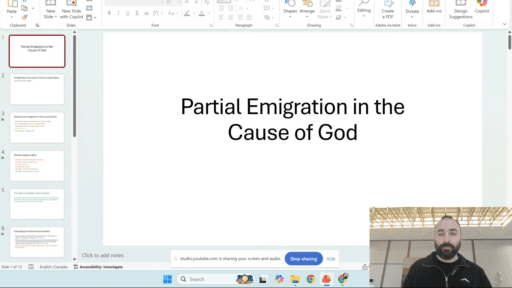
Sermon Introduction
Praise be to God. There is no other god except God.
What I want to talk about today is partial immigration in the cause of God. As you might have noticed in a lot of Friday sermons, but also video clarifications, I emphasize that we can partially apply some of the things which the Quran mentions because the conditions under which we are today quite often are partially true for us. So this is one of those examples and, God willing, let’s find out what partial immigration in the cause of God actually means.
First of all, we all agree that immigration in the cause of God is a good deed. This is mentioned many times in the Quran. It mentions how immigrants are a degree higher than non-immigrants, that they will be rewarded by God, and that if anyone dies while immigrating to God, they’ll go to heaven. There are many verses like that, and basically, it’s an easy thing to conclude that immigration in the cause of God is a good deed (3:195, 8:74, 9:20 , 22:58).
But what are the reasons for immigration in the cause of God? When do we have enough reasons to immigrate in the cause of God? Let me go over them.
One reason is if we are evicted from our homes and deprived of our properties (59:8).
If you don’t have a home and a property, or if you are denied entry to your home, you might be forced to immigrate.
Another reason is the fear of big injustice and your life being in danger (28:21).
For example, this applied to the case of Moses when he escaped from Pharaoh. He had killed someone accidentally while trying to help, and then the other person accused him the next day. Moses thought that people would not understand and would accuse him, so he felt his life was in danger. People told him his life was in danger.
Unfairly punishing someone is different; if someone commits a sin, that doesn’t mean they should immigrate, they should actually get the punishment. But if someone knows that they are unfairly going to be punished, then it’s different. So that’s another reason to immigrate in the cause of God.
By the way, these first two reasons were involuntary because you are just forced and there’s nothing you can do about it. The other ones I’m going to mention are more voluntary.
Redefining Immigration to the Messenger today
These first two reasons were involuntary because you are just forced and there’s nothing you can do about it. The other ones which I’m going to mention are more voluntary.
These reasons of immigration which I am mentioning, in general they just don’t apply to us. (There might be rare exceptions) That’s why I am showing them in red color.
In a democratic country (what they call a «free country») like today where almost all of us are (and in the future it is going to be even more), these reasons for immigration don’t really exist. For all practical purposes, they just don’t exist :
- Who has kicked you out of your home?
- Who has denied us from our properties?
- Who thinks his life is in danger in his country so they have to move to another country?
I don’t see any of us being in that situation.
The third case is also like that, and let me explain. Immigrating to the messenger of God (4:100) today is not a reason for immigration. I explained this in one of the video clarifications titled The Clarifying Messenger. There, I explain all the different subcategories of where I am not a messenger of God, where Alban is not a messenger of God. Some people think I’m just being funny or trying to sound smart, but I’m actually laying down when I am a messenger of God and when I’m not.
For example, I say there that :
- When Alban sleeps, He is not a messenger of God.
- When Alban eats, He is not a messenger of God.
- When Alban presents a Friday sermon like this, unless it is a video clarification, Alban is not a messenger of God.
- When Alban is just walking in the park or staying home, He is not a messenger of God.
- When Alban is chatting with you in the chat, He is not a messenger of God.
The only time Alban is the messenger of God is when he publishes video clarifications.
I make this clear in The Clarifying Messenger. There, I tell you that I’m not a messenger of God in almost all cases except when I am presenting in English online in a video clarification, and in that case, you can always hear it online. So there is no reason to physically immigrate to the messenger of God, because the messenger of God really is online. You cannot find the messenger of God offline today.
Some people find it strange that one can be a messenger of God sometimes and not a messenger of God at other times. But this was true with Muhammad as well :
- Until the age of 40 : He was not a messenger of God.
- After 40 : He was a messenger of God most of the time when he was reciting the Quran, but when he said some stuff which might have been recorded in what they call hadith, he was not acting as a messenger of God.
So this is not a new idea. It looks like a new idea because people have simplified things, but it is really not a new idea.
What this means is that this verse about immigrating to the messenger of God does not really apply in our situation. There’s no reason for you to use this verse to say : “I am immigrating to the messenger of God.” For example, right now I am living in Canada but no one should say : “Oh, I am going to Canada because that is where the messenger is” , because the messenger is online. If you have access online, you have already fulfilled it, so there’s no reason to immigrate for this purpose. This does not apply in our situation either.
Religious Rights and the rightful Maintenance of Mosques
The fourth reason is If you are Wronged (16:41).
(I put this in sort of orange color because it might apply to someone in an individual case, but it does not apply to us at all as a community. Individually it might apply to someone)
Let’s say you’re walking someday down the street in what they call a bad neighborhood and someone beats you. So you decide : “I’m going to sell my home, I’m going to go to another neighborhood or to another city because there’s too much violence in my neighborhood.” Yeah, that can apply, but it does not apply to us as a community. Most of us live in safe neighborhoods, I think. So it might be an isolated incident where it applies to an individual, but it does not apply to us as a community.
Basically, all of these reasons which I presented are not good enough reasons in today’s society, or they don’t happen to us. We don’t have the reasons to immigrate in the cause of God for these reasons. They might apply in The End Times (during the time of the Mahdi or etc.) but today with us, they don’t really happen in practice.
The final reason to immigrate in the cause of God in Surah 4:97. They have translated it in many different ways : some translate it as oppression, some as a weakened state. But actually the literal meaning of that word in Arabic: is basically when you don’t have equal opportunities like other religions.
A way to summarize all of those meanings is probably to say:
If we are denied religious rights (4:97)
If we are denied religious rights, then we have a reason to immigrate in the cause of God. And God willing, I will show why this is a partial reason to immigrate in the cause of God, not a full reason. It’s a partial reason because we are only denied our religious rights a tiny bit. For most of our religion, we are not denied our religious rights.
Let’s go over some basics of our religion and see if they are denied:
The right to say the Shahadah (witnessing) :
The first thing which we believe in our religion is the right to say the shahada, the right to say there is no other god except God, which is called the witnessing in English.
- Do we have the right to say that?
- Yes, we do. No one has denied this to us. This has not been denied. We are free to do this.
The right to fast during Ramadan :
- Has our right to fast during Ramadan been denied?
- No. Ramadan came and went, and to whomever it applied, we did fast. I fasted. I think all of the submitters to whom it applied they fasted.
- Did someone tell you not to fast?
- Did the police come to your home and tell you not to fast?
- Did they fire you from your job or beat you because you fasted?
- No. So this religious right has not been denied; we are free in this aspect as well.
The right to Zakat :
- Has our right to give zakat been denied?
- No, because we are doing zakat, and even though it’s online, we are doing it. No police here in Canada has ever come to our home and said : “Oh, you guys are organizing zakat, you will have to report to the police.” No, it has never happened. We are free to do this as well, and I’m quite sure this happens for almost all of you.
The right to do Hajj :
We have the right to go to Hajj. There were a few limitations, but we basically did Hajj. Whoever could afford and wanted to come with us to do Hajj did come, and it went perfectly.
There was a tiny bit of a limitation when we went to Mina, for example; there were some guards or workers who didn’t want to let us go there, but God willing, someday I will show that Mina is not an obligatory part of Hajj anyway. So basically, in that tiny part where they wanted to deny us our right, that was not obligatory for us anyway. Mina is part of Hajj, let me make it clear, it’s part of Hajj, but it’s not an obligatory part, and there’s a difference there. I’ll explain it one day.
To summarize, we have not been denied our right to do Hajj.
The right to do the Contact Prayers :
The right to do the contact prayer also has not been denied to us. I did the contact prayer yesterday, the day before, and the day before that. No one said : “Oh, you’re doing the contact prayer, you’re going to have to report to the police,” or “You’re going to be fired because of this.” There might be some isolated incidents, but maybe you asked a little bit for it, or maybe there’s just not enough space. We’re not talking about that; I’m talking about in general. We as a community are not being denied our religious rights to do the contact prayer, so we are free to do this religious right as well.
There is one thing, however, which we as a community are being denied :
The right to maintain God’s masjids.
In Surah 9, verse 18, it says:
“Only shall maintain the masjids of God those who believe in God and the Last Day, and observe the contact prayer, and give the zakat and do not fear except God.”
If someone fulfills these criteria, they have the right to maintain the masjids of God. These criteria are fully fulfilled by us. We as submitters believe in God, we believe in the Last Day, we observe the contact prayers, we give the zakat, and we do not fear except God. What this means is that we should have the right to maintain the masjids of God.
I can tell you from practice, I tried once and they reported me to the police. I went to a few masjids (not just one masjid). That’s a long story but for the purposes of this, I tried to maintain the masjids of God without permission from the Sunnis or the Shias. By maintain, I mean in that case I wanted to remove Muhammad’s name from the walls because that shouldn’t be there. Those masjids where we are permitted to pray belong to God; we don’t need anyone’s permission. Those belong to God, they don’t belong to the Sunnis, they don’t belong to the Shia. Since the day they were dedicated to God, they still belong to God.
That means that we have the right to maintain those masjids more than anyone else, and here’s why: because actually, the others do not have the right to maintain those masjids : Verse 9:18 says the right belongs to those who observe the contact prayers and give the zakat. However, the Sunnis most of the time don’t give the Zakat in most Sunni countries or Shia countries, and in some countries where they do, it’s not accepted. The reason is that the Quran says that nothing of what they spend, including the Zakat, is accepted because they disbelieved in God’s messenger. Unless they believe in God’s messenger, their zakat is not accepted, and because their zakat is not accepted, they lose the right to maintain God’s masjids.
So the Sunnis and the Shia do not have the right to maintain the masjids of God. We have the right to maintain the masjids of God. However, in practice, we are being denied that right. We are not allowed to do that.
As an example, I wanted to maintain a masjid and when I tried to remove Muhammad’s name, what happened ? They called the police and reported me. It went peacefully, I didn’t go to prison, but I could not maintain the masjid of God. I was denied that right. I did it fully peacefully. And I don’t recommend anyone else do it because it doesn’t work.
Why doesn’t it work?
It doesn’t work because you are not allowed to use violence or to do it by force, which I didn’t do. You’re not allowed to fight people inside the masjid of God. Therefore, you cannot do it by force.
The only way is to defeat those people who have occupied those masjids from the outside and then free the masjid. But in that case, you would have to fight the whole state because all they have to do is call the police.
Today’s democratic states think that those masjids belong to the Sunnis or to the Shia, so there’s nothing we can do about it. For this reason, we have been denied this religious right. This is the only religious right which I found in the Quran which has been denied to us. We are the rightful maintainers of God’s masjids, but we are being denied that right.
Before I continue further, let’s repent.
Praise be to God. There is no other god except God.
Calculating the Denied Benefits and the Concept of the “Submitter’s Retreat”
So we concluded that the only right which they have denied us is to maintain the masjids of God. When we lost this right, we also lost the benefits which come with it. Had we had the chance to maintain the masjids, it would mean that we would organize the Friday gatherings locally. That would mean we wouldn’t have to do it online at all, because you guys wouldn’t meet me like this, your souls in another body would actually get to hear about this message in a physical masjid, not online. In that case, we would be able to enjoy the extra benefits of group prayer.
In previous sermons (Estimating Group Prayer Values, The problem of establishing mosques today, The Call to the Friday Gathering), we went over the fact that when you do a group prayer, you get extra benefits from it. Because we are being denied the right to maintain God’s masjids, we are also being denied the extra benefits of group prayer during Friday (because we can go at another time, that’s fine)
Someone might say : “Oh, but you guys have chosen not to go, they are not stopping you.” Well, let me give you an example. Let’s say a wife or a husband commits adultery and the other one divorces them. The one who broke the marriage is the one who committed adultery, not the one who decided to divorce them. It’s the same way with the Sunnis. Even though we do not go to those masjids during the Friday prayers, it’s the Sunnis who committed the religious adultery. It is them who made the mistake which forces us effectively to separate from them. So effectively, they have denied our right to maintain the masjids of God.
Let’s estimate the denied extra benefits :
- Why are we going through this estimation?
- It’s because we want to know how much of our religious rights have been denied to estimate how much reason we have to immigrate in the cause of God.
As we concluded earlier, we have a reason to immigrate when religious rights are denied, so we are going to calculate exactly how much it is.
The total potential benefits of Friday group prayer can be calculated as:
Total Benefits = 52 Fridays × 2 rakaats × 4.76 (group multiplier)=495 rakaats
I am using a group multiplier mean of 4.76 because we currently have 65 people. From the calculation method I showed you in the previous Friday sermon (Estimating Group Prayer Values), if there are 65 people, doing one rakaat counts as 4.76 rakaats. So, 495 rakaats is the total we would get if we went to a physical mosque. But we are denied all of it.
However, we found a way to get back part of it through the online Friday gathering. We already found a way to get back some of those benefits (the minimum) by doing the Friday gathering online while doing four rakaats for the individual prayers. What we are doing today is:
52 Fridays × 4 rakaats = 208 rakaats
We are getting this back. However, this is the minimum.
- What do I mean by the minimum?
- Because we concluded in the last Friday sermon that doing four rakaats individually is the same value as doing two rakaats with four people. This means that when we organize the Friday gathering online the way we are doing it today, it counts exactly the same as if we were in a village and prayed the Friday prayer with a total of four people. That’s how much it is worth. It fulfills the minimum because the minimum threshold for a Friday gathering is four people. We are fulfilling the minimum, and it is good enough, but we could have benefited much more.
The minimum we are benefiting is 208 rakaats, but we could have benefited 495 rakaats. Let’s calculate the difference:
We are still denied the religious right to :
495 – 208 = 287 rakaats of extra benefits
The Sunnis, the Shias, and the democratic states (or whichever state which support them because they are in power) have denied us the religious right to enjoy 287 rakaats of extra benefits in a group prayer on Friday. Our religious rights have been denied by this much.
- What did we conclude earlier?
- Therefore, we have a reason to partially immigrate.
- Why do I say partially?
- Because for all the other reasons, we had no right to immigrate; the only reason is this gap. Therefore, we have a reason to partially immigrate to the cause of God up to the amount of reaping these extra benefits of 287 rakaats.
- How many days of immigration would that be if we want to get back those 287 rakaats which have been denied to us?
- How much would we have to travel to get them back? (The Quran says you have a reason to immigrate to get them back)
= 60 rakaats denied
- How many days would it take us to do those 60 rakaats?
= 3.5 days per year
So we have a valid reason to immigrate for 3.5 days per year to get back those 287 extra rakaats of benefits.
We have reason to immigrate but only partially and only for 3.5 days per year.
(Not like during Muhammad’s time when they had reasons to immigrate for 365 days per year, for the whole year, because they were beaten, they were denied some rights, etc. And that is not happening to us.)
The more appropriate word in English would be to call it a “retreat” rather than an immigration. That’s just the word we use in English for short-term, very temporary immigration. I mean, who says : “I’m immigrating for three and a half days”? They would probably say, “I’m going on a retreat,” or “I’m going on vacation.” So very likely, we’ll call this the Submitters’ Retreat.
Affordability Calculations for the Retreat
- Who can afford to come to the retreat?
- Not all people immigrated with Muhammad to Medina during his time. For example, there were slaves who could not immigrate because they were not allowed to leave their master’s home without permission, so it was just not possible for them. A few of them Muhammad and some believers bought so they could immigrate, but a lot of them could not. It is just not possible for some people; some people are just too poor, and it is okay.
Don’t feel guilty if you cannot do this tiny partial immigration, because it happened to the people of the past and they were still submitters. In my heart for the community, for every one of us, we should still consider those people submitters even if they cannot immigrate, because as long as they do the contact prayer and give the Zakat, they are submitters.
Verse 2:273 reminds us that some people cannot afford or are not wealthy enough to emigrate, or simply might have obstacles to travel. For example, mothers with children under two years old might not find it suitable to travel because they have to feed their baby, or students without an income, or people with prohibitive physical disabilities, or people in extreme old age, and of course, people who do not have enough money. These categories very likely just cannot immigrate, and it is fine if they cannot come to that retreat.
But I want to focus on the last one: the people who don’t have enough money.
- How much money would you need to have to be able to afford this retreat?
- How do you know if you can come to the retreat and afford it?
We can calculate that as well :
Because you did not have to travel to a physical mosque every Friday since we made it available for you online, you saved about 40 minutes (0.66 hours) of extra time each Friday. Because a group of people made it possible for you to do it online, you have extra time which you could have used for work :
0.66 hours × 52 weeks = 34.32 hours in a year
You have that extra time, and you could have turned that time into money.
Assuming that we’ll organize the retreat to be partially on the weekend, you might end up with two days of the retreat happening during workdays. Two workdays equal 16 hours of work. Yes, you had all that extra online time, but if you come to the retreat, you’ll lose some of that work time.
By the way, we are not going to repay you or apologize for the time that you lose with your family, because the Quran says the real family is the believers. So I’m not going to say : “I’m sorry that you have to leave your family who maybe are not submitters.” No, I am not sorry, because the real family is the submitters. But I am sorry you might have to leave work for two days, and for that, I am going to discount that lost work time in the calculation of how much you can afford, so it is taken into account :
34.32 hours saved – 16 hours lost = 18.32 hours of net extra work time
Since a standard year has 1,920 hours of work, 18.32 hours of work represents roughly 1/104th of your annual work.
Therefore, to find out if you can afford it, take your annual net income after taxes (whatever it is: $5,000, $10,000, $50,000, $100,000) and divide it by 104:
Affordable Ticket Cost (Every year) =
That result is how much you should be able to afford to buy the ticket to travel to the retreat. If your travel ticket is more expensive than that, you don’t have to come. It’s fine, you simply cannot afford it. If you still want to come despite it being more expensive than what you would naturally afford, you are welcome to come anyway; it’s your choice. All I am telling you is that it is possible to calculate if you can afford it. So I do not want people to use empty excuses. I can know how much you can afford.
To make it affordable for most submitters (because our group is very widespread globally), we will organize it every two years, God willing, in the near future. We’ll start with every two years, and then when we have many subgroups, we will do it every year, God willing.
When you submitted your Zakat, you also used your income to calculate the Zakat, so I used those numbers to calculate who can afford this retreat and who cannot. If we do it every two years, most people can afford it : about 60% of our people. But if we do it every single year, it’s going to be only about 30-40% of people who can afford it, which is not enough. I think at least more than half of the people should be able to afford it. That is why I decided on a schedule of every two years.
This is all a practical solution. It’s not a religious law. We might change it or switch it later, and that’s okay. In practice, I’m trying to give you an opportunity to get back the denied benefits which the Sunnis and the Shia have denied you of. That’s all. It’s an opportunity, not a religious obligation. Because I feel sorry for you and for myself, that the Sunnis, the Shias, and the democratic countries have denied us a religious right, which has resulted in denying us some benefits. I’m giving you an opportunity to reclaim those benefits by coming to a retreat.
If it is organized every two years, your income is twice as much, so instead of dividing by 104, you simply divide by 52 :
Affordable Ticket Cost (Every 2 years) =
That is how much you should be able to afford to buy the ticket to travel to the retreat.
Reallocating Zakat to Fund Accommodations
So take your annual net income after taxes, divide it by 52, and you will know how much money you have to buy a ticket to come to a retreat if we organize it every two years instead of every one year. And as a bonus, we’ll pay for your hotel or accommodation from the collected zakat, God willing.
We have already collected some zakat from different subgroups of zakat. A lot of it was intended to promote the message online, to pay ads. We tried Google ads, we tried YouTube ads, and we tried some other types of ads so that the message of God can reach people, but what happened is I realized it was not effective. So, all I am going to do is redirect that money which a lot of it was not used, redirect it and pay the hotel for people who come to the retreat.
Now, people have paid that zakat, so they might have a question about it. They’ll be like : “Oh, wait a minute. Can you actually do it? Why should I pay the money, and someone else comes to the retreat and gets the benefit, getting a free hotel?”
Let’s see if that’s actually according to the Quran, Verse 9:60 says:
“Charities shall go to the poor, the needy, the workers who collect them, the lonely, to free the slaves, and to those burdened by sudden expenses, In the cause of God, and to the traveling alien. Such is God’s commandment. God is omniscent, Most Wise.”
All people who are doing the Friday gathering online are lonely because we are not in a physical group. So, we have a reason to pay the hotel for them.
What are we doing?
We are gathering in a retreat to pray, to do the contact prayer, and to worship God. That is strictly in the cause of God. The verse ends:
So what we are doing is using this zakat to give it to these three categories. People who come to that retreat fulfill and are a part of all three of those. So basically, they fulfill half of the reasons we have to give the Zakat.
Nature and Schedule of the Submitter’s Retreat
Think of the retreat as a vacation (The Submitters’ Retreat). We are not going to do some kind of conference where we have to present stuff and things like that. The main thing we are trying to achieve there is doing the contact prayer together for three and a half days. That’s it. Other things are optional. Someone might want to meet someone, someone might want to enjoy the views. They can do it separately in groups. It doesn’t matter
We might just share time. You can think of it as a vacation, you can think of it as an opportunity to learn, or you can think of it as an opportunity to do extra group worship (Worshiping God in a group, etc.) .Whatever you want to do. The important part is that we do the contact prayer together.
As we can see, we do have a reason according to the Quran to use a portion from the collected Zakat to pay for the hotel or accommodation. God willing, whoever comes to the retreat gets the hotel for free. And that’s a lot of money, by the way. I’ve calculated it, and it is like tens of thousands of dollars if most people come.
Rewards for Both Immigrants and Supporters
The second verse which has to do with this is 8:74. It says:
“Those who believed and emigrated and strove in the cause of God, as well as those who hosted them and gave them refuge, and supported them, these are the true believers. They have deserved forgiveness and a generous recompense.”
- Who are those who hosted and supported them?
- Those who hosted and supported them are the people paying for the hotel for them.
Basically, if you gave the penalty Zakat because you live with a non-submitter and you paid a penalty zakat for that ; if you come to the retreat, you’ll enjoy the benefits of giving that. But if you don’t come, then someone else will enjoy that benefit, and it’s fine because in that case, you are the supporter, you are the host, and the other person is the immigrant. You are supporting someone doing that, and it is fine. It is within this verse; it’s within what the Quran recommends :The verse says they have deserved forgiveness and generous circumstances.
Both those who are giving the Zakat which is being used partially for the hotel) and those who are using the hotel to meet with other submitters to do the contact prayer together, both get a reward from God. They are both considered true believers according to God. It says : “these are the true believers.” It is a sign of true belief.
Concluding Remarks and Q&A
We’ll talk about locations of the retreat (like where, how, and when) on future Friday gatherings, God willing.
Does anyone have any questions or anything to say?
- Faisal is saying :“Exciting.”
- Alban says : «Yeah, yeah, I think it’s also exciting»
- George Parfin is saying : «I can help you make better YouTube videos»
- Alban says : «George, you’re a young submitter, you need to learn.»
Any other comments?
By the way, George Parfin joined us as a submitter. May God bless him.
For those who have to do the contact prayer, do the contact prayer. Peace be upon you.
Friday Sermon by: Alban Fejza, Online Congregation Director