
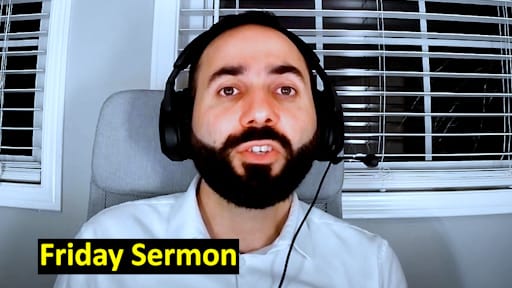
Friday Sermon by: Alban Fejza, Online Congregation Director
Summary:
In this Friday sermon, Alban Fejza shows how today’s disbelievers and hypocrites use softer versions of the insults and excuses the Quran predicts, such as calling a messenger crazy, a fool or a magician, and warns us not to let the softness hide their disbelief.
Video Transcript:
Praise be to God. There is no other god except God.
A lot of times, during debates or arguments, or when we are verbally attacked by disbelievers, some of us fail to notice that those attacks have been prophesied in the Quran, but in a more extreme form. The Quran predicts what the most extreme disbeliever would say to the most extreme believer. However, because today the disbelievers are not the most extreme disbelievers, and the believers are not the most extreme believers, their verbal debates and disputes will fit the Quranic prophecies in a softer version. Because the disbelievers of today come up with slightly softer words compared to what the Quran predicts for extreme disbelievers, some of us might not always be aware that what they just said is an expression of disbelief, only in a softer version. Let’s examine some examples of the softer versions of what I have heard the disbelievers say about me, or about us in general, and then I’ll tell you the more extreme version predicted in the Quran.
For example, some of the things people have called us, or me specifically, are “brainwashed,” “indoctrinated,” “he has not gone to religious school,” “he does not speak Arabic,” “idiot.” This is the soft version, but the hard version is simply “fool.” The Quran predicts that. Verse 2:13 says that when the disbelievers are told to believe like the believers, they say, “Shall we believe like the fools who believed?” So the extreme disbelievers go directly to the word “fool,” but the less extreme disbelievers will use softer synonyms, or softer versions, of the word “fool.”
Here is another example. The disbelievers of today, being soft disbelievers, will dig up any mental disorder in the field of psychology and label me with it: “He has schizophrenia,” “he’s a psychopath,” “he has hallucinations,” “he’s bipolar,” “he has a multiple personality disorder.” Or they will come up with even softer psychological accusations, like, “Who abused you that you became like that?” “You need help.” “Have you visited a therapist?” “Are you sure that what you are saying does not stem from some psychological episode?” These are the softer versions, but the extreme version, which is predicted in the Quran, is that they say, “He is crazy.” In verses 15:6 and 23:25, God says that the extreme disbelievers will label the messenger as crazy, which means that softer disbelievers, being softer today, will label him with softer versions of the word “crazy.”
Here is another example. Even though I’m not that kind of messenger, when I write emails or chats, they said, “He’s making spelling mistakes in his emails or chats, so he cannot be a messenger,” or they say, “He has an accent.” This is simply a softer version of what Pharaoh said about Moses. Verse 43:52 reports that Pharaoh said to his people, “Which one is better, me or that one who is lowly and can hardly speak?” Pharaoh used this as an argument against Moses, since Moses had a slight speech defect.
Here is another example. When I told them about the smoke which the Quran predicts will come, they said, “Well, that’s a little bit too far. We don’t know if we will be alive then to witness it and verify that you’re telling the truth. Can you make another prediction of another retribution which will come earlier?” This statement is simply a softer version of what the extreme disbelievers said to the extreme believing messengers of the past. For example, they told Noah, “We challenge you to bring the doom you threaten us with.” Basically, they told him, “Do it now, if you are truthful.”
Here is another example. When I preach, they try to come up with softer versions of prohibiting my speech. For example, they said, “Advertisements are not allowed here, so please do not post links to your videos,” or, “This is spam,” or, “Remove us from your email list,” or, “You’re not welcome to speak at our conference,” or things like that, which are partial limitations on my ability to contact other people, just enough to the point where they think it will give them enough advantage. The extreme disbelievers of the past were more extreme. As reported in verse 15:70, they directly told Lot, “Did we not stop you from contacting anyone?”
Here is another example. The Catholics do not eat meat on Fridays. This is a very soft version of an invented dietary prohibition. A stronger version is that of the Hindus, who do not eat cow meat at all. The Quran mentions the more extreme version of a dietary prohibition in verse 6:138, where God tells us that the disbelievers of the past said, “These are livestock that are prohibited; no one shall eat them except whomever we permit,” and they even prohibited the riding of certain livestock, and so on.
Here is another example. They said, “Let him come here so we can expose him. He’s trying to mislead you. He’s the messenger of Satan. He’s trying to deceive you. He’s tricking you.” And the Quran mentions the most extreme version of what they will say, in verses 43:30 and 10:76: the disbelievers said, “This is magic; he’s a magician, a trickster.”
Here is one final example for today, and this one is not about what soft disbelievers say, but what soft hypocrites say. They might say, “I cannot leave my job to attend the live Friday sermons,” or, “I had to take care of my family,” or, “The monetary compensation which you are proposing is too much; it’s going to be a burden for the submitters, and others might not join us because of it,” or things like that. The Quran gives us the more extreme version of what the extreme hypocrites say. Verse 9:81 reports that they said, “Let us not mobilize in this heat.” Verse 5:22 reports that they said, “O Moses, there are powerful people in that city, and we will not enter it unless they get out of it.” Verse 28:57 reports that they said, “If we follow your guidance, we will be persecuted.”
So these are some examples of what the hypocrites within us and the disbelievers outside our group say. Today they come up with softer versions of those sayings, because they are softer disbelievers and softer hypocrites, just as we are softer believers. The future is full of in-between people, modern people, moderate people. “Moderate” means reduced, less extreme. So we are living in a more moderate environment compared to the past, which makes it easier for us to deal with the disbelievers. But let’s not let the softness of their disbelief fool us into not recognizing their disbelief. It’s still disbelief, but in a softer version.