
Friday Sermon by: Alban Fejza, Online Congregation Director
Summary:
In this Friday sermon, Alban Fejza uses a spreadsheet to show how good deeds done early in life grow in value like an investment, and urges us to do good deeds as early as possible, when they are worth the most.
Video Transcript:
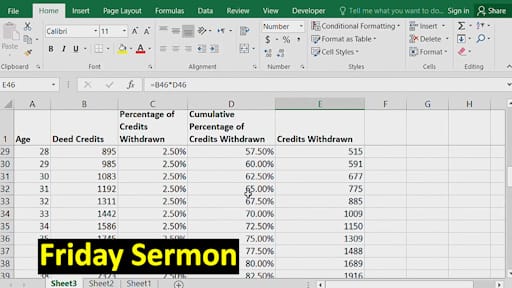
Today, let me just talk about how important it is to do good deeds early in life rather than later in life. Let me use this Excel file to explore how it works. Okay, so let’s create a variable called age. Let’s assume that we will live about 75 years, which is close to the average life expectancy in this world. So, let’s list the number of years a person can live. 1 2 3 4 5 up to 75. Okay, so we have numbers listed up to 75. Now, let’s assume that we started to do good deeds when we were about 5 years old. Or whatever. Let’s assume that when we were 5 years old, we did good deeds equal to 100 credits. 100. Maybe we picked up 100 apples which fell from an apple tree or something or something similar or whatever it is. Or let’s just assume that the total amount of good deeds we did when we were 5 years old was equal to $100. So, let’s create a new variable called deed credits.
Deed credits. Now, just like with any investments, the value of these $100 will increase each year in value. Let’s assume that it will increase in amount equal to the average increase of investments in this world. The average increase of investments is measured in the world approximately. It’s called the Dow Jones index. So, we are talking about the increase in the Dow Jones index. Each year, it increases by about 9%. Let’s round it up to 10% increase each year. So, let’s increase this $100 by 10% each year. So, 100 times 1.1. So, basically in the next year we have $110 and and so on each year. And if we increase this by 10% each year, by the age 75, we will have $78,000 or maybe around $79,000. Let me just fix how this shows these numbers. Okay? Now, these credits can be withdrawn. And usually the more we have from those credits, a higher proportion God allows us to withdraw after making sure that we have enough left for the next life if we are chosen to go to paradise, of course. So, let’s assume that we can withdraw all of it in 40 years, which means that we can withdraw 2.5% of those credits each year. If we don’t withdraw it in 1 year, we can withdraw it in another year. So, if we wait for 2 years, for example, we can withdraw 5%. If we let it accumulate. Let’s create a new variable called percentage of credits withdrawn.
Percentage of credits withdrawn. And another variable, cumulative percentage of credits withdrawn.
So, when we were 5 years old, we had 100 credits, and we could withdraw 2.5% of it. 2.5% And let’s assume we can do that for the next 40 years. So, up to the age of 45. Now, let’s see how those percentages accumulate. So, we have this equals to this plus this. And in the last year, we should have 100%. Okay. Now, let’s calculate how many credits we can withdraw each year. So, credits credits withdrawn And that this is equal to this times this. So, when we become six, we can withdraw $2.75. And so on up to the age of 45. And when we are 45, we can withdraw $4,525. let me just fix these decimal places.
Okay. So, when we are six, we can withdraw $3. And then, when we are, let’s say 10 we can withdraw $20 when we are let’s say 40 we can withdraw 2,000 and about $500 and then when we are 45 we can withdraw about $4,500. It’s easy to see that if you do a deed when you’re very young it adds up to a very large amount when we get when you get older. And you can withdraw it which means that if we did good deeds when we were young usually encouraged by our parents that means that we are sort of destined to be blessed with wealth later in life. Unfortunately, this is not true for most of us. Most of us will become submitters maybe after the age of 20 or 30 or 40 or 45 or 50. So let’s see what happens if we start it later. Okay, so let’s move all these numbers down by let’s say 20 years. So let’s say we started at the age of 25.
Now these for the same values to be withdrawn instead of withdrawing let’s say something at the age of 25 we would have to withdraw it at the age of 45. Or instead of getting the credits at the age of 45 we would have to wait until the age of 65 until we get those credits. Or let’s say we became submitters even later. Let’s say we became submitters at the age of let’s say 50. In that case let’s go to 50. So if we started at 50 it would probably be better for us to not cash in any of the credits because it’s just going to be worse for us in the next world. So, basically, what this means that if we start late in life to be good people, we should not expect to have a lot of wealth. We should expect it only in the next world. For example, Moses started slightly later in life, which is why he did not have much wealth. While Joseph started early in life, and this is why he had a lot of wealth. This is why it is possible for a group to be the right group, but because it started later, it still did not start to reap the benefits of righteousness enough. While a group which is dominant can only be dominant because it started earlier. But, that does not mean that they are right now. Now, let me just read a few verses which are related to this. Surah 2, verse 261 says, “The example of those who spend their money in the cause of God is that of a grain that produces seven spikes, with 100 grains in each spike.” So, basically, seven hundredfold. Let’s go back to that example. And let’s say we did a good deed when we were 5 years old, and we waited until 75, and you will see here that it’s 700 times bigger. Actually, here it’s 780 times bigger. Chapter 2, verse 286 says, “God never burdens a soul beyond its means. To its credit is what it earns, and against it is what it commits. Our Lord, do not condemn us if we forget or make mistakes. Our Lord, and protect us from blaspheming against you like those before us have done. Our Lord, protect us from sinning until it becomes too late for us to repent.” So, as you can see, the time when we do a good deed or repent actually does matter. The earlier we do it, the better it is. Chapter 2 verse 267 says, “O you who believe, you shall give to charity from the good things you earn and from what we have produced for you from the earth. Do not pick out the bad there in to give away.” So, in this verse, we can see that it’s not good to give the bad wealth to charity. And doing good deeds, it’s like donating part of our life. And if we donate the bad parts of our life, meaning if we become good when we are old, as you can see, it’s possible that it might not be acceptable. Of course, we should never lose hope. Even in old age, God will accept our worship. But as you can see, it has much less value. Just like sacrificing an old sheep, it has less value. Or giving a rotten apple, for example, it might not have any value at all. So, let’s do good deeds as early as possible when they have more value.