Friday Sermon by: Alban Fejza, Online Congregation Director
Summary:
In this Friday sermon, Alban Fejza explains that artificial intelligence chat tools simply predict the most likely next words people would say, and predicts that for everything that eternally matters, we will still need the Quran.
Video Transcript:
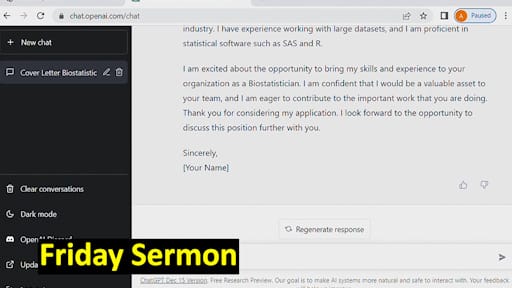
Praise be to God! There is no other god except God. As some of you might know by now, an artificial intelligence chatting webpage has recently become popular and is being promoted in social media, which you can see here. Actually, earlier versions have been in existence for several years now, but recently it has become slightly more sophisticated and popular. But what is it really? Well, they promote it as intelligence with which you can chat and it tells you information. You can basically chat with it. But, what is really happening in the background is that it simply tries to predict what would be the most likely next word a human would say in given topic, and then it predicts the next word after that and so on, and things like that, and it has learned this by being rewarded by humans, every time it gets it right, and increasing the likelihood that it will do it again, and being “punished” by humans, every time it gets it wrong, decreasing the chances that it will do it again, and people actually train it by using it. So, let me try it. Let’s request something from it: “Write me a cover letter about a biostatistician position”. “Dear Hiring Manager, I am writing to express… ok…”
So there we have it. So, how did it do it? Basically, it tries to find the most likely response to any chatting text which you send it, and with which people are satisfied. And the most likely response is pretty much the average response. And this is where the limitations of AI come from. By giving you the average response, what ends up happening is that in anything which doesn’t really ultimately matter, it can give you the best answers, sometimes better answers than any human. And this is because, the believers and disbelievers actually do agree on things which do not matter. So, the more an issue does not matter, the more likely the believers and disbelievers are likely to agree about it, and the more the they agree about it, the more likely that opinion becomes the average opinion in the world, and the more likely it is to be picked up by the Artificial Intelligence. What this means is that Artificial Intelligence actually is the best at helping you in things which do not really matter. But when it comes to things which really matter, it adds no value. So, there is a gap which Artificial Intelligence will never be able to fill. It’s the gap of importance. If an issue is eternally important, Artificial Intelligence will never give you a definite answer about it, because believers and disbelievers do not agree about it.
So, the disagreements between believers and disbelievers happen on things which eternally matter, and those disagreements force Artificial Intelligence to come up with an average answer between belief and disbelief, which actually is not the right answer, and therefore not helpful. This is why my videos are important in the modern world. My videos fill that gap of truth which is missing on the internet. The reality is that people in the future will be used to using Artificial Intelligence, and after a while they will see it as a go to tool to find the answers, and once they get used to it, they will be inclined to use it even in things which do matter. For example, once the artificial intelligence tells them 100 answers which are correct, they might be inclined to ask it whether “God exists?” and then be fooled into thinking that it will give them the correct answer. But, exactly because this question matters, Artificial Intelligence does not give you the correct straightforward answer. “The correct answer is simply “Yes.” So, let’s ask it. “Does God exist?” “The existence of god is a matter of personal belief and faith, and it’s not something that can be proven or disproven…” Ok. You can see the answer.
As you can see, the answer is a sophisticated answer which seeks to find a way in between believers and disbelievers. So, the more important the question is, the less likely it is that Artificial Intelligence will give you a straightforward answer. So, if you live in the future when Artificial Intelligence has become a common daily thing, just be aware that asking it any question is the same as asking that question to the best person who will end up in Hell, or the worst person who will end up in in Purgatory. The best people who will end up in Hell, and the worst people who will end up in Purgatory are people who actually think like Artificial Intelligence. Let’s call these people, “the doubters”, which are people between belief and disbelief. So, the way in which the doubters think is somewhere in between what believers think and what disbelievers think, which is exactly what Artificial Intelligence tries to maximize. The way it is built, it’s goal is to maximize the most likely, but by doing that in all important issues, it maximizes the answers suitable for doubters. So, on all important issues for the hereafter, the doubters and Artificial Intelligence think alike, and the more we go into the future, the more people become like that, and this is mentioned in the Quran.
In verse 42:14, it says “Indeed the later generations who inherited the scripture are full of doubts. So, here it is talking about later generations, and the more those generations are into the future, the more this applies, and the more and more they start to think like this, like the answers which this Artificial Intelligence is giving us. And as you know, in a lot of my videos, I make predictions, and here is my prediction about Artificial Intelligence. I predict that for all issues which really eternally matter, in the beginning, Artificial Intelligence will give in-between answers, neither here, neither there. After a while, the variety of answers will increase, trying to maximize the likability for a particular person. For example, if it knows based on my previous chat history that I am a submitter, it will tell me that there is only one God, but if it knows that a certain person who is asking is a Hindu, it might tell him exactly what he wanted to hear. So, after a while, the variety of answers will increase in important issues, but then towards the end of the world, Artificial Intelligence will go back to giving everyone the same in-between answer. So, religiously Artificial Intelligence will look in the beginning years of its use the same as in the end years of its use – basically average mediocre answers for all religious issues which matter. And this is because, in the beginning it is not sophisticated enough to pick up the variety of answers of people, and it just aims for the middle, and towards the end of the world, the people will converge towards the middle anyway, so despite the fact that Artificial Intelligence has learned how to pick up the variety, the variety among people has actually decreased. The believers and disbelievers would have become very similar to one another in the way they think. So, Artificial Intelligence when it comes to important issues, will start with being uncertain and will end with being again uncertain, except that in the beginning, it will blame itself for being uncertain, but towards the end, it will blame you for being uncertain, because then the uncertainty will be because of the people, not because of the AI, and this is predicted in verse 27:82, which says, “At the right time, we will produce for them a creature, made of earthly materials, declaring that the people are doubtful about our revelations” See, it doesn’t say, that the people will be disbelievers about God’s revelations. It is talking about people who are doubtful or not certain about the revelations, and this is exactly what Artificial Intelligence does. It increases doubtfulness in issues which matter, and it increases certainty in issues which don’t matter. Which is exactly the opposite of how it was in the past. In the past, people expressed certainty about issues which mattered, and they expressed uncertain about issues which didn’t matter. But, not in the future. In the future, they will be certain about issues which don’t matter, but doubtful about issues which matter, and this is what makes it possible for believers and disbelievers to be more alike in the future, because in issues which really matter, they are both uncertain. However, the Quran was more suitable for each person of the past, because the believers of the past generally deserved more. So, the Quran gives clear answers for issues which matter, and vague answers for issues which don’t matter, while Artificial Intelligence gives you clear answers for issues which don’t matter, but vague answers for issues which matter. And this is why Artificial Intelligence and the Quran will never replace one another. The Quran is clear in what matters, and AI is clear in what does not matter, and my role with my videos is to create a bridge between the two, so that those who have AI thinking style, the doubters, can travel towards the Quranic thinking style, if God chooses to enlighten them. But AI will continue to evolve, in the beginning, blaming itself for the uncertainty, and then towards the end blaming us for the uncertainty. So, it will gradually turn from being like our servant, then to being like our friend, then to being like our boss, and then ultimately it will act like our master, but this does not mean that we should not use it, at least until close to the very end. God willing, I plan to use it, if I find it useful for daily non-religious things, but for everything important and religious, we have the Quran.