
Sermon Introduction
Praise be to God. There is no other God except God.
Let me just inform you that last Friday’s sermon, where I think it was titled “Completing the Friday Gathering,” I deleted it from YouTube. And there are two reasons why I deleted it. One is that the initial intention of that Friday sermon was to solve a social problem, and I ended up creating a rule—a new religious rule—which I didn’t like the way it came out. And God willing, I’ll redo it for that reason.
But also, there is a second reason. The second reason is that I did some calculations there, and I didn’t take into account some other factors. One of those important factors is that the prayers do not have the same values in groups versus when you do them individually. So, God willing, I will redo that Friday sermon completely. So please try just to forget that I did it in the first place. It’s deleted now from YouTube.
The Objective: Adjusting the Calculations
But this is a good opportunity because now I can focus on those two mistakes and correct them in more detail. So today, what I want to do before I redo last Friday’s sermon, today I want to just focus on that adjustment. So I forgot to take into account a specific adjustment which should have been done in those calculations. So I’m just going to focus on that adjustment. The adjustment mainly deals with the idea that group prayers and individual prayers do not have the same value for that particular individual. So let me focus on that today, and then we’ll use this to adjust what I was trying to do in the last Friday sermon.
Okay, so let me share the screen. Okay, so the topic of today is “Estimating Group Prayer Values.” How would we estimate group prayer values?
Individual Prayer vs. Group Prayer Values
We know when you do an individual prayer, let’s say you do the noon prayer, the value of that prayer for you is one prayer. Now, of course, in other videos I do mention that God rewards it 40 times (Reconstructing the Muslim Prayer Completely from the Quran), but that’s for the next world. God rewards every good deed 40 times, but that’s for the next world. God rewards it even more because the hereafter is forever. But I’m talking about how much does God consider it to be—that’s for the next world. For this world, one prayer is one prayer.
However, is one prayer in a group still one prayer, or is it more than one prayer for you? And that’s what I want to focus on to estimate this. And by the way, I’m calling it estimating group prayer values; I’m not calling it calculating group prayer values. The reason for that is because it’s an approximate estimation, and that’s on purpose to keep it simple, because I’m purposefully ignoring a lot of other factors like gender. Gender has an effect, the age of the person has an effect, the setting where they are doing the prayer—all of those have effects. Is it in a mosque, is it not in a mosque? And many other things do, like the faith of the person who’s doing the prayer, the sincerity of the person who’s doing the prayer—all of those do have an effect on the value of the prayer.
However, if you ignore all of those and just focus on the effect of the group on the prayer, then we can simplify it and talk about it. That’s why I’m calling it estimating group prayer, because it’s not exact, because we’re disregarding on purpose so many other factors. And so how do we estimate the group prayer? The idea is actually quite basic. Let’s say that you are doing the prayer alone. That prayer, let’s say that noon prayer, is just one prayer.
The Spiritual Mechanics of Group Synergy
However, now let’s say you add another person to that group—to you—and now you’re doing the prayer together with one other person. The prayer for you is one prayer still. But what’s the value of your prayer for that other person? It does have a value, otherwise you wouldn’t do it in a group. Why would that person join you if there’s no value to joining you? What’s the purpose of joining you? What’s the purpose of doing it together if there’s no value to it? So it does have a value for that person.
So what’s that value, how much value is that? You can indirectly or logically think of it by using the verse in the Quran which says:
“Whoever mediates a good deed receives a share thereof…” [Quran 4:85]
In English, you can also call it: whoever enables a good deed receives a share thereof. Because whenever you mediate, you’re enabling. You’re enabling, you’re making it possible for that person to do the group prayer. So you’re doing the prayer yourself, but also when the other person is there, you’re enabling him to do his prayer in a group. You are the group for that person.
Your one prayer is one prayer, but to that person, the prayer is half of the group prayer because your prayer is half of the group prayer. His prayer is half of the group prayer. So your prayer now has one prayer plus half a prayer, plus 1/2 prayers, because the group has two people. So now the value of your prayer is 1.5, and the value of his prayer or her prayer is also 1.5, because he’s also enabling you to do the contact prayer. So a prayer in a group, the value for each individual has the value of 1.5. In other words, when two people separately do the contact prayer, each of their prayers is just one prayer. But if they do the prayer together, those two people, now the total of those two prayers is three prayers because each of them is one and a half. As you can see, there’s an additional value to it just from the fact that you’re doing it in a group.
Distinguishing Worldly Blessings from Eternal Reward
And let me focus on something actually really important. As you can see, the group—and this in business or in economy is called synergy—there’s an additional value which is being added just from the fact that you’re doing it in a group. But what’s important, so we don’t misunderstand this topic, is that this does not automatically make people who are in groups better than people who live alone. And here’s why: because even though the prayer has a bigger value, that person, because he or she lives in a group, they get the benefits also. Being in a group might enable you to get married, when you need some help, someone might help you, it just feels better and easier to live in a group, someone might give you a ride. So you get the benefits. If you don’t, you’ll get them in the next world.
But almost always, the benefits which come from the group prayer are utilized—are used in this world. Yes, the group prayer has extra value, but almost all of it is used for this world, not for the next one. For the next one, the most important part is your individual prayer—the value of your individual prayer.
So let’s not misunderstand, let’s not think that maybe people who are doing it in a group might be in a higher place in heaven. Well, people who have a chance to do it in a group and don’t do it in a group, yeah, that’s a problem. But if you’re in a group and you do the group prayer, it does have an extra value and you get the benefits of it in this world. But regardless if you get them in this world or the next world, it’s a good thing. It’s a good thing, so it does have an extra value.
The Mathematical Formula: The Harmonic Series
As we said, the value of prayer in a group of two people does have that extra 0.5 because you are half of the group. So you’re enabling that person, you’re half of the group prayer. So your prayer is 1 + 1/2. And with this logic, now we can calculate, what if there’s three people? Well, in a group of three people, then when you add that third person, your prayer now—the value for that third person—is only 1/3 because there’s three people. 1/3 of the group prayer has been enabled by you, 1/3 of the group prayer has been enabled by this other person, and 1/3 of the group prayer has been enabled by that other person. So your extra group value for that third person is 1/3.
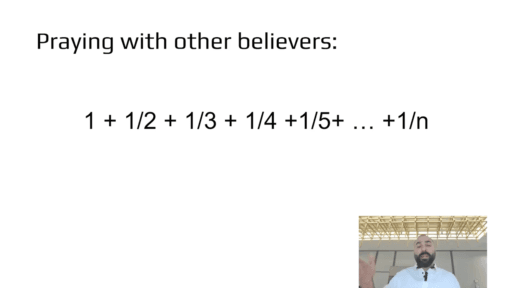
So now, what is the total value of the group prayer for you in a group of three people? In a group of three people, it’s 1 + 1/2 + 1/3, whatever that is. So that’s the formula. Then when you add the fourth person, it’s 1 + 1/2 + 1/3 + 1/4 if it’s a group of four people, and so on. So the formula in math of how to calculate the group prayer value for you—and I am not talking about the value of the total group prayer, all the prayers in the group, I’m talking about the value for you for the fact that you did the prayer in a group when you pray with other believers, of course—takes this form or expression:
And the “n” here is the group size. So if there’s 100 people in the group, you add these numbers up to 100. If there’s a thousand people in the group, you go up to 1,000. If there’s 50 people in the group, you go up to 50. So you add these numbers up to 1/50.
This is the form in math, and in math, this has a name. It’s called the harmonic series. They named it like this—it’s not really important—because these numbers also are used in musical notes. The notes in music are created by the lengths of chords, of actual wires in a guitar, which are these specific numbers. But that’s just the name.
Convergence vs. Divergence in Group Size
The more important part is to analyze whether this is a convergent series or a divergent series. There’s two types of series. And this is a series, meaning that it’s a list of additions which end up at a certain point or they might never end in some types of math. Is this convergent or divergent?
As you can see all the numbers are getting smaller and smaller—1/2, 1/3, 1/4—they are getting smaller as we increase the group size. Each additional value to that prayer is getting smaller and smaller. Then the idea is, if it gets so small, will it even change anything at the end? Let’s say if there’s 1 million people or 2 million people, will it change anything there at the end, or will the addition be smaller than the increase in the number? If it has a limit to how big this number can be, then it’s called convergent; it converges. Let’s say the limit is 100—no matter how many numbers you add here, you will never get more than 100, the total value will never be more than 100. That would be convergent.
But in this case, this is a divergent series. It’s divergent because if you go up to 100 million, you will still get a bigger number than a specific number. It doesn’t have a limit; it doesn’t have a ceiling to how high it can go. However, even though it doesn’t have a ceiling, it slows so much that for practical purposes, it behaves almost like a convergent series. There’s no limit, but it really slows a lot. So it’s almost like it has a ceiling for practical purposes.
And what do I mean by practical purposes? I mean that we don’t have an infinite number of people in the world. There’s eight billion people in the world. I don’t know what the number would be for 8 billion, but probably if we add this series all the way to the 8 billionth person, we probably will get like 25—the value of 25 or something. Basically, if you do the prayer—I don’t know if that’s correct, actually, you can do it on ChatGPT to calculate it. All you have to do is add the harmonic series up to 8 billion, and it’s going to give you an answer. I don’t know what it is; it’s probably 25, 30, 40—I have no idea. But the number is still quite small, because as you add more people in the group, each person in the group is less and less valuable for your prayer because they are a smaller part of that bigger group. So that’s the idea. Yes, it does increase forever, but it slows down so much to the point that for practical purposes, you cannot really expect a number to be more than 20.
Practical Examples of Group Values
Let’s go through some examples.
-
In a group of one: The value of your prayer is 1.
-
In a group of two people: The value of your prayer is 1 + 1/2, which is 1.5. So there’s an extra value of 0.5.
-
In a group of three people: The value of your prayer is 1.83. So we add 1 + 1/2 + 1/3, that’s 1.83.
-
In a group of four people: The value of your prayer is 1 + 1/2 + 1/3 + 1/4, and that’s 2.
If you do the prayer with four people—being a part of a group of four people—then the value of your prayer is double whatever you did alone. And this is important because this has some connection with the Friday gathering.
But before we do that, let’s repent. Toubou ila Allah.
The Jurisprudential Value of a Four-Person Group
Praise be to God. There is no other God except God.
Okay, so the conclusion is if we do the prayer with four people in a group, then the value of our prayer doubles. And this is important because, as we said in previous Friday gatherings—I think it was early on Friday sermons—we said that when you do the Friday prayer alone, we do four rakaats, four units. But when we do it in a group, if all the submitters join in that group—not if some of them do it and some don’t, if all the submitters join in that group—then we do two rakaats if we do it regularly in a mosque with all the submitters there. So then we do only two rakaats. So we do four when we do it alone, but we do two if we do it in the correct setting with the group.
And as you can see, because we do four when you do it alone, if it was a group of two people and we did two rakats only, that would be less than doing four rakaats. So what this means is that unless there’s four or more people in the group, doing the Friday prayer with two rakaats has less value than doing four rakaats alone. This means, if we go by this logic, that the minimum number of people in a group prayer on Friday must be four or more people. Because if you do it with less people and you do two rakaats—if you do it somewhere outside, if you do only two rakaats—the prayer for you, if you do it with three people, the prayer for you is going to be 1.83. But you would have gotten a bigger value if you just did it alone with four rakaats, because then you would get double value from the four rakaats instead of two on Friday. So this means that we need at least four people to do the Friday gathering.
Clarifying Structural Group Sizes: 4, 20, 40, and 100
Now, some people I think have gotten a little bit confused because I’ve thrown so many numbers in relation to this. I’ve mentioned the number 20, I’ve mentioned the number 100, I’ve mentioned the number 40, and now I’m mentioning the number four. And all of these have different reasons why I mention them, so there’s no contradiction here. I mentioned the number 20 in relation to what is the minimum group size to organize the religion, which is what we’re doing. I’ve mentioned the number 100 in relation to what is the minimum group size to have a separate group, a following group after that. The next generations, they cannot say, “Oh, we’ll just have 20 people and we’ll separate, we’ll have our own separate group.” No, to have a separate group you need 100—by separate, I mean like the same religion but a subgroup. So that’s 100.
But for practical reasons, in an organized religion, to have an affordable way of building a mosque for the Friday prayer, you need about 40 people—and I’ll talk about that another time, about 40 people. But for just doing the Friday gathering in an unorganized group, disregarding the fact that you have to build a mosque, if you just do it anywhere—let’s say outside—then you just need four people. So all of these are separate things. And so the conclusion here is that we need four people.
Quranic Proofs for the Minimum Threshold of Four
Can we find this in the Quran? Yes, indirectly. In the Quran it says when you do a transaction, have two witnesses. So let’s say you’re in a Friday prayer—by transaction a business deal, let’s say someone wants to sell a home to another person. There’s two people: one of them wants to sell the home to the other one. They meet in a Friday gathering. After the Friday gathering, the person says, “You know what, I want to buy your home.” The other says, “Okay, deal. Where’s the witnesses?” You need two witnesses. So those two people plus two witnesses, that’s four people, otherwise the community cannot function.
There’s another verse in the Quran which says if someone commits adultery, you need four witnesses. So you cannot function as a community unless there’s a minimum of four people. And we are here disregarding the fact that if you want to build a mosque you need even more people, and if you want to organize the religion you need 20 or 100 depending on the situation.
But here we’re talking about an informal way of organizing. You need at least four people, otherwise you cannot fulfill some of the laws in the Quran. Because let’s say there’s three people exiting the masjid. On the way out of the masjid, they see two people committing adultery. What can they do? There’s nothing they can do because they don’t have four people. But if there’s four people, they can execute God’s law. I mean, in a democracy that might be dangerous, but whatever, that’s for another day. What I’m saying is it wouldn’t be possible. Let’s imagine in the past, it wouldn’t be possible to have a group with less than four people. And this means one leader and three followers. When they do the prayer, one person leads the prayer and a minimum of three people for the Friday prayer should be following—if we are doing it, of course, if we’re not doing it online like this.
Linguistic Insights from Arabic Plurality
Anyway, so—and by the way, this is why the Arabic grammar has—the plural starts with three rather than with two. Unlike English where we have the singular which is one person and then we have the plural which is two or more, in Arabic, the grammar also has a third version. It has a version for one, which is singular. Then what they call the smaller plural, which is two people. And then what they call the bigger plural, which is three or more people. It’s a different form of words in Arabic. So the way the ancient Arabs thought of it is like you have to have three people to think of them as a group; you cannot think of two people as a group. So you have a group of three, plus the leader is four.
So again I’m repeating, we need four people in an informal setting to have a group Friday prayer—not two, not three, you need four. However, if you want to build a mosque, then the situation changes. Then you have to also estimate: is it efficient to build a mosque with four people? That’s another question. And because we’re doing it online now, the issue is: is it better to build a mosque with, let’s say, 10 people or something? Those are all different answers. Here, I’m just going to focus on what is the value of the group prayer, and then we’ll use this for other conclusions. But please don’t rush into conclusions because there’s other factors to consider. Let’s just learn this as a separate fact.
Mathematical Expansion of the Harmonic Series
Okay, so if we have, let’s say, 10 people, the value of the prayer would be 1 + 1/2 + 1/3 + 1/4 all the way to 1/10 — that would be 2.92. That’s the value of the group if there’s 10 people in the group. If there’s 20 people in the group, the value would be 3.59. If there’s 30 people in the group, the value would be 4. If there’s 60 people in the group, the value would be 4.67. If there’s 100 people in the group, the value would be 5.18. If there’s a thousand people in the group, the value would be 7.58.
So this means that if you pray in a group of a thousand believers—not just any group, it has to be submitters and believers—if you pray in a group of a thousand believers, your prayer is seven times more valuable. So you do one prayer, it counts as seven. If you pray in a group of 10,000 people, the value of your prayer is 9.78. If you pray in a group of 100,000 people, the value of your prayer is 12.09. If you pray in a group of 1 million people, the value of your prayer is 14.39.
For practical purposes, it’s hard to imagine a prayer with a bigger group. In Kaaba they say that the sacred masjid fits about 4 million people, but honestly, do they even pray together sometimes? Like, there’s separate sections, people pray in the yards, they count that as well. I don’t know if that’s a prayer together. So for practical purposes, I don’t think it really makes sense to go beyond a million. You just don’t see who’s there or who’s praying, who’s not praying. So it’s not that you have to see it, but the issue is like, there’s separate sections, they’ve created roads between sections of the masjid—is it really a full group then? So, yeah, but as you can see, it’s kind of like it’s hard for practical purposes to imagine a prayer because of the group effect to have more than 14 times the value of your actual prayer.
Group Values Within Multi-Denominational Mosques
Now, what if you pray in permissible mosques dominated by Sunnis or Shia? Now, then the value is different because, as we know, we are allowed to pray in some mosques which are dominated by Sunnis—in some of them, and I deal with that in another video (Places of Worship) . And in those mosques, if we happen to be there, then there might be Sunnis there and you might be forced to join them in the prayer. And in that case, what is the value of your prayer? In that case, we have to use the idea from that video clarification (Demographics of Heaven and Hell) where I concluded that in each group, whether a state group, religious group, or whatever, there’s always, sort of almost by chance, for every 10 disbelievers, there is one believer. They don’t know that they are believers; they think they are Sunnis, but there’s one person there who’s honest for every 10 people who are evil people. And so that means that among Sunnis, by chance, you’ll get one person who’s a believer. And by the way, even the Quran mentions that there are believers in the groups of disbelievers.
You go into a Sunni mosque, for every 10 disbelievers there’s one believer. You don’t know who that person is, you might never know, but he’s there, he’s probably there. So in this situation, what’s the value of your prayer? Now, to calculate the value of your prayer in that situation, first imagine that all the prayers of these disbelievers go to waste. The Quran says whoever commits idol worship, all his works will be nullified, meaning that his prayer is just nothing, as if he never prayed. It’s like he went to the gym. For all the Sunnis, when they do the prayer, it’s like going to the gym. I mean, when you go to the gym, at least you gain some muscle or whatever, there’s some health benefits, but there you don’t even gain much muscle. It might be good for your health maybe a little bit, I don’t know. What I’m saying is it doesn’t count as a prayer for all those disbelievers—the 10 disbelievers. But for one person among them, for some reason, he probably hasn’t committed idol worship in his heart, and it counts as a good thing.
So in that situation, what’s the value of your prayer? In this case, the value of your prayer is one, but the next person is zero, for the next person is zero, for the next person is zero. Then on average, the 11th person, his prayer does count. So then that 11th person, how much value does he have for you? He’s the 11th person, he’s not the second person. He’s the 11th person in the group. So 1 + 1/11, because now you are one among 11 people. And then for that next person who’s a believer, he’s 1/22, for the next person is 1/33. So that’s how we calculate the value of our prayer in a group setting in a permissible mosque with Sunnis or Shias.
And this is the form, this is the math expression:
depending on how many people there are. So let’s calculate that, let’s take some examples. So let’s say there’s 110 people—see, this ends with 110 in a mosque, that’s typical. In a typical mosque, if you go there and pray, it’s usually about 100 people, that’s quite typical. So the value of that would be 1 + 1/11 + 1/22 + 1/33—if you add all those numbers up to 1/110. If you add all of them up, you get 1.26, which is not even enough for a group prayer, for a Friday prayer, because it has to be more than two, otherwise it would be better just to do four rakaats instead of two and that’s it. So it’s not even enough if you do it with Sunnis to count as the Friday prayer.
If there’s a thousand people, if you add all of them up, see now it’s—again, this series is slowing, it’s increasing much slower—it’s 1.46 if you do it with a thousand people. Finally, with 1 million people, it gets the value of 2, and this is probably the setting in Kaaba maybe. Because even in Kaaba they have separated the group, so you can never think of it as 1 million people. So the conclusion here is that if you go into God’s mosques which are dominated by Sunnis, even if the mosque has a million people, it would be better for you just to pray with four submitters separately than to pray in that mosque. I’m not saying that you shouldn’t go there; all I’m saying is there’s more value to praying with submitters than to praying with Sunnis in a mosque. Even if there’s 1 million Sunnis compared to just four submitters, just four submitters gives you more value.
Let me go back to that because here, with just four submitters, we achieve the value of two, and imagine with more submitters. But if you pray in a mosque—in a permissible mosque with Sunnis—you need a million Sunnis to just let’s say have that additional value as much as four submitters, which is a big difference.
The Amplify Effect of Group Actions in Scripture
Yeah, so now what Quranic verses support this idea? Let’s say verse four. By the way, I can prove this specifically, but then I would have to go into taking into account all other factors like gender, age, and all of that, and I don’t want to go too much into it. I don’t think it helps to focus on gender differences, so I’m just going to sort of superficially support the idea. So, Surah 4 verse 85 says:
“Whoever mediates or enables a good deed receives a share of the credit thereof, and whoever mediates an evil work incurs a share thereof. God controls all things.” [Quran 4:85]
So this is the basic idea of why the group prayer has more value than an individual prayer for you—why it has more value for you as well, for each individual in that group.
By the way, this same idea, as you can see from this verse, is also true in an evil group. This is why sometimes people don’t realize how much they are damaging their life by hanging around bad people, because as you can see, the deed is amplified by the group. This is why the gangs, the mafia, all of that are worse than they think. Someone probably just buys the gun, the other one person kills the person—that’s a big deal there. Being part of that group where someone got killed, that’s a big deal.
Oh, by the way, this is also the reason why there’s no contradiction in the Quran when the Quran says if you kill someone—I’m talking about like as a believer—if you kill someone, then yeah, it’s a bad deed. But if you kill in a group setting, meaning in a war, it’s not necessarily bad. The reason is that if a believer kills a believer, whatever was good in that person now becomes a sin for you because you stopped his good deeds. But if that person is half-half, let’s say he’s half good, half bad, then you sort of half killed the person. Yeah, it’s killing, but for 50% of it maybe you had the justification, for another 50% you didn’t have. But this is dangerous because you’re adding sins to yourself.
However, in a group setting—let’s say in war, when Muhammad fought with the believers in actual war—even though you might have let’s say committed a 50% sin, let’s say the group was 100 people. 100 people fought against a thousand disbelievers, let’s say. Yeah, but the reward is five times more. So in this case, even though you did a sin which is prohibited in the Quran—it’s prohibited in the Quran to kill someone—in a group setting in war, the benefits outweigh the costs, because in the group setting your reward was five times more. Therefore, it outweighs the sin. That’s why wars are allowed and killing is not. Okay, so this is one of the reasons, not all the reasons.
The Realities of Associative Responsibility
Okay, so but I want to also sort of focus on the idea that some people think that—you know, you might have heard the expression, and this is important because some submitters don’t fully appreciate this—a lot of times you hear it in English, they say, “Keep your friends close, but your enemies closer.” What they mean by it is like, yeah, he or she might be useful, an enemy might be useful for some situation, so I’m just going to keep them close to me just in case. It doesn’t work like that. Once you’re part of a group, whatever they do, you’re responsible for part of it. And as you can see, it amplifies. Let me go back here: if the group is 100 people, even if you do something not as bad, it’s five times worse. You then become part of that mafia.
The next verse which supports this idea, it says for example in Surah 7 verse 161, it says:
“Recall that they were told, (the people of Moses) ‘go into this town to live and eat therefrom as you please. Treat the people amicably and enter the gate humbly. We will then forgive your transgressions; we will multiply the reward for the righteous.'” [Quran 7:161]
Because they were a group of people, and if they joined the town, there would be a bigger group and the rewards would be multiplied.
Then we have Surah 61 verse 4. It says:
“God loves those who fight in His cause united in one column, like the bricks in one wall.” [Quran 61:4]
There’s an additional goodness in being united.
Surah 2 verse 43 says:
“You shall observe the contact prayers and give the obligatory charity and bow down with those who bow down.“[Quran 2:43]
If there was no additional value to the group prayer, God would never order us to bow down with those who bow down. There’s an additional value to that; that’s why God mentions it. We bow down with those who bow down because it’s better than bowing down alone.
Then Surah 18:28 says:
“You shall force yourself to be with those who worship their Lord day and night seeking Him alone. Do not turn your eyes away from them seeking the vanities of this world, nor shall you obey one whose heart We rendered oblivious to Our message, one who pursues his own desires and whose priorities are confused.” [Quran 18:28]
Friday Sermon by: Alban Fejza, Online Congregation Director