
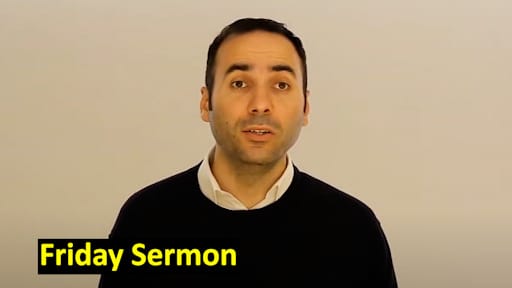
Friday Sermon by: Alban Fejza, Online Congregation Director
Summary:
In this Friday sermon, Alban Fejza explains how believers should react to anyone who claims to be a messenger, true or fake, and why it is better to leave a group than to argue with fake claimants.
Video Transcript:
Praise be to God. There is no other god except God. A few days ago, I was asked the question about how we should react towards fake messengers. Well, to answer this, first let me answer a more general question. The more general question is, “How to react towards any messenger claimants, true or fake?” This question needs an answer because when someone comes with a messengership claim in the beginning, you still don’t know whether he is a true messenger or a fake messenger. Had you known beforehand who is a true messenger and who is the fake messenger, there would be no need for a messengers, because knowing why he is a true messenger or a fake messenger comes from the fact that you know about his message, and once you know the message, you have already decided about the messenger. So, what this means is that, “You have to have a strategy on how to react towards any messenger claimant, regardless if you know whether he is a true or fake messenger?” Well, first of all, if he is a true messenger, then you should not reject him, of course, and if he is a fake messenger, then you should again not reject him for other reasons. And here is how it is possible to do that. So, at the moment when someone claims to be a messenger, you do not reject him, but you wait until he or she asks you to do something, and when he asks you to do something, you ask for proof about that. So, you never ask for proof about someone’s messengership in any case.
Only the disbelievers do that according to verses 13:7, 20:133, 10:20, and 13:27, and 29:50. If you check these verses, you will see that they clearly state that those who disbelieve are the ones who will ask a messenger claimant about proof for his messengership. There are no cases in the Quran where the believers will ask a messenger claimant for proof about his messengership, regardless if he is a true or a fake messenger. So, we never never ask for proof about someone’s potential messengership, never. But we wait until he asks us to do something, then we ask him for proof about that thing. So, as long as the messenger claimant is not asking you to do something, you do not ask for proof, but once he asks you to do something, you ask for proof about that specific thing. And this is why I never ask people to do anything, because I do not bring new proofs. I only demand you to do two things which is the Contact prayers and the Obligatory Charity, because those are already in existence and demanded in the Quran. If I ask you to do something else, then I would have to provide proof about that. Of course, in some cases, it might seem like I am asking you to do something, but if you analyze it carefully, it was always a response to something which you asked me before.
For example, someone once asked me whether I would be willing to debate a certain famous person. I told him, “reserve the venue, and invite the person” Now, he can not tell me then that I am asking him to do something, because it was he who came up with the idea first. So, my asking was a response to his asking, which means that I do not need to bring proof about that. Or in things where we already agree about something. If we agree about something beforehand, and then I ask you to do something within that project, of course, I don’t need to bring proof about that, because you already agreed to be within that project. Or in cases where I become aware that you want to do something anyway, I might ask you to do something. So, anyway, regardless if the person is a true messenger or a fake messenger, we never ask for proof from him, but we wait until he asks us to do something, and then we ask for proof about that specific thing. If he does not ask as to do something, then let him claim whatever he wants. It’s not going to affect us. If he is fake, he will go to Hell, and if he is true, he will go to Heaven, but as long as he does not ask us to do anything, it has no positive or negative effect on us. You can just ignore him or her, and that’s it. There is no need for a response, because there is no demand for an action. So, this is the general approach without even knowing who is a true messenger and who is a fake messenger. But here is an even better approach. What if before you hear about anyone’s messengership claim, you identify all the possible messengers, by simply doing a research analysis of the Quran. I already did it, and you can do it also, although it takes quite some time. But what you can do is take the whole Arabic Quran, and then you search for the word messenger in it. You take all those verses one by one and put them in another file. Hundreds of verses. Now, all you have to do, is read them one by one, and divide them into two groups. 1. Verses which clearly talk about a messenger which you already know about (like Abraham, Moses, and so on) 2. Verses which leave the possibility open for a messenger which you have not heard before. Then you delete or disregard the verses of the first group, because they are messengers of the past, and you are left only with the verses which leave the possibility open that they might be talking about a messenger about whom you did not hear before, a current or future messenger. Now, you take those remaining verses, and you try to make sense of them. And actually you will realize that from those remaining verses, only four different messengers are mentioned. 1) The Messenger of the Covenant, 2) The Clarifying Messenger, 3) The Strengthening Messenger, and 4) The Guide Messenger.
Now given that the Quran is complete and fully detailed, it is not possible for a messenger to come in our times, unless it is mentioned in the Quran, and since the Quran only mentions four possible messengers, then we only accept those four. And you can even identify them before they come, but this is a longer analysis, which I give in my video titled “Three Messengers, one Mahdi”. So, given now that we have identified all the four messengers who come after the Quran, that means that any other person who claims to be a messenger, outside of these four, he must be a fake messenger. So, in this way, we can know for sure that anyone who claims to be messenger today is a fake messenger, unless he is one of the four which God identified for us. So, today it is much easier to know who is a fake messenger, compared to the past, but now finally the question comes, “How should we react towards the fake messengers, knowing for sure that they are fake messengers?” Well, if you went to him or her and wanted to talk to him or debate him, then it is your own fault. You were asking for trouble yourself. I can not help you with that. You just got enticed by the devil. That’s it. So, if you approach him or her, then it was your mistake. But what if he or she approaches you. Well, that can only happen when you stay in environments where there is something wrong going on in that group.
For example, in Facebook groups without any Quranic based rules, that will happen. Of course, there will be fake messenger claimants there. And we do not need to respond to them, because the better option is always to leave the group instead of responding to them. If it is bothering you, just leave the group. Facebook is not obligatory. But if it does not bother you, you can just stay there. But I never read what they have to say. I just scroll down and skip it. It should not make you curious at all, if you already know who all the four true messengers are, of our modern times. And, if you force yourself to be with the correct group of people, in the Friday Sermon for example, and the people who meet to do the Contact Prayer, and they do the Zakat together, then this is an environment where fake messengers do not pop up. Jesus says in the bible, “Where the dead people are, that is where the vultures will gather, to eat the dead meat”, which means that if you create an organized group, be it a fake mosque, or an unwise social media group, or discord server, without no prior Quranic rules, it will attract bad people (as well as good people), and of course fake messengers will pop up. So, where the dead bodies are, that is where the vultures will gather. So, where the dead, meaning the dead souls (disbelievers) are, that is where the fake messengers will gather to prey on them. So, to protect us from that, first we need to make sure that we are with the correct group, joining to give zakat, and you will see that the fake messengers will not bother you anymore, and never again will you have to decide who is a messenger and who is not. They are sifted away indirectly, simply by us moving forward in the cause of God, so fast that they can not catch up with us. Let me take a more extreme example from the past to prove my point. If we gathered for battle to fight against a big army of disbelievers, and there were a few disbelievers in our group, who deep inside their mind were thinking about claiming messengership, how many of them would get the courage and come up in front and claim messengership, when the other army is about to kill us. They would be looking for an escape route, and the group would be purified from potential fake messengers. Now, let’s say that instead of organizing to fight a big army of disbelievers, we organized to just chill and waste our time and enjoy each other’s presence, kind of like a solution to mitigate our loneliness. Now, the disbelievers will realize that the more they are at the center of attention, the better it is for them, and this will motivate them to claim messengership, to attract attention. So, today we deal with messengership claimants in two ways depending on whether you have seen my video titled “Three messengers, one Mahdi”. 1.
If you have not seen that video, you do not know for sure who is a true messenger, and who is a fake messenger today, and your approach in that case should be: Regardless of who claims messengership, we never ask them for proof about their messengership, but we wait until they ask us to do something, then we ask them for proof about that. 2. The second case, or the second way to deal with messenger claimants is applicable for those who have seen my video titled “Three messengers, one Mahdi”, which informs you about all the true messengers of the modern world, and by default all the others are fake. And therefore, when it comes to all the other claimants, messengership claimants, we disregard them and never engage with them. We don’t try to expose them. Don’t worry, no fake messenger who comes after a true messenger can ever have more followers than the true messenger. How many fake messengers who came after Moses have more followers than Moses? None. How many fake messengers who came after Muhammad have more followers than Muhammad? None. In the same way, no fake messenger who will come after me, will ever have more followers than me, which means that really there is no need to expose them. And even though, as predicted in verse 44:14, I am destined to be heavily rejected, the fake messengers will be even more rejected.
They will just be somewhere in the margins and dark spaces of the web, followed by people with fake accounts, out of curiosity, but not out of true conviction. They will not have any significant influence which would require an engagement from us. By the way, we should not even mention their names. There were many fake messengers during the time of Muhammad and Jesus who are mentioned in the history books, and also Prophet Elijah fought against 800 fake messengers at once. They are mentioned in history books, but in the Quran, which is the best form of speech, the names of fake messengers are never mentioned, not even as a bad example. And that’s because, even when you say, “So and so is a fake messenger, you are actually promoting them, spreading their name, encouraging people to watch it.” And this is why those who try to oppose me are disbelievers under any assumption. If I am a true messenger, they are disbelievers for opposing me, and if I am a fake messenger, they are disbelievers for mentioning me. You know, they will take a small portion from a larger text where I might have said something, they take it out of context, and then they spread it, “This is what Alban Fejza said. Look how bad he is” Are they my slaves or what? Mentioning me in places where I wouldn’t be able to reach? So, more importantly, let’s just focus on worshiping God, and helping each other in the cause of God, and keeping the harmony and peace among us, and forgiving one another when we make mistakes, and motivating each other for righteous deeds, and God willing, things will be fine.