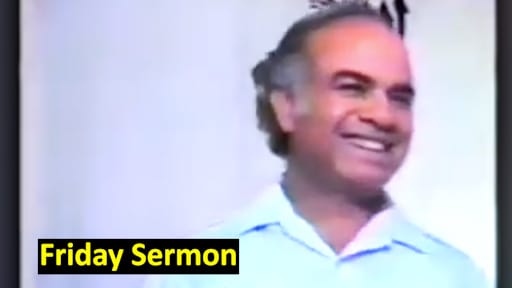
Friday Sermon by: Rashad Khalifa, Imam of Masjid Tucson
Summary:
In this Friday sermon, Rashad Khalifa compares what people do for the body, which lasts about 100 years, with what they do for the soul, the real person, which lives forever. He urges believers to put their priorities in perspective by worshiping God alone, observing the Contact Prayers and the Friday prayer, and remembering God throughout the day, and he explains why not a single letter of the prayers, such as Al-Fatiha, may be added or removed.
Video Transcript:
Praise God. We bear witness that there is no god except the one God. There are no other gods or idols besides Him.
In the last khutba we reached the conclusion that you do not really believe in God unless you know that He is doing everything. You make the initial decision. This is our role. We make a decision, a decision to be with God or not. And “not” means you are with Satan, because there’s no other choice. You’re either with God or with Satan. And this is the decision where we have absolute freedom of choice. After that, you’re either guided by God or messed up by Satan. But the ultimate doer of everything is God, and everything is happening in accordance with God’s will.
Today I want to compare our priorities. I want to use the board here to illustrate something about priorities.
Most people do not know who they are. We recognize now the human being as consisting of two entities. Just to make it very simple: the body and the soul. The body goes on for, let’s be optimistic, about 100 years, and then it dies and becomes nothing. The soul is the real person, the real you. This is the real person right here, and it goes on for eternity.
The body has requirements and the soul has requirements. What I want to compare here is what we do for this entity and what we do for this entity.
For the body, people start with the infant. The infant is given milk and nourished, given shots, painful shots, and growing pains and teething. And then the body goes to school. You have to go to school, right? There’s a commercial on the radio and TV now with that comic cat, Garfield. He says if you want to be a fat cat, go to school, go to college. So you go to school and you take tests and go through the homework and the absence reports and the chastising from the parents and the teachers, and working very hard studying. You know, school is not popular with most kids. You go through grade school, junior high school, then you go to high school, with all the hard work involved in it, and you’re so glad to graduate, only to go into college. Then you’re a freshman, and you study very hard and work, and you’re very busy, devoting a lot of effort and time and money to school. Why? Because of this body. You want to dress nicely, have good clothes, and you want to buy a house, preferably in the foothills, with so many rooms and luxuries and carpets and drapes. This body wants that, and you work hard for that.
You graduate from college and you apply for jobs. You go to the placement office and you stand in line for the people who interview you, and you are very polite. You want to be bright, or pretend to be bright, and you put on your best appearance, some sense of humor, intelligence, abilities. You pretend to be perfect for the interview, and you get the job. And then you do a lousy job and you’re fired. Then you’re applying for other jobs and you’re miserable. All this is for the body, because the body wants clothes, housing, food, and we do all this work for the body.
Now, what does the average person do for the soul? This is the real person. After all this, the body dies, goes to dust, becomes nothing.
There was a person this body belonged to called Rock Hudson. Do you remember that name? He died recently; this is why you still remember him. Rock Hudson was a very successful person: lots of money, fame, front covers of magazines, TV, movies, wealth, a Beverly Hills mansion. His body had a lot of fun, and he also broke God’s law, as we know, and he died in humiliation. Now, the real person, Rock Hudson, does exist. What did he do for this body, and what did he do for this? What did the fame and money bring him? What is the value of the fame and the money that he accumulated?
Remember Liberace, the glitter, the suits that he was wearing, and the showmanship, and the people clapping for him, the performances he gave and how many millions of dollars he made? But how much does he, the real person, have? At the end, the mortician was afraid to touch him because of the AIDS virus. Or Rockefeller, or any of them. People work very hard for this entity here, the body. What do they do for the soul? This is the question. What I’m trying to bring out is rearranging our priorities, putting our priorities in perspective.
What are we doing for the soul? What does the soul need? The soul needs worshiping God alone. This is the first step, because the soul is part of God, any way you want to look at it, because God said, “I blew into Adam from My spirit.” So the soul needs to worship God alone, and then it needs food, nutrition. The five daily meals, the five prayers, are needed. You need fasting.
People like Rock Hudson, for example, put themselves in the service of this body. He was serving this body. Whatever the body wanted, he gave it. But he neglected himself. If the soul was this size when he started, it is still this size now. It didn’t grow. He didn’t feed his soul. His priorities were mixed up. I’m using a real person as an example because here’s a person who attained fame and fortune.
The conclusion from this is that anything we do that is not developing our soul is a waste of time. If you do anything that has nothing to do with God, it is a waste of time. So from when you wake up in the morning until the end of the day, you ask yourself: am I doing this for God, which is, in other words, for feeding my soul? Because anything you do for God causes your soul to grow and develop. It is actually for yourself, for the real entity. So we have to rearrange our priorities, put them in perspective. How much of the day are you doing for the body, and how much are you doing for you? You went to school and suffered through examinations to have a good job. What did you do for you?
By the way, 100 years compared to infinity is zero. So this is the proportion of what you should do for yourself and for your body. You should do zero for your body, and you should do 100% for you. It is not intelligent otherwise, because this is zero. It’s going to be nothing. So you have to put the body in the service of you, and not the other way around. Almost everybody out there has the priorities reversed. They put themselves in the service of a vanishing garment.
Alhamdulillah.
From this diagram, I want to move on to comparing the believer, a Muslim, one who has submitted to God, and a regular person.
I was looking out the window the other day. I had prayed my morning prayer, and about an hour later I saw one of my neighbors coming out, and he was obviously very sleepy. His hair was all messed up. You can imagine, he just got up, he’s walking like this, he can hardly walk. He’s young; he’s not old. His clothes are a mess, and he was out to get the newspaper.
Now, a Muslim wakes up in the morning. Remember, we pledged this; I hope you didn’t forget. We do forget once in a while. But the first thing you say when you get up in the morning is “In the name of God,” because this is what you will say when you get up on the Day of Resurrection: whatever you say every morning. And I have to repeat what most people say when they get up in the morning, look at the clock, and see the time. This is exactly what they will say on the Day of Judgment: “Oh, sh—!” Because usually they turn the alarm off and go back to sleep, and when they get up the next time, it’s too late, and they utter the four-letter words.
So the Muslim gets up in the morning saying “In the name of God.” If this is a habit here, it’s going to be a habit also on the Day of Judgment. God will see to it. God will help you. And when you get up on the Day of Resurrection saying there is only one God, there’s no place to go but heaven. So this is what the Muslim does. Now, what did my neighbor do when he got up in the morning looking for the paper? God is not on his mind, just like the average person. I hope God was on his mind, but it didn’t look like it.
And then the Muslim goes to do his or her ablution. You do ablution in the morning and you pray the morning prayer. This is the first thing you do. And this act of ablution and the morning prayer is very refreshing. You’re alert. You look nice. You wash your face. You comb your hair. You will not look like this guy. He really looked terrible. You only see that in the movies, somebody who just got out of bed.
The Muslim commemorates God at every chance he or she gets. The Muslim sees the sunrise and says, “Subhan Allah.” All these are nutrition for the soul, for you, the real person, and your soul grows. You say, “Subhan Allah, glory be to God,” as you see the sun rising, because you’re always conscious of God. The sun is rising exactly at the precise second and from the same spot that it is supposed to, without delay. And God committed that sun to your service, and you say, “Subhan Allah.” You look at a flower and you do the same thing.
Then you make a telephone call to one of your friends or associates, and you say, “Tomorrow I’m going to do this and that, inshallah, God willing.” There’s a certain behavior of the person who has submitted to God, because you know that God is doing everything, and you know that you will do this and that tomorrow only because God wills it. And the Quran gives you this very clear commandment. And then your kids get up, and you admire them and you say, “Mashallah.” This is God’s gift to you. This is God’s will that you have these children, and you thank God.
Now, the non-Muslim is unaware. God is not in his or her mind at all, and they are neglecting the real person, neglecting themselves. They’ll be very careful to have breakfast, but they will not give breakfast to their soul.
So you are living 24 hours a day commemorating your Creator. And your Creator doesn’t need that. God doesn’t need any of our praise or our worship. We do. You are being prepared for the eternal life which is coming. You don’t see anybody around who’s 200 years old, do you? You haven’t heard of anyone. It’s coming, the Day of Resurrection. And then you’ll be assigned that eternal rank depending on where you qualify, how much growth you did.
So far I have talked about rearranging the priorities, or putting the priorities in perspective: how much time you devote to your soul, the real person, and how much time you give to your job and your boss and your family and so on. Strictly, you can give time to your family in the cause of God. Our priorities must be in perspective.
This is why you are here for the Friday prayer. You dropped all business and you are here for the Friday prayer. This is the correct priority. Any time you are not here on Friday, you’re out of God’s grace. It’s a commandment for every Friday: you drop all business and you go to the Friday prayer. And God associates this with business and profit. God says it is better for you to drop business, because God runs the world. God is doing everything. And when you drop your business and go to the Friday prayer as God commands you to, God will see to it that you make more money, more profit. You don’t care, but it will come.
I’m going to read a couple of verses from the Quran that deal with this subject of priorities, in Sura 18, starting at verse 45. I seek refuge in God from Satan. In the name of God. It says, “Cite for them the example of this world: like sending water from the sky that causes plants to grow on the earth, and then it turns into hay, blown away by the wind.” This is the example of this world, in verse 45 of Sura 18.
The plant grows. It is strong. You see all those flowers out there? They’re very nice. Watch them. They’re going to turn into something dry like hay, and they blow away. In fact, the time will come and you will say, “I want to remove this stuff from here.” It’s going to be dry and shriveled, and this is how this world is.
The next verse says that money and children are the beauty of this life, the adornments of this life. These are the good things of this life: money and children. And I’ve heard many people say, “God says that money and children are the adornments of this life. I have lots of children. Where is the money?” But generally, money and children are the beauties, the adornment, of this life.
And then the rest of the verse says, “However, the eternal righteous works,” the righteous works that last forever, and we’re talking about the real person here, “are far better.” So money and children and properties in this world are the good things in this life, and God tells us what is better than that. Like I mentioned in the last khutba, worshiping God alone and nourishing your real person, the Quran says, is much better than owning everything on this earth and twice as much. All the real estate in Vancouver and New York, all the real estate in the whole world, all the oil, the gold, the diamonds: believing in God alone and nourishing your real person, when you have the right perspective, is much better than owning everything on earth and twice as much.
So verse 46 of Sura 18 says money and children are the beauties, the good things of this world, but the righteous works that last forever are far better, and the end of the verse says they provide better hope. There is better hope in them. There is no hope in the properties. Rock Hudson was very famous and very rich. You can still go as a tourist and look at Liberace’s mansion, but he’s not there. Because there’s something better that he could have acquired: righteous works, and developing his soul in order to withstand life next to God in the Hereafter. If he didn’t develop his soul, he will not stand being close to God.
And verse 47 says that the day will come when We remove the mountains and you see the earth barren. Everything will go. And then We will gather every single one. The Arabic says We will not leave a single person. God says We’re going to gather everybody for this reckoning. How much did you do for this vanishing garment? How much did you do for yourself? The reckoning is going to be automatic, but every single one will come to account.
The next verses go on and describe why the righteous works and feeding your soul are the number one priority, and when you do anything else, it’s a waste of time. Anything that does not develop your soul is a waste of time. And missing a Friday prayer, missing this, because you’re all here: when you miss a Friday prayer for any reason, it’s a terrible, terrible loss. Once a week there’s a congregational prayer where you meet your brothers and sisters, and it’s a commandment from God to do this. When you miss it, you miss a lot. I cannot put it in billions of dollars. We always have to remember the right perspective, and the advice in the Quran is to commemorate God 24 hours a day. Every chance you get, you can turn your work into worship.
It’s 1:00, so I’m going to read some material, as a kind of quiz. I want you to think about where it is from.
[He reads a passage stating that adding or omitting even a single word or letter from the sacred text of the prayers destroys their religious meaning and is a grave sin.]
Remember, there are certain statements in the Quran that say, “Woe to those who are doing their prayer.” These are people who are doing their prayer, but they end up in the negative because they are heedless of their prayers, or for other reasons. So you must make sure that your prayer is perfect, your Salat, your Contact Prayer. I’m not talking about supplications; I’m talking about your Contact Prayers.
Barry is visiting us for the first time, and he will wonder why we do the prayer in Arabic, and why this particular prayer, for example. All of us ask this question; in fact, it’s going to come up. We in this mosque fully appreciate the mathematical composition of everything that’s connected with our worship: the Quran, and even the bones in our body, and everything else. So we should appreciate what is written here.
Al-Fatiha is the sacred text that God gave us, the first sura of the Quran. We cannot add anything to it. As you know, Satan succeeded everywhere in the Muslim world: they add the word “Amin.” Our people in Washington, DC have a radio program, and I have one of the tapes here talking about this “Amin.” They got it from a recognized dictionary, and they read what “Amin” is. It turned out to be an old Hebrew or Greek word that has nothing to do with Arabic. It is not in the Quran. This is how Satan tricked the people into adding it. So here’s a person doing the prayer, committing a grave sin.
[He reads further passages describing a medieval mystical teaching that the words, letters, order and numbers of the prayers reflect a sacred, divine harmony, so that no change can be tolerated, even one that seems to improve the meaning.]
We are not saying the Contact Prayer for its literal meaning. “Guide us in the right path” is wonderful, but there is much more to it. Every letter that God composed in the first sura of the Quran, Al-Fatiha, is numerically controlled. The sounds when you say “Alhamdu lillah” are composed by God for a specific reason, a combination that causes your contact with your Creator. You may think of composing a Shakespearean, excellent literary marvel that praises God. It doesn’t mean a thing. Forget it. It is not the meaning we’re after. It’s the numerical composition and the sounds.
[The quiz is revealed: the passages come from a book about Rabbi Judah, who fiercely criticized changes made to the prayers, fearing they would be regarded as purely human and lose their mystical connection between man and God.]
A lot of people accuse me of being harsh with some people who are making changes in the prayers, or in the Quran, or in the practices of religion. But there is a precedent. It is fear for these people, and it is concern for them. It’s not just the words; there’s a numerical composition in it. The Contact Prayer, Salat, is a connection between us and God. And we direct our prayers to God alone.
Alhamdulillah.