
Sermon Introduction
Praise be to God, there is no other god except God.
As you guys saw this sort of Adhan or Friday sermon intro, let me just tell the story about it. It’s mainly compiled of footage which we did from Hajj as some of you might have noticed. Some of us took some footage from Hajj. And I think it came out nicely, and the background music is taken from one of the movies which Rashad used as well.
I want to focus on today is because the words which are there are :
Allahu Akbar
Allahu Akbar
Allahu Akbar
Allahu Akbar
La Ilaha Illa Allah
So I want to focus on what is known as Adhan, which from now on I’m going to call it in English :The call to the Friday Gathering. And the reason for this is because I have what turns out to be good news. Because what you just heard here online was actually not the Adhan, it was just an intro video which I used to buy some time for the people who have technical difficulties to watch us live.
And the actual Adhan, or let’s call it in English : The Call to the Friday Gathering was actually done when you received the email from me. As you, the submitters, know that you received an email which said :
God is Great !
God is Great !
God is Great !
God is Great !
There is no other god except God.
That was the actual Call to the Friday Gathering.
What I showed here is just an intro to buy us some time. And God willing, during every Friday gathering I will have a slightly different one. And hopefully, this will motivate the people to join in time so that they can see the different intro. It’s going to be the same footage, or similar footage, but it’s going to have a different music every time. Same words, but kind of different music just to make it more festive. I did it with AI, so it wasn’t that much work. It’s not really my work, it’s AI work.
Understanding the Call to Prayer in the Quran
I want to focus now on the actual topic of this Friday Sermon. The actual topic is :
- What is actually the call to the Friday prayer?
- How do we do the Call to the Friday Gathering online?
The intro that you saw was not The Call to the Friday Gathering. It was the one which you received in the email.
How can we reach that conclusion? This is the key verse for it :
[62:9] “…Oh you who believe. When the call is made for the prayer on the day of Friday, then hasten to the remembrance (or the mentioning of God) and leave (the) business. That is better for you if you know.”
Now the key word in this verse which I want to focus on is the word “call”. Here in the Arabic Quran, it’s not actually using the word Adhan. And when you look in the whole Quran, you do not see the word Adhan at all mentioned for calls to prayer. It is not mentioned at all. Here the word «nudiya» is mentioned. So this word, which means call, is mentioned in another verse where it’s talking about how the disbelievers laugh at the call to prayer, but even there the word Adhan is not used. It’s the word «nudiya» which is used. You do not see the word Adhan used for the call to prayer at all in the Quran. What we see is this word being mentioned, which is «nudiya».
- Then why did God leave it for thousands of years for people to call it Adhan in Arabic ? (which is translated as the call or the announcement to prayer)
- Why did God leave the people use a word which is not even in the Quran for their call to prayer ?
That is because the word nudiya : “call”, is bigger than the word Adhan, it includes the word Adhan. I am not saying that the way people have done it traditionally is wrong (the way Rashad taught us : « Allahu Akbar,… ») .I am not saying that is wrong. All I am saying is that there is more to it, meaning the word nudiya does not include just that version, it includes other versions as well.
And what do I mean by this ? Let me give an example :
Let’s say that the Quran tells us to wear upper body clothes (it kind of says it anyway). And then imagine in the time of Muhammad that he is telling them : “Wear a shirt.” A shirt is upper body clothes for a warm weather. But in today’s world, someone in a colder weather might say : “Wear a jacket.” Or “Wear a sweater.” That’s also upper body clothes. So as you can see, the word “upper body clothes” includes both the shirt and the jacket. In the same way, the word nudiya here includes both the Adhan and what I’m going to call it in English : The Call to the Friday gathering.
And here, probably it’s important to specify something more : The Adhan, as we know, is the call to the « Salat », to the contact prayer. They’ve translated it here as prayer in this context, but actually, as we know, this word actually means connection. And it’s on purpose like that. It means connection with God. So there is another context as well.
Let me be clear, I’m not denying what we know so far. All I’m saying is that there is more knowledge which is included in the Quran compared to what we have known before. So I want to draw the attention to the fact that the word “prayer”, which here it has been translated as prayer, in Arabic it literally to connect. And here in this verse, we can understand the word “connect” in two ways: One way is to connect with God. But it’s also talking on the day of Friday, and jumaa’ in Arabic means gathering, when people gather ; So to connect on the day when people gather.
What does it mean?
The word « nudiya » also means to connect with people.
So, in this verse, the word connection is about connecting with God, but also about connecting with people. In our case, because we are doing it online, we have connected with each other. Basically, I am live streaming, and God willing we will add the chat function in the future. So basically, The verse is telling us to connect. It is not specifying what kind of connection. We definitely know that it’s connection with God when we do the contact prayer, but here it is talking about connecting on the day when people gather, so it must be also some sort of other connection, to connect with other people, to connect with God together with other people.
A Human-Made Decision Across History
So, given this additional meaning of the word « salat » in the Quran, then when we talk about the call to connection, it specifically means two things : First meaning is the Adhan which we know traditionally, and the other meaning is The Call to the Friday Gathering, which specifically has to do with the connection online. I think I have explained it partly (Can We Do Friday Sermons Online ?), and God willing I will explain again in future videos that Friday gatherings or Friday sermons are okay to be done online in specific circumstances, which are our circumstances.
It is on purpose that the word Adhan is not mentioned. Because if God used the word Adhan, we would have to assume that it is the traditional Adhan in the way it was done, which was in Arabic : « Allahu Akbar,… » and they do it in the mosques to this day. And by the way, if we have a local mosque, we should do it like that as well in Arabic. But we here we are talking about online, and the question is:
- Why did I take the liberty to do it English online?
- Who gave me the right to do it in English when we are doing it online?
No one had to give me the liberty.
The reason is that the Adhan which Muhammad did, which also Rashad did, if we analyze it carefully, it’s actually a human decision. So it’s not that God said : “This should be the Adhan.” God told us about about Nudya, which is the call to prayer, which one version of it is the Adhan, but that version is a human-made decision. Let me go back again to to the same example : If God told us to wear upper body clothes, it is a human decision whether they wear a t-shirt and what type of t-shirt, or whether they will wear a jacket and how thick that jacket will have to be. It is a human decision.
And how do we know that it’s a human decision?
First of all, studying the Quran : If God wanted specifically to tell us that these words are the words of the Adhan, God would tell us, but he did not. And he did not because God knew that people will reach the correct decision about this, a specific decision for every time. During Muhammad’s time, they reached a specific decision and it was correct; it was correct for them in that specific place and time, in those specific circumstances, they reached the human decision. And by the way, if any Sunnis or Shia might think that I am changing something, I just want to remind them that even according to their hadith, this is how Adhan came to be. Their hadith proves that it was a human decision.
Before I tell the story of that Hadith, let me just say that the word nudya, which is the fifth word in 62:9, it actually includes even the human decisions which existed in the past. But of course, here it is talking about the Friday prayer. they did not do the gathering on Friday, they did it on Saturday before Muhammad. It includes even those because it is a human decision.
In the past, during the time of David, it was a human decision, they decided that they are going to use the horn to call the people to the congregational gathering. Then it was Saturday. And then the Christians, after Jesus, use the bell. What I am saying is that even those are legitimate as long as people agree that that is the correct thing to do, as long as they agree and it is a correct decision. It was correct for the time and place. And Muhammad never actually sort of said that they are wrong, he never said : “Oh, if you call the people with a horn or if you call the people with a with a bell like they do it in the churches that is wrong” He never said that it is wrong.
What Muhammad said, according to the Sunni hadith and the Shia hadith, is that he wanted to have it different, not that it was wrong. He just wanted a different version so that people can distinguish whether they are being called to a church, to a synagogue, or to a mosque, which shows that he was aware that it’s a human decision. He just wanted to have it different so that people know where they are being called now. So what I’m saying is this : The word nudya includes even the horns and the bells which the church has used (for the past of course) and the Adhan, the traditional Arabic Adhan for circumstances outside of online, but it also includes this word also includes what I have sent in the email earlier. It also includes that because God left it up to us to make a human decision. It does not have to be revealed by God whether we want to wear a t-shirt or whether we want to wear a jacket, God told us : “Wear upper body clothes” . Let’s say that is just an example.
So let me go back now to the hadith which the Sunnis and Shia use. By the way, we do not believe in hadith, we do not rely on them as a source of religion, we know that. However, the Sunnis might say : “Oh, you guys changed it online.” If they say we changed it, we tell them that their hadith, the Sunni hadith and the Shia hadith according to them, tells us about how the Adhan came to be like this. So Muhammad one day wanted to come up with a way to call people to prayer, but he did not want to mix it up with the bells which the churches use or the horns which the Jews use, so he wanted to have a different version, which shows that he was aware that it is a human decision and while he was discussing it with the believers, according to their hadith, a person from the group came, and he said : “I saw in a dream that someone was just saying aloud… [the Adhan]… ”, and Muhammad said : “Oh, that’s a good idea, we should do that.” So basically, Adhan was not revealed by God to Muhammad. Adhan is a human decision which Muhammad made for that time in their circumstances. And the idea came in a dream to another person, it was not even Muhammad. And God did it like this so that we can have the liberty to do it in our way, not thinking that we are going against Muhammad, because it was not never revealed to Muhammad, it was never Muhammad’s idea, it was someone else’s idea. Anyone can go and search online how the Adhan came to be, and you can see that someone else proposed it by saying that : “Oh, I saw it in a dream,” and then Muhammad Muhammad liked it and he said : “Oh, let’s do it like that.”
Preserving Unity and Language Online
So they made a human decision how the nudiya, the call to prayer which is mentioned in the Quran, how the nudiya will be executed in Muhammad’s circumstances in the Arabic world in the seventh century. And that is what they called Adhan. We don’t need to call it Adhan. That is the Adhan, the Arabic one which was done in that specific form. But here in the Quran, there is more than that.
So then when Rashad came, he made again a human decision that we should still do the Adhan the same way in circumstances within mosques even in places where people don’t speak Arabic : (US, Canada, Europe,…) . Rashad thought that it’s a good idea if we still do it in Arabic so that we can keep the unity. If we today have a mosque, I would still do it in Arabic. And the purpose and the reason is not because that’s how God revealed it, but because I don’t want to break the unity, that’s how people have done it.
First of all, there’s a verse in the Quran which says that the believers are united. So if you change it, you are kind of causing disunity. And second of all, there’s a verse in the Quran which says : “Do not betray those who trust you,” we should not betray those who trust us. Rashad trusted that we will do it in Arabic in a mosque, but he never did it online. So what I’m saying is I do not want to go against the verses which tell us to not break the unity, to be united, and to not betray each other. I do not want to go against that verse. That’s why I still believe that’s how it should be done in mosques. It is not God’s decision, it is a human-made decision, but we respect it. I respect there is nothing wrong with the way Adhan was done during the time of Muhammad, the way Muhammad approved it. There’s nothing wrong with it for that circumstance. There is nothing wrong to do it still in Arabic in a mosque outside of the Arabic world.
But because we are in a circumstance which has never happened before, I would not cause disunity if we decide to do it the way we do it. I know it’s a human decision, just like during Muhammad’s time it was a human decision, just like during Rashad’s time it was a human decision. In our time, because it has never been done online. People publish it online, but they don’t believe in the online Friday Gathering, so it has never been done online.
That means that we get to decide, we have the privilege, we are the lucky ones. God gave us the opportunity to decide how the Adhan should be for the online circumstances. And for the online circumstances, I am deciding. It’s a human decision, but it’s binding, because why would you break the unity? By the way, I am not breaking the unity with the traditional Adhan because this is a totally different circumstance. I still want to do it the way they have done it in mosques. Let them do it in Saudi Arabia. But online they have never done it. So that means that God gives us the privilege or the chance or the opportunity to decide how the Adhan should be so as long as it is within this nudiya idea, the call to prayer, in a similar way that God gave us the opportunity to decide what type of clothes we want to wear as long as they are within the Quran.
The reason why I want to do it in English is because there is a verse in the Quran saying that all the messengers are sent in the language of the people, and the language online is English. So from now on, the Arabs are going to have to get used to the online idea of doing it in English, just like the rest of the world was used to the traditional idea of doing it in Arabic. So from now, we are going to do the call to connect for the Friday gathering in English. I am not talking about in mosques, I am talking about online.
The Online Call to Friday Gathering
Why did I decide on those specific words?
Because those specific words are here where it says : “When the call is made for prayer, hasten to the mentioning of God”. So basically, I wanted a call to prayer where God is mentioned, and when we say : “God is Great ! God is Great ! God is Great ! God is Great !” God is mentioned, so we Are fulfilling that commandment. And then we’re specifying which God: “There’s no other god except God.” So basically, that’s going to be the call to prayer in English now online. Now because online, people don’t hear it unless they go online already. They probably read it first, so it is going to be a written version.
God gives us the liberty to decide about this on our own. I am deciding for us because I happen to be the leader for our group. So as a human being, I am deciding that for our circumstances, the Adhan online, only online, is:
God is Great !
God is Great !
God is Great !
God is Great !
There is no other god except God.
Live Friday Gathering within minutes at :
Let’s not call it Adhan anymore, because Adhan is that specific Arabic version. Here I’m talking about the English version, which is still within what the Quran says, it’s still that word, the call, nudiya. And it’s easy also to remember, we know the words, so it’s: « God is great, God is Great ! God is Great ! God is Great ! There is no other god except God ». And then every person can add in their own way where the person can connect. Here I said : “Live Friday gathering within minutes at TheSubmitters.org.” In the future, these specific words might be different.
Why did I say “within minutes” ?
- We are fulfilling the verse in the Quran which says the minimum unit of time is the hour. So the Quran doesn’t mention minutes or seconds, that means that as long as we do it within that hour when the time for the gathering is, as long as we do it within that hour, it’s specific enough.
- You can send this Adhan 10 to 40 minutes ahead of time, and it is still within that unit of time which the Quran mentions. So basically, it’s specific enough. Some people might have to wait a little bit, but as long as it is within that hour, then it’s specific enough, and that’s why I said : “within minutes,” because minutes are within an hour, so it has to be within an hour.
It is a human decision, but that is what I am deciding. The call to the prayer for our circumstances online should be : « God is Great ! God is Great ! God is Great ! God is Great ! there is no other god except God ». And everyone can decide how they put the link there, you can decide on your own.
Let’s repent first.
Utilizing Social Media for Promotion
Praise be to God, there is no other god except God.
So we just included what the call to the Friday gathering should be for live online circumstances, which is our circumstance. We also came up with a photo version which can be posted on social media.
Let me share the photo version :
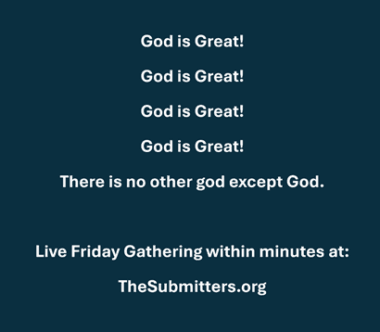
It is with a darker background. The reason is so that it can stand out a little bit more when you post it on social media. Again, it says : “God is great ! God is great ! God is great ! God is great ! there’s no other god except God.” And my words are : “Live Friday gathering within minutes at the submitters.org.”
Why is this still within the Quran and kind of like is confirmed that it is within the Quran?
I am not saying that this is what the Quran tells us to do. What I am saying is that the Quran gives us the freedom to do things like this, and all of this is within the Quran. There’s a verse in the Quran which says : « Force yourself to be with those who call God ». And here, we are calling God. This is the best way to call people to us. We do not go there and say : “Oh, can you please join for the Friday sermon? Can you please guys join in this group ?” That is almost like begging. You know what they do, half-submitters and traditional religious people, they will go online and they will call people : “Oh, can you please join us?” That is actually a sign that you should not join them, because God tells us : “Join those who call on God,” not who call you. So here, we are calling God. We are not necessarily calling people, we are calling God. We are saying : “God is great ! God is great ! God is great ! God is great ! there is no other god except God.” And then there is a verse in the Quran which says to the believers : “Go after those who call God.” So this call to the Friday Gathering is within that verse, it confirms that verse.
And then the other reason why we should do it like this is because there’s another verse in the Quran which says : « If you support God, God will support you ». So basically, we should not go there and call people : “Oh, come here, let’s do this, let’s do that.” The verse says you support God. We support God, God supports us. So this is the best way to promote the message, to have more people join us in the cause of God. The best way is to support God, and then God will support us, God will let other people join us. This is the best way.
This solves one of the most long-standing problems which we’ve had as a community. We have talked about this a lot, especially with people who had marketing backgrounds about what is the best way to promote the message. And finally, I think we have found most of the answer. As you guys know, we have tried many methods, I compiled an email, we tried Facebook ads, we have tried many different things. And finally, I think this is the answer. This is the answer to how we should promote the message, and it is simple. It has been all along in the Quran. All we have to do is saying in front of others : “God is Great ! God is Great ! God is Great ! God is Great ! There is no other god except God.”
And because it’s online, we tell them where the link is. In this case, I’m saying : “Live Gathering within minutes at TheSubmitters.org.” By the way, the reason why they did not add this part in the past (they actually added it in certain circumstances) but the reason why they did not add it because they would call it from the mosque, everyone would know where the sound is coming from, so they would go there. Here they would not know where the message is coming from, they have to know where the message is coming from, where they can join, so we had to add that.
And again, this is a human decision just like in the past it was a human decision. There is historical sources which say that Muhammad, when it was raining, he would say : « Allahu Akbar, … » and then he would say : “Pray in your homes.” He would add that because the circumstances were different in that day. Let’s say it was raining too much, he didn’t want people to get all muddy, so he told them : “Pray in your homes” at the end. And in the same way, we are adding this because it is a necessary information where to join us. Today we are doing it in this website, which I do not think we will ever change it God willing. But if we ever change it, that link is going to be something else, some other information. But the actual Call to the Friday Gathering is : « God is Great ! God is Great ! God is Great ! God is Great ! there’s no other god except God ». This solves one of our biggest problems because we could not figure out how to promote the message to other people. We just could not come up with the best way to promote the message, to call the people to God’s cause, and finally I think this answers most of it. It solves one of the biggest problems we’ve had as a community.
The Role of the Community
- What is your role in this?
- Who is supposed to do the Call to the Friday Gathering ?
The answer to this is similar to the Funeral Prayer. Both the funeral prayer and the call to the Friday gathering, are mentioned in the Quran but not as an individual obligation. They are mentioned that they exist. For example the Quran says : “Do not do the funeral prayer for the disbelievers, for those who were believers once and now they are disbelievers, do not do the funeral prayer for them.” That is what the Quran says.
It is not giving a rule that every individual should do the funeral prayer, but it is mentioning it. The fact that the Quran is mentioning it assumes that at least someone is doing it. So basically, the rules of the funeral prayer are that at least someone in the community should do it. It could be one person, but more people is better. As long as one person does it, the obligation is fulfilled, but if more people do it, it is better. In the same way with the Call to the Friday Gathering : If one person does it, the obligation is fulfilled, but more is better. If other people do it as well, it is better.
And in the traditional circumstances, that is why many mosques have many minarets. If you go to so many mosques in the Middle East, you will see that some mosques, the big ones, have more than one minaret. Some of them have six minarets. Minarets are the places where they make the call to prayer. So why six minarets? The reason is that they understood that more than one person can do the call to prayer. When someone does the call to prayer, some other people don’t hear him, then another person does the call to prayer. This is even according to historical sources : Muhammad would tell someone to do the call to prayer, and if others did not hear it, someone else who heard that first person then would call the others. So it’s a way to call the people to the Friday Gathering.
Now in this case, I wrote it once and the computer sent it automatically, but God willing, it is going to be sent automatically by the computer. Once you received that call, let’s say you are on Facebook at that time or some other social media : Did the people to whom you are talking or socializing with hear the call? No, you heard it, they did not hear it. So in that case, the best thing you can actually do is to make that same call to other people, on Facebook, or Instagram, or other social media, or even direct messages.
Especially the ones where you can delete it later, because this is a call for a specific time. We are calling God, but indirectly the people are supposed to join at a specific time, which in our case is 12:00 UTC. It does not have to always be like this, but in our case, it is at 12:00 UTC. So it is for a specific time that we are calling them, let’s say 20-30 minutes ahead of time, so that they can see the message or the post. This is actually most suitable for social media, not emails, because emails you cannot delete them later. If you call them at a specific time and they see it later, what are they going to do? It is not very useful.
But it is very useful if you post it on social media, God willing. This is the best way you can help. You do not have to try with old methods we have done, or that others have done, or traditional Muslims and Christians do. God willing, you will see this will work the best. That is all we have to do. You decide based on how fast people see the messages on social media : You decide whether it’s going to be 10 -40 minutes ahead of time, or 5 minutes if it is a direct message, etc.
- You take those words.
- You copy-paste them from the email.
- You post them where you want to post them.
Just post that, and you don’t have to engage. If they say : “What is this?” you do not have to engage, because now we are doing the Friday sermon. You do not have to engage with them. When the Friday sermon is finished, you go and delete it, because it is not applicable anymore. Next Friday, you can do the same thing, call them again. In this way, they do not get bored as much, in the sense that the post is not going to stay there all the time. So this is how you can help.
So God willing, from now on, the way I am going to do the call to the Friday Gathering online is through an email with those words. That is the call to prayer, that is the call which is mentioned in the Quran. But because most people who are communicating with you do not hear it, it would be best if you share it. It’s not an obligation, because as long as one does it, it’s done, but it would be better just like in the funeral prayer. It is better if more people do it within practical reason. I would say it is actually an obligation within practical reason, meaning : Do it if it makes sense. In most cases, it makes sense.
Let’s say you know the Friday prayer is going to be 20-30 minutes later, if you have some time and you’re out of work and you receive the email, you copy-paste the message and post it on social media. You can post it as a photo or as text depending on the social media. In this way even the non-submitters can join and check what the message is.
The additional reason why this method is good is because you can also post it in groups of other religious groups. You can post this message at a specific time. The reason why this method is so good is because the administrators or leaders of those groups do not have time to delete it so quickly. So within minutes, some people might join and listen. And then after that, you delete it. The leader might not even see it. It’s fine; if two or three people see it, you’ve done a good job. It is okay as long as you do it.
Now, not everyone uses social media, and that’s okay. What I’m saying is within reason. Whatever social media you use, if you use it, why not use it to call God, which indirectly calls people to the cause of God?
I hope I did not forget something about this. It is quite an important Friday Sermon because I think it is going to resolve a lot of issues.
For those who have to do the contact prayer, you can do the contact prayer at this time if it is the due time. For the rest of you, peace be upon you, peace.
Friday Sermon by: Alban Fejza, Online Congregation Director