
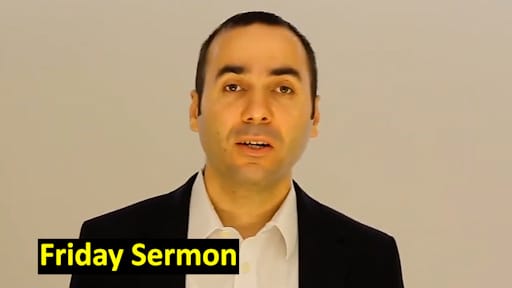
Friday Sermon by: Alban Fejza, Online Congregation Director, with a text by: Fannol Gashi
Summary:
In this Friday sermon, Alban Fejza reads a sermon by Fannol Gashi explaining why the Quran is structured with its stories spread throughout the book, how this helps us learn, and the conditions we must meet for God to let us understand it.
Video Transcript:
Praise be to God! There is no other god except God. Today let me read a Friday Sermon sent by Fannol Gashi who lives in Heilbronn, Germany. Here it goes: Have you ever wondered why is Quran structured like it is now? As you know, it is not like the other books where every story or subject is in one chapter then the next one deals with something else. Instead, in the Quran, every story is spread out in the whole book and it uses narratives to tell us information. One chapter may have the name “The Heifer” but the content has almost completely other stories and only few verses talk about the heifer (the cow). There is only one exception here and that is Chapter 12 called “Joseph” and Joseph’s story is mentioned only once in another verse, in verse 40:34, “Joseph had come to you before that with clear revelations, but you continued to doubt his message. Then, when he died you said, “GOD will not send any other messenger after him. (He was the last messenger)!” GOD thus sends astray those who are transgressors, doubtful.” It isn’t a coincidence that the story of Joseph is all in one chapter and God only mentions him once in another verse by pointing out that people will believe a messenger only after his death and will never believe that another messenger will come after him, and this verse uses the word Rasul (Messenger) and not Nabih (Prophet).
Also, the last verse in the same chapter says, that Joseph’s story is a lesson for those who possess intelligence. In verse 12:111, says, “In their history, there is a lesson for those who possess intelligence. This is not fabricated Hadith; this (Quran) confirms all previous scriptures, provides the details of everything, and is a beacon and mercy for those who believe.” Let’s continue with why the Quran is structured like it is now. God created everything including Humans and of course he knows what is the best way to learn something. First, we all enjoy a good story, whether it’s a novel, a movie or simply something one of our friends is explaining to us that they’ve experienced. But why do we feel so much more engaged when we hear a narrative about events? It’s quite simple. If we listen to a PowerPoint presentation with boring bullet points, certain parts in the brain get activated. Scientists call these Broca’s area and Wernicke’s area. Overall, it hits our language processing parts in the brain, where we decode words into meaning, and that’s it. When we are being told a story, though, things change dramatically, according to some researchers who published a study in the NeuroImage journal in 2006. Not only are the language processing parts in our brain activated, but any other area in our brain that we would use when experiencing the events of the story are too. The brain, it seems, does not make much of a distinction between reading about an experience and encountering it in real life; in each case, the same neurological regions are stimulated. Secondly, we all might remember from school that when we have an exam and want to learn about it, we used at least one technique called “Flash cards”, one of the classic study tools, and for a good reason – they promote studying through active recall, which is one of the practices through which our brains learn most effectively. The Quran is composed somehow in the same way, as you may have for example only one verse that talks about Moses in the middle of a completely different story, and that single verse activates your learning mechanism that pushes you to try and remember Moses’s story and try to understand why is that verse in there? As this topic repeats all over, it activates your learning mechanism all the time, and we get to learn and understand more and more from the Quran. That’s why God says that we must read the Quran from the beginning till the end: Verse 73:4 says, “… And read the Quran from cover to cover.” By reading it from cover to cover, every time we will learn something new that we didn’t know before. However, this works only with one very important condition, as it states in the verses 3 and 4 in chapter 2, that, we should believe in the unseen, observe the Contact Prayers, and from God’s provisions we should give to charity, believe in Quran and other books before, and regarding the Hereafter, we should be absolutely certain. Otherwise, God will seal our minds, our hearing and cover our eyes as it is stated in verse 7 of the same chapter. And the next verse reminds us that simply claiming that we believe in GOD and the Last Day is not enough. There are other verses that remind us that only believing in the existence of God is not enough. For example, verse 29:61 says, “If you ask them, “Who created the heavens and the earth, and put the sun and the moon in your service,” they will say, “GOD.” Why then did they deviate?” Verse 31:25 says, “If you ask them, “Who created the heavens and the earth,” they will say, “GOD.” Say, “Praise be to GOD.” Yet, most of them do not know.” And let me conclude the sermon with this verse: Verse 114 in Sura 20 says, “Most Exalted is GOD, the only true King. Do not rush into uttering the Quran before it is revealed to you, and say, “My Lord, increase my knowledge.”