
Introduction to Dhul Qarnayn
Praise be to God. There is no other god except God.
Today I want to talk about Dhul Qarnayn. As you guys know, Dhul Qarnayn is a person or a thing, but we know him as a person. A person mentioned in the Quran, so I want to just kind of elaborate on it a little bit more. But before I elaborate on it, let me sort of read the verses in the Quran so we can be reminded what I’m talking about. Let me share the screen.
Okay, so here I have put the verses in the Quran. In Surah 18, starting with verse 83, the Quran says:
[18:83] They ask you about Dhul Qarnayn; say, ‘I will narrate to you some of his history.’
[18:84] We gave him authority on earth and provided him with all kinds of means.
[18:85] Then he pursued one way.
[18:86] When he reached the west, he found the sun setting in a vast ocean.”…
By the way, this is how Rashad translated it, and technically in Arabic, it’s more literally “in a spring of dark mud.” It’s okay, both of them are correct.
[18:86] …And found people there. We said, ‘O Dhul Qarnayn, you can rule as you wish; either punish or be kind to them.’
[18:87] He said, ‘As for those who transgress, we will punish them, then they will return to their Lord; he will commit them to more retribution.
[18:88] As for those who believe and lead a righteous life, they receive a good reward; we will treat them kindly.’
[18:89] Then he pursued another way.
[18:90] When he reached the far east, he found the sun rising on people who had nothing to shelter them from it.
[18:91] Naturally, we were fully aware of everything he found out.
[18:92] He then pursued another way.
[18:93] When he reached the valley between the two palisades,…
Here, technically in the Quran, it can be translated as “the two barriers,” or “the two high lands,” or “the two mountains,” or even “the two continents’ highlands.” It’s like northern lands, two continents, so all of them are correct.
[18:93] …He found people whose language was barely understandable.
[18:94] They said, ‘Oh Dhul Qarnayn, Gog and Magog are corruptors of the earth; can we pay you to create a barrier between us and them?’
[18:95] He said, ‘My Lord has given me great bounties; if you cooperate with me, I will build a dam between you and them.
[18:96] Bring to me masses of iron.'” Once he filled the gap between the two palisades, he said, “Blow.” Once it was red hot, he said, “Help me pour tar on top of it.”
Here, “tar” in Arabic is actually also brass or copper. Brass, basically brass is, I think, copper and some other metal. Is it nickel or something? I don’t remember. You guys can search it online. AI these days is really good for these things; just search it on AI—what is brass? Brass is copper and something else, a tiny bit. So basically, copper is too soft. In the past, they would make brass by mixing a tiny bit of another metal to make it stronger.
[18:96] …He said, “Help me pour tar or brass or copper on top of it.
[18:97] Thus they could not climb it, nor could they bore holes in it.
[18:98] He said, ‘This is mercy from my Lord. When the prophecy of my Lord comes to pass, he will cause the dam to crumble. The prophecy of my Lord is truth.’
[18:99] At that time, we will let them invade with one another, then the horn will be blown, and we will summon them all together.
[18:100] We will present hell on that day to the disbelievers.
[18:101] They are the ones whose eyes were too veiled to see my message, nor could they hear.”
So these are the verses which pretty much talk about Dhul Qarnayn in the Quran. And I kind of brought this up because there’s so much speculation about who this person is, who is Dhul Qarnayn.
Outlandish Theories and Scholarly Debates
Especially recently, probably like a few months ago, I sometimes receive crazy ideas or outlandish—let me call them outlandish ideas. A guy from India contacted me—he’s not even a submitter. Instead of asking, “How do I join? How do I become a submitter?” instead of asking about the basics, he’s like, “My father knows who Dhul Qarnayn is, and it’s Jesus.” What? Okay, out of nowhere. Okay, we don’t see that in the Bible; we don’t see that in any scripture—it’s not like other sources matter, but it’s kind of too new. If it’s too new, then you really better prove it well, and he didn’t really have much, and I didn’t even pay attention to it, to be honest.
Let’s kind of go over some theories of what scholars, so-called scholars, say Dhul Qarnayn is. Recently there are so many crazy online people just saying stuff in chats and things like that; they think they found something, but typically scholars throughout centuries have sort of narrowed it to pretty much two people.
Some scholars said Dhul Qarnayn was Alexander the Great. But here in this verse it says, “We gave him authority on earth,” meaning someone, some important, strong person who was helped by the people and who had influence. So we’re not talking about any sort of non-important person.
The older scholars thought that it’s talking about Alexander. The newer scholars thought that it’s talking about Cyrus II, Cyrus the Great. One of them was king of Macedonia, the other one was king of Persia. Both of them lived before Jesus, about similar times. Cyrus the Great—I don’t know exactly when he lived. Let’s check Cyrus the Great, when did he live? I think around 480 or something. No, actually 480 was pretty much the peak of the Persian Empire, so it should have been earlier.
By the way, why do they come up with these ideas, Alexander or Cyrus? Because there are statues or coins where these two people are depicted with horns. Let’s search Cyrus the Great with horns. Okay, so this is a depiction of Cyrus the Great with horns. I hope you guys can see it. Let me get a bigger photo. It’s hard to make it larger. As you can see, there’s this—maybe you can see it better here—this is a drawing of this, if we can call it a 2D statue.
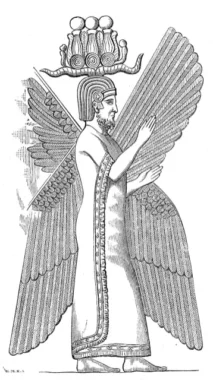
Don’t pay attention to this one, this is just like fake AI and stuff. So this is Cyrus the Great with two horns.
And then we have Alexander the Great with two horns—this is in a coin, I think. So we have here Alexander the Great being depicted with two horns.
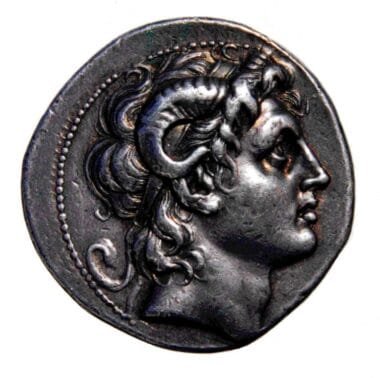
Based on these two artifacts, this archaeological evidence, scholars disputed, “Oh, he must be Alexander the Great,” or “He must be Cyrus the Great.” But which one is it, if any of them?
As I said before, archaeology is really very unreliable to reach religious conclusions. The reason for that is because if we rely on archaeology, we might as well go and search for other people who have two horns, like Amun, the Egyptian “god” with two horns. We have Amun with two horns; there are so many other Egyptian idols with two horns.
And then even recently—it’s a copycat, by the way—Alexander the Great was a copycat of Cyrus. And we have the national hero of Albanians, Skanderbeg, which is his Turkish name—his real name is George Kastrioti Skanderbeg. You can see he has two horns, like here for example. Why did he have these? Because the Turkish people—they didn’t really distinguish between Macedonians and Albanians very well—thought this guy was from Macedonia. “Skander” in Turkish means Alexander; it’s the Turkish version of Alexander. So basically, they kind of branded him as the new Alexander. As you can see, when we rely on history and archaeology, it’s really hard to reach the right conclusion, and we go through very wild theories.
The Biblical Context of the Quran
This is mostly because people forget, when they go through these wild theories, they forget that the Quran was revealed within a certain context. And part of that context is that the Quran was revealed while the Bible existed. Actually, I think there’s a verse—I don’t know if I’m saying it exactly word for word—but there’s a verse in the Quran which says to Muhammad, “We did not reveal anything to you which was not revealed before you,” meaning pretty much there’s not much new in the Quran which you cannot find in the Bible unless it has nothing to do with the Jews. If it has anything to do with the Jews and the ancient Israelis, it has to be in the Bible. You cannot just make it up: “Oh, Alexander the Great, because here’s a coin with two horns.” If we go with those theories, we can pretty much make up anything. To know exactly who it is, if we don’t find it in the Quran, we have to look in the Bible.
By the way, we don’t follow the Bible; it’s more like we are informed that the Quran is revealed within a society where the Bible already existed. The Bible already existed when the Quran was revealed, so the Quran is talking within that context, assuming that people already know the Bible. A lot of people didn’t know the Bible when the Quran was revealed in Saudi Arabia, but some people did: the Jews, the Christians, and within that context, the Quran was revealed.
Before we find out from the Bible who Dhul Qarnayn is—the translation of Dhul Qarnayn means literally “the one with two horns”—before we find it out from the Bible, let’s repent. Toubou ila Allah.
Praise be to God, there is no other God except God.
Now I’m going to read the verses in the Bible which talk about Dhul Qarnayn. By the way, these two horns which are depicted on those people were sort of inspired by the Bible. Let me share the screen.
The Vision of Daniel
Let’s read the Bible verses which will help us figure out who it is—is it Alexander the Great or is it Cyrus the Great? Daniel lived before Cyrus the Great, and let me actually show the map a little bit.
This is the map of the Middle East, and here we have Turkey. At that time, the Turkish people were not here; they were somewhere in Asia. Before this—here we’re talking around the 5th century BC, before Christ—there was a group of people here which were called Lydians.
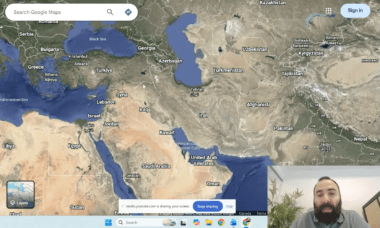
Here, where Iran is today, was a group of people called the Medes and the Persians, two groups of people. And here, where Iraq is, that’s where Babylon was—the Babylonians. The Jews, which included all the way to Israel, had been taken away from their home; basically, they were in exile. The king at that time, the king of Babylon, had decided to take them as slaves from Israel to send them to where Iraq is today, in Babylon. So basically, they were taken away from their home, their temple was destroyed, and this is the context.
Babylon was this bad kingdom which had oppressed the Jews, similar to how Pharaoh had oppressed the Jews as mentioned in the Quran. The Jews got oppressed again by the Babylonians, and in that environment, there were three other groups of people: the Medes north of Iran, the Persians south of Iran, and the Lydians which were pretty much living where Turkey is today. In that context, God inspired, in the Bible, a guy named Daniel, who was a messenger and a prophet, to sort of make predictions about what will happen in the future while he was living in Babylon. Basically, he’s one of the Jews who is living in Babylon under Babylonian people. God reveals things which will happen in the future, and here’s what the Bible says. This was told to Daniel through a dream or through a vision—it doesn’t matter, we’ll see, or even through a prophecy. In the past, they didn’t really distinguish sometimes between these words; they didn’t have the words for this—they said “vision,” which sometimes meant dreams, sometimes meant prophecy.
Daniel 8 in the Bible—I’m reading from the Bible now, and this is a subtitle of the Bible, it’s not in the original one, it’s just the translators doing it:
The Vision of the Ram and Goat
8 1 “During the third year of King Belshazzar’s reign, —I think this must be a Babylonian king— I, Daniel, saw a vision after the earlier vision that had appeared to me.
by the way, this is before Cyrus the Great and before Alexander the Great, this is before anything happened.
2 As I observed the vision, I looked around the citadel of Susa in Elam Province (this is in Iran). While I watched, I found myself beside the Ulai Canal.
By the way, all these locations are in Iran, south of Iran, these locations which are mentioned there.
3 “Then I turned my head to look, and to my surprise, a two-horned ram…
I did this in bold on purpose because now we can see where the two-horned one came from
…was standing beside the canal. The two horns grew long, the first one growing longer than the second, with the longer one springing up last. 4 I watched the ram charging westward,
Can you see the sort of connection with what the Quran says?
northward, and southward…
Let’s go back to the map. So here’s this guy who lives in Babylon, which includes Israel, Iraq, and all of these. He’s saying the ram charged westward, northward, and southward. But from Saudi Arabia, it would have been different; it would have been eastward because Saudi Arabia is in the south, so there’s no southward—if he went to Iraq or to Saudi Arabia, like to Mecca, to people in Mecca it would have been north, but to people in Israel it would be west. So anyway, what I’m saying is there are slight differences because Daniel and Muhammad lived in different locations.
Let’s continue to read:
4 I watched the ram charging westward, northward, and southward; no animal could stand before him.”
What does the Quran say? It says, [18:84] We provided him with all kinds of means and we gave him authority.” In the Bible, it says:
No animal could stand before him, nor was there anyone who could deliver from his control.
And this is in a vision what Daniel saw.
He did as he pleased and exalted himself. 5 “As I watched and wondered, a male goat was coming from the west over the surface of the entire earth without touching the ground. The goat had a distinctive horn between its eyes.
so now it’s only one horn, the second goat has only one horn.
“It approached the ram with two horns that I had observed while standing beside the canal and charged at him out of control with rage.”
So basically, a goat with one horn is attacking a ram—a ram, by the way, is a male sheep—is attacking the ram with two horns.
7 I saw it approach the ram, overflowing with fury at him, and run into him with the full force of its strength. The goat shattered the ram’s two horns, and the ram could not oppose it. So the goat threw him to the ground and trampled him. No one could rescue the ram from its control. 8 Then the goat grew extremely great, but when it was strong, its great horn was shattered. In its place, four distinctive horns grew out in all directions.”
Gabriel’s Interpretation
And then here, Gabriel in the Bible helps Daniel interpret what the meaning of the vision is, or the dream whatever it is, or the prophecy. Gabriel then tells him the meaning, and this is important because in this context, the Quran says, “They ask you about Dhul Qarnayn.” Because The Jews had asked Muhammad who Dhul Qarnayn is, and that’s when these verses were revealed. Then why would the Jews ask Muhammad who Dhul Qarnayn is, who the one with two horns is? Because they thought that unless Muhammad is a prophet, he cannot tell them. Because here even Daniel, who was a prophet as well, was not able to know unless Gabriel told him.
So basically, this was a test by the Jews to see if Muhammad is a real prophet, by asking him about something which only Gabriel could reveal. Of course, only God through Gabriel could reveal, which no one would be able to know unless God told them. This was their way of seeing if Prophet Muhammad is a liar or a true prophet. Of course, they didn’t believe him anyway, but this was their way of distinguishing.
Let’s continue to read. It says:
Gabriel Interprets the Vision
15 “After I, Daniel, had seen the vision, I tried to understand it. All of a sudden, there was standing in front of me one who appeared to be valiant. 16 I heard the voice of a man calling out from the Ulai Canal, ‘Gabriel, interpret what that fellow has been seeing.’
So Gabriel appears to Daniel in the form of a man, telling him what he saw, what was the meaning of the ram with two horns and the goat with one horn.
17 “As he approached where I was standing, I became terrified and fell on my face. But he told me, ‘Son of man, understand that the vision pertains to the time of the end.’ (meaning in the future). 18 “While he had been speaking with me, I had fainted[q] on my face, but he touched me and enabled me to stand upright on my feet. 19 Then he said, ‘Pay attention! I’m going to brief you about what will happen at the end of the period of wrath, because its end is appointed. 20 The ram that you saw with a pair of horns are the kings of Media and Persia.
So it’s the kings of Media and Persia. By the way, here it says the kings of Media and Persia. Cyrus the Great is the one who united these two kingdoms, so he became the king of Media and Persia both at the same time, and that’s partly the meaning of the two horns: because he was a king of two nations at the same time.
The Legacy of Cyrus the Great
How did this happen? If you search on AI, you’ll see that Cyrus the Great, when he was young—he was a descendant of the king of Persia, but his mom was the daughter of the king of Media. And the king of Media saw a dream, according to legends, while he was a child, that Cyrus was going to become the new king. So he became jealous, and he tried to kill him. He ordered someone to kill him, but the person couldn’t do it; they gave Cyrus to a shepherd. Later on, he grew up with that shepherd family. Later on, through some kind of game, they figured out that he is really the descendant of the king of Persia. His grandfather from his mom’s side—basically his mom’s dad, the Median king—tried to attack Persia, but his soldiers defected; they didn’t go along with his plan. In this way, Cyrus was actually able to capture his grandfather. He forgave him, but in this way, he became the king of both Media and Persia. So basically, Cyrus became a king of two kingdoms at the same time.
And here the Bible is telling us: 21 The rough goat is the king of Greece…
Meaning the goat with one horn, not the goat with two horns.
…and the great horn between its eyes is its first king.
which was Alexander the Great.
22 The shattered horn and the four that took its place are four kingdoms that will come from his nation, but they will not have his strength.
So basically here, before Cyrus the Great and Alexander the Great lived, the Bible told them what will happen through Daniel.
Now let’s just see how that happened. Cyrus the Great was born in the south of Iran—there’s a tomb of Cyrus the Great which is here.
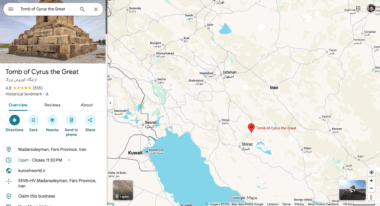
He was born about here, and then the Quran says he traveled east. If you look at history, what happened is he attacked Media—I mean, Media attacked him, then he sort of overpowered them, so he became a king of two kingdoms. Then he went all the way to today’s Turkey, which at that time was Lydia, all the way to the west, which is what the Quran says—all the way to the west.
By the way, there’s a couple of things we might talk about another day because today I spent too much time; we can even identify the places where the spring with black water could have been. There’s to this day a part of an island there. So he went all the way to the west—meaning ruling all those places. Then he went all the way to the east, and then he went here to the north, and this is actually the border between Europe and Asia, let’s call it between the two continents.
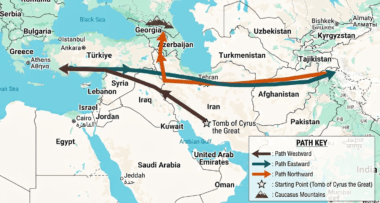
So basically, that’s what Cyrus did. Alexander, on the other hand, only traveled east to capture the new kingdom. Alexander’s kingdom later on destroyed the Persian kingdom, but he didn’t destroy Cyrus the Great; Cyrus the Great established the kingdom. He was the first king of Persia, and after many bad kings after him, eventually Alexander defeated them. But here the Bible is telling us that the one with two horns is the king of Persia, not the king of Greece.
Let’s look at some more prophecies to see if it fits. Here we have it mentioned in Isaiah, chapter 45, verses 1-7. Isaiah was one of the messengers during the times of the ancient Israelis.
Isaiah 45:1-6
Cyrus: God’s Deliverer
45 This is what the Lord says to his anointed, Cyrus,—Now Cyrus is mentioned by name in the Bible— whose right hand I have grasped, to subdue nations before him”—what the Quran says: “provided him with all kinds of means”—
to subdue nations before him,
as I strip kings of their armor,
to open doors before him
and gates that cannot keep closed:
2 “I myself will go before you,
and he will make the mountains level;
look, he will make the mountains level; what does the Quran say? That he leveled the place between the two mountains
“I’ll shatter bronze doors and cut through iron bars.“—these are materials which were used to build the dam—
3 I’ll give you concealed treasures
and riches hidden in secret places,
so that you’ll know that it is I, the Lord,
the God of Israel, who calls you by name.
So here, through Isaiah, God is talking to Cyrus.
so that you’ll know that it is I, the Lord,
the God of Israel, who calls you by name.
4 For the sake of Jacob my servant,
Israel my chosen,
I’ve called you,
and he has established you with a name,
although you have not acknowledged me.
And this is important. What God is saying, I have supported you, meaning God supported Cyrus even though Cyrus has not acknowledged God properly. Because if you look at the ancient sources of what Cyrus believed, he actually allowed idols in his kingdom, but he did believe in God; he had another name for God. I don’t know what the Persian name was. So basically, he believed in God, he was a good man, but he didn’t have the knowledge of the Bible; he was just a person who believed in God naturally.
5 I am the Lord, and there is no other besides me:
and there are no gods.
I’m strengthening you,
although you have not acknowledged me,
So he didn’t acknowledge that it was the God of the Jews necessarily, he just believed in God in general, the way we say today God, not necessarily “Allah”.
6 so that from the sun’s rising to the west
people may know that there is none besides me.
“I am the Lord, and there is no other.”
Let me read another verse, and these are predictions about Cyrus the Great:
Isaiah 45:13
God will Bless Cyrus
13 “I have aroused him in righteousness,
and I’ll make all his pathways smooth.
It is he who will rebuild my city
and set my exiles free,
but not for a price nor reward, ”
says the Lord of the Heavenly Armies.
Rebuilding the Second Temple
By the way, why is Cyrus mentioned in the Bible? Why is it important? It’s because Cyrus, after he did everything which the Quran says about him, actually attacked Babylon after that and did manage to free the Jews from Babylon, send them back to Israel, and build their temple.
The Jews at this time were held as slaves in Babylon after having been purified. Basically, first of all, they became bad, the Babylonians occupied them, they were purified for many decades, and then Cyrus the Great, with God’s permission, freed them again—similar to how Moses freed them from Egypt—and actually built their temple, gave them money to build the temple. This is what is known as the Second Temple in Jerusalem, which was destroyed later on by the Romans after they rejected Jesus.
The Second Temple was technically not really built by the Jews; it was built by a guy who was not even a Jew. And that’s kind of why it makes sense for Jesus to say, “Destroy this temple and I will build it in three days.” It wouldn’t make sense for Jesus to say “destroy this temple” if it was built properly by God’s people. This Second Temple was built unofficially, basically not necessarily with the same status as the First Temple, which was built by Solomon with God’s full guidance. This was built just by a righteous man who was not even a prophet. By the way, Dhul Qarnayn was not a prophet or a messenger; he was just a righteous king, an average good king. I mean, he was extraordinary in the sense that he was a very important king, the one who founded the Persian Empire, but spiritually he probably was not better than us.
Let me try to finish now. This part of the Bible is actually just history; it’s not revealed scripture, but it exists in today’s Bibles. I didn’t include it in our version of the Bible, so it’s not revealed, it’s just history which was included in the Bible. This is after Cyrus was a king; this is not a prophecy, it’s just a description of what happened after the fact.
Ezra, who was a scribe, not a prophet, he added this part in the Bible:
Ezra 1:1-4
An Edict to Rebuild the Temple
1 During the first year of Cyrus, king of Persia, in fulfillment of the message from the Lord spoken through Jeremiah, the Lord prompted Cyrus, king of Persia, to make this proclamation throughout his entire kingdom, which was also released in written form:
2 An Official Statement
from Cyrus, King of Persia
All of the kingdoms of the earth have been given to me by the Lord God of Heaven, and he specifically charged me to build a temple for him in Jerusalem, which is in Judah. 3 Therefore, who among the Lord’s people trusts in his God? Whoever among this group wishes to do so may travel to Jerusalem of Judah to rebuild the Temple of the Lord God of Israel, the God of Jerusalem. 4 Furthermore, everyone who wishes to repatriate from any territory where he now resides is to receive assistance from his fellow residents in the form of silver, gold, equipment, and pack animals, in addition to voluntary offerings for the Temple of the God of Jerusalem.
So basically, the Second Temple was built even though the Jews didn’t fully deserve it.
Interactive Q&A
So, Dhul Qarnayn is Cyrus the Great. This is sort of the answer to who was the one with two horns, Dhul Qarnayn. God willing, in the next Friday sermon or the Friday after that, I will explain what is Dhul Qarnayn, the one with two horns. Because here, if you pay attention carefully, we will see that he was not necessarily just a human. Yeah, he was a human based on this interpretation of the Bible, but there’s a way to understand these verses in a deeper version and realize what is Cyrus the Great. God willing, I’ll answer that question in the next sermon—not just who is Dhul Qarnayn, the one with two horns, but what is the one with two horns.
Let me stop sharing, and should I check if there’s any chats? Let me just see. Does anyone have any questions?
Oh, Adam Fraser said zinc. Yeah, so brass is copper and zinc.
Faisal, you’re ruining my next sermon—I’m joking. Faisal is saying, “Can Dhul Qarnayn mean two generations instead of just two horns?” Yeah, it can also mean two generations; both of them are correct, and that’s going to help us a little bit more with understanding what is Dhul Qarnayn. Spoilers! It’s okay. Yeah, but God willing, we’ll use both meanings—the one with two horns and the one with two generations—to understand what is Dhul Qarnayn, what is the one with two horns.
“Where is the barrier he made?” So the barrier he made is between the two continents, which is today’s—and God willing, I’ll explain this more one day when we talk about Gog and Magog—around here: Georgia, Armenia, Azerbaijan, Dagestan, these countries between the two mountains. There’s a mountain here and a mountain there. By the way, it will never be discovered because the Quran says it will be destroyed in the end times. So basically, people will not be able to discover it until the end times.
And by today, it was probably not some sort of great thing; it was just some local, very small part which they filled with iron, and today it might have been mixed and covered with soil, and it’s probably not very pure iron anyway. If I was an archaeologist—which I don’t think they’ll discover it, so I don’t think they should even try—they should just look for areas with extra iron in one of these mountains. Yeah, it’s not really that important where exactly, but it’s one of these countries, because it’s never going to be discovered until the end of times, like when it gets destroyed when the whole earth gets destroyed, including those mountains and including the barrier.
Officially, this is the border between Europe and Asia.
Let me close this. For those who have to do the contact prayer, you can—oh, sorry, I didn’t share the screen. Let me share the screen again. I don’t need to share it because people actually know where Georgia and Azerbaijan and these countries are.
Okay, so for those who have to do the contact prayer, do the contact prayer. The rest of you, peace be upon you.
Friday Sermon by: Alban Fejza, Online Congregation Director