
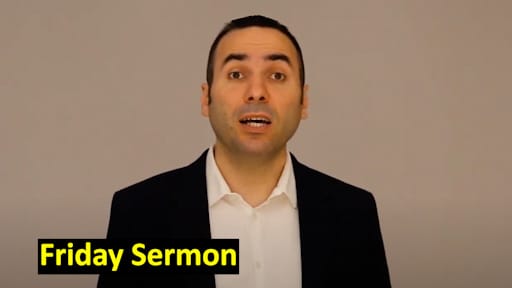
Friday Sermon by: Alban Fejza, Online Congregation Director
Summary:
In this Friday sermon, Alban Fejza argues that surveys only measure whether scientists say they believe in God, not whether they truly do, and explains why many scientists deny God.
Video Transcript:
Praise be to God. There is no other god except God. In several social studies which have been conducted, when people were asked whether they believe in God, the majority of the people said that they do believe in God, but when it comes to the scientists, the majority said that they don’t believe in God. And often, Atheist use this as an argument against the existence of God, because they say, “See, the smarter people are less likely to believe in God.” Well, their argument would be correct, if those studies measure whether those people believe in God, but they only measured whether people say that they believe in God. So, it is true that scientist tend to say much less that they believe in God, and this is because in reality only about 9% of people truly believe in God anyway, even less than the scientists say, which I explain elsewhere, and so 91% either do not believe or are not sure, and this is true in all professions. It just happens that it benefits the scientist to admit it more than the others, or they are people who have thought more about what they truly believe, and have realized that they actually don’t believe in God. On the other hand, the non-scientists are simply more likely to go along with the flow, and going along with the flow for many centuries and for a large part our times, means simply saying that you believe in God, while your deeds don’t match with the fact that you claim to believe in God. So, basically the scientists don’t know the truth about God more than the non-scientists. However, they are less likely to be hypocrites, because they are less likely to say that they believe something while believing something else, while in the general population, people are more likely to say that they believe what they actually don’t believe. And this difference is partly because science is a profession where you gain credibility, and get rewarded, if you can show that you think independently of what other people think and if all people thought fully independently of others without any fear of being judged, then about 91% of them would realize and claim that they don’t believe in God, while only 9% of them would say that they believe in God. And this is the reality. Now, this does not prove much. It’s just what people would say, and not whether God really exists or not. You can not know the existence of God with social questionnaires where people answer what they personally think, or very often what they think others expect them to think. Instead, proving the existence of God should be a matter of physical facts, and not a matter of measuring social attitudes, and I explain how to do that in other videos.
However, here let me deal with how circumstances actually affect a large part of what people claim to believe, because most people go with the flow, and haven’t truly thought about whether they really believe in God or not. For example, because scientists are more likely to think about how things are, rather than how things should be, the disbelievers among them will have an exaggerated idea that they truly know how to evaluate whether there is a god or not. On the other hand, an engineer might be dealing with how to make things better, how things should be instead of how things are, so the disbelievers among them will have an exaggerated idea about their effectiveness, and this might cause them to think that God is not effective. For example, after they build a bridge on top of a river from one hill to another hill, deep in their heart they might start to think that they have defeated nature, and this might cause them to think that they can deceive God, even if he happens to exists. Or an artist for example, the disbelievers among them might start to think like this. They will think, “Whether there is a god or not, I do not know, but I surely know that he doesn’t seem to be fun. I want to express myself, not to suppress myself, so it doesn’t matter whether there is a god or not, I chose to live my life in a version which doesn’t stop me from fully expressing myself.”
That’s how an artist among the disbelievers thinks. Or a disbelieving policeman might also not care whether God exists or not, but according to him, God surely does not stop crime. If it wasn’t for us, the policemen, crime would not stop. So, a disbelieving policeman does not believe in a just God. So, depending on the profession, and depending on what people are exposed to for most of their life, the disbelievers among them will tend to deny that aspect of God which has to do with their experience. Some of them might think that God is not just, and some of them might think that God is not merciful, some of them might think that God is too dominant, some of them might think that God is not running things well, or the Jews who deal with money a lot because they have an advantage in that area, because of their believing ancestors – so because they deal with money slightly more than other people, they will tend to think that the wealth of the world depends on them, and this causes them to deny that God is the bringer of wealth. And the Quran mentions this. In verse 5:64, it says that the Jews said that God’s hand is tied down, meaning that God doesn’t give enough to people, or God doesn’t have enough. And the response in the Quran is that it is their hands who are tied down. So, they are the stingy ones, not God. So, based on what their dominant experience in life is, people tend to deny one aspect of God or another one, and the scientists simply have more experience dealing with analyzing the existence itself, so the disbelievers among them will end up denying the existence of God, but weirdly some of them actually manage to accept some other aspects of God, even if they don’t believe in him. For example, you might hear some of them saying something like, “I don’t believe in God, but I think it’s beneficial for humanity that people believe in him, because it creates a sense of community among the people, and it helps with lowering crime rates and so on.” But, anyway, the truth is that only 9.1% of people truly believe in God, and that is the same across all professions which are permissible. And when I say “permissible professions” I mean professions which do not have discriminatory barriers to entry. But there are professions which have a larger number of disbelievers than usual, because of their discriminatory barriers to entry. For example, because being a model, or a fashion influencer is a profession which discriminates against old people and males, it is a profession which might have more than 91% disbelievers. Or being a spy, or secret agent is a profession which might discriminate against females or other nationalities, for example, then again it might have more than 91% disbelievers, but here I am talking about normal professions which are permissible and with fair barriers to entry, like doctors, nurses, engineers, teachers, farmers, chefs, accountants, builders, traders, scientists, and so on. So, among these professions, among these permissible professions, 9.1% of people truly believe in God, and about 23% of them can not make up their mind, and about 66% of them truly do not believe in God, and whether these percentages are expressed outwardly like that, it depends on the culture in which people live, in the profession which they have, in what type of religious upbringing they had, in the poverty levels, simply on the general life circumstances which a person was more exposed too, rather than his true convictions. And actually, depending on how much a group of people are different from these true percentages, you can know how much they are faking it. Those percentages stay the same across all sufficiently large groups, but if that’s not what they admit to be, they are just faking it in front of the others, or they are fooling themselves without knowing it, or they haven’t had enough life experiences to realize what they truly believe.