[search-in-place-form in_current_page="1"]

Polygamy

Polygamy was a way of life until the Quran was revealed 1400 years ago. When the earth was young and under-populated, polygamy was one way of populating it and bringing in the human beings needed to carry out God’s plan. By the time the Quran was revealed, the world had been sufficiently populated, and the Quran put down the first limitations against polygamy.

Polygamy is permitted in the Quran, but under strictly observed circumstances. Any abuse of this divine permission incurs severe retribution. Thus, although polygamy is permitted by God, it behooves us to examine our circumstances carefully before saying that a particular polygamous relationship is permissible.

Our perfect example here is the prophet Muhammad. He was married to one wife, Khadijah, until she died. He had all his children, except one, from Khadijah. Thus, she and her children enjoyed the Prophet’s full attention for as long as she was married to him; twenty-five years. For all practical purposes, Muhammad had one wife—from the age of 25 to 50. During the remaining 13 years of his life, he married the aged widows of his friends who left many children. The children needed a complete home, with a fatherly figure, and the Prophet provided that. Providing a fatherly figure for orphans is the only specific circumstance in support of polygamy mentioned in the Quran (4:3).

Other than marrying widowed mothers of orphans, there were three political marriages in the Prophet’s life. His close friends Abu Bakr and Omar insisted that he marry their daughters, Aisha and Hafsah, to establish traditional family ties among them. The third marriage was to Maria the Egyptian; she was given to him as a political gesture of friendship from the ruler of Egypt.

This perfect example tells us that a man must give his full attention and loyalty in marriage to his wife and children in order to raise a happy and wholesome family.

The Quran emphasizes the limitations against polygamy in very strong words: “If you fear lest you may not be perfectly equitable in treating more than one wife, then you shall be content with one.” (4:3) “You cannot be equitable in a polygamous relationship, no matter how hard you try.” (4:129)

The Quranic limitations against polygamy point out the possibility of abusing God’s law. Therefore, unless we are absolutely sure that God’s law will not be abused, we had better resist our lust and stay away from polygamy. If the circumstances do not dictate polygamy, we had better give our full attention to one wife and one set of children. The children’s psychological and social well-being, especially in countries where polygamy is prohibited, almost invariably dictate monogamy. A few basic criteria must be observed in contemplating polygamy:

  1. It must alleviate pain and suffering and not cause any pain or suffering.
  2. If you have a young family, it is almost certain that polygamy is an abuse.
  3. Polygamy to substitute a younger wife is an abuse of God’s law (4:19).


Friday Sermon based on Appendix 30 of Authorized English Translation of the Quran by Rashad Khalifa (1989)


For more information:

Polygamy or Monogamy in the Quran

Marriage and Divorce Rules from the Quran

How to Find Your Perfect Marriage Partner?

Join us to listen to our online Friday meetings every Friday.

The Missing Basmalah

Every sura in the Quran opens with the statement “In the name of God, Most Gracious, Most Merciful,” known as the Basmalah, with the exception of Sura 9. This conspicuous absence of the Basmalah from Sura 9 has been an intriguing feature of the Quran for 14 centuries. Many theories have been advanced to explain this phenomenon.

Now we learn that the missing Basmalah plays a significant role as [1] a significant constituent of the Quran’s mathematical miracle, and [2] a glaring sign from the Most Gracious, Most Merciful, that Sura 9 has been tampered with and must be purified (Appendix 24). Both roles of the missing Basmalah were revealed with the discovery of the Quran’s mathematical code. The following list of factual observations illustrate the miraculous features of the missing Basmalah:

1. Since the Basmalah consists of 19 Arabic letters, and prefixes all the suras except one, it can be considered the foundation upon which the Quran’s 19-based code is built. But the absence of the Basmalah from Sura 9 causes the number of this crucial opening statement to be 113, a number that does not conform with the Quran’s code. However, we find that this deficiency is compensated for in Sura 27. Two Basmalahs occur in Sura 27, one as an opener and one in Verse 30. This restores the total number of Basmalahs in the Quran to 114, 19×6.

2. From the missing Basmalah of Sura 9 to the extra Basmalah of Sura 27, there are 19 suras.

3. The sum of sura numbers from the missing Basmalah (Sura 9) to the extra Basmalah (Sura 27) is 9 + 10 + 11 + 12 + … + 25 + 26 + 27 = 342, 19×18. This is a mathematical property, any consecutive 19 numbers will add up to a multiple of 19. But the miraculous phenomenon is
that this number, 342, equals the number of words from the first Basmalah of Sura 27 to the second Basmalah in 27:30.

4. The occurrence of the extra Basmalah in 27:30 conforms with the Quran’s code in that the sura number, plus the verse number is a multiple of 19 (27 + 30 = 57 = 19×3).

5. The occurrence of the extra Basmalah in Verse 30 compares with the occurrence of the number 19 itself in Verse 30 (Sura 74).

6. The Quran contains 6234 numbered verses. The absence of the Basmalah from Sura 9, and compensating for it in Verse 30 of Sura 27 gives us two numbered Basmalahs, 1:1 & 27:30, and 112 un-numbered Basmalahs. This causes the total number of verses in the Quran to be 6234 + 112 = 6346, 19×334.

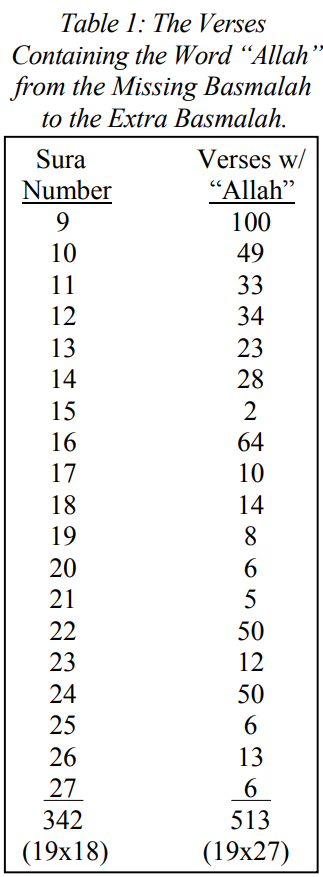
7. From the missing Basmalah to the extra Basmalah, the number of verses containing the word “Allah” is 513, 19×27. Note that 27 is the sura number where the extra Basmalah occurs. The data are in Table 1.

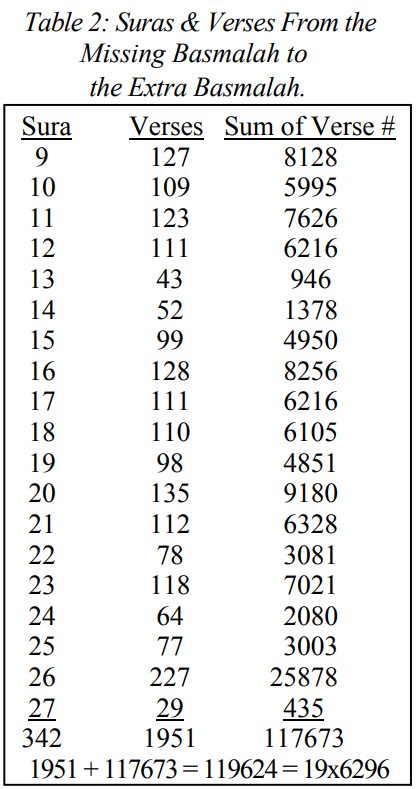
8. The sum of verse numbers (1 + 2 + 3 + … + n), plus the number of verses, from the missing Basmalah to the extra Basmalah is 119624, 19×6296. See Table 2.

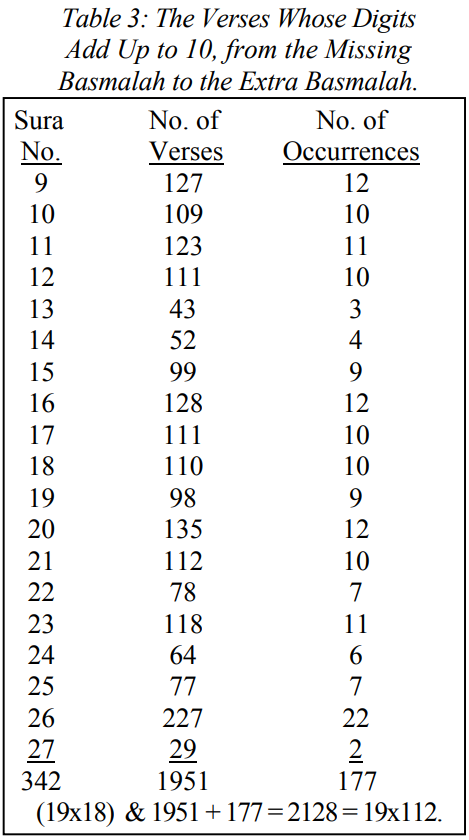
9. This item also proves that Sura 9 consists of 127 verses, not 129 (see Appendix 24). The sum of digits of 127 is 1 + 2 + 7 = 10. By finding all the verses whose digits add up to 10, from the missing Basmalah of Sura 9 to the extra Basmalah of Sura 27, then adding the number of these verses to the total number of verses from the missing Basmalah to the extra Basmalah, we get 2128, or 19×112 (Table 3).

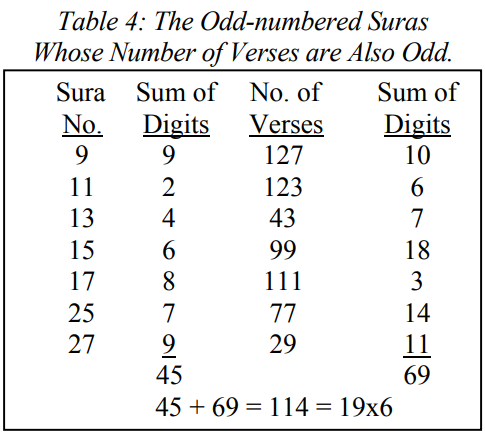
10. Sura 9 is an odd-numbered sura whose number of verses (127) is also odd. From the missing Basmalah to the extra Basmalah, there are 7 suras that possess this property; they are odd-numbered suras whose numbers of verses are also odd. As detailed in Table 4, these are Suras 9, 11, 13, 15,17, 25, and 27. By adding the digits that make up the sura numbers and the numbers of verses, the grand total is 114, 19×6

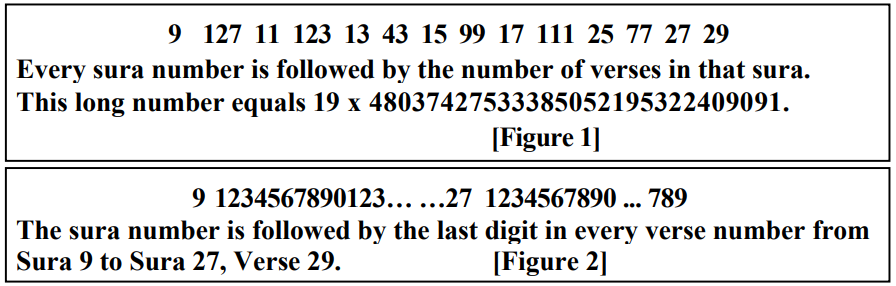
11. The next two features authenticate both the missing Basmalah and the number of verses in Sura 9 (where two false verses had been injected). If we take the same suras listed in Table 4, odd-numbered suras whose numbers of verses are also odd, and write down the number of every sura, followed by its number of verses, the resulting long number (30 digits) is a multiple of 19 (Figure 1).

12. Let us take the last digit of all the verses from the missing Basmalah to the extra Basmalah. If we write down the number of every sura, followed by the last digit in every verse in that sura, we end up with a long number, of 1988 digits, which is divisible by 19 (Figure 2).


Friday Sermon based on Appendix 29 of Authorized English Translation of the Quran by Rashad Khalifa (1989)


For more information:

The Mathematical Composition of Quranic Initials

The Mathematical Miracle of the Quran

One of the Great Miracles [74:35]

Join us to listen to our online Friday meetings every Friday.

Muhammad Wrote God’s Revelations With His Own Hand

Praise be to God! There is no other god except God.

The first revelation was “Read,” and included the statement “God teaches by means of the pen” (96:1-4), and the second revelation was “The Pen” (68:1). The only function of the pen is to write.

Ignorant Muslim scholars of the first two centuries after the Quran could not understand the Quran’s challenge to produce anything like it. They had no idea about the Quran’s mathematical composition, and they knew that many literary giants could have composed works comparable to the Quran. In fact, many such literary giants did claim the ability to produce a literary work as excellent as the Quran. One of the latest claims came from Taha Hussein, the renowned Egyptian writer.

The ignorant Muslim scholars then decided to proclaim Muhammad an illiterate man! They figured that this would make the Quran’s extraordinary literary excellence truly miraculous. The word they relied on to bestow illiteracy upon the Prophet was “UMMY.” Unfortunately for those “scholars,” this word clearly means “Gentile,” or one who does not follow any scripture (Torah, Injeel, or Quran) [see 2:78, 3:20 & 75, 62:2]; it does NOT mean “illiterate.”

Muhammad was a successful merchant. The “Muslim scholars” who fabricated the illiteracy lie forgot that there were no numbers during Muhammad’s time; the letters of the alphabet were used as numbers. As a merchant dealing with numbers every day, Muhammad had to know the alphabet, from one to one thousand.

The Quran tells us that Muhammad wrote down the Quran—Muhammad’s contemporaries are quoted as saying, “These are tales from the past that he wrote down. They are being dictated to him day and night” (25:5). You cannot “dictate” to an illiterate person. The Prophet’s enemies who accuse him of illiteracy abuse Verse 29:48, which relates specifically to previous scriptures.

On the 27th night of Ramadan 13 B.H. (Before Hijerah), Muhammad the soul, the real person, not the body, was summoned to the highest universe and the Quran was given to him (2:97, 17:1, 44:3, 53:1-18, 97:1-5). Subsequently, the angel Gabriel helped Muhammad release a few verses of the Quran at a time, from the soul to Muhammad’s memory. Muhammad memorized and wrote down the verses just released into his mind. When Muhammad died, he left the complete Quran written down with his own hand in the chronological order of revelation, along with specific instructions as to where to place every verse. The divine instructions recorded by the Muhammad were designed to put the Quran together into the final format intended for God’s Final Testament to the world (75:17). The early Muslims did not get around to putting the Quran together until the time of Khalifa Rashed ‘Uthmaan. A committee was appointed to carry out this task.

On the other hand, it is also worth noting that when Muhammad wrote God’s revelations with his own hand, he was writing them in the role of a scribe, and not in the role of a messenger. And therefore, it is not very important whether he wrote them or not, because the Quran was revealed as a recitation. The word “Quran” means “recitation”, and the different written versions of the Quran which are written on earth do not define the Quran. When God promised to preserve the Quran in verse 15:9, He did not promise to preserve the written book, but to preserve the reminder – to preserve it within the minds and hearts of the people. The written versions of the Quran are simply human-made aids to help people recollect the Quran. In written form, the original Quran only exists high up in heaven (43:4). People can choose to write the written earthly versions with whatever symbols they want to represent the sounds of the original recitation. Muhammad in the role of a scribe happened to write it with Arabic letters, because those were the letters which his society was using, but that does not make it the official version. There is no official written version of the Quran on earth. One of the roles of the Mathematical Miracle of the Quran was to help us distinguish which written human-made versions are correct representations of the revealed spoken Quran, because many written human made versions can exist and exist. Therefore, the written human-made versions can also be written with English letters, or Greek letters, or even computer characters, or even with bits inside a computer, (i.e. only with numbers 1 and 0), and they would still have the Mathematical Miracle based on number 19 in them. So, there is no official symbols (letters) of how the Quran should be written. The written symbols are human made. God taught Adam the words, the sounds of things, but not the writing of it. More than about half of how Adam spoke sounded similar to the Arabic of today, but God never taught or officiated the Arabic symbols. If anything, the symbols or the letters which have more merit to be correct are the letters which were used in the tablets of Moses. Those were the only letters which were directly written by God and angels. Moses received them in written form (7:145). And those symbols were in a shape which Moses would understand. Moses, being a Semite, would understand the Proto-Semitic symbols, which are pretty much the Phoenician alphabet. So, even though there is no official symbols chosen by God, if we had to choose one set of symbols, the closest to being correct are the Phoenician letters, which are similar to the English letters of today. So, when God called Muhammad “a gentile”, “an unlettered one”, in the Quran, among other things, it meant that he is someone who does not know how to read the Phoenician letters with which originally the people of the scripture wrote God’s previous revelations.


Friday Sermon based on Appendix 28 of Authorized English Translation of the Quran by Rashad Khalifa (1989)


For more information:

Role of the Prophet Muhammad

Explaining Quranic Initials, Predicting the Future

One of the Great Miracles [74:35]

Join us to listen to our online Friday meetings every Friday.

Who Is Your God?

Praise be to God! There is no other god except God. But, who is your god? Most people are outraged upon hearing this question. “What do you mean, ‘Who is your god?’. “My god is the Creator of the heavens and the earth.” And most of these people will be shocked to find out that their proclamation that their god is the Creator of the heavens and the earth is no more than lip service, and that they are in fact destined for Hell (12:106).

To put this commandment into practice, we must establish certain habits whereby we guarantee that God occupies our minds more than anything else. The Quran helps us establish such soul saving habits:

  1. The Contact Prayers (Salat): those who observe the daily prayers come a long way towards commemorating God a significant proportion of their waking hours.
  1. Commemorate God before eating: Verse 6:121 enjoins us to mention God’s name before we eat. It says, “You shall not eat from that upon which God’s name has not been mentioned.”
  2. Saying, “God Willing (IN SHAA ALLAH): Verse 18:24 says, “You shall not say, ‘I will do this or that tomorrow,’ without saying, ‘God willing’ (IN SHAA ALLAH). If you forget to do this, then apologize and say, ‘May my Lord guide me to do better next time.’ ”. This is a direct commandment that we must carry out, no matter who we are talking with.
  3. God’s Gift (MAA SHAA ALLAH): To invoke God’s protection for our beloved objects—our children, our cars, our homes, etc.—we are enjoined in verse 18:39 to say “MAA SHAA ALLAH” (This is God’s gift).
  4. Glorify God day and night: When we eat anything, we shouldn’t be like animals; we must reflect on God’s creation of the food we are eating—the flavor, our enjoyment due to the senses God has given us, the perfect packaging of the banana or the orange, the varieties of sea foods created by God, etc.—and glorify Him as we enjoy His provisions. When we see a beautiful flower, or animal, or sunsets, we must glorify God. We must seize every possible opportunity to remember and glorify God, so that God may be our God.


Friday Sermon based on Appendix 27 of Authorized English Translation of the Quran by Rashad Khalifa (1989)


For more information:

Who is Your God (part 2)?

Why Were We Created?

Why Are We Here?

Join us to listen to our online Friday meetings every Friday.

The Three Messengers of Islam

This Appendix provides the Quranic mathematical evidence that [1] Abraham was the original messenger of Islam, i.e., Submission (22:78), [2] Muhammad was the scripture delivering messenger (47:2), and [3] Rashad is the purifying and consolidating messenger who delivered the religion’s authenticating proof (3:81, & Appendix 2).

Perpetual and Verifiable Evidence

1. As pointed out in Appendix 2, the gematrical value of “Abraham” is 258, the gematrical value of “Muhammad” is 92, the gematrical value of “Rashad” is 505, and 258 + 92 + 505 =855 = 19×45.

2. If we include “Ismail,” whose gematrical value is 211 and “Isaac,” whose gematrical value is 169, we still end up with a total gematrical value of 855 + 211 + 169 = 1235 = 19×65. The total gematrical value of the three messengers, or the five, cannot conform with the Quran’s 19- based mathematical code if either Abraham, Muhammad, or Rashad is not included.

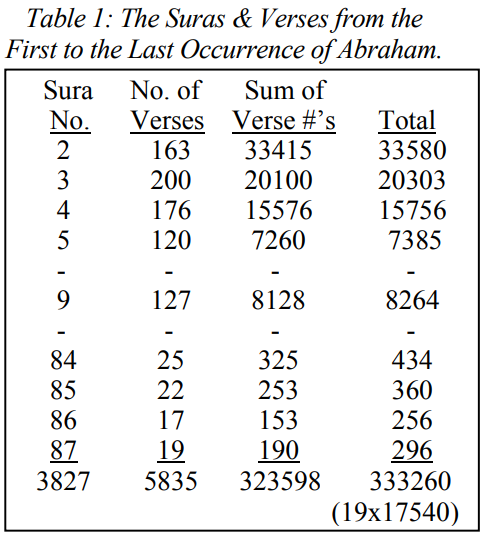
3. The first and last occurrences of “Abraham” are in 2:124 and 87:19. By adding the sura numbers plus the number of verses, plus the sum of verse numbers from the first occurrence to the last occurrence, the grand total is 333260, 19×17540 (Table 1).

4. As pointed out in Appendix 2, the name of God’s Messenger of the Covenant is introduced to the computer age through mathematical coding. If the name was specified in the Quran, as is the case with past messengers, millions of people would have named their children “Rashad Khalifa.” Thus, the root word “Rashada” is mentioned in the Quran 19 times (Appendix 2).

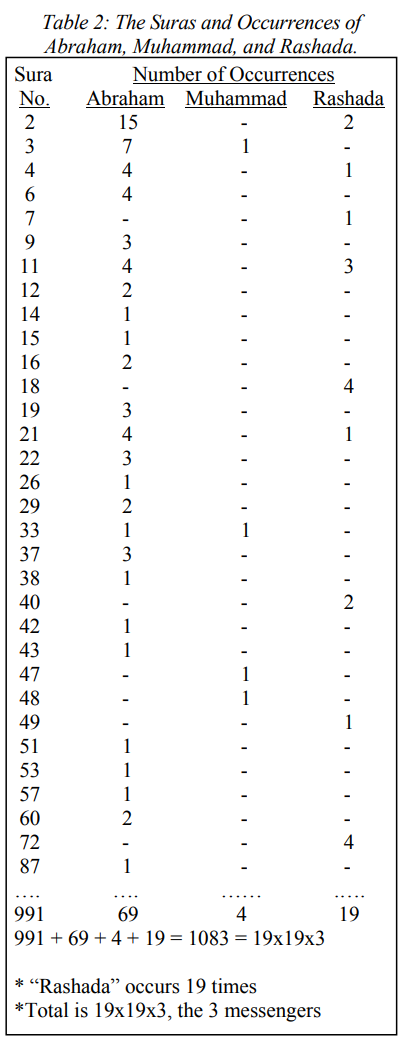
5. “Abraham” is mentioned in 25 suras, “Muhammad” is mentioned in 4 suras, and “Rashada” occurs in 9 suras. The total of these suras is 25 + 4 + 9 = 38 = 19×2 (INDEX TO THE WORDS OF QURAN, Abdul Baqi).

6. If we add the numbers of the suras where Abraham, Muhammad, and Rashada occur, plus the number of occurrences per sura, the total comes to 1083, 19x19x3 (Table 2)

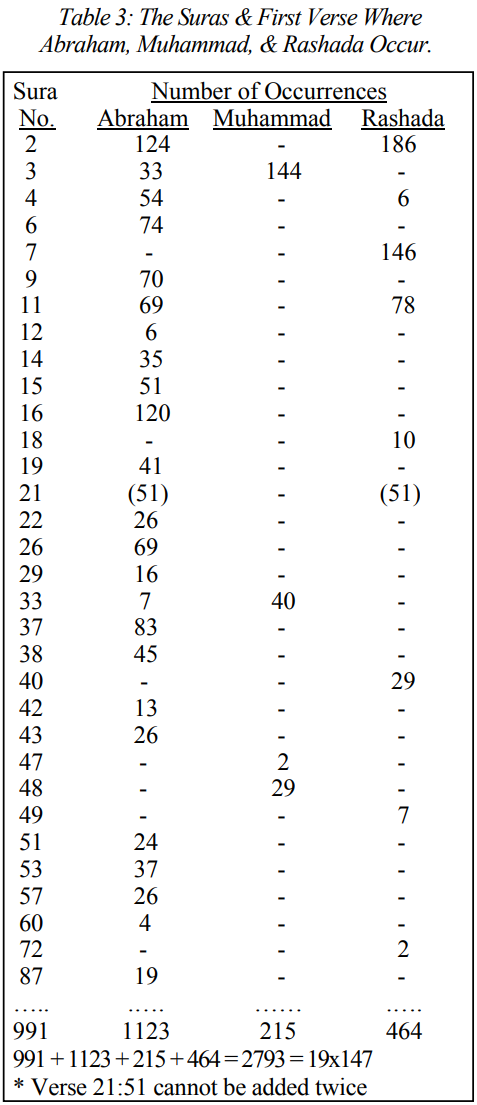
7. If we take all the suras where Abraham, Muhammad, and the root word “Rashada” are mentioned, and add the sura numbers, plus the number of the first verse in each sura where each of the three words is mentioned, the total comes to 2793, 19×147 (Table 3).

8.  The sum of all sura numbers where the three words occur, without repetition, plus the sum of all the verse numbers, without repetition, add up to 6479, 19×341. The suras are 2, 3, 4, 6, 7, 9, 11, 12, 14, 15, 16, 18, 19, 21, 22, 26, 29, 33, 37, 38, 40, 42, 43, 47, 48, 49, 51, 53, 57, 60, 72, and 87. The sum of these numbers is 991 (see Table 3). The verses where the three words are mentioned, without repetition, are 2, 4, 6, 7, 10, 13, 14, 16, 17, 19, 21, 24, 26, 29, 31, 33, 35, 37, 38, 40, 41, 43, 45, 46, 51, 54, 58, 60, 62, 65, 66, 67, 68, 69, 70, 74, 75, 76, 78, 83, 84, 87, 95, 97, 104, 109, 114, 120, 123, 124, 125, 126, 127, 130, 132, 133, 135, 136, 140, 144, 146, 161, 163, 186, 256, 258, and 260. The sum of these numbers is 5488, and: 5488 + 991 = 6479 = 19×341.

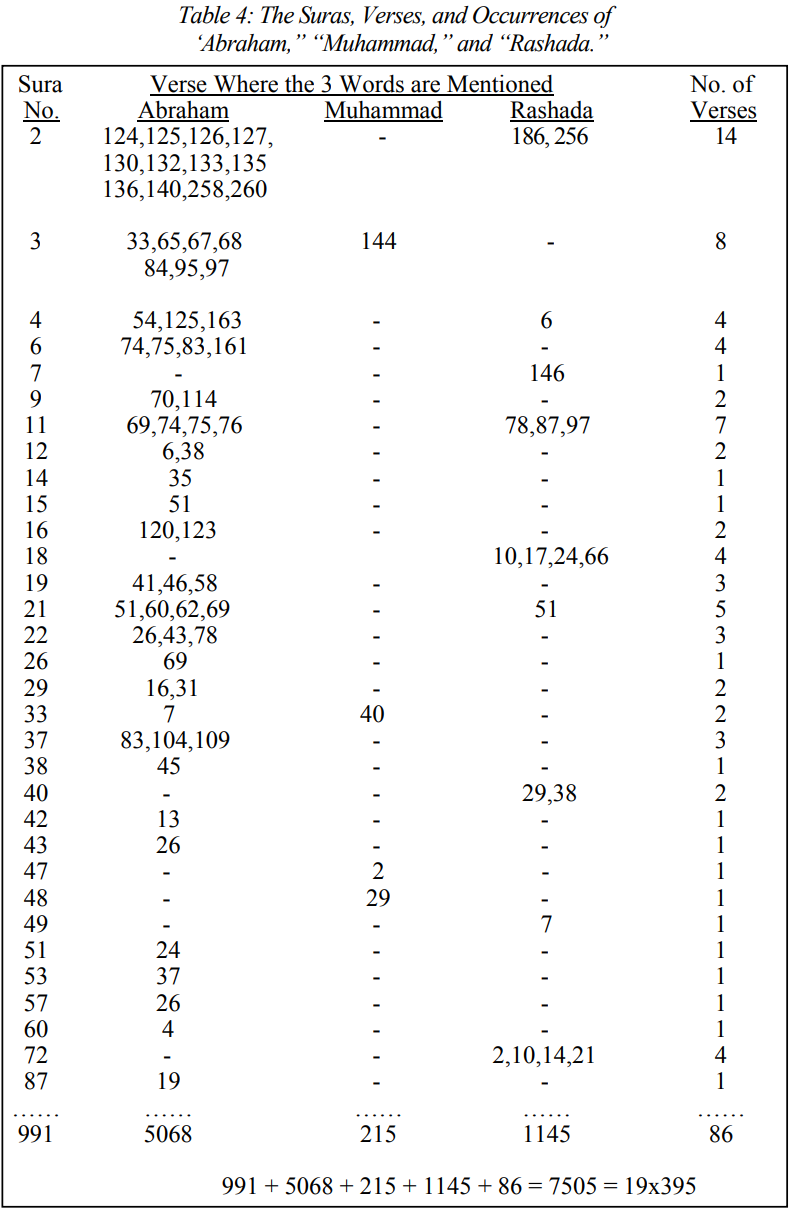
9. If we add the sura number, plus the verse number, plus the number of verses where Abraham, Muhammad, and Rashada occur, we get a grand total that equals 7505, 19×395 (Table 4). Thus, it is mathematically coded into the Quran that Abraham, Muhammad,
and Rashad are the three messengers of Islam (Submission).

10. As shown in Table 4, the 19 occurrences of the root word “Rashada” are in verses 186, 256, 6, 146, 78, 87, 97, 10, 17, 24, 66, 51, 29, 38, 7, 2, 10, 14, and 21. These are 38 digits, 19×2.

11. Table 4 shows that the sum of the verse numbers where we see the 19 occurrences of the root word “Rashada” is 1145. By adding this total of verse numbers (1145), to the gematrical value of the name “Rashad” (505), plus the gematrical value of the name “Khalifa” (725), we get 1145 + 505 + 725 = 2375, 19×125.

12. If we write down these numbers next to each other, i.e., the total of verse numbers (1145), followed by the gematrical value of the name “Rashad” (505), followed by the gematrical value of the name “Khalifa” (725), we also get a number that is a multiple of 19: 1145505725 = 19×60289775

Sum of Verse Numbers Where the 19 “Rashada” Occur…………………….= 1145
Gematrical Value of the Name “Rashad” …………………………………………= 505
Gematrical Value of the Name “Khalifa”…………………………………………= 725

1145 + 505 + 725 = 2375 = 19×125

1145 505 725 = 1145505725 = 19×60289775


Friday Sermon based on Appendix 26 of Authorized English Translation of the Quran by Rashad Khalifa (1989)


For more information:

Abraham: Original Messenger of Islam

Role of the Prophet Muhammad

God’s Messenger of the Covenant [3:81]

Join us to listen to our online Friday meetings every Friday.

End of the World

[72:27] (God is) the Knower of the future;
He does not permit anyone to unveil such knowledge.
Only through the messengers that He chooses
does He reveal future and past events.

Among the duties charged to me as God’s Messenger of the Covenant is unveiling the end of the world. We learn from 18:7-8 and 69:13-15 that this world will come to an end. A new earth and new heavens will replace the present heavens and earth (14:48).

Signs of the Approaching End of the World

The Quran provides many signs, and states that the means for unveiling the end of the world have been given (47:18). The signs given in the Quran include:

  1. The splitting of the moon: This already happened in June 1969 when we landed on the moon and brought back moon rocks. People on earth can go now to many museums, colleges and observatories to look at pieces of the moon.
  2. Discovering the Quran’s 19-based mathematical code (74:30-37): Fulfilled in 1969-1974.
  3. The creature (27:82): “Made from the earth, it alerts the people that they have been oblivious to their Creator.” The Creature, made from the earth, did appear and was instrumental in unveiling the Quran’s numerical code, and proclaiming that the world has neglected God’s message; the creature is the computer. Note that the digits that make up 27:82 add up to 19.
  4. Appearance of God’s Messenger of the Covenant (3:81): As detailed in Appendix 2, a consolidating messenger, prophesied in the Quran, comes after all the prophets have delivered the scriptures, to purify and unify. This prophecy was fulfilled in Ramadan 1408.
  5. The Smoke (44:10): occurs after God’s Messenger of the Covenant has delivered the unified message and proclaimed Islam (Submission) as the only religion acceptable by God.
  6. Gog and Magog: they re-appear, in accordance with God’s plan, in the year 1700 AH (2271 AD). Gog and Magog are mentioned in 18:94 and 21:96. If you count the verses from 18:94 to the end of Sura 18, you find them 17. If you count the verses from 21:96 to the end of Sura 21, you find them also 17. This is the Quran’s sign that Gog and Magog will re-appear in 1700 AH.

It Will Not Remain Hidden [20:15]

Verse 15 of Sura 20 informs us that the end of the world will be revealed by God before the end of the world, and Sura 15, Verse 87, gives the time for that event:

[15:87] We have given you the seven pairs, and the great Quran. 

The seven pairs are the 14 Quranic Initials. The total gematrical value of these profound pillars of the Quran’s miracle pinpoints the year of the end of the world. It is noteworthy that Verse 85 of Sura 15 states: “The end of the world will surely come to pass.” The next verse, 15:86, tells us that God is the Creator of this world, and, of course, He knows when it will end. The following verse, 15:87, tells us when the world will end. As shown in Table 1, the gematrical values of “The Seven Pairs” of Quranic Initials total 1709 (see also Table 1 of Appendix 1). According to 15:87, the world will survive for 1709 lunar years from the time this prophecy is stated in the Quran. This means that the world will end in the year 1710 AH. This number is a multiple of 19; 1710 = 19×90.

The unveiling of this information took place in the year 1400 AH, 309 years before the prophesied end of the world (1709-1400 = 309). The number 309 is a Quranic number (18:25), and is connected with the end of the world (18:21). The peculiar way of writing 309 in 18:25, “Three hundred years, increased by nine,” indicates that the 309 are lunar years. The difference between 300 solar years and 300 lunar years is 9 years. The year of this discovery, 1400 AH, coincided with 1980 AD, and 1980 plus 300 solar years is 2280, also a multiple of 19, 19×120. Thus the world ends in 1710 AH, 19×90, which coincides with 2280 AD, 19×120. For the disbelievers who do not accept these powerful Quranic proofs, the end of the world will come suddenly (6:31, 44, 47; 7:95, 187; 12:107; 21:40, 22:55; 26:202; 29:53; 39:55; 43:66; and 47:18).

While Hadith is forbidden as a source of religious teachings (Appendix 19), it can be a useful source of history. We can derive a lot of information about historical events and local customs and traditions during the early centuries of Islam. The books of Hadith indicate that the Quranic Initials were believed to determine the life span of the Muslim Ummah. The classic exegesis by AlBaydaawy cites the following historical event as a possible explanation of the Quranic Initials. The same event is detailed in Al-Suyooty’s ITQAAN, First Printing, 1318 AH, Vol 2, Page 10:

The Jews of Medina went to the Prophet and said, “Your Quran is initialed with A.L.M., and these Initials determine the life span of your religion. Since ‘A’ is 1, ‘L’ is 30, and ‘M’ is 40, this means that your religion will survive only 71 years.” Muhammad said, “We also have A.L.M.S.” They
said, “The ‘A’ is 1, the ‘L’ is 30, the ‘M’ is 40, and the ‘S’ is 90. This adds up to 161. Do you have anything else?” The Prophet said, “Yes, A.L.M.R.” They said, “This is longer and heavier; the ‘A’ is 1, ‘L’ is 30, ‘M’ is 40, and ‘R’ is 200, making the total 271.” They finally gave up, saying, “We do not know how many of these Initials he was given!” [Al-Suyuty’s Famous Reference ITQAAN]

Although this narration is well known, many scholars have been reluctant to accept the unmistakable connection between the Quranic Initials and the end of the world. They could not bring themselves to deal with this subject for the simple reason that the calculation makes the end of the world, and judgment, a reality


Friday Sermon based on Appendix 25 of Authorized English Translation of the Quran by Rashad Khalifa (1989)


For more information:

The End of the World

The End Times

Explaining Quranic Initials, Predicting the Future

Join us to listen to our online Friday meetings every Friday.

Two False Verses Removed from the Quran

Tampering With the Word of God

The Quran is God’s Final Testament. Hence the divine pledge to keep it perfectly preserved. To assure us of both the divine authorship, and the perfect preservation of the Quran, the Almighty author has rendered the Quran mathematically composed. As proven by the physical evidence in Appendix 1, such mathematical composition is far beyond human capabilities. The slightest violation of God’s Final Testament is destined to stand out in glaring disharmony. A deviation by only 1—one sura, one verse, one word, even one letter—is immediately exposed.

Nineteen years after the Prophet Muhammad’s death, during the reign of Khalifa ‘Uthman, a committee of scribes was appointed to make several copies of the Quran to be dispatched to the new Muslim lands. The copies were to be made from the original Quran which was written by Muhammad’s hand (Appendix 28).

This committee was supervised by ‘Uthman Ibn ‘Affaan, ‘Ali Ibn Abi Taaleb, Zeid Ibn Thaabet, Ubayy Ibn Ka’ab, ‘Abdullah Ibn Al-Zubair, Sa’eed Ibn Al-‘Aas, and ‘Abdul Rahman Ibn Al-Haareth Ibn Heshaam. The Prophet, of course, had written the Quran in its chronological order of revelation (Appendix 23), together with the necessary instructions to place every piece in its proper position. The last sura revealed in Medina was Sura 9. Only Sura 110, a very short sura, was revealed after Sura 9, in Mina.

The committee of scribes finally came to Sura 9, and put it in its proper place. One of the scribes suggested adding a couple of verses to honor the Prophet. The majority of scribes agreed. ‘Ali was outraged. He vehemently maintained that the word of God, written down by the hand of His final prophet, must never be altered.

A superhuman mathematical system pervades the Quran and serves to guard and authenticate every element in it.

Nineteen years after the Prophet’s death, some scribes injected two false verses at the end of Sura 9, the last sura revealed in Medina. The evidence presented in this Appendix incontrovertibly removes these human injections, restores the Quran to its pristine purity, and illustrates a major function of the Quran’s mathematical code, namely, to protect the Quran from the slightest tampering. Thus, the code rejects ONLY the false injections 9:128-129.

Surely, we have revealed this scripture, and surely, we will preserve it. [15:9]

Ali’s protest is documented in many references, but I cite and reproduce here the classic reference AL ITQAAN FEE ‘ULUM AL QURAN by Jalaluddin Al-Suyuty, Al-Azhareyyah Press, Cairo, Egypt, 1318 AH, Page 59.

Translation: ‘Ali was asked: “Why are you staying home?” He said, “Something has been added to the Quran, and I have pledged never to put on my street clothes, except for the prayer, until the Quran is restored.”

The horrendous dimensions of this crime can be realized once we look at the consequences:

  1. ‘Uthman was assassinated, and ‘Ali was installed as the fourth Khalifa.
  2. A 50-year war erupted between the new Khalifa and his supporters on one side, and the Mohammedan distorters of the Quran on the other side.
  3. ‘Ali was martyred, and eventually his family, the prophet Muhammad’s family, except for some women and children, were killed.
  4. The disaster culminated in the infamous Battle of Karbala, where ‘Ali’s son, Hussein, and his family were massacred.
  5. The Muslims were deprived of the pure, unaltered, Quran for 1400 years.

The distorters of the Quran finally won the war, and the “official” history that came to us represented the victors’ point of view. This apparent victory for God’s enemies was, of course, in accordance with God’s will. In just two decades after the Prophet’s death, the idol worshipers who were defeated by the Prophet in the conquest of Mecca (632 AD) reverted to idolatry. Ironically, this time around their idol was the Prophet himself. Such idol worshipers obviously did not deserve to possess the pure Quran. Hence the blessed martyrdom of the true believers who tried to restore the Quran, and the apparent victory for the distorters of God’s word.

The first peace time ruler after this lengthy and disastrous war was Marwan Ibn Al Hakam (died 65 AH/684 AD). One of the first duties he performed was to destroy the original Quran, the one that was so scrupulously written by the Prophet’s own hand, “fearing it might become the cause of NEW disputes” [see ‘ULUM AL-QURAN, by Ahmad von Denffer, Islamic Foundation, Leicester, United Kingdom, 1983, Page 56]. The question an intelligent person must ask is: “If the original Quran were identical to the Quran in circulation at that time, why did Marwan Ibn Al-Hakam have to destroy it?!”

Upon examining the oldest Islamic references, we realize that the false injections, 9:128-129, were always suspect. For example, we read in Bukhary’s famous Hadith, and Al-Suyuty’s famous Itqaan, that every single verse in the Quran was verified by a multiplicity of witnesses “except Verses 128 and 129 of Sura 9; they were found only with Khuzeimah Ibn Thaabet Al-Ansaary.” When some people questioned this improper exception, someone came up with a Hadith stating that “the testimony of Khuzeimah equals the testimony of two men!!!”

Strangely, the false injections 9:128-129 are labeled in the traditional Quran printings as “Meccan.”

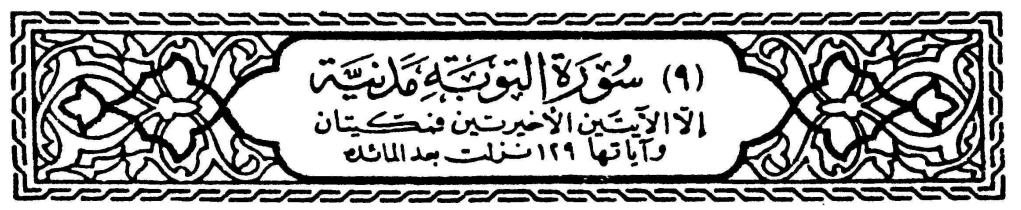
The Title Figure of Sura 9 from a standard Quran, showing that this sura is Medinan, “except for the last two verses; they are Meccan”!!!

How could these ‘Meccan’ verses be found with Khuzeimah, a late ‘Medinan’ Muslim?! How could a Medinan sura contain Meccan verses, when the universal convention has been to label as ‘Medinan’ all revelations after the Prophet’s Hijerah from Mecca??!! Despite these discrepancies, plus many more glaring contradictions associated with Verses 9:128-129, no one dared to question their authenticity. The discovery of the Quran’s mathematical code in 1974, however, ushered in a new era where the authenticity of every element in the Quran is proven (Appendix 1).

As it turns out, the injection of the two false Verses 9:128-129 resulted in:

  1. demonstrating the major function of the Quran’s mathematical system, and
  2. producing an awesome miracle in its own right, and
  3. distinguishing the true believers from the hypocrites (they uphold traditions).

The translation of the two false verses:

“A messenger has come to you from among you who wants no hardship to afflict you, and cares about you, and is compassionate towards the believers, merciful. If they turn away, then say, ‘Sufficient for me is God, there is no god except He. I put my trust in Him. He is the Lord with the great throne.'”


THE PHYSICAL EVIDENCE

[1] The first violation of the Quran’s code by Verses 9:128-129 appeared when the count of the word “God” (Allah) in the Quran was found to be 2699, which is not a multiple of 19, unless we remove one. The count of the word “God” is shown at the bottom of each page in this translation. The total shown at the end of the Quran is 2698, 19×142, because the false injections 9:128-129 have been removed.

[2] The sum of all the verse numbers where the word “God” occurs is 118123, or 19×6217. This total is obtained by adding the numbers of verses wherever the word “God” is found. If the false Verse 9:129 is included, this phenomenon disappears.

[3] As shown at the end of Sura 9 in this translation, the total occurrence of the word “God” to the end of Sura 9 is 1273, 19×67. If the false injections 9:128-129 were included, the total would have become 1274, not a multiple of 19.

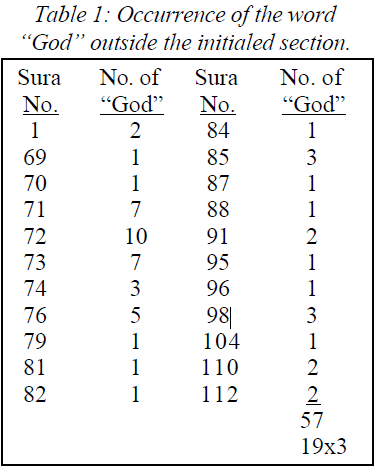
[4] The occurrence of the word “God” from the first Quranic initial (“A.L.M.” of 2:1) to the last initial (“N.” of 68:1) totals 2641, or 19×139. Since it is easier to list the suras outside the initialed section of the Quran, Table 1 shows the 57 occurrences of the word “God” in that section. Subtracting 57 from the total occurrence of the word “God” gives us 2698-57 = 2641 = 19×139, from the first initial to the last initial. If the human injections 9:128 and 129 were included, the count of the word “God” in the initialed section would have become 2642, not a multiple of 19.

[5] Sura 9 is an un-initialed sura, and if we look at the 85 un-initialed suras, we find that the word “God” occurs in 57 of these suras, 19×3. The total number of verses in the suras where the word “God” is found is 1045, 19×55. If 9:128-129 were included, the verses containing the word “God” would increase by 1.

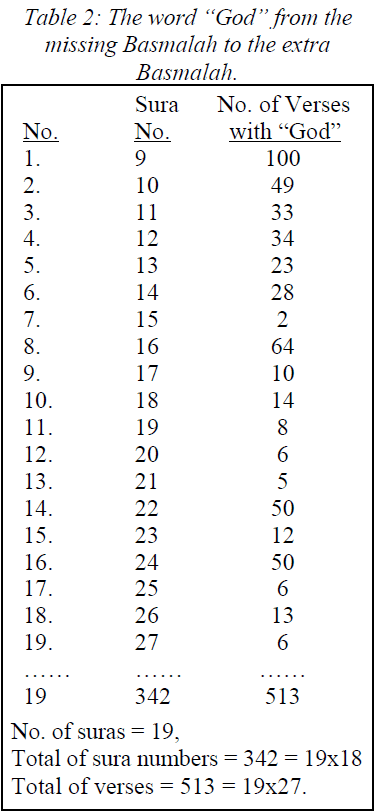
[6] The word “God” from the missing Basmalah (Sura 9) to the extra Basmalah (Sura 27) occurs in 513 verses, 19×27, within 19 suras (Table 2). If the false Verses 9:128-129 were included, the number of verses containing the word “God” would have become 514, and this phenomenon would have disappeared.

[7] The word “Elaah” which means “god” occurs in Verses 9:129. The total occurrence of this word in the Quran is 95, 19×5. The inclusion of 9:128-129 causes this word to increase by 1, to 96.

[8] The INDEX TO THE WORDS OF THE QURAN, lists 116 “Rasool” (Messenger) words. One of these words is in 9:128. By removing this false verse, 115 “Rasool” words remain. Another “Rasool” word which must be excluded from counting is in 12:50, since it refers to the “messenger of Pharaoh,” not the messenger of God. Thus, the total occurrence of “Rasool” of God is 114, 19×6.

[9] Another important word that occurs in the false Verses 9:128-129 is the word “Raheem” (Merciful). This word is used in the Quran exclusively as a name of God, and its total count is 114, 19×6, after removing the word “Raheem” of 9:128, which refers to the prophet. According to 7:188, 10:49, and 72:21 the Prophet did not possess any power of mercy.

[10] The INDEX lists 22 occurrences of the word “‘Arsh” (Throne). After removing the false injection 9:129, and the “‘Arsh” of Joseph which occurs in 12:100, and the “‘Arsh” of the Queen of Sheba (27:23), we end up with 19 “‘Arsh” words. This proves that the word “‘Arsh” of 9:129 does not belong in the Quran.

[11] The Quranic command “Qul” (Say) occurs in the Quran 332 times. Also, the word “Qaaloo” (They said) occurs the same number of times, 332. Since the false Verse 9:129 contains the word “Qul” (Say), its inclusion would have destroyed this typical Quranic phenomenon.

[12] The Quran contains 6234 numbered verses and 112 un-numbered verses (Basmalahs). Thus, the total number of verses in the Quran is 6346, 19×334. The false Verses 9:128-129 violate this important criterion of the Quran’s code.

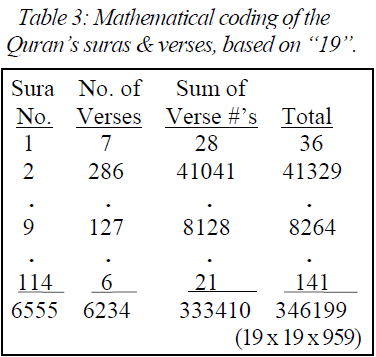
[13] In addition to violating the numbers of words as listed above, 9:128-129 violate the Quran’s mathematical structure. When we add the number of verses in each sura, plus the sum of verse numbers (1 + 2 + 3 + … + n, where n = number of verses), plus the number of each sura, the cumulative total for the whole Quran comes to 346199, or 19x19x959. This phenomenon confirms the authenticity of every verse in the Quran, while excluding 9:128-129. Table 3 is an abbreviated illustration of the calculations of Item 13. This phenomenon is impossible if the false Verses 9:128-129 are included.

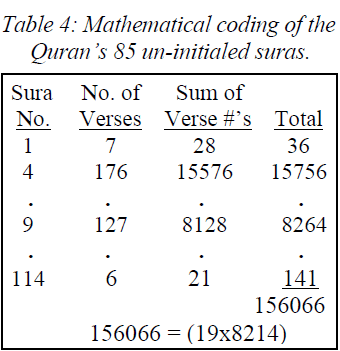
[14] When we carry out the same calculations as in Item 13 above, but for the 85 un-initialed suras only, which include Sura 9, the cumulative total is also a multiple of 19. The cumulative total for all un-initialed suras is 156066, or 19×8214. This result depends on the fact that Sura 9 consists of 127 verses, not 129. The cumulative total for all un-initialed suras is 156066, or 19×8214. This result depends on the fact that Sura 9 consists of 127 verses, not 129. The data are shown in Table 4. The false verses would have destroyed this criterion.

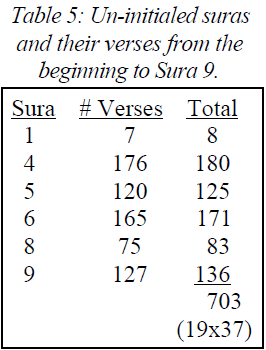
[15] By adding the sura numbers of all un-initialed suras (85 suras), plus their number of verses, from the beginning of the Quran to the end of Sura 9 we get 703, 19×37. The detailed data are shown in Table 5. This phenomenon depends on the fact that Sura 9 consists of 127 verses.

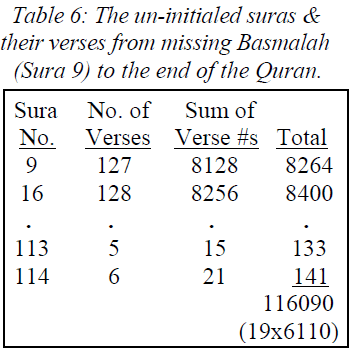
[16] By adding the sura number of the un-initialed suras, plus the number of verses, plus the sum of verse numbers from the missing Basmalah (9:1) to the end of the Quran, the grand total comes to 116090, or 19×6110. These data are in Table 6. If Verses 9:128-129 are included, the
number of verses for Sura 9 becomes 129, and the grand total becomes 116349, not a multiple of 19.

[17] When the same calculations of Item 16 are done for all the verses from the missing Basmalah of Sura 9 to the extra Basmalah of Sura 27, the grand total comes to 119966, or 19×6314. This phenomenon would be destroyed, and the total would no longer be divisible by 19, if the number of verses in Sura 9 were 129. Since this phenomenon is also related to the absence of Basmalah from Sura 9, it is explained and the detailed data are given in table form in Appendix 29.

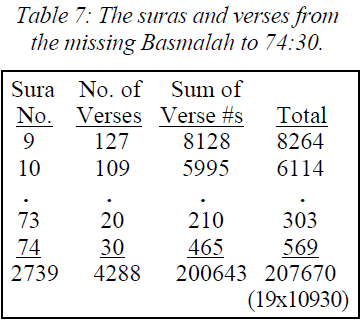
[18] When the same calculations of Items 16 and 17 are carried out from the missing Basmalah (9:1) to the verse where the number 19 is mentioned (74:30), we find that the grand total comes to 207670, or 19×10930 (Table 7). Sura 9 must consist of 127 verses.

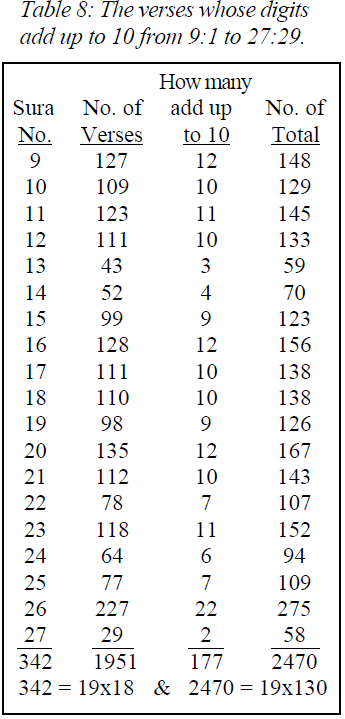
[19] Sura 9 consists of 127 verses. The digits of 127 add up to 1 + 2 + 7 = 10. Looking at all the verses whose digits add up to 10, from the missing Basmalah of Sura 9, to the extra Basmalah of Sura 27, the grand total is 2470 (19×130). If Sura 9 consisted of 129 verses, the grand total would be 2472, not a multiple of 19, and this phenomenon would have disappeared. The data are in Table 8.

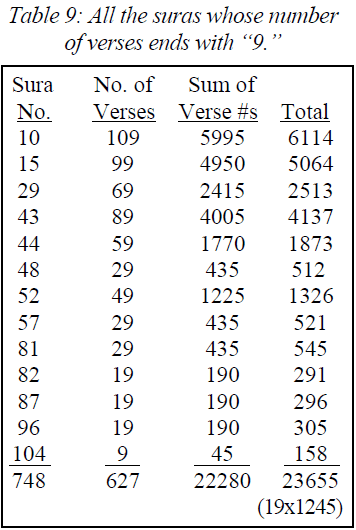
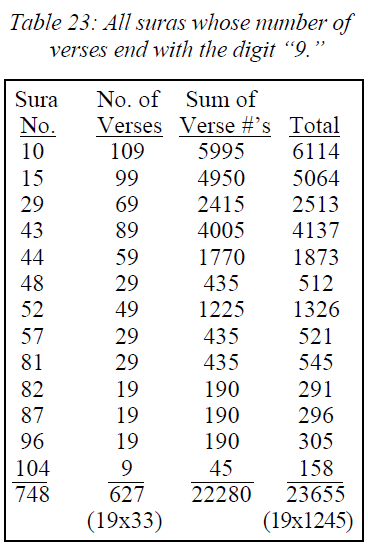
[20] The falsifiers wanted us to believe that Sura 9 consists of 129 verses. The number 129 ends with the digit “9.” Let us look at the first sura and the last sura whose number of verses ends with the digit “9.” These are Sura 10 and Sura 104. By adding the sura number, plus the number of verses, plus the sum of verse numbers, from Sura 10 to Sura 104, we get a grand total that equals 23655, or 19×1245. The details are shown in Table 9. The inclusion of Sura 9 with the wrong number of verses, 129, would have altered both the sum of verse numbers and the cumulative total—the sum of verse numbers would have become 627 + 129 = 756, and the cumulative total would not be 23655—and the Quran’s code would have been violated (Table 9).

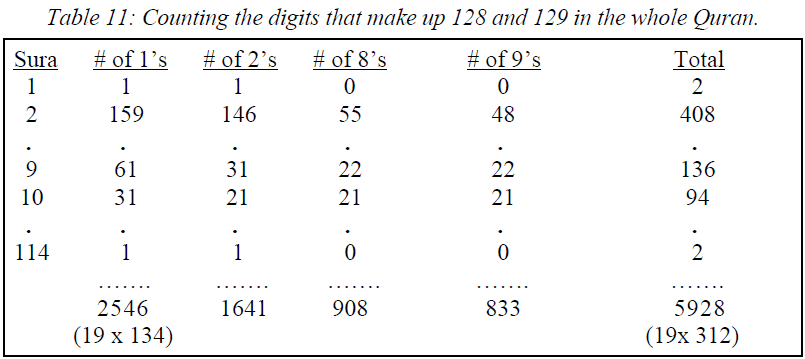
[21] The false injection consisted of Verses 128 and 129 at the end of Sura 9. These numbers contain two 1’s, two 2’s, one 8, and one 9. Counting all the 1’s in all verse numbers in the Quran gives a total of 2546 (19×134), provided the correct number of verses in Sura 9, 127, is used. If 128 and 129 are included, the grand total becomes 2548, not a multiple of 19.

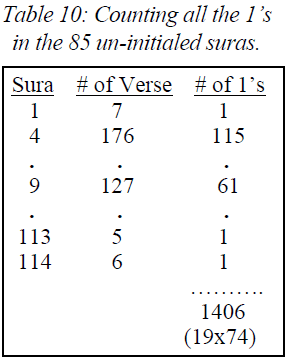
[22] Looking at all the verse numbers in the 85 un-initialed suras and counting all the 1’s, the total count of the digit “1” is 1406, or 19×74. If Sura 9 consisted of 129 verses, we would see two additional 1’s, and the code would be violated.

[23] Counting all the 2’s, 8’s, and 9’s in all the verse numbers of the whole Quran gives a total of 3382, or 19×178. The grand total of all the 1’s, 2’s, 8’s, and 9’s is 2546 + 3382 = 5928, 19×312. Since 128 and 129 contain 6 digits, the inclusion of these human injections causes the total count to be 5928 + 6 = 5934, not a multiple of 19.

[24] The total count of all the digits (1 through 9) in all the verse numbers of the 85 un-initialed suras, including Sura 9 with 127 verses, is 27075, or 19x19x75.

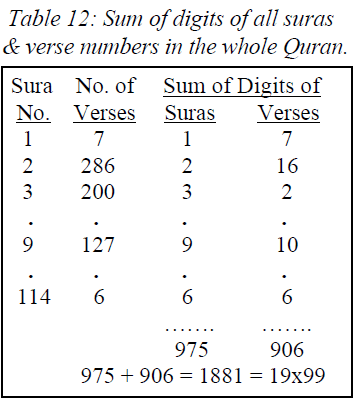
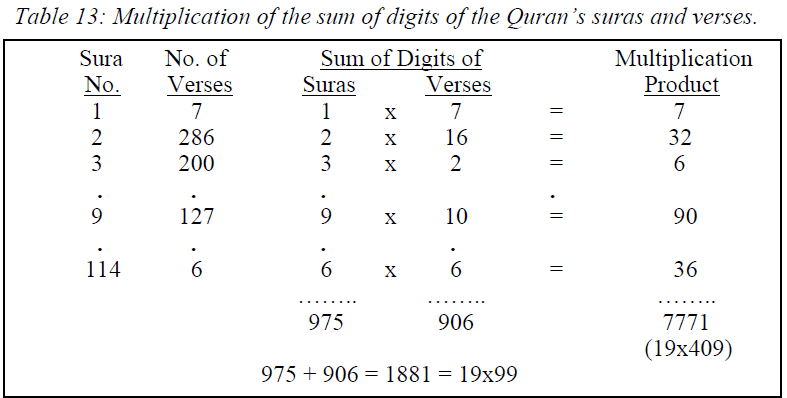
[25] Adding up the digits of the Quran’s suras and verses produces a multiple of 19, provided the correct number of verses for Sura 9, 127, is taken. The total for all sura-number digit sums is 975, and for all verse-count digit sums is 906. The grand total is 975 + 906 = 1881 = 19×99. This would not hold if Sura 9 consisted of 129 verses.

[26] Multiplying (rather than adding) the digit sum of each sura number by the digit sum of its verse count, and totaling across all suras, gives 7771, or 19×409.

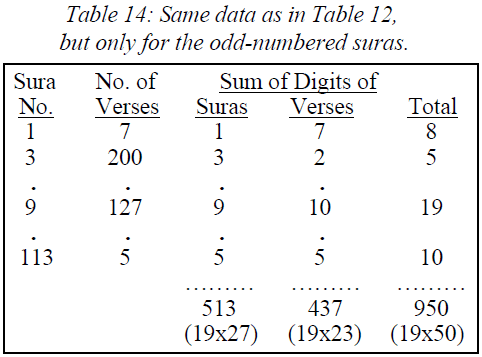
[27] Sura 9 is an odd-numbered sura. Carrying out the calculations of Item 26 for odd-numbered suras only: the total for the suras is 513 (19×27), the total for the verses is 437 (19×23), and the grand total is 950 (19×50).

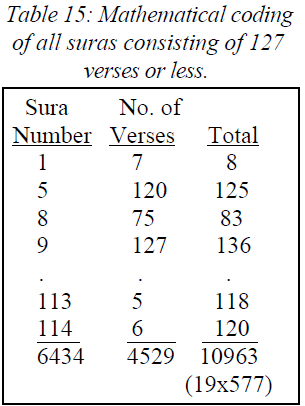
[28] Taking all suras with 127 verses or less (105 such suras), the sum of the sura numbers plus the sum of their verse numbers is 10963, or 19×577. Sura 9 is the only sura with exactly 127 verses in this list. If Sura 9 had 129 verses, it would be excluded, the total would be 10827, and the phenomenon would be violated.

[29] Looking at all odd-numbered suras whose number of verses is also odd (27 such suras, including Sura 9 with 127 verses), the sum of sura numbers plus sum of verse numbers is 2774, 19×146. Using the wrong count of 129 for Sura 9 destroys this.

[30] The correct number of verses in Sura 9, 127, is a prime number. Looking at all suras whose verse count is prime, the digits of the sura numbers add up to 137, the digits of the verse counts add up to 129, and the grand total is 266 = 19×14.

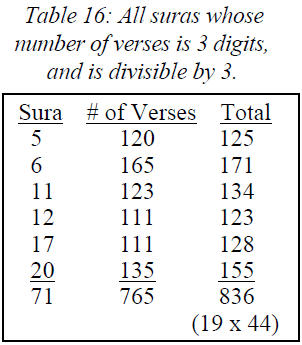
[31] Looking at suras whose number of verses is divisible by 3 and consists of 3 digits, the total of sura numbers is 71 and total number of verses is 765, giving a grand total of 836, or 19×44. If Sura 9 had 129 verses it would have been included, destroying this phenomenon.

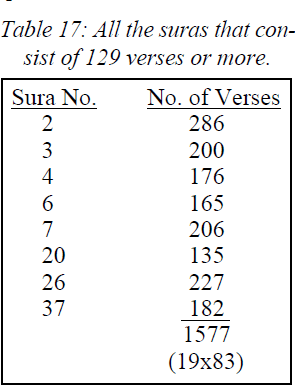
[32] If Sura 9 had 129 verses, and we looked at all suras with 129 verses or more (8 such suras with 1577 total verses, 19×83), adding Sura 9’s 129 would make the total 1706, not a multiple of 19.

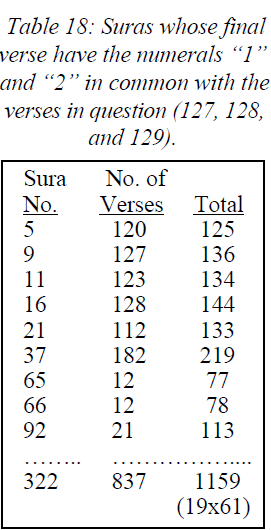
[33] The numbers 127, 128 and 129 share the digits “1” and “2.” Suras whose verse count contains both digits 1 and 2 sum (sura numbers + verse counts) to 1159, 19×61. Including Sura 9 as 129 verses would make the total 1161, not a multiple of 19.

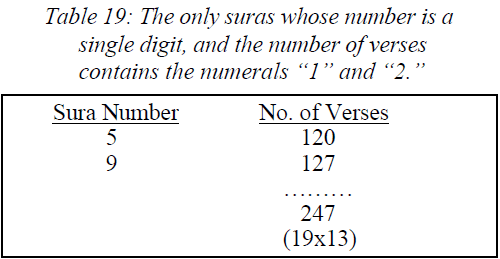
[34] Sura 9 is a single-digit sura whose verse count contains “1” and “2.” The only other such sura is Sura 5 (120 verses). Together: 120 + 127 = 247 = 19×13. With 129 verses this would be 249, not a multiple of 19.

[35] Suras whose verse count begins with digit “1” (30 such suras) have a sum of verse numbers (1+2+…+n) totaling 126122, or 19×6638. With Sura 9 at 129 verses, the total would be 126379, not a multiple of 19.

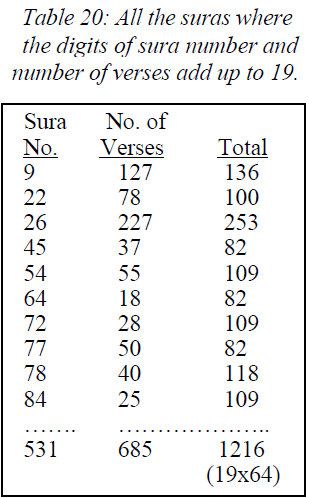
[36] Sura 9’s digits (9+1+2+7) add up to 19. Suras where sura-number-plus-verse-count digits add to 19 (10 such suras) total 1216, or 19×64.

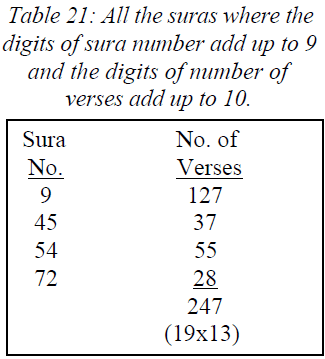
[37] (Discovered by Gatut Adisoma of Masjid Tucson.) Suras where the sura digits add to 9 and verse-count digits add to 10 are Suras 9, 45, 54, and 72 (127, 37, 55, 28 verses). Total verses: 247, 19×13.

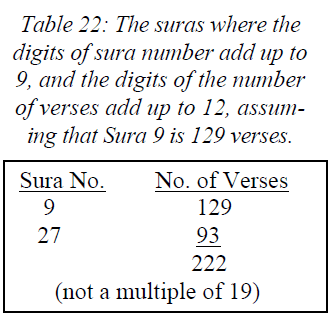
[38] If Sura 9 had 129 verses, the only other sura whose sura-digits add to 9 and verse-digits add to 12 would be Sura 27, giving 129+93=222, not a multiple of 19.

[39] Suras whose verse count ends in “9” (13 such suras, excluding Sura 9) total 627 verses, 19×33, and sura+verses+sum-of-verse-numbers total 23655, 19×1245.

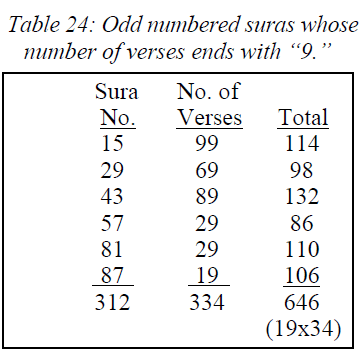
[40] Odd-numbered suras whose verse count ends in “9”: total of sura number plus verse count is 646, or 19×34. Including Sura 9 at 129 would make it 784, not a multiple of 19.

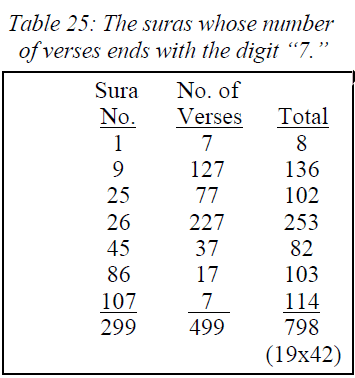
[41] Suras whose verse count ends in “7” (7 such suras including Sura 9 with 127) have a grand total (sura number + verse count) of 798, 19×42.

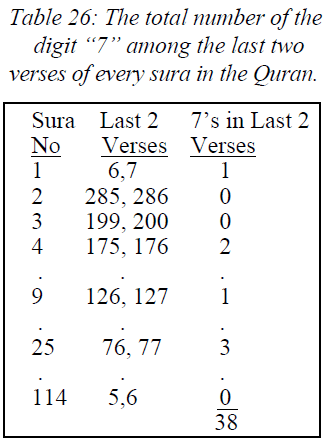
[42] Counting occurrences of the digit “7” among the last two verse numbers of every sura in the Quran gives 38, 19×2. If Sura 9’s last verse were 129 instead of 127, the count would be 37, not a multiple of 19.

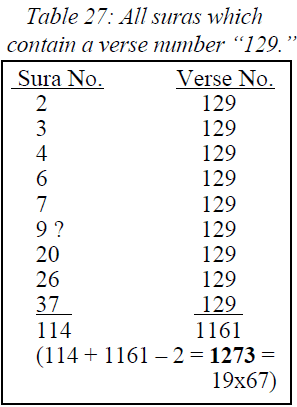
[43] Assuming Sura 9 has 129 verses, and looking at all suras containing a verse numbered 129 (9 such suras), the sura numbers total 114 (19×6) and the verse-129 numbers total can only reach a multiple of 19 if 2 is deducted — pointing to Sura 9 as the sura with 2 extra verses. 114 + 1161 − 2 = 1273 = 19×67.

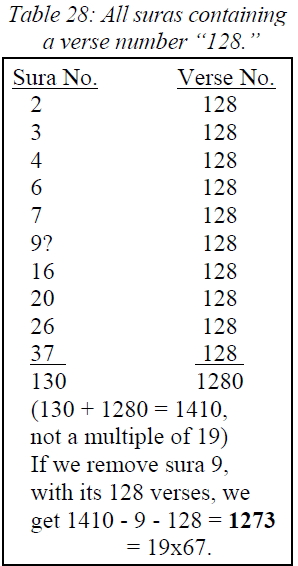
[44] Looking at suras containing a verse numbered 128 (same list plus Sura 16, which genuinely has 128 verses), the total is 1410, not a multiple of 19 — unless Sura 9 is removed, giving 1273, 19×67, matching Item 43. This singles out Sura 9 as containing the false verses.

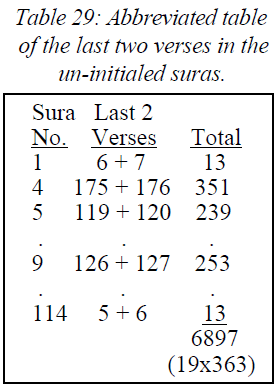
[45] Taking the 85 un-initialed suras and summing their last two verse numbers gives 6897, 19×363, confirming Sura 9’s last two verses as 126 and 127.

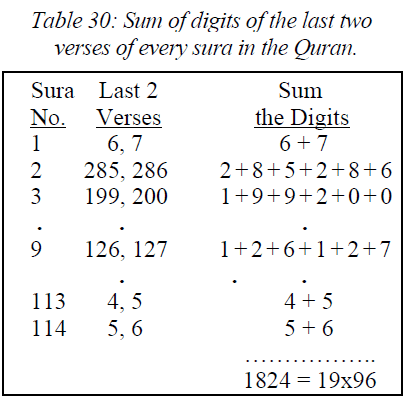
[46] Summing the digits of the last two verse numbers of every sura in the Quran gives 1824, 19×96, confirming Sura 9’s last two verses are 126 and 127, not 128 and 129.

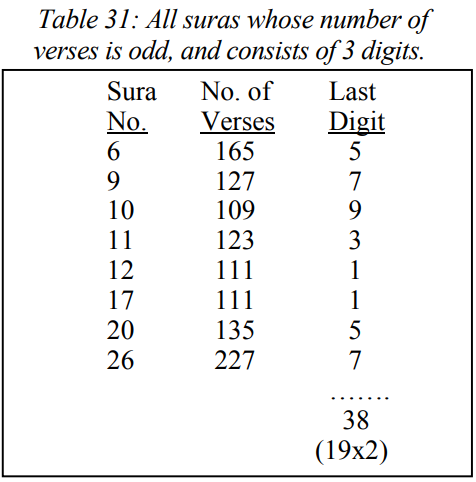
[47] Suras whose verse count has 3 digits (18 such suras, including Sura 9’s 127): summing the last digit of each verse count gives 76, 19×4. If Sura 9 had 129 verses, its last digit would be 9 instead of 7, making the total 78, not a multiple of 19.

[48] Among those, suras with an odd 3-digit verse count (8 suras including Sura 9): the sum of last digits is 38, 19×2. With 129 verses, Sura 9’s last digit would be 9, making the sum 40, not a multiple of 19.

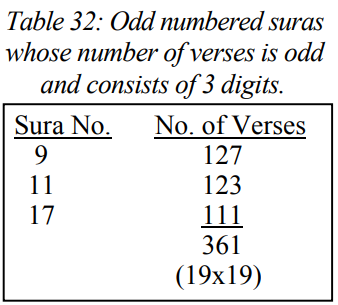
[49] Among odd-numbered suras with odd 3-digit verse counts, only three exist: Suras 9, 11, and 17 (127, 123, 111 verses).

[50] Adding the individual digits of these three suras’ verse counts: 1+2+7+1+2+3+1+1+1 = 19. With 129 for Sura 9, this would be 1+2+9+1+2+3+1+1+1 = 21, breaking the pattern.

[51] Adding the individual digits of the three sura numbers (9, 11, 17): 9+1+1+1+7 = 19.

[52] If Sura 9 had 129 verses (divisible by 3), and we require sura odd-numbered, 3-digit odd verse count divisible by 3, only Suras 11 and 17 qualify. Their digit sum is 1+1+1+2+3+1+7+1+1+1 = 19 — only true if Sura 9 has 127 verses.

[53] Sura 9 (odd-numbered, odd verse count ending in 7, prime verse count, sura number divisible by 3 & 9) shares these traits only with Sura 45 (37 verses). Digit sums: 9+1+2+7=19 and 4+5+3+7=19; combined total 38.

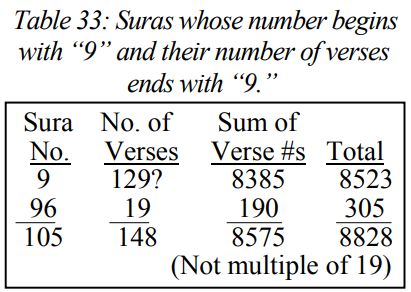
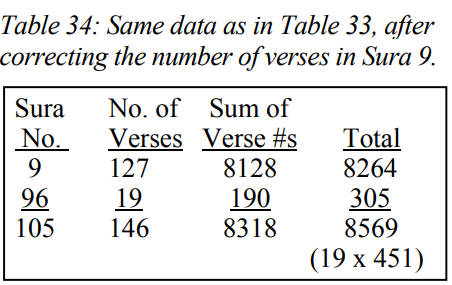
[54] If Sura 9 had 129 verses, the only suras whose number begins with “9” and verse count ends in “9” would be Sura 9 and Sura 96, with a grand total of 8828, not a multiple of 19. Correcting Sura 9 to 127 verses gives 8569, 19×451.

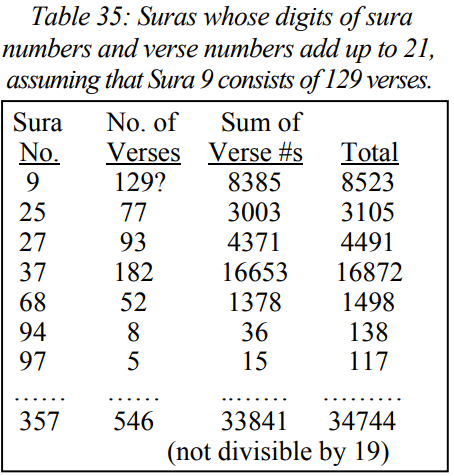
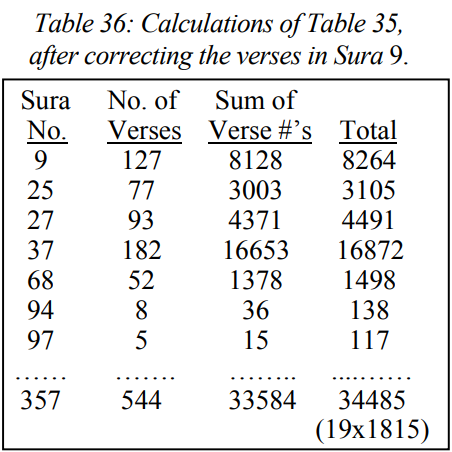
[55] If Sura 9 had 129 verses, its digit sum would be 21. Suras with verse-count digit sum of 21 (7 such suras) would total 34744, not a multiple of 19. Using the correct 127 verses, the total becomes 34485, or 19×1815.

[56] If Sura 9 had 129 verses (odd, divisible by 3, verse count divisible by 3, ending in 9), only Sura 15 shares these traits. Combined (9+129+15+99=252) is not a multiple of 19. Using the correct data (just Sura 15 alone, 15+99=114=19×6) restores the pattern.

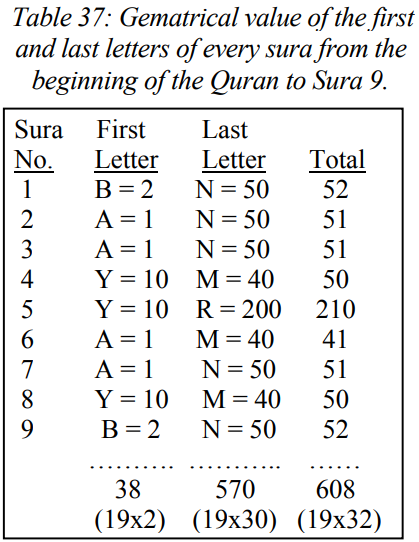
[57] The last statement in 9:127 describes the disbelievers as “LAA YAFQAHOON” (they do not comprehend), ending in the letter “N” (Noon). The falsifiers’ version would end in “M” (Meem), from “AZEEM.” Examining first and last letters of every sura from the beginning to Sura 9 by gematrical value confirms the last true letter must be “N.”

[58] (Discovered by Ihsan Ramadan of Masjid Tucson.) 43 suras end with the letter “N,” matching Sura 9. Adding the sura numbers plus the count of such suras gives 1919 (a multiple of 19), confirming Sura 9 ends in “N,” not “M.”

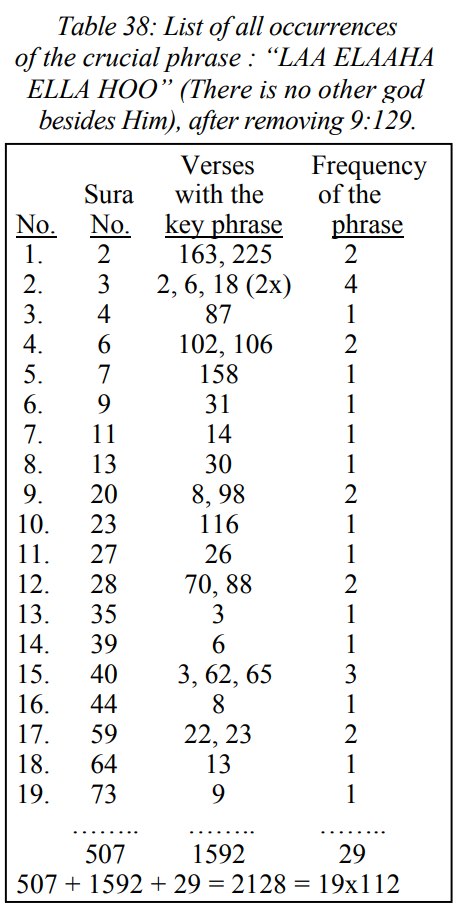
[59] The phrase “LA ELAAHA ELLA HOO” (There is no god except He) occurs in the false injection 9:129. Excluding 9:129, this phrase occurs 29 times in 19 suras. Adding the sura numbers, the verse numbers where it occurs, and its occurrence count gives 2128, or 19×112.

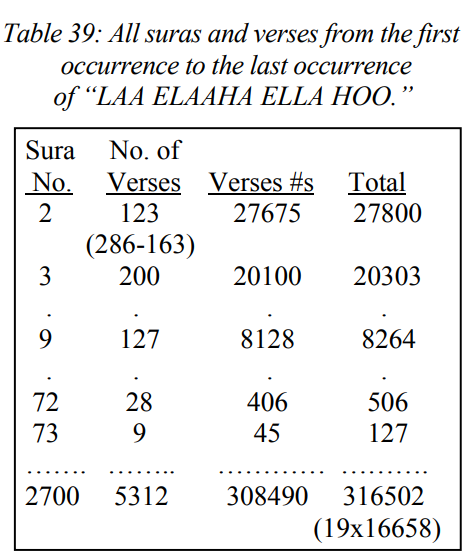
[60] From the phrase’s first occurrence (2:163) to its last (73:9), the sum of sura numbers, verse counts, and sum of verse numbers is 316502, or 19×16658.

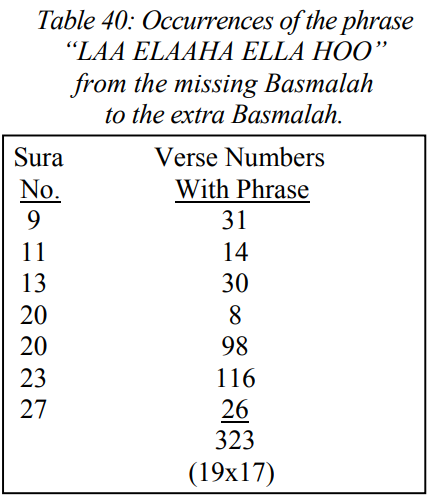
[61] The phrase occurs 7 times between the missing Basmalah of Sura 9 and the extra Basmalah of Sura 27. The sum of these 7 verse numbers is 323, or 19×17. If 9:129 were included, the total would be 452, not a multiple of 19.

The Ultimate Quranic Miracle

[62] (Discovered by Abdullah Arik.) Writing the number of verses in every sura followed by the numbers of every verse in that sura, in sequence, from the beginning to the end of the Quran, produces a number with 12692 digits (19×668), which is itself also a multiple of 19. Using 129 instead of 127 for Sura 9 would break both properties.

[63] Writing sura number 9, followed by its correct verse count 127, followed by the verse numbers 1 through 127, produces a number that is a multiple of 19.

[64] Applying the same method but using only the last digit of each odd-numbered verse in every sura produces a 3371-digit number divisible by 19. This depends on Sura 9 being represented correctly.

[65] Applying the same method to the 85 un-initialed suras only (each sura’s verses written in sequence, without the verse count prefix) produces a 6635-digit number divisible by 19. This depends on Sura 9 having 127 verses, not 129.


God’s Messenger of the Covenant Destined to Purify the Quran

[66] It is mathematically coded that “The person destined to prove that Sura 9 consists of 127 verses is Rashad Khalifa, God’s Messenger of the Covenant” (see Appendix 2). The gematrical value of “Rashad” (as written in the Quran, 40:29, 38) is 505 (R=200, Sh=300, A=1, D=4). The gematrical value of “Khalifa” (as written in 38:26) is 725 (Kh=600, L=30, I=10, F=80, H=5). Writing 505, then 725, then 9, then 127 produces 5057259127, a multiple of 19 (19 x 266171533).

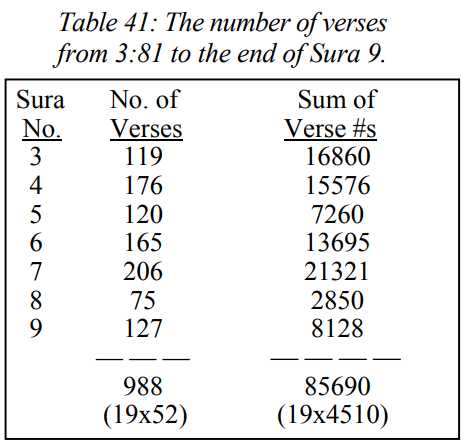
[67] The number of verses from 3:81, where God’s Messenger of the Covenant is prophesied, to 9:127, is 988 (19×52).

[68] The sum of verse numbers from 3:81 to 9:127 is also a multiple of 19.

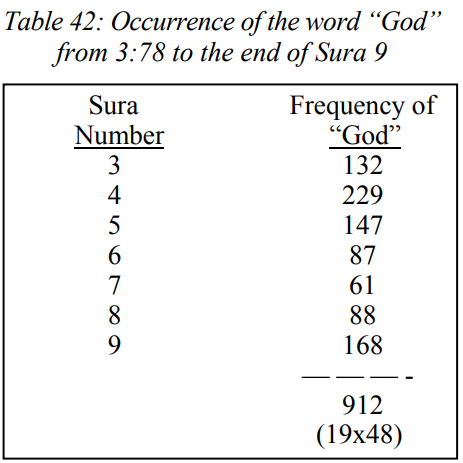
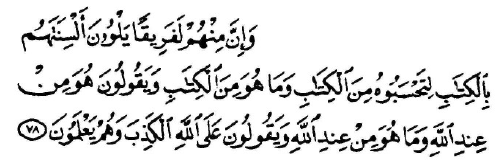
[69] In Verse 3:78, just 3 verses before proclaiming God’s Messenger of the Covenant, the word “God” number 361 (19×19) occurs. This verse informs us that some falsifiers will “add falsehood to the Quran, then claim that it is part of the Quran; they attribute lies to God, knowingly.”

[70] The word “God” occurs 912 times (19×48) from Verse 3:78, which exposes the falsifiers, to 9:127.

[71] The number of letters plus the number of words in 3:78 and in the false verses 9:128-129 give the same total, 143. Verse 3:78 consists of 27 words and 116 letters; 9:128-129 consist of 115 letters and 28 words.

What Can We Say?

The overwhelming physical evidence provided by the Almighty to protect and authenticate His message leaves no doubt that: (1) no distortion of any kind can enter the Quran, (2) Verses 9:128-129 do not belong in the Quran, and (3) every element in the Quran is mathematically structured far beyond human capabilities—the number of suras, the number of verses, the numbers assigned to the suras and verses, the frequency of occurrence of key expressions, the number of words, the number of letters, and the unique and often uncommon spelling of certain words.

This Appendix documents a profound miracle in its own right. Vast and utterly overwhelming as it is, it does not surpass or even match the overall mathematical miracle of the Quran which is detailed in Appendix One. This merely confirms the fact that the Almighty Author of the Quran has deliberately permitted the blasphemous addition of two verses to Sura 9 in order to:

  1. Demonstrate an essential function of the Quran’s mathematical composition.
  2. Prove the impossibility of tampering with the Quran.
  3. Fulfill God’s promise to distinguish the believers and expose the hypocrites.

Why Did God Permit It For 1400 Years??

Due to the mass corruption of Islam shortly after the prophet Muhammad’s death, God obviously has fulfilled His pledge in 47:38. A divine decree issued in Sura 47, entitled “Muhammad,” Verse 38 (19×2), stipulates that “if the Arabs failed to uphold the Quran, God will dismiss them from His grace, and substitute other people in their place.”

When the Arabs distorted the Quran a few years after the Prophet’s death, and exterminated the Prophet’s family in the process, they incurred God’s pledge of 47:38, and no longer deserved to possess the Quran; the true Quran. The evidence is irrefutable that the Arabs have abandoned the Quran en masse.

For example, there is not a single mosque in the so-called Muslim world today (1989) that upholds the crucial commandment: “The mosques belong to God; you shall not invoke anyone else besides God” (72:18).

The call to prayer (Azan) and the prayer itself are no longer devoted to God alone; Muhammad’s name is invariably invoked along with the name of God.

The “First Pillar of Islam” is clearly stated in the Quran, 3:18 & 47:19, and its words are decreed to be: LAA ELAAHA ELLA ALLAH (There is no other god besides God). But the Muslims, as early as the first century AH, do not want God if Muhammad is not invoked along with Him. This is easily demonstrable today by going into any mosque and declaring: “LAA ELAAHA ELLA ALLAH;” this will actually enrage today’s Muslims. This behavior is documented in the Quran, 39:45. Moreover, my own research has now convinced me that the traditional Muslims are forbidden by God from uttering the Quranic, divinely dictated Shahaadah: “Ash-hadu Allaa Elaaha Ellaa Allah.” They can never say this Shahaadah (without invoking Muhammad’s name). Test them yourself. The First Pillar of the distorted Islam, LAA ELAAHA ELLA ALLAH, MUHAMMAD RASOOL ALLAH, does not conform with God’s commandments that came to us through Muhammad (see Appendix 13).

A number of other commandments are violated as well by this Mohammedan Shahaadah. For example, the Quran enjoins us repeatedly from making any distinction among God’s messengers (2:136, 285; 3:84). The distorted Shahaadah gives more distinction to Muhammad, against his will. Despite the Quran’s repeated assertions that it is “complete, perfect, and fully detailed” (6:19, 38, & 114), the “Muslims” have refused to believe their Creator; they uphold such ridiculous and nonsensical sources as Hadith and Sunna. This unanimous rebellion against God and His messenger, and the mass reversion to glaring idolatry—idolizing the Prophet and the saints—called for fulfillment of God’s pledge in 47:38.

In view of the incontrovertible divine evidence presented here, and in Appendices 1, 2, and 26, one can truly appreciate the following verses:

Surely, we have revealed this message, and surely, we will preserve it. [15:9]

Say, “If all the humans, and all the jinns, banded together, in order to produce a Quran like this, they will surely fail, no matter how much assistance they lend one another.” [17:88]

The disbelievers rejected this message when it came to them, though it is a profound scripture. No falsehood can enter it, through addition or deletion. For it is a revelation from the Most Wise, Most Praiseworthy. [41:41-42]

If we revealed this Quran to a mountain, you would see it trembling, crumbling, out of reverence for God. [59:21]


I acknowledge with thanks the valuable contributions of Mahmoud Ali Abib, Gatut Adisoma, Abdullah Arik, Ihsan Ramadan, Lisa Spray, and Edip Yuksel. Some of the astounding mathematical facts presented in this Appendix were discovered by these hard working researchers at Masjid Tucson.


Friday Sermon based on Appendix 24 of Authorized English Translation of the Quran by Rashad Khalifa (1989)

 

For more information:

The Mathematical Miracle of the Quran

One of the Great Miracles [74:35]

Quran: Unlike Any Other Book

Join us to listen to our online Friday meetings every Friday.

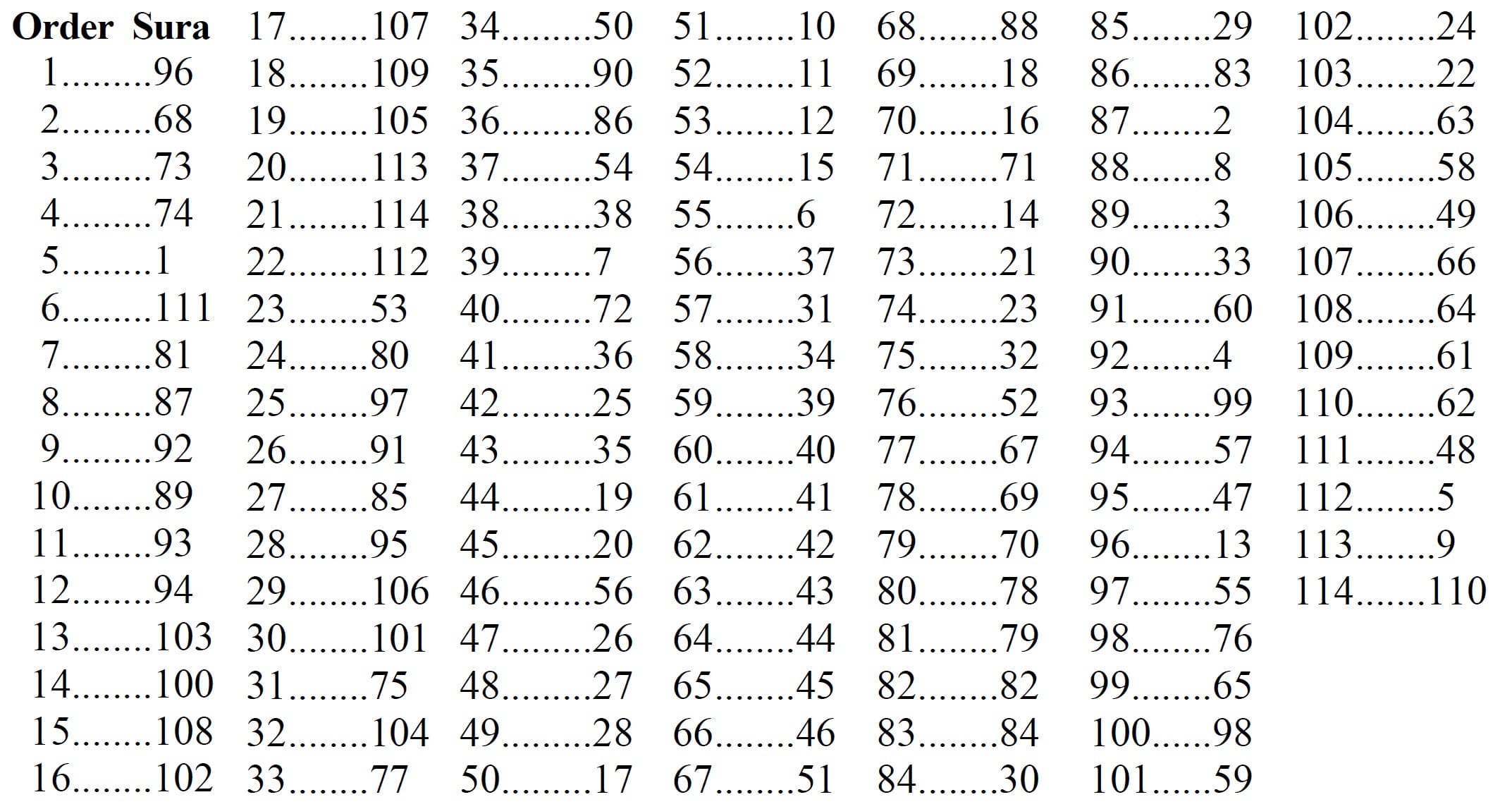
Chronological Sequence of Revelation


Chronological Sequence of Revelation:

34 – Sura 50: Q
38 – Sura 38: S


Friday Sermon based on Appendix 23 of Authorized English Translation of the Quran by Rashad Khalifa (1989)
 

For more information:

Quran: Unlike Any Other Book

We Made the Quran Easy [54:17]

Quran: All You Need for Salvation

Join us to listen to our online Friday meetings every Friday.

Jesus

Praise be to God! There is no other god except God.

The Quran, informs us that Jesus was a human messenger of God whose sole mission was to deliver God’s message; he never possessed any power, and is now dead (4:171, 5:75, 117). Those who consider Jesus to be God, or Son of God, or part of a trinity are “pagans” (5:17, 72, 73). Outstanding Christian scholars have reached these same conclusions (THE MYTH OF GOD INCARNATE, John   Hick, ed., The Westminster Press, Philadelphia, 1977 & THE MYTH MAKER, Hyam Maccoby, Harper & Row 1986). Christianity is the product of the Nicene Conferences, the first of which happened 325 years after Jesus.


The Bible’s Jesus

Jesus proclaimed aloud: “Whoever puts faith in me believes not so much in me as in him who sent me;…. For I have not spoken on my own; no, the Father who sent me has commanded me what to say and how to speak. Since I know that his commandment means eternal life, whatever I say is spoken just as he instructed me.”  

[ John 12:44-50 ]

“I cannot do anything of myself. I judge as I hear, and my judgment is honest because I am not seeking my own will but the will of him who sent me.”

[ John 5:30 ]

Jesus said: “My doctrine is not my own; it comes from him who sent me.”

[ John 7:16 ]

“Men of Israel, listen to me! Jesus of Nazareth was a man whom God sent to   you with miracles, wonders, and signs as his credentials. These God worked through him in your midst, as you well know.”

[ Acts 2:22 ]

 “…The man who hears my word and has faith in him who sent me possesses eternal life.”    

[ John 5:24 ]

“Whoever welcomes me welcomes, not me, but him who sent me.”

[ Matthew 10:40, Mark 9:37, Luke 9:48, & John 13:20]

“…I have not come of myself. I was sent by One who has the right to send, and him you do not know. I know him because it is from him I come; he sent me.”

[ John 7:28-29 ]

Jesus looked up to heaven and said, “…Eternal life is this: to know you, the only true God, and him whom you have sent, Jesus Christ.”

[ John 17:1-3 ]

All who are led by the Spirit of God are sons of God.

[ Romans 8:14 ]

Jesus looked upward and said, “Father, I thank you for having heard me. I know that you always hear me but I have said this for the sake of the crowd, that they may believe that you sent me.”

[ John 11:41-42 ]

As he was setting out on a journey a man came running up, knelt down before him and asked, “Good Teacher, what must I do to share in everlasting life?” Jesus answered, “Why do you call me good? No one is good but God alone.”

[ Mark 10:17-18 ]

“None of those who call me ‘Lord’ will enter the kingdom of God, but only the one who does the will of my Father in heaven.”

[Matthew 7:21]

“…Go to my brothers and tell them, I am ascending to my Father and your Father, to my God and your God.’ ”

[ John 20:17 ]

“God is my Lord and your Lord; you shall worship Him alone. This is the right path.”

[ Quran 3:51, 19:36, & 43:64 ]

Trinity, the doctrine of God taught by Christians asserts that God is one in essence but three in “person,” Father, Son, and Holy Spirit. Neither the word Trinity, nor the explicit doctrine as such, appears in the New Testament, nor did Jesus and his followers intend to contradict the Shema in the Old Testament which is “Hear O Israel: The Lord our God is one” (Deut. 6:4).

[Encyclopedia Britannica, 1975]


Friday Sermon based on Appendix 22 of Authorized English Translation of the Quran by Rashad Khalifa (1989)
 

For more information:

Jesus – How overestimated!? How underestimated!?

In Defense of the Bible

How to Use the Bible Today?

Join us to listen to our online Friday meetings every Friday.

Satan: Fallen Angel


Praise be to God! There is no other god except God.

In God’s kingdom, certain creatures are necessarily given the powers needed to perform their duties. Satan believed that his God-given powers qualified him to function as an independent “god”. As evidenced by the prevalence of misery, disease, accidents, and war in his dominion, we now know that Satan is incompetent.

The Quran clearly states that Satan was an angel, by virtue of the immense powers and rank bestowed upon him. This is why he is addressed as an angel (2:34, 7:11, 15:29, 17:61,18:50, 20:116, 38:71) prior to his fall. By definition, a jinn is a fallen angel (18:50). Satan’s rebellion teaches us that the angels were created with minds of their own, and absolute freedom of choice (2:34).


Friday Sermon based on Appendix 21 of Authorized English Translation of the Quran by Rashad Khalifa (1989)
 

For more information:

King of Chaos

Why Were We Created?

Hadith and Sunna: Satanic Innovations

Join us to listen to our online Friday meetings every Friday.