[search-in-place-form in_current_page="1"]

L’Essentiel de l’Islam (FRENCH)

Qu’est-ce que l’Islam ?

Au nom de Dieu, Très Gracieux, Très Miséricordieux. L’Islam a en fait commencé avec le premier homme, le premier être humain, Adam ; il était le premier messager de Dieu ; il a apporté à ses enfants et petits-enfants le message d’adorer Dieu seul et c’est cela l’Islam, se soumettre à Dieu, adorer Dieu seul.


Abraham était le Prophète Originel de l’Islam

Une série de messagers après Adam a apporté le même message – adorez Dieu seul (21:25) – le premier commandement de la Bible, le message de Moïse, le message de Jésus, les messages de tous les prophètes d’Israël, David, Salomon et ainsi de suite, est un seul et même, le premier commandement – adorez Dieu de tout votre cœur, de tout votre corps et de toute votre âme – adorez Dieu seul. Le Coran indique très clairement que la religion en ce qui concerne Dieu est l’Islam (3:19).

Il n’y a donc qu’une seule religion en ce qui concerne Dieu. Si vous voulez être plus précis, le prophète originel de l’Islam est Abraham, parce qu’il a apporté toutes les pratiques religieuses dans l’Islam, et nous le voyons tout au long du Coran. Par exemple, dans la Sourate 21, le verset 73 nous dit qu’Abraham était la source originale – bien sûr, Dieu est la source originale de tout – mais Abraham nous a livré la Prière Salat, les Prières de Contact et la Charité Zakat. Et nous le voyons aussi avec le Jeûne, le Pèlerinage du Hadj, toutes les pratiques de l’Islam nous sont venues à travers le prophète Abraham. Le prophète Mohammed a apporté le message, l’écriture de l’Islam, qui est le Coran.


Le Rôle du Prophète Mohammed était de Livrer le Message Final de Dieu – le Coran

Le prophète Mohammed a apporté le message, l’écriture de l’Islam, qui est le Coran. Dieu nous a révélé le Coran par l’intermédiaire du prophète Mohammed. Le prophète Mohammed est né en l’an 570 après J.-C., et à l’âge de 40 ans, il a été nommé prophète final de Dieu. Prophète signifie qu’il a apporté une nouvelle écriture, la dernière édition du message de Dieu au monde, et c’est le Coran.

Le Coran a été donné au prophète Mohammed en une nuit, comme nous le voyons dans le Coran dans de nombreux versets – dans la Sourate 17, verset 1, dans la Sourate 44, verset 3, et dans la Sourate 97. La libération du Coran de l’âme de Mohammed à sa bouche et à sa main s’est faite sur une période de 23 ans – de l’âge de 40 ans à l’âge de 63 ans – il est mort à l’âge de 63 ans. Ainsi, sur une période de 23 ans, le Coran a été libéré après avoir été placé dans le cœur de Mohammed lors de la Nuit du Pouvoir (en arabe, Laylatul Qadr). Le but de la libération du Coran sur une période de 23 ans est d’aider le prophète et les croyants de l’époque à mémoriser le Coran tel qu’il était libéré et cela est indiqué dans le Coran. Dans le Coran, il est dit, « le fixer dans ta mémoire » (25:32). La libération a donc été très lente, très progressive, et cela a pris 23 ans.

Dieu a créé l’univers, et a créé l’espèce humaine, et par Sa miséricorde, Il a envoyé des messagers et des livres pour nous parler de Lui. Tous ces messagers et tous les livres que Dieu nous a envoyés prêchent une seule et même religion. Le premier messager était Adam lui-même, le père de toute l’humanité. Après lui sont venus des messagers, comme Noé, Jésus, Moïse, Mohammed. Mohammed était le dernier prophète, apportant la dernière écriture, le Coran, et dans le Coran, nous trouvons tout ce dont nous avons besoin – tous les devoirs, obligations, commandements, interdictions dans l’Islam.

Le Coran est l’écriture final. C’est l’achèvement du message, parce que les Écritures précédentes étaient adaptées à ce stade du développement humain, le Coran est venu compléter le tableau, et maintenant nous avons la religion finale, complète, l’Islam. Le Coran est tout ce dont vous avez besoin, en fait, parce que Dieu a dit que le Coran est complet, parfait et entièrement détaillé ; si vous allez à une autre source, vous désobéirez à Dieu et désobéirez au messager de Dieu, Mohammed, qui a sorti ce Coran de sa bouche.

Dieu nous a fait sortir le Coran de la bouche de Mohammed, et vous désobéiriez à Dieu et désobéiriez à Mohammed, si vous suivez d’autres sources que le Coran, et en particulier, je veux dire des sources comme les Hadiths, la Sunnah et tous les autres livres et choses que les traditions et les coutumes ont inventées.

Si vous allez à une source autre que le Coran, vous désobéirez à Dieu, car il est clair que Dieu dit dans la sourate numéro 6, verset 114, par exemple, que le Coran est entièrement détaillé – vous n’avez besoin de rien d’autre. Dieu dit au verset 19 de la sourate numéro 6 que le Coran est ce qui a été donné à Mohammed pour livrer au monde et qu’il est la seule source de guidance religieuse et d’éducation religieuse. Le Coran nous dit exactement quels sont les éléments essentiels de l’Islam, et ils le sont très rapidement – j’entrerai dans les détails à ce sujet plus tard :


Le Premier Pilier de l’Islam est : Adorer Dieu seul

Tout d’abord, vous devez croire en Dieu seul. Vous n’avez pas d’autres idoles. Vous êtes dévoué à Dieu seul, et cela est représenté par le Shahada, le fameux premier “pilier” de l’Islam.

Partons de cette idée – le premier pilier de l’Islam est la Shahada, et la Shahada est énoncée dans le Coran dans la sourate 3 verset 18. Il est dit : « Dieu témoigne qu’il n’y a pas d’autre Dieu que Lui », et aussi les anges et ceux qui possèdent la connaissance feront cette Shahada, qui est La ilaha ila Allah. C’est le premier pilier de l’Islam – sourate 3, verset 18 – la Shahada, le premier pilier de l’Islam est “La ilaha ila Allah”. Si vous voulez le rendre complet, alors vous dites : « Je témoigne qu’il n’y a pas d’autre Dieu qu’Allah, le seul Dieu.

Maintenant, n’ajoutez rien d’autre. Certaines personnes qui imitent les anciennes inventions et les vieilles traditions diront Ashadu An La Ilaha Ila Allah, puis elles feront une autre Shahada que Mohammed est un messager de Dieu. Nous savons que Mohammed est un messager de Dieu, mais si vous injectez cela dans la Shahada, cela ruine tout, parce que maintenant vous n’avez pas Dieu seul – vous mettez une idole, Mohammed, à côté de Dieu, et cela, soit dit en passant, est une interdiction très forte dans le Coran – de mettre tout autre nom en plus du nom d’Allah, le nom de Dieu. Nous trouvons cela dans la sourate 39, verset 45 – vous devez vous consacrer à Dieu seul – vous n’idolâtrez pas Mohammed et ne le mettez pas à côté de Dieu. Cela ira contre Dieu et contre Mohammed. Ainsi, le premier pilier de l’Islam est la Shahada, La Ilaha Ila Allah.


Le Deuxième Pilier de l’Islam est les Prières de Contact (Actions et Mots Spécifiques)

Le deuxième pilier est d’observer cinq prières de contact chaque jour. C’est la nourriture pour votre âme. C’est une faveur que Dieu fait pour vous. Vous ne faites pas la faveur à Dieu. Et les cinq Prières de Contact commencent avant le lever du soleil ; vous devez vous lever avant le lever du soleil afin de nourrir votre âme, de donner le petit déjeuner à votre âme – votre corps sera paresseux et ne voudra pas sortir du lit avant le lever du soleil, mais pour votre bien, sortez du lit avant le lever du soleil et faites la Prière de Contact du matin, par laquelle vous contactez votre Créateur et nourrissez votre âme.

Soit dit en passant, les détails des prières sont donnés sur une autre vidéo que nous appelons Principes de la Prière Musulmane où vous pouvez voir comment les prières de contact sont effectuées de la bonne manière, et non les innovations traditionnelles que nous voyons dans le monde Musulman.

La deuxième prière est la Prière du Midi et elle commence dès que le soleil descend du point le plus élevé du ciel. C’est la Prière du Midi. Elle se compose de quatre unités. (La prière du matin est de 2 unités ; la Prière de Contact du Midi est de 4 unités).

La Prière de Contact de l’Après-midi se fait environ trois ou quatre heures après la Prière du Midi en milieu d’après-midi. Et la quatrième Prière de Contact est la Prière du Coucher du Soleil, et elle se fait immédiatement après le coucher du soleil. Et la dernière Prière de Contact, la prière de la nuit, doit être faite environ deux heures après le coucher du soleil. Ce sont donc les cinq Prières de Contact, et elles représentent le deuxième pilier de l’Islam.


Le Troisième Pilier de l’Islam est Jeûner Pendant Un Mois (Ramadan)

Le troisième pilier de l’Islam est le jeûne (en arabe, « Siyam ») (2:183). Dieu nous commande de jeûner pendant un mois de l’année, et c’est le neuvième mois du calendrier lunaire (2:185).

Maintenant, je souris parce qu’il y a un test énorme dans ce système où l’année lunaire est plus courte que l’année solaire, et cela fait que le mois de Ramadan se déplace d’environ 10 à 15 jours chaque année.

Donc, cela arrive parfois en hiver, quand la journée est agréable et courte, et que le jeûne est très facile, et se déplace vers l’été où les jours sont très longs 16 heures ou plus, parfois, et que la journée est chaude et que vous ne pouvez pas manger ou boire pendant cette longue période, et beaucoup de gens abandonneront. Ils ne jeûneront pas, même si personne ne meurt en ne mangeant pas ou en ne buvant pas pendant 24 heures. Mais, certaines personnes abandonneront, et vous pouvez voir que le système est conçu pour montrer qui jeûnera et obéira au commandement de Dieu, quelle que soit la durée de la journée.

Ce changement de la journée de jours courts et froids à longs et chauds nous montrera qui sont les décrocheurs, qui ne jeûneront que si la journée est courte, agréable et froide. C’est donc le troisième pilier de l’Islam, jeûner pendant le mois de Ramadan, le neuvième mois du calendrier Islamique.

Comme vous le voyez, le jeûne du Ramadan est également conçu pour apprivoiser le cheval sauvage qu’est votre corps. Voyez, votre corps veut manger et boire, et vous, la vraie personne ou l’âme, dictez au corps en disant : “Non, tu ne mangeras ni ne boiras jusqu’au coucher du soleil”, parce que le jeûne consiste à ne pas manger ou boire ou à avoir des rapports sexuels de l’aube au coucher du soleil.

L’aube signifie environ deux heures avant le lever du soleil, jusqu’au coucher du soleil. Ne pas manger, ne rien boire, pas de sexe, et c’est le contrôle de votre cheval sauvage. Vous domptez le cheval sauvage qu’est votre corps, et vous pouvez voir que Dieu vous forme, vous enseigne à être une personne de forte volonté, et vous prépare à la vie éternelle de l’au-delà, la vraie vie, parce que dans la vraie vie qui vient après cette vie, Dieu veut les gens qui sont forts, qui ont pratiqué et fait de l’exercice, et qui savent comment se contrôler, je veux dire leur corps. Cela amène également votre âme à se nourrir, à grandir et à se développer.


Le Quatrième Pilier de l’Islam est la Charité Zakat

Le quatrième pilier de l’Islam est la Charité (en arabe « Zakat ») (2:43). Il y a une Charité Obligatoire où vous vous asseyez et vous calculez exactement ce que vous possédez, quels sont vos biens, et vous donnez une partie, une partie fixe de votre valeur nette.

Vous faites cela une fois par an, vous choisissez un jour spécifique de l’année, peut-être le dernier jour du Ramadan, ou le premier jour du Ramadan, ou le premier jour de janvier, un jour, un jour fixe de l’année, et vous vous asseyez ce jour-là, et vous calculez combien vous possédez.

Cela signifie que vous additionnez la valeur marchande de votre maison, de votre voiture, de vos vêtements, de tout ce que vous possédez. Si vous vendez tout cela aujourd’hui, combien cela vaudrait-il, la vraie valeur marchande, pas le prix de la chose neuve – mais la valeur marchande actuelle de tout ce que vous possédez, puis vous en donnez 2,5 %. Vous voyez que c’est un petit pourcentage, et vous le faites une fois par an, et cela va à des personnes spécifiques.

Le Coran les énumère dans cette priorité : d’abord, vos parents. Si vos parents sont riches – et ce sont les bénéficiaires de votre charité – si vos parents sont riches, les deuxièmes de la liste sont vos proches – vous donnez ces 2,5 %, vous les donnez à vos proches.

S’ils sont tous riches, alors vous trouvez des orphelins, des personnes qui n’ont pas de soutien, de soutien parental ou autre soutien ou quelque chose comme ça, et vous leur donnez cette charité.

Après les orphelins, vous donnez à l’étranger, quelqu’un qui voyage, qui est bloqué et qui n’a pas l’argent ou le billet de bus pour se rendre dans sa ville natale. Vous aidez cette personne.

Ainsi, l’ordre dans le Coran est : les parents, les proches, les orphelins, l’étranger voyageur, les pauvres, les mendiants, et ainsi de suite. Il y a donc un ordre spécifique pour donner ces charités.

Cependant, il y a aussi une charité générale appelé “sadaka”, et c’est une charité sur place ; vous marchez dans la rue et vous voyez une personne pauvre, et vous voulez aider, puis vous aidez cette personne et cela s’appelle “sadaka” ou charité.

Vous êtes censé être charitable toute l’année, tout le temps, vous devez être charitable, mais la Zakat est la Charité Obligatoire où vous la donnez à quelqu’un que vous connaissez personnellement, vous savez personnellement que ce type est pauvre et a besoin d’aide, et vous donnez vos 2,5 % à ces personnes que vous connaissez personnellement.

Vous ne pouvez pas considérer les impôts par exemple comme une charité Zakat, parce que vous ne savez pas où les impôts iront. Ils peuvent aller pour réparer la rue ou quelque chose, ou à l’armée ou quelque chose comme ça, mais l’idée derrière la Zakat est que vous la donnez aux gens que vous savez personnellement qu’ils sont dans le besoin, et le Coran énumère les parents d’abord, les proches, les vôtres ; vous commencez par votre propre famille, puis vous allez vers d’autres en dehors, dans cet ordre.


Le Cinquième Pilier de l’Islam est le Pèlerinage – Hadj à La Mecque

Le cinquième pilier de l’Islam est le pèlerinage du Hadj en terre sainte à La Mecque (2:196). Et ce n’est, bien sûr, que pour les personnes qui peuvent se le permettre.

Quand vous pouvez vous le permettre, vous allez à La Mecque, et vous observez le Hadj, et c’est la commémoration du prophète Abraham, pas de l’homme Abraham, mais de sa soumission exemplaire à Dieu.

Il pensait, il voyait un rêve une fois, et il pensait que Dieu lui commandait de sacrifier son fils unique, Ismaël, et il procéda à l’exécution de ce commandement, même si Dieu ne lui avait pas ordonné de le faire. Il pensait juste dans un rêve que Dieu lui ordonnait de le faire, mais il était prêt à sacrifier son propre fils en soumission à Dieu, et, bien sûr, Dieu est intervenu pour sauver Ismaël et Abraham de cette tragédie et le Dieu a substitué un mouton à sacrifier à la place d’Ismaël, et c’est ce que vous faites quand vous allez au Hadj.

Et le Hadj consiste à arriver à La Mecque vêtues uniquement de vêtements non personnalisés – juste un drap ou quelque chose comme ça – et de chaussures ou de sandales sans couture – des vêtements sans couture et des sandales sans couture – les femmes s’habillent d’une robe longue qui est simple, de sorte que vous ne pouvez pas distinguer les riches des pauvres.

Pour observer le Hadj, vous allez à La Mecque, vêtu de vêtements sans couture et de sandales sans couture – ceci est pour les hommes. Les femmes s’habillent modestement dans une robe modeste ordinaire (toute blanche par exemple) de sorte que vous ne pouvez pas faire la différence entre les riches et les pauvres.

Vous arrivez à La Mecque, et vous faites le tour de la Kaaba, à La Mecque, sept fois, puis vous allez entre Safa et Marwah, les collines de Safa et Marwa, sept fois, puis vous allez à Arafat, le mont Arafat, et vous restez là-bas toute la journée. Vous passez toute cette journée sur le mont Arafat à commémorer Dieu, à adorer et à prier, puis vous allez à Mina. C’est une petite ville près de La Mecque. Vous allez à Mina pendant deux ou trois jours. Ensuite, vous retournez à la Kaaba, vous y faites le tour sept fois, ce qui s’appelle “la circumambulation d’adieu” autour de la Kaaba, et c’est tout.

Maintenant, mon conseil pour vous est de ne jamais aller à Médine, parce que les gens vont à Médine et ils gâchent leur Hadj. Ils vont à la tombe du prophète Mohammed, au mausolée, et ils idolâtrent le prophète, et cela ruine tout, ruine toute la religion, pas seulement le Hadj (39:65). Donc, le Hadj ne doit être fait qu’à La Mecque où vous faites le tour de la Kaaba sept fois, entre Safa et Marwa sept fois, vous allez à Arafat pour une journée et à Mina pendant deux ou trois jours, et c’est tout. Ce sont des étapes spécifiques qui sont mentionnées dans le Coran.


Tout Notre Travail Serait Annulé, Si Nous Pratiquons le Culte des Idoles. Nous Devons Être Dévoués à Dieu Seul.

Et, soit dit en passant, tous ces devoirs de l’Islam nous sont venus par l’intermédiaire du prophète Abraham. Si vous regardez Sourate 22, le dernier verset, numéro 78, vous verrez qu’Abraham est la source, le père de l’Islam et le père des Musulmans, et si vous regardez sourate 16 verset 123, vous verrez que le prophète Mohammed a suivi la religion d’Abraham.

L’Islam est la religion d’Abraham. Il est le fondateur de l’Islam, et tous les devoirs de l’Islam sont venus d’Abraham, pas du prophète Mohammed. Mohammed a apporté le Coran ; Dieu a apporté le Coran par Mohammed. C’est pourquoi certaines personnes deviennent confuses lorsque vous leur dites que Dieu dit que le Coran est complet, parfait et entièrement détaillé.

Certains des anciens traditionalistes diront : « Ok, où est le nombre de raqqas pour la Prière de Midi dans le Coran ». Vous voyez, ils oublient que les Prières de Contact, le Jeûne du Ramadan, la charité Zakat et le pèlerinage du Hadj, tous ces devoirs nous sont venus d’Abraham, et le Coran le dit.

Si vous regardez la sourate 21, verset 73, il est dit qu’Abraham a commencé la Salat, et la Zakat. Et dans la sourate 22, intitulée « Hadj », vous voyez qu’Abraham est la source du Hadj, et ainsi de suite (22:26).

Le Coran dit clairement que tous les devoirs et obligations nous sont venus par le prophète Abraham et nous dit dans la sourate 22, verset 78, que c’est la religion d’Abraham. Le prophète Mohammed a simplement contribué avec le Coran, et le Coran est la parole de Dieu transmise par Mohammed (5:99).

Alors faites attention à ce point, et ne laissez personne vous tromper en vous faisant croire que le Coran n’est pas complet. Le principe le plus important de l’Islam est « Dieu seul ». Vous devez être dévoué à Dieu seul (21:25). Vous n’idolâtrez pas le prophète Mohammed, comme les chrétiens l’ont fait avec le prophète Jésus. Vous vous consacrez complètement à Dieu seul, et vous suivez la parole de Dieu seul, le Coran seul, aucune autre source.

Si vous suivez d’autres sources, vous annulez toute votre œuvre comme nous le voyons dans la sourate 39, où Dieu dit que si vous tombez dans le culte des idoles, toutes vos œuvres sont annulées (39:65). Vous pouvez faire la Salat, la Zakat (la Charité), le Hadj, le jeûne et tout cela, mais tout sera en vain si vous n’êtes pas dévoué à Dieu seul et si vous ne prononcez pas votre Shahada, « Ashadou An La Ilaha Ila Allah ». C’est tout. Voilà donc les éléments essentiels de l’Islam.


Interdictions

Les interdictions sont également importantes. Il y a quatre viandes que vous ne pouvez pas manger, par exemple, et ce sont (6:145) :

  1.  Les animaux qui meurent d’eux-mêmes sans interférence humaine.
  2. Le porc, la viande des porcs.
  3. Le sang coulant, du sang qui coule que vous pouvez mettre dans un verre et cuisiner ou boire.
  4. Les animaux dédiés à autre que Dieu, qui sont spécifiquement dédiés à Mohammed ou à Jésus ou à Ali ou à quelqu’un.

Ces choses-là sont interdites. Donc, si vous allez au marché, vous allez au supermarché Carrefour, par exemple, et vous regardez la viande, si vous voulez savoir si elle est Halal (permise) ou Haram (interdite), vous vous posez ces quatre questions :

(1) Est-ce du porc ? La réponse est « non », puis
(2) ces animaux sont-ils morts d’eux-mêmes sans interférence humaine ? La réponse est « non ».
(3) Est-ce du sang qui coule ? La réponse est « non ».
(4) Cette viande était-elle dédiée à Jésus ou à quelqu’un d’autre ou à saint François ? La réponse est « non ».

Par conséquent, cette viande est Halal, c’est bon, vous pouvez la manger. Si vous la rendez Haram, si vous l’interdisez, alors vous suivez une autre religion. Vous n’êtes pas un Musulman, quand vous faites ça. Il est donc très important de suivre spécifiquement ce que le Coran interdit. Si vous interdisez quoi que ce soit d’autre – certaines personnes vont jusqu’à interdire des savons, des brosses, des chaussures et d’autres choses de ce genre – il s’agit bien sûr d’une religion qui n’est pas l’Islam. Cela n’a rien à voir avec l’Islam.

Tous les intoxicants sont également interdits – l’alcool, la marijuana, tout ce qui affectera votre esprit, tous les intoxicants, tout ce qui affecte votre capacité à penser et à avoir un cerveau sain (5:90). Donc, toutes les drogues intoxicantes, le cannabis et l’alcool, toutes ces drogues sont interdits. Les jeux de hasard sont également interdits. Ne jouez pas à la loterie. Cela vous coûtera encore plus cher, même si vous gagnez le jackpot, vous finirez par être un perdant. Dieu est aux commandes et Il a interdit les jeux d’argent, les jeux de hasard, quels qu’ils soient.

Bien sûr, les principales interdictions sont énumérées dans le Coran : l’adultère est interdit, le meurtre, le vol, la tricherie, le mensonge. Dieu veut que vous soyez une personne parfaite, une personne gentille. Même rompre une promesse est interdit. Vous devez être une personne de parole, vous devez être un homme de parole ou une femme de parole. Lorsque vous dites quelque chose, vous le faites, et les gens doivent vous connaître comme tel. Voilà ce qu’est un Musulman.


Quelques Conseils pour le Hadj

De nos jours, certaines personnes sont fascinées par le pèlerinage du Hadj, et ils veulent juste le faire tout de suite. Ils sont fascinés par le pays exotique, vous savez, l’Arabie Saoudite, et le voyage, et tout ça, mais mon conseil pour vous est de perfectionner d’abord votre religion. De par mon expérience, ce n’est pas un voyage très agréable. Il y a un million et demi ou deux millions de personnes qui font le pèlerinage, et c’est une épreuve exigeante. Au lieu de profiter – vous n’y allez pas en tant que touriste – c’est un processus difficile et certaines personnes peuvent devenir désillusionnées lorsqu’ils ou elles y vont trop tôt avant que la foi ne soit assez forte. Alors, assurez-vous de perfectionner d’abord votre religion dans un premier temps, et ensuite de faire le pèlerinage du Hadj.

Une autre chose dont il faut se prémunir en ce qui concerne le Hadj, c’est que certaines personnes vont faire le pèlerinage du Hadj, comme je l’ai dit, avant que leur foi ne soit suffisamment forte, et elles reviennent gonflées et pensant, vous savez, « Je suis parfait maintenant, je suis cool, et personne ne m’arrive à la cheville. J’ai fait le Hadj ». Vous savez, ça leur monte à la tête et ça aboutit au résultat inverse. Ils deviennent de pires Musulmans que de meilleurs Musulmans. Ainsi, vous voulez aller faire le pèlerinage de Hadj, après avoir perfectionné votre religion, et cela doit vous rendre humble, plus humble. Et je me souviens du proverbe qui dit : « Sois humble. Tu n’es pas si génial que ça ».


Le Processus Habituel du Hadj

Pour accomplir le pèlerinage du Hadj, c’est très facile. Il vous suffit de vous préparer financièrement, de prévoir vos congés et tout le reste, et ensuite de vous rendre en Arabie Saoudite (à l’aéroport de Jeddah).

Dès votre arrivée, un guide vous sera attribué et lui et ses assistants vous indiqueront exactement ce qu’il faut faire. Mais l’essentiel est que vous appreniez par cœur la phrase « Labbayka Allahoumma Labbayk », qui signifie « Mon Seigneur, je réponds à Ton appel ». « Labbayka La Shariika Laka, Labbayk.” “Je Te réponds. Il n’y a pas d’associé avec Toi. » Et la déclaration entière vous sera enseignée par le guide. La principale déclaration que vous devez connaître tout au long du Hadj est la suivante : « Labbayka Allahoumma Labbayk », ce qui signifie « Mon Seigneur, je réponds à Ton appel ». « Labbayka La Shariika Laka, Labbayk », « Je Te réponds. Tu n’as pas d’associé. Il n’y a pas de partenaire avec Toi. Je réponds à Ton appel.”

Donc, « Labbayka Allahoumma Labbayk. Labbayka La Shariika Laka, Labbayk « . C’est tout ce dont vous avez besoin, et vous prononcez cette déclaration, vous la mémorisez et vous la répétez à tout moment pendant le Hadj – tout au long du Hadj, chaque fois que vous changez de direction, que vous montez une colline, que vous descendez une colline, que vous rencontrez des amis, vous dites cela.

Les détails du Hadj vous seront donnés par le guide qui vous sera assigné dès votre arrivée en Arabie Saoudite.


Par : Rashad Khalifa, le Messager de l’Alliance

Traduction française par : Guillaume Guy

Article original : Essentials of Islam


Pour continuer à explorer :

Principes de la Prière Musulmane

La Charité Obligatoire (Zakat)
Principes de la Prière du Vendredi

Assistez à notre rassemblement en ligne chaque vendredi

The Submitters’ New Group Chat


——————————————–    Warning: This section is still under construction    ——————————————–

Sermon Introduction

Praise be to God. There is no other God except God.

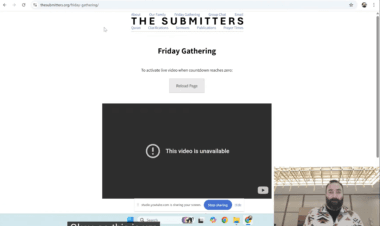
Today I’d like to introduce the new chatting feature which we’ve added to the website, in our website, thesubmitters.org. Some of you might have already noticed it, others probably haven’t, might not have noticed it yet. So I’m just going to share the screen and tell you what’s new on in our website. So let me share the screen.

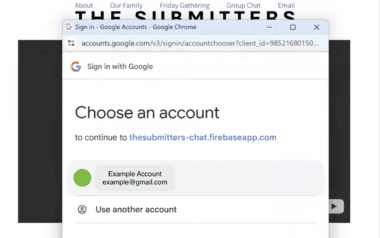
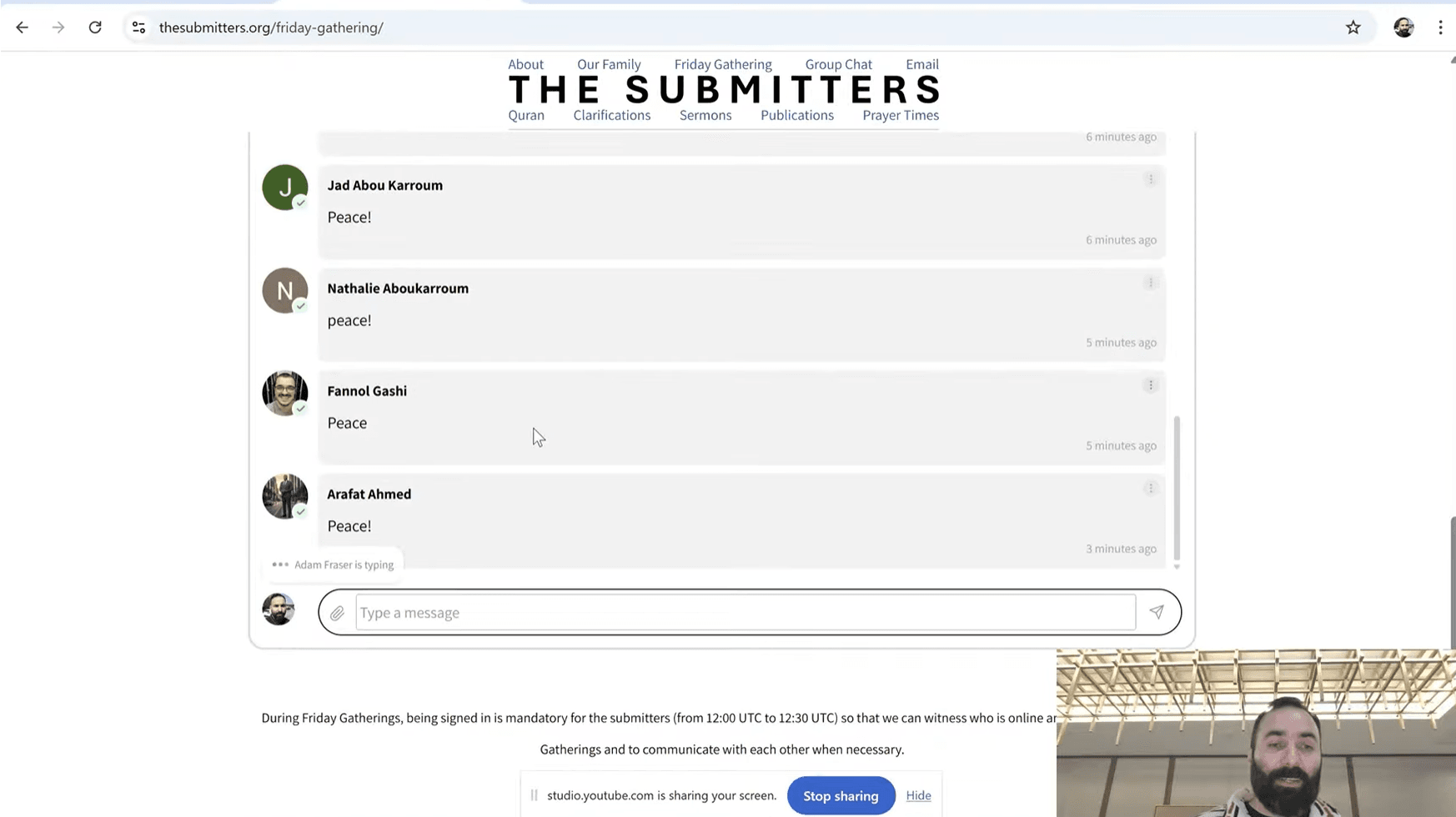
Okay, so this is our new chatting feature. It’s below here, below the Friday sermon, if you guys are watching the video. So all you have to do is scroll down and here it says “sign in with Google.” By the way, let me just read what I wrote here. It says: “During Friday gatherings, being signed in is mandatory for the submitters from 12 until 12:30 UTC so that we can witness who is online and attending the Friday gatherings, and to communicate with each other when necessary.”

So this is important so that you guys know among each other who’s attending the Friday sermons, the Friday gatherings, and but also so that I know who’s watching. It’s important so that we know who’s a submitter. It’s not that we are trying to spy on one another, but we want to know who’s a submitter and who’s not. We know that doing the Friday gathering is obligatory for submitters and it’s done in public. So we should be able to know who is doing it like us and who is not doing it like us.

So for those who haven’t signed yet, if you just go here to “sign in with Google,” it’s going to ask you to—you can choose—by the way, we don’t have access to your Google accounts. So this is totally under Google’s control. We don’t have access to it. So when you sign in with Google, Google doesn’t send us any information except your name, which is shown in the website, and your photo, which is taken from Google. But that’s a standard signing procedure for most of the apps, it’s not different from other apps.

Okay, so when we sign in, right now 37 people are attending online. Probably more will join after they hear what I—after they hear my explanation. I’m just going to wait a little bit so that other people can also join the chatting app. I kind of like the way it came out. It’s a very simple app, but it has some unique features which I think are useful for the submitters. Let me pause the video here. Okay.

Guidelines for Chatting During the Gathering

Okay, so one good thing about this is that you can both watch the video and see who’s online at the same time. Plus, we can chat when necessary online. By the way, chatting during the Friday—because I can see people starting to type already—chatting during the Friday gathering, you shouldn’t do it unless you’re asked to do it. Unless the congregation director asks you specifically or in general, “Okay, does anyone have something to say?” or whatever, you shouldn’t do it because it distracts the viewers, the listeners.

So this chatting app is useful for outside of the Friday sermon. You can talk at any time, but during the Friday gathering, only if you’re asked or absolutely necessary. So unless you have something absolutely necessary to say or I ask you to say something, then there’s no need to say anything during the Friday gathering because during the Friday gathering we’re supposed to pay attention to what is being said, let’s say in this case in the video.

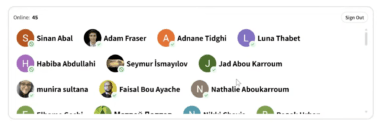
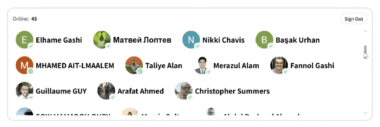
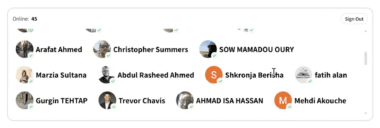
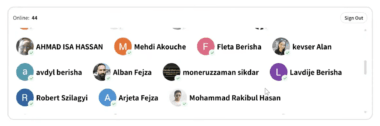
But I want to actually, before we go to the chatting app, I want to use the opportunity to mention the names because if people are embarrassed to be public about the fact that they are submitters, I think they shouldn’t be submitters. Okay, so who do we have here right now online? We have San Abal, Adam Fraser—sorry for mispronouncing the names—Adnan TK, Luna Habib, Abdulai Sur, Jad Abukarum, Monira Sultana, Falu Ayak or Aayache, I think, Natalia Abukarum. Sorry for mispronouncing the names again. Alameshi, Mad Loft, I guess, Nikki Chavis, Bashak Orhan, Muhammed Lamal, I guess, Talia Alan, Mazul Alam, Fol Gashi, Gill Gung, Guy Arafat Ahmed, Christopher Summers.

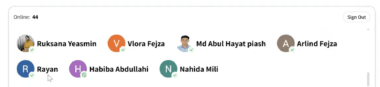
So yeah, Mohammad Ori, Marzia Sultana, Abdul Rashid, Ahmedia Bisha, Fati Alan, Gorgenab, Trevor Chavis, Ahmed Isa, Hassan, Media Auche, Fleta Barisha, Kear Alan, Abdul Barisha, Alban Fesa. Who else do we have? People are going in and out so I’m losing track of it. It’s okay. Where was I? Then Robert Zilagi, Arat Fesa, Muhammad Rakulasan, Rukan, Yasmin Fesa, Abdul Hayat Pash, Arin Fesa, Rayan—I don’t know the last name of this person—Habib Abdullahi, and Nah Mille. So these are the names which are online right now. Others probably will, but as we know, there’s more submitters. So others will, I guess, eventually learn how to do this and they’ll do it in the next time.

For some of you, if you have signed already, it might show you the older version before the Friday sermon. God willing, if you have any problems, you can contact Feno and see how to fix that.

Group Transparency vs. Private Meetings

But okay, I want to focus on why is this chatting app different from, let’s say, a typical chatting app. It’s different because, first of all, it’s a group chat, so if someone has to say something, it has to be fully transparent.

When I used to work in my previous jobs, most of them in Kosovo, quite often people would let’s say have informal meetings over coffee. They’d go drink, have coffee, and then someone would tell someone something and they would actually reach an agreement about what to do at work, and no one else would know. And then I’d be surprised, “Oh, you guys reached an agreement already? Like, I was not in the meeting.” “Oh, we spoke about it over coffee.” And that’s actually not the way submitters do things. They don’t do things like—it’s not fair.

For example, we’ve done lots of work let’s say with Fol, but that was the only option we had. A lot of—we had a lot of discussions which were just personal, just me and him. It would be much better if everyone knew. In this way, they would know how much work was put into this chat, into this chatting app. They would know what the problems were. They would see if there’s something they can help with. So this chatting app is different because it’s a group chat, so everyone sees everyone’s chat. That’s important. Plus, it’s important because sometimes people, if it’s sending a message to only one person, they’ll say something else. But if it’s public, they will probably be more careful about it. So that’s one difference in this chatting app.

The Deletion Feature and Guarding Against Satan

The other difference is that—I guess people are learning how to sign in, so there’s 51 people online now—the other difference is that unlike most of the chatting apps, I don’t actually know any chatting app which is like this, maybe Wikipedia but it’s not even a chatting app, this allows every submitter to delete everyone’s message. So right now, even if I don’t like a message, I can just delete it. Let me see if there’s a message I don’t like. I don’t want to embarrass anyone. Okay, all messages are fine.

Basically as a submitter, not just me, everyone, every submitter can delete a message. And why is this important? This is important to keep the peace within the community.

Reference: Quran (General Passage on Speech and Satanic Division)

Let me just give you an example because there’s a verse in the Quran which says try to be with each other the nicest possible because Satan will always try to drive a wedge between you. Satan is always trying to kind of make us fight each other. And one way to prevent that fighting is if we allow everyone to delete the message if you don’t like it.

Let me just give you an example. So let’s say, because you can post here photos as well, let’s say a woman has a new child, and then she wants to show the group, “Oh, alhamdulillah, thanks to God, me and my husband have been blessed with a new child. We named the child like this name.” But in the photo, she’s kind of not dressed very well. Yeah, it’s a good message in general that she’s telling everyone that there’s a new submitter among us. That’s a good message, but the photo might not be very modest. In that case, instead of us telling her, “Oh, you have to change the photo, we don’t agree with this,” anyone can just delete it. If you don’t agree with it, just delete it.

Now the question is, what if we delete all the messages? So what? It’s okay. It’s okay. We don’t write any message, it’s still fine. God willing, in the future I might change my mind, I might make it so that two submitters have to delete it, so any two submitters so that the message can be deleted. But for now, I want to try it like this, and if it works, I’ll just leave it like this.

So the idea is that any submitter, instead of arguing—so let’s say someone says something which is partly right, partly wrong—instead of arguing and saying, “Oh, by the way, you’re right, wrong about this, you’re wrong about that, I have a different opinion, whatever,” if you don’t like it, just delete it. In this way, only the positive messages remain. And when only the positive messages remain, there’s less chance for Satan to drive a wedge between us, to kind of make us hate each other. Just delete it.

And it’s not a problem, even my messages. So the way to delete it, the submitters only can do this. The non-submitters cannot delete messages. They can delete their own but not someone else’s. So let’s say if I go here in any place, I can just delete it. I cannot block, by the way. I cannot block. Funnel here has subscribed, I think, with a non-submitter email at this Funnel Republic. This actually I can also block. We can also, by the way, every submitter can also block a non-submitter, but not a submitter. So basically if someone, if an outsider comes and says something bad or whatever, and we think he had really clear bad intentions to let’s say to fight our group or to hate our group, then we can just block that person.

So we cannot block submitters. No submitter can be blocked. I cannot even block a submitter, so you have a guarantee that you’ll not be blocked. However, anyone can delete your message if they don’t like it. And this goes in line with the idea in the Quran which says that submitters reach agreements with consensus. So everyone has to agree. If one person doesn’t agree about the message, they can just delete it.

Let me give you an example. For example, someone might post a vacation photo which might be fine for most people. But maybe someone lives in a poor country, he thinks that’s bragging, that’s too much. They can just delete it. If they don’t like it, they can delete it. At the same time, no hard feelings. Someone can try and post it and see if it’s deleted, fine. If it’s not, it’s kind of like a way to see if other people are liking what you’re posting. So yeah, you can delete anyone’s message, and please, if you think it should be deleted, delete it. Just do it, don’t think twice. “Okay, I don’t like this,” just delete it.

And why is this important again, let me go back again, why this is important for the peace in our group. Let’s say that someone’s message is true, it’s correct, but it’s not full. So let’s say that someone says that it’s not Ramadan which brings us closer to God, but it’s fasting. Which is true, that’s true. It’s not complete, but it’s true. There’s more to it in the Quran, but it’s true if you say that it’s fasting, not Ramadan, which brings us closer to God. That is true. However, it’s not the complete truth. There’s some more to it.

What’s more to it is that during Ramadan, the Quran says those who witness the month, they fast. So let’s say that’s a more complete truth. So during Ramadan, the believers who witness it, they fast. However, it’s the fasting which brings them closer to God, not the Ramadan, not just the fact that it’s Ramadan. And as you can see, however, let’s say someone says that fasting is what brings us closer to God, not Ramadan. Someone might think that it’s not complete, which is true, it’s not a complete message, it’s not a complete truth. It is true, it’s mostly true—I mean it’s totally true—but it’s not—there’s more to it than just that. And someone might notice the part which is missing, let’s say the statement which would complete it, and they mention only the other statement. Then they post let’s say just a verse to complete that statement.

What Satan can do here, even though both of them are correct, is make one submitter pay attention to one part of the truth, the other submitter to the other part of the truth, and then in this way, if they couldn’t delete the messages, they might start to have an ego discussion. “Oh no, you’re wrong. He’s wrong.” Especially if other people are involved, then there’s some ego there. The easier option is if it bothers you, just delete it. So this app enables it, you just delete it, so there’s no argument. If there’s something you don’t like about the message, just delete it.

Submitter Verification and Zakat

So another feature in this app is that you can tell who is a submitter and who is not a submitter by this tick mark. So if you have this tick mark, that means you are a submitter. If you don’t have this tick mark—by the way, this guy, I think he has actually asked us to be a submitter. We haven’t enabled him to fill the zakat yet. So we can call it what the Quran—there’s a verse in the Quran which mentions those whose hearts have been inclined, meaning those who in their heart, they are submitters, but they haven’t officially joined us because there’s different levels of people. There’s non-submitters, there’s people who are exploring, there’s people who think that maybe this is true, but then there’s people who have decided to join, but they haven’t gotten a chance yet. I think it’s this guy, he sent me an email that he wants to join, but I haven’t enabled it for him yet. I haven’t replied to his email yet, or at least I haven’t replied positive like that in time.

We can call—the Quran, Rashad translated this as converts, but it doesn’t matter. Officially he’s still not a submitter. It’s okay. So basically people who are not submitters can join, or people who are almost submitters, or people who want to become submitters, but we haven’t enabled it for them yet. By enabled, I mean that we let them report the zakat. They cannot be submitters unless they report the zakat, the obligatory charity. Once they report the obligatory charity, which is a form which you are using, then they are officially submitters. Anyway, so there’s a tick mark here. I hope you guys can see it in the live stream. There’s a tick mark here which shows who’s a submitter and who’s not.

And this is pretty much it. I mean, it’s a simple app. Let’s repent. Praise be to God. There’s no other god except God.

Community Testing and Support Feedback

Okay, so maybe we can just test the app now. So I’m asking you to chat and see how it works. By the way, all the chats disappear in seven days, so you don’t have to be embarrassed whether you’ll post something and it’s going to stay there. It’s just going to be deleted in seven days. But this video is public, just so you know, this video is public. So maybe we can just test it and see. Oh okay, a lot of people are writing. I want to test deleting this message. Okay, great. Fal, maybe you can test it. Do you want me to—okay, you want to write again and see if I can delete it?

“Hello,” Mad LV is saying hello. Okay, so let’s say Faisal says, “hi.” Maybe I don’t like this message, I can just delete it. Okay, there we go. Everyone is saying, “peace, peace.” Okay, I don’t want to embarrass you guys, but let me give you an example of how this can be useful. So in the last Friday gathering, I introduced the new call to the Friday gathering online, and I said that anyone can do it and it’s better if anyone who can should do it and post it online. Can anyone—is anyone willing to share where they posted the call to the Friday gathering? In which social media, what form? Was it Facebook? Was it a Facebook story? Was it a Facebook post? And how many people they think saw it, can be an estimate. Okay, it’s okay if it’s taking some time to write.

Okay, so Mazul Alam is saying, “I posted on the PNG.” What is PNG? “To Facebook post.” I don’t know what PNG is, but okay. Gun posted it on Instagram at the submitters. Oh, it says one people liked it. What do you mean by photo file, Trevor? Like you posted the photo file somewhere, or there’s an app which is called photo file? So Abdul Rashid posted it on WhatsApp, the—I mean made the call to the Friday gathering. So Arafat made it on WhatsApp status and Facebook stories. Okay, I think Facebook stories is useful for this, like it’s probably the right place to do it.

Sorry guys, I still don’t know what PNG is. Trevor is explaining, but sorry, maybe I’m old-fashioned in this. Gorgon posted it on WhatsApp. Bashak is saying, “Salam alaykum.” Oh, the—oh, PNG, I understand it now. So yes, PNG is the photo format. Okay, I get it. I guess thanks for explaining. “I posted the PNG to Facebook post.” Okay, so you posted the photo in the Facebook post. Okay.

By the way, those who are not submitters yet, who have asked to join, God willing, we’ll enable you to join at least by the end of the year, if not earlier. A lot of people from Turkey have joined us recently, so I see some messages from Turkey. And one more thing, so the non-submitters—let me see if there’s—non-submitters are supposed not to be able to message during the Friday gathering. So if someone is a non-submitter, let me double check, has any non-submitter been able to message? I don’t see any non-submitter who has messaged during this time, and they cannot message because we don’t want them to interrupt us. Tasim Ali is saying, “Praise be to God.”

Trevor Chavis is saying, “I’m seeing people that don’t have the check mark but are submitters on the website.” Which people, for example, Trevor? Gorg is showing us like what he posted. Okay. Oh, I see. For example, now what can happen, I can see a potential problem. The way the website knows if you’re a submitter or not is if the email with which you filled the zakat—so when you submit the zakat, you put an email there, and we use that email so that the website double checks. If that email matches, then it considers you a submitter. If the email address doesn’t match, then it doesn’t consider you a submitter. So if someone is signed in with another email, it’s not going to know that you’re a submitter. So maybe that’s the problem, I mean that’s probably the problem.

So let me check a name, for example. So Captain MD Nuraman Sigdar is not recognized as a submitter here, but we know he’s a submitter. He even came to Hajj with us. Captain, probably this doesn’t recognize you as a submitter because you have signed in with another email. Okay. Okay, so Taskin and yeah, they are submitters, but if they sign in with another Gmail account—if they have two Gmail accounts, please sign in with the one which we know, the official email with which you have subscribed as a submitter. I hope that answers the question, because otherwise the website cannot know if you’re a submitter or not, or I typed the email wrong, but I don’t think so because I just copied and pasted.

Okay, just a few more messages and I’m going to end this stream, God willing. Jad Abu Karum is saying, “God is great.” Yes, God is great, Jad. By the way, this brings me back to the idea of the call to the Friday gathering, which is in English. Some people like it because I have many different styles of it. Some people might like some of them, maybe not others. Some of them are cheesy, I know it, but I just wanted to capture many different versions of what people like. A lot of them I don’t even like myself, like the music style, but it’s okay, like people like different styles of music. Fal is saying, “Peace. After some time, my status becomes offline, but I’m still online, though.” Okay, we need to double check why that’s happening.

Yeah, so this chat—good question, Fal—so this chat is available outside of the Friday gathering. When there’s no Friday gathering, if you go to the group chat here in our website, you can still chat within the same app. The only difference there is that you don’t see this video, but you still see the chatting app and you can chat at any time.

Trevor is saying, “God says in the Quran, ‘I am God. There’s no other god beside me. You shall worship me alone and observe the contact prayers to remember me.'” Okay, great, great point, Trevor.

Okay guys, I just see that people are typing, that’s why I’m waiting, but I think we should finish it soon. K Rakan is saying, “Peace be upon you.” Kate Ibrahim is saying, “God is great.” Okay, I don’t want to waste too much time for all the rest of the people. I’m going to end it here. Let me stop sharing.

So yeah, that’s it. I hope you guys like the chatting app. You can use it outside the Friday sermon as well, outside the Friday gatherings for anything. If you need to contact—by the way, even if you have questions for me, please just post it there. If I don’t like the question, I’m just going to delete it, by the way. Or someone else can delete it. Whoever wants can delete it. But in this way, if someone can answer the question for you without me having to be involved, that would be even better. Whoever sees it first and knows the answer, they can, or we can have discussions even. You can post about let’s say where you went to vacation last week or things like that.

Privacy Rules on Social Media

As long as these—oh, this is probably—it’s good that I forgot about it—this is probably the most important rule. If you are going to post photos, and this is not just for this, it’s for any social media. If you’re going to post photos, this is let’s say the principle how to use the social media. Think about it: is this in a private space? Why would you put a private space in public? What do I mean by private space? You shouldn’t put—let’s start with the worst. A lot of let’s say girls these days, but even boys, will go and take a picture in the bathroom, even with clothes, and kind of like you know make a face or whatever, a duck face kind of like this whatever, and then in the mirror, in the bathroom mirror. Anyone can see that it’s a bathroom. It’s a bathroom! That’s a private space. Why would you put the private space in your life into a public space?

So don’t mix private and public. Bathrooms are private. Even the bedroom is private. Even the living room is private. So don’t post something, “Oh guys, I want to share how lovely my family is,” but you have a photo of you in your living room. So try to post only public spaces. We don’t want to know what your house looks like, what your home inside looks like. Yeah, you can post it outside, like you can take a picture outside of your home or from the outside. Maybe you want to show your car, I don’t know. Some people like to brag, maybe you want to show your car, I don’t know. That’s public, but at least it’s within the rules. But don’t post private photos in private spaces in public. And this is for any social media, not just this, any social media.

We should learn how to separate public versus private. What’s inside a home is private. God designed it so that others don’t see it. So don’t post the living room, your bedroom, your bathroom, even your kitchen, unless it’s probably sometimes there’s an angle where you cannot tell what it is, that’s different. But always try to post only public things in a public internet space. That’s let’s say the most important rule. I don’t care what your living room looks like. I don’t want to see it. I don’t want to see it. It’s different if you just send a message let’s say to a friend or who has been to your home, or to just one person, because they already let’s say—it’s kind of like a private conversation, maybe let’s say a brother or sister, that’s different. I’m talking about this—this group chat is a public space, it’s public. Most social media are public. Don’t post private spaces into a public space, into a public online space. This is probably the most important rule, and this fixes lots of issues.

I mean, you can take a photo while walking in the street, that’s fine, you can post it. But why would you post it from a private space? By the way, cars, the inside of cars are semi-private because the Quran says God has designed homes which move. So the car is partly private, partly public. So there, I don’t know, it’s a gray area. I wouldn’t make a rule about it. If you post a picture from inside the car, that’s semi-private, partly private but also partly public. In that case, that’s the great feature, is that we can delete it. If someone thinks it’s a little bit too private, they can just delete it. If someone thinks, “Oh, this is fine for me,” they don’t delete it.

Okay, so that’s it. For those who have to do the contact prayer, do the contact prayer. Peace be upon you.

The Call to the Friday Gathering


——————————————–    Warning: This section is still under construction    ——————————————–

Sermon Introduction

Praise be to God, there is no other God except God. As you guys saw this sort of Adan or video intro or Friday sermon intro, let me just kind of tell the story about it. It’s mainly compiled of footage which we did from Hajj, as some of you might have noticed. Some of us took some footage, and yeah, it’s footage from Hajj. And I think it came out nicely, and the background voice and the music is taken from one of the movies which Rashad used as well.

Now what I want to focus on today is because the words which are there are Allahu Akbar, Allahu Akbar, Allahu Akbar, La ilaha illa Allah. So I want to focus on what is known as Adan, which from now on I’m going to call it the Friday gathering in English, the call to the Friday gathering. And the reason for this is because I have some really, let’s say, what turns out to be good news. Because what you just saw or what you just heard here online was actually not the Adan, was just an intro, an intro video which I used so that people who have technical difficulties to go to watch us live, basically to buy some time for them.

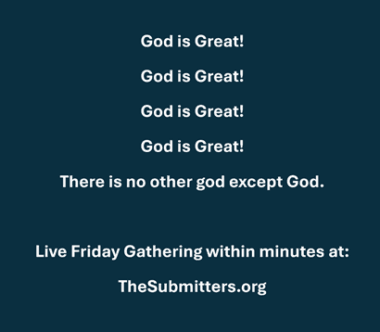
And the actual Adan, the actual Adan, or let’s call it in English because I want to correct it, the actual call to the Friday gathering was actually done when you received the email from me. As you, the submitters, know that you received an email which said, “God is great, God is great, God is great, God is great” four times, and “There’s no other God except God.” That was the actual call to the Friday gathering. What I showed here is just an intro just to buy some time.

And by the way, before I go to talk about the call to the Friday gathering, I just want to say that the intro, God willing, I’ll have a different intro, especially English ones, every, God willing, every Friday during every Friday gathering I’ll have a slightly different one. And hopefully, this will motivate the people to join in time so that they can see the different intro. It’s pretty much going to be the same footage, or similar footage, but it’s going to be a different, let’s say, music every time. Same words also, but kind of different music just to kind of make it more, let’s say, festive. I did it with AI, by the way, so like it wasn’t that much work. It’s not really my work, it’s AI work.

Understanding the Call to Prayer in the Quran

But I want to focus now on the actual topic of this Friday sermon. The actual topic is what is actually the call to the Friday prayer? What is the call, and what does it mean to make the call to the Friday gathering online, specifically online? How would how— So the question I’m trying to answer is: how do we do the call to the Friday gathering online? What you just saw, that was not it. The one which you received in the email, that was it. But how did I reach that conclusion? How can we reach that conclusion? Before we go there, let me actually share the verse, the key verse for this. Let me share the screen. Okay, I hope you guys can see it. Okay. So here we have the Quran glossary, and I’m showing verse basically Surah 62:9.

“…Oh you who believe. When the call is made for the prayer on the day of Friday, then hasten to the remembrance or the mentioning of God and leave the business that is better for you if you know.”

Now the key word in this verse which I want to focus on is that the call—the word “call” in Arabic here in the Quran, it’s not actually using the word adan. And when you look in the whole Quran, you don’t see the word adan at all mentioned for calls to prayer. It’s not mentioned at all. There’s another verse in the Quran which mentions this word, which is not adan, which is here, it’s nudiya. I hope I’m pronouncing it right, or nuda. So this word, which means call, is mentioned in another verse where it’s talking about how the disbelievers laugh at the call to prayer, but even there, the word adan is not used. It’s this word which is used. And nowhere else do you see, like, you don’t see the word adan used for the call to prayer at all in the Quran. What we see is this word being mentioned, which is nudiya.

Then why did God leave it for thousands of years for people to call it adan in Arabic, which is translated as the call or the announcement to prayer? Why did God leave the people use a word which is not even in the Quran for their call to prayer? And the reason for that, like to explain that, is because this word nudiya, “call,” is bigger than the word adan, meaning it includes the word adan. So I’m not saying the way people have done it traditionally, the way Rashad taught us to do it, which is Allahu Akbar, I’m not saying that’s wrong. All I’m saying is that there’s more, there’s more to it, meaning the word nudiya doesn’t include just that version, it includes other versions as well.

And what do I mean by this? Let me give an example. So let’s say that the Quran tells us to wear upper body clothes. The Quran says, okay, let’s just assume that, which kind of says it anyway, but let’s say that the Quran says you should wear upper body clothes. And then imagine in the time of Muhammad, Muhammad is telling them—he’s not using the same word as the Quran—he’s telling them, “Wear a shirt.” A shirt is upper body clothes for a warm weather. But in today’s world, someone in a colder weather might say, “Wear a jacket.” That’s also upper body clothes. Or, “Wear a sweater.” So as you can see, the word “upper body clothes” includes both the shirt and the jacket.

In the same way, the word nudiya here, which is the call, includes both the adan and what I’m going to call it in English, the call to the Friday gathering. And here, probably it’s maybe it’s important to specify something even more. Now the reason why we can, let’s say, this includes more than just the adan, because the adan, as we know, is the call to the salat, to the contact prayer, is because this word “the salat” here, which is mentioned, even this word because in this context, in this verse, because it’s talking, it says “call when the call is made for…” They’ve translated it here as prayer, but actually, as we know, this word actually means connection, connection. And it’s on purpose like that, connection. It means connection with God, of course. But here, there’s another context as well.

By the way, everything I’m saying, I’m not denying what we know so far. Let me be clear, I’m not denying what we know so far. All I’m saying is that there’s more to it, there’s more knowledge which is included in the Quran compared to what we’ve known before. So what I want to, let’s say, draw the attention to is that the fact that the word “prayer,” which here it has been translated as prayer, in Arabic actually literally means connect, to connect. And here in this verse, we can understand the word “connect” in two ways: one is to connect with God, but it’s also talking on the day of Friday, and juma in Arabic means gathering, when people gather. So to connect on the day when people gather, what does it mean? It also means to connect with people.

So basically, this word connection is about connecting with, in this verse, it’s connecting with God, but also connecting with people. So we, in this case, because we are doing it online, we have connected with each other. Basically, I’m live streaming, God willing we’ll add the chat function and stuff like that in the future. So basically, it’s telling us to connect. It’s not specifying what kind of connection. We definitely know that it’s connection with God when we do the contact prayer, but here it’s talking connecting on the day when people gather, so it must be also some sort of other connection, to connect with people, with other people, or we can say to connect with God together with other people.

A Human-Made Decision Across History

So, given that this is the the meaning, let’s say, the additional meaning of this word, the word salat in the Quran, then when we talk about the call to connection, the call to connect here, the call, it specifically means two things. First one meaning is adan, the adan which we know traditionally, and the other meaning is the call to the Friday gathering, which specifically has to do with the connection online. And I deal with in another video, I think I’ve explained partly, and God willing I’ll explain it again in future videos, that Friday gatherings or Friday sermons are okay to be done online in specific circumstances, which are our circumstances.

But given that we are doing it online, the specific meaning here of this word nudya, it’s on purpose that the word adan is not mentioned. Because if God used the word adan, we would have to assume that it is the adan which traditionally traditionally has been done in the way it was done, which was in Arabic, Allahu Akbar, and they do it in the mosques to this day, they do it in the mosques. And by the way, if we have a a local mosque, we should do it like that as well in Arabic. But we here here we are talking about online, and the question is: why, let’s say, did I take the liberty to do it English online? Well, let’s say, who gave me the right, who gave me the right to do it in English online when we’re doing it online? No one had to give me the liberty.

The reason is that the adan which Muhammad did, which also Rashad did, if we analyze it carefully, it’s actually a human decision. So it’s not that God said, “Oh, this is should be the adan.” God told us about about Nudya, which is the call to prayer, which one version of it one version of it is the adan, but that version is a human-made decision. Let me go back again to to the same example. If God told us to wear upper body clothes, it’s a then after that, it’s a human decision whether they wear a t-shirt or whether what type of t-shirt or what type of shirt, or whether they will wear a jacket, or how thick that jacket will have to be. It’s a human decision.

And how do we know that it’s a human decision? First of all, studying the Quran. If God wanted us specifically to tell us the words that these are the words of the adan, God would tell us, but he didn’t. And he didn’t because God knew that people will reach the correct decision about this, a specific decision for every time. During Muhammad’s time, they reached a specific decision and it was correct; it was correct for them in that specific place and time, in those specific circumstances, they reached the human decision. And by the way, if any Sunnis or Shia might think might be like might think that I’m kind of changing something or anything, I I just want to remind them that even the hadith, their hadith says that and this according to their hadith, this is how adan came to be. And the hadith proves their hadith proves that it’s a human it was a human decision.

So, according to their hadith, here’s how adan came to be. And by the way, before I go to the to to to tell that story, let me just say that this this word nya, nudya, or whatever, actually in which is here the fifth word in in in surah 62:9, it actually includes, ironically, even the human decisions which existed in the past. But of course, here is talking about about the Friday prayer, so they didn’t do the contact like the gathering on Friday, they did it on Saturday or whenever before I’m talking before Muhammad. But includes it includes even those because it’s a human decision.

And in the past, let’s say during the time of David, they decided, it was a human decision, they decided that they are we’re going to use the horn, the horn to do the to call the people to to the to the congregational gathering. Then it was Saturday. And then after after that, the Christians, after Jesus, Jesus use the bell. What I’m saying is even those are legitimate as long as people agree that that is the correct thing to do, as long as they agree and it’s a correct decision. It was correct for the time and place. And Muhammad never actually sort of said that they are wrong, never said that, “Oh, if you call the people with a horn or if you call the people with a with a bell like they do it in the churches…” He never said that it’s wrong.

What Muhammad said, according to the Sunni hadith and the Shia hadith, is that he wanted to have it different, not that it was wrong, but he just wanted a different version so that—and which shows that he was aware that it’s a human decision—so that so that people can distinguish whether they are being called to a church, to a synagogue, or to a mosque. So he just wanted to have a to have it different so that to know where where people are being called now. So what I’m saying is this: the word nudya includes even the horns and the bells which the church has used for the past, of course, or the adan, the traditional Arabic adan for circumstances outside of online, but it also includes this word also includes what I’ve sent in the email earlier. It also includes that because God left it up to us to make a human decision. It doesn’t have to be revealed by God whether we want to wear a t-shirt or whether we want to wear a jacket, God all God told us, “Wear upper body clothes,” for example. Let’s say that’s just an example.

So let me go back now to the hadith which the Sunnis and Shia use. By the way, we don’t believe in hadith, we don’t rely on them as a source of religion, we know that. However, the Sunnis might say, “Oh, you guys changed it, you guys changed it online.” If they say we changed it, we tell them that their hadith, the Sunni hadith and the Shia hadith according to them, tells us about how the adan came came to be like this. So Muhammad one day wanted to come up with a way to call people to prayer, but he wasn’t, let’s say, he didn’t want to mix it up with the bells which the churches use or the horns which the Jews use, so he wanted to have a different version, which shows that he was aware that it’s a human decision. Then, as he was, let’s say, discussing this, he was discussing this, imagine he was discussing it with with the believers. They didn’t say, “Oh, God told me this is the adan,” he was discussing it with the believers.

While he was discussing it, according to their hadith, while he was discussing it, a person came, one of the, let’s say, people in the group came, and he said, “I saw in a dream that someone was just saying aloud…” basically the adan, and Muhammad said, “Oh, that’s a good idea, that’s a that’s a good idea, we should do that.” So basically, adan was not revealed by God to Muhammad. Adan is a human decision which Muhammad made for that time in their circumstances. And the idea came in a dream to another person, it was not even Muhammad. And God did it like this, did it like this so that we can have the liberty to to specifically, let’s say, do it in our way, not thinking that we go we are going against Muhammad, because it was not never revealed to Muhammad, it was never Muhammad’s idea, it was someone else’s idea. Anyone can go and search it online how the adan came to be, and you can see that someone else proposed it by saying that, “Oh, I saw it in a dream,” and then Muhammad Muhammad liked it, he said, “Oh, let’s do it like that.”

Preserving Unity and Language Online

So in the same way, then the question is, then they made a human decision how the nudiya, the call to prayer—the nudiya is the one which is mentioned in the Quran—how the nudiya will be executed in Muhammad’s circumstances in an Arabic world in the, whatever, seventh century. And that’s what they called adan. We don’t need to call it adan. That is the adan, the Arabic one which was done in that specific form. But here in the Quran, there’s more than that.

So then when Rashad came, he made again a human decision that we should still do the adan the same way in circumstances within mosques, but even when there’s people who do not speak Arabic, let’s say in US, Canada, Europe. So even in places where people don’t speak Arabic, Rashad thought that it’s a good idea if we still do it in Arabic so that we can keep the unity. Basically, I would also stick or I would also continue, if we today have a mosque, I would still do it in Arabic. And the purpose and the reason is not because that’s how God revealed it, but because I don’t want to break the unity, that’s how people have done it. And there’s a verse in the Quran which says, first of all, that the believers are united, so if you kind of change it, you are kind of causing disunity.

And second of all, there’s a verse in the Quran which says, “Do not betray those who trust you,” so we shouldn’t betray those who trust us. So basically, Rashad trusted that we will do it in Arabic, we’ll just do it in Arabic in a mosque, though, because he never did it online. So what I’m saying is I do not want to go against the verses which tell us to not break the unity, to be united, and to not betray each other. I don’t want to go against that verse. That’s why mosques, I still believe that’s how it should be done. It’s a human-made decision, it’s not God’s decision, it’s a human-made decision, but we respect it. I respect there’s nothing wrong with it.

There’s nothing wrong with the way adan was done during the time of Muhammad, the way Muhammad approved it, there’s nothing wrong with it for that circumstance. There’s nothing wrong with it outside of the Arabic world to do it still in Arabic in a mosque, there’s nothing wrong with it either. But because we are in a circumstance which has never happened before—I wouldn’t break the unity, I wouldn’t, let’s say, cause disunity if we decide to do it the way we do it. So today, it’s a human decision, I know it’s a human decision, just like during Muhammad’s time it was a human decision, just like during Rashad’s time it was a human decision. In our time, because it has never been done online—I mean, people publish it online, but they never—they don’t believe in the online prayer, online Friday gathering—so it has never been done online.

That means that we get to decide, we have the privilege, we are the lucky ones. God gave us the opportunity to decide how the adan should be for the online circumstances. And for the online circumstances, I’m deciding, it’s a human decision, but it’s binding, because why would you break the unity? By the way, I’m not breaking the unity with the traditional because this is totally different circumstance, it’s different. The way they’ve done it in mosques, I still want to do it like that. The way they’ve done it in Saudi Arabia, let them do it in Saudi Arabia. Online they have never done it, so that means that God gives us the privilege or the chance or the opportunity to decide how the adan should be, in a similar way that God gave us the opportunity to decide what type of clothes we want to wear as long as they are within the Quran. So as long as it is within this nudiya idea, the call to prayer.

And by the way, the reason why, let’s say, I want to do it in English is because there’s a verse in the Quran says that all the messengers are sent in the language of the people, and the language online is English. So now from now on, the Arabs are going to have to get used to the online idea of doing it in English, just like the rest of the world was used to the traditional idea of doing it in Arabic. So from now on, online—only online, I’m not talking about in mosques, I’m talking about online—we’re going to do the call, the call to the Friday gathering, to connect for the Friday gathering in English, which is—let me show it actually, let me share the screen.

The Online Call to Friday Gathering

And by the way, why did I decide on those specific words? Because those specific words are here where it says, “When the call is made for prayer,” it says, “hasten to the…” to the mentioning of God. So basically, I wanted a call to prayer where God is mentioned, and when we say, “God is great, God is great, God is great, God is great,” God is mentioned, so we’re fulfilling that commandment. And then we’re specifying which God: “There’s no other God except God.” So basically, that’s going to be the call to prayer in English now, in online. Now because online, people don’t—unless they go online already, they don’t hear it, they probably read it first, so it’s going to be in the written version. Let me share the screen.

Okay, so here it is. So this I, as a human being, am deciding that for our circumstances—and God gives us the liberty to decide about this on our own—I am deciding for us, because I happen to be the leader, that for our group, the adan online, only online, is: God is great, God is great, God is great, God is great, there’s no other God except God. So this is the call to the Friday gathering. Let’s not call it adan anymore, because adan is that specific Arabic version. Here I’m talking about the English version, the English version which is still within what the Quran says, it’s still that word, the call, nudiya. So again, it’s easy also to remember, we know the words, so it’s: God is great, God is great, God is great, God is great, there’s no other God except God.

And then every person can add it in their own way, where the person can connect. Here I said, “Live Friday gathering within minutes at the submitters.org.” In the future, it might be different, these specific words might be different. Now, why did I say “within minutes”? The reason why I said this is because in the Quran, the minimum unit of time is hours. So basically, we are fulfilling the verse. Let me just check if—okay, let me just make sure that you guys are seeing it. Yeah, I think you guys should be seeing this in the screen. Okay.

So yeah, the call to the prayer for our circumstances online should be—it’s a human decision, but that’s what I’m deciding: God is great, God is great, God is great, God is great, there’s no other God except God. And everyone can decide how they put the link there, you can decide on your own. So why did I say here “within minutes”? It’s because the minimum unit of time in the Quran is the hour. So the Quran doesn’t mention minutes or seconds, that means that as long as we do it within that hour when the time for the gathering is, as long as we do it within that hour, it’s specific enough.

Meaning that you can send this adan 30 minutes ahead of time, 40 minutes ahead of the time, 20 minutes ahead of time, 10 minutes ahead of time, and they still are within that time, within that unit of time which the Quran mentions. So basically, it’s specific enough. Some people might have to wait a little bit, but as long as it is within that hour, then it’s specific enough, and that’s why I said “within minutes,” because minutes are within an hour, so it has to be within an hour. And for letter band: Allahu Akbar, Allahu Akbar, Allahu Akbar, Allahu Akbar, La ilaha illa Allah.

Utilizing Social Media for Promotion

Praise be to God, there’s no other God except God. Okay, so we just included what the call to the Friday gathering should be for the online circumstances, which is live online circumstances, which is our circumstance. And I also did, let’s say, actually, my wife helped me as well, which is as you can see, it’s a human decision, it’s not revealed by God, it’s a human decision. We also came up with, let’s say, a photo version which can be posted on social media. And let me share the photo version. Okay, I think you guys are seeing it now.

So it’s just kind of like, let’s say, darker with a darker background. The reason is so that it can stand out a little bit more when you post it on social media. Again, it says, “God is great, God is great, God is great, God is great, there’s no other God except God.” And my words are, “Live Friday gathering within minutes at the submitters.org.” Now, why is this still within the Quran and kind of like is confirmed that it is within the Quran? I’m not saying that this is what the Quran tells us to do. What I’m saying is that the Quran gives us the freedom to do things like this, and all of this is within the Quran. There’s a verse in the Quran which says, “Force yourself to be with those.” And a lot of us know this verse, force yourself to be with those who call God. And here, we’re calling God.

So this is the best way to call people to us. We don’t call them, we don’t go there, “Oh, can you please join for the Friday sermon? Can you please…” That’s almost like begging. “Please guys, join in this group.” You know what they do, some of the, let’s say, half-submitters and traditional, let’s say, any type of religious people, they’ll go online and they’ll call people, “Oh, can you please join us?” Once people do that, that’s actually a sign that you shouldn’t, because God tells us, “Join those who call on God,” not to call you. So here, we’re calling God. We’re not calling people necessarily, we’re calling God. We’re saying, “God is great, God is great, God is great, God is great, there’s no other God except God.” And then there’s a verse in the Quran which says to the believers, “Go after those who call God.” So this call to the Friday gathering is within that verse, it confirms that verse.

And then the other reason why we should do it like this is because there’s another verse in the Quran which says that if you support God, God will support you. So basically, we shouldn’t go there and call people, “Oh, come here, let’s do this, let’s do that.” The verse says you support God, we support God, God supports us. So this is the best way, let’s say, to promote the message, to have more people join us in the cause of God. The best way is to support God, and then God will support us, we’ll let other people join us. This is the best way.

And by the way, this solves one of the most long-standing problems which we’ve had as a community. We’ve talked about this a lot, especially with people who had marketing backgrounds. What is the best way to promote the message? And finally, I think we have found most of the answer. We tried, as you guys know, we’ve tried many methods. We—I compiled an email, we tried some Facebook ads, we’ve tried many different things. And finally, I think this is the answer. This is the answer to how we should promote the message, and it’s simple. It has been all along in the Quran. All we have to do is say in front of others, “God is great, God is great, God is great, God is great, there’s no other God except God.”

And because it’s online, we tell them where the link is. In this case, I’m saying, “Live gathering within minutes at the submitters.org.” By the way, the reason why they didn’t add this part in the past—they actually added it in certain circumstances, things like this—but the reason why they didn’t add it because they would call it from the mosque, everyone would know where the sound is coming from, so they would go there. Here they wouldn’t know where the message is coming from, they have to know where the message is coming from, where they can join, so we had to add that.

And again, this is a human decision just like in the past it was a human decision. There’s again, historical sources which say that Muhammad, when it was raining, he would say, Allahu Akbar, and then he would say, “Pray in your homes.” He would add that because the circumstances were different in that day. Let’s say it was raining too much, he didn’t want people to get all muddy, so he told them, “Pray in your homes” at the end. And in the same way, we’re adding this because it’s a necessary information where to join us. It could be that this website today we’re doing it in this website, if we ever change it, which I don’t think we will, God willing, but if we do, it’s going to be something else, some other information. But the actual call to the Friday gathering is: God is great, God is great, God is great, God is great, there’s no other God except God. And this, again, this solves one of our biggest problems because we couldn’t figure out how to promote the message to other people. We just couldn’t come up with the best way to promote the message, to call the people to God’s cause, and finally I think this answers most of it, like it solves one of the biggest problems we’ve had as a community.

The Role of the Community

Now, what’s your role in this? So basically, the way you can, let’s say—by the way, before I go there, who is supposed to call, to do the adan? Who should do the adan? Let’s not call it adan anymore, sorry for using the term. Online we call it the call to the Friday gathering. So who should do this? Who is supposed to do this? The answer to this is similar to the funeral prayer. Both the funeral prayer and the call to the contact prayer, or in this case, the call to the Friday gathering, are mentioned in the Quran but not as an individual obligation. They are mentioned that they exist. For example, in the Quran it says, “Do not do the funeral prayer for the disbelievers, for those who were believers once and now they are disbelievers, don’t do the funeral prayer for them.” That’s what the Quran says.

Now, it’s not giving a rule that every individual should do the funeral prayer, but it’s mentioning it. The fact that it’s mentioning it, it assumes that someone, at least someone, is doing it. So basically, the rules of the funeral prayer are that at least someone in the community should do it. It could be one person, but more people is better. More people is better. As long as one person does it, the obligation is fulfilled, but if more people do it, it’s better. In the same way with the call to prayer: if one person does it, the obligation is fulfilled, but more is better. If other people do it as well, it’s better.

And in the traditional circumstances, that’s why many mosques have many minarets, many places where they make the call to prayer. Traditionally they would have, like if you go to so many mosques in the Middle East, you will see that some mosques, the big ones, have more than one minaret, like two, three, four, five, six. So some of them have six minarets. Minarets are the places where they make the call to prayer. So why six minarets? The reason is that they understood that more than one person can do the call to prayer. And especially if, let’s say, when someone does the call to prayer, some other people don’t hear him, then another person does the call to prayer. This is according to even according to historical sources: Muhammad would tell someone to do the call to prayer, and if others didn’t hear it, someone else who heard that first person then would call the others. So it’s a way to call the people to the Friday gathering.

Now, in the online circumstance, let’s say the congregation director—in this case, I sent it automatically, the computer did it. I wrote it once, but, God willing, it’s going to be sent automatically by computer. Once that is done, that means you received that call. But let’s say you’re on Facebook at that time or some sort of social media. Did the people to whom you’re talking or socializing with hear the call? No, you heard it, they didn’t hear it. So in that case, the best thing you can do is actually make that same call to other people. Let’s say you’re on Facebook, or Instagram, other social media, or even direct messages.

Especially the ones where you can delete it later, because this is a call for a specific time. We’re calling God, but indirectly the people are supposed to join at a specific time, which in our case is 12:00 Universal Time (UTC). It doesn’t have to always be like this, but in our case, it’s at 12:00 UTC. So it’s a specific time that we’re calling them, say 30 minutes ahead of time or 20 minutes ahead of time, so that they can see the message or the post. This is actually most suitable for social media, not emails, because emails you cannot delete later. If you call them at a specific time and they see it later, what are they going to do? It’s not very useful.

But it’s very useful if you post it on social media. God willing, this is the best way you can help. You don’t have to try with old methods we’ve done, or that others have done, or traditional Muslims and Christians do. God willing, you’ll see this will work the best. All we have to do, about 30 minutes or 20 minutes or 10 minutes—you decide based on the social media how fast people see the messages, or 5 minutes if it’s a direct message—you decide. You decide whether it’s going to be 30 minutes, 40 minutes, 20 minutes, or 10 minutes ahead of time.

  • You take those words.
  • You copy-paste them from the email.
  • You post them where you want to post them.

Just post that, and you don’t have to engage. If they say, “What is this?” you don’t have to engage, because now we’re doing the Friday sermon. You don’t have to engage with them. When the Friday sermon is finished, you go and delete it, because it’s not applicable anymore. Next Friday, you can do the same thing, call them again. In this way, they don’t get bored as much, in the sense that the post is not going to stay there all the time. So this is how you can help.

So God willing, from now on, the way I’m going to do the call to the Friday gathering online is through an email with those words. That is the call to prayer, that is the call which is mentioned in the Quran. But because most people who are communicating with you don’t hear it, it would be best if you share it. It’s not an obligation, because as long as one does it, it’s done, but it would be better—just like in the funeral prayer, it’s better if more people do it within practical reason. I would say it’s actually an obligation within practical reason, meaning that do it if it makes sense. In most cases, it makes sense.

You can go on Facebook, let’s say you know the Friday prayer is going to be 30 minutes or 20 minutes later. If you have some time and you’re out of work, you receive the email, you copy and paste the message, and post it on social media. You can post it as a photo or as text, depending on the social media, and in this way—with the link there—people, even the non-submitters, join and check what the message is.

And by the way, the additional reason why this is good is because you can also post it in groups of other religious groups. You can post this message at a specific time. The reason why this method is so good is because the administrators or leaders of those groups don’t have time to delete it so quickly, so within minutes, some people might join and listen. And then after that, you delete it. The leader might not even see it. It’s fine; if two or three people see it, you’ve done a good job. It’s okay as long as you do it.

Now, not everyone uses social media, and that’s okay. What I’m saying is within reason, whatever you use, if you use it, why not use it to call God, which indirectly calls people to the cause of God?

I hope I didn’t forget something about this. It’s quite an important Friday sermon because I think it’s going to resolve a lot of issues. So, for those who have to do the contact prayer, you can do the contact prayer at this time if it’s the due time. For the rest of you, peace be upon you, peace.


Friday Sermon by: Alban Fejza, Online Congregation Director