[search-in-place-form in_current_page="1"]

Loneliness, the Poverty of Our Times

Friday Sermon by: Alban Fejza, Online Congregation Director

Summary:

In this Friday sermon, Alban Fejza argues that as democracies reduce poverty, loneliness grows as a hidden problem in its place, and suggests ways, such as cutting processed sugar, to turn loneliness and poverty to our advantage in the cause of God.

Video Transcript:

Praise be to God. There is no other god except God. As I might have implied before, and God willing I will explain it more in the future, democracies, which are increasingly the only physically possible government systems in the end times, they never solve any problems without causing another problem somewhere else, but at the same time we are not against it, because they don’t make the problems bigger. They only redistribute them from places where they are more measurable to places where they more hidden. And one of the measurable problems is poverty. Democracies are gradually defeating poverty by causing other hidden problems and one of those hidden problems is loneliness. So, as poverty is increasingly reduced around the world in the future, loneliness increases. So, if you ever felt lonely, don’t feel bad about it. It was caused by democracies trying to avoid poverty. If you are a person who is suffering from loneliness today, had you lived in the past, you would have suffered from poverty. And if loneliness feels like too much to carry, and you would rather be poor than lonely, I can assure you that had you lived in the past, you would rather be lonely than poor. So, there is no escape from it in the short run, in the early part of your life, because it was caused to us by the system, but there is a way to mitigate it. There is a way to use it to make yourself a more resilient person. Let’s think of poverty and loneliness like two wounds from a knife in your chest. Our hearts are slightly deeper than about one inch from our skin. If you are stabbed with one two-inch knife in your chest, you will die. But, if you are stabbed with two one-inch knives, you will survive. So, the same with poverty and loneliness. If you are suffering from too much loneliness, accept some poverty willingly, and some of the loneliness will go away, and vice-versa. If you are suffering from too much poverty, accept some loneliness, and some of the poverty will go away. In practice, it can be realized in many ways, and you don’t have to completely understand it, but it will happen. Let me just give you some insight in some of the ways it happens. For example, let’s say that you live in poor country, and you are suffering from a lot of poverty but no loneliness, if you migrate, whatever poverty you avoided, it will turn into loneliness. And the opposite is also true. Let’s say that you are suffering from loneliness. If you want to reduce it, you simply have to start imitating a poor person, but an actual poor person of the past.

So, do what a poor person of the past would do. Do more physical work and less mental work. More nature, less comfort. Eat less calories, and recently I have come to realize that the healthiest way to reduce calories is to reduce processed sugars, because all the other types of calories also have other valuable things in them. Processed sugar is the only thing which only has calories. By the way, don’t go on spreading the word that I am saying that we should eat less processed sugar. I am not diet guru. I would never prohibit something which God has allowed. All I am saying is that if loneliness has become too much for you and you want to solve it, one of the most effective ways is to reduce the eating of processed sugar. And actually processed sugar is slightly addictive because it does not exist in nature, so it is almost impossible to just reduce it. To be more effective at it you can quit for example for several months, and then eat it for a few months, and then quit again for more months, and this stopes the addiction. If you just reduce it by a little bit, whenever you taste it, it drags you back to the old memories, and you lose the battle. By the way, if you are thin and lonely, and you decide to avoid processed sugar, make sure that you get all the needed calories through other ingredients, which might require that you learn how to cook wholesome meals.

One more thing, did you know that the word “sugar” which is pretty much the same word all over the world, sheker in Turkish, shuker in Arabic, it comes from the Quran, which means “wine”, and it is mentioned in verse 16:67, and they did not have artificial sugars in the past, and the only artificially sweet thing was wine. And this explains why the Quran seems like it does not completely prohibit intoxicants. It seems like it is only recommending us to not overindulge in it. And people get this impression because they forget that the Quran is talking about many things at once. The aspect which seems like a recommendation, but not a prohibition, that aspect is talking about processed sugar, and the aspect which seems like a prohibition, it is talking about alcohol and other intoxicants. So, if sugar is 10% as additive as alcohol, for example, then those verses apply 100% to alcohol, and only 10% to sugar. So, a diluted application of the verse, for the diluted effects. And again, I am not prohibiting sugar. I ate a chocolate today, but when loneliness becomes a problem for us, one of the very effective ways to eliminate it is to avoid processed sugar.

I am only talking about pure sugar, not natural sugar like in bread or rice and so on. So, basically, to avoid loneliness imitate poor people, and poor people of the past did not have chocolates, and drinks with added sugar, and so on. So, to avoid loneliness, imitate poor people, and to avoid poverty, imitate lonely people. Half loneliness and half poverty is less damaging than either one of them in full. This is only knowledge which I am divulging. I am not recommending any action. I never give any recommendation or order which is not in the Quran, but I am just revealing knowledge which you might chose to use or abuse. So, all this knowledge I told you, it will only make you more powerful, not better. So, my assumption is that you are good people, and giving you more tools for power will make you better. But if you are not good people, applying this same knowledge will make you worse. It’s like giving you a sword. You might use it for good or for bad. Knowledge is like a sword. This sermon was just knowledge, but I am not giving an order how to use it. If you are a good person, when you need it, you might want to use it, but if you are bad, you will misuse it. Similar to the angels of Haroot and Maroot, which are mentioned in verse 102 of sura 2, when they revealed secret knowledge, they warned the people that the same knowledge can be used for bad or for good, and it was up to the people to decide to use it for good. So realizing how to manipulate loneliness and poverty is just knowledge. I am not telling you what to do. I am only giving you an additional tool. So, here is how I am trying to use this knowledge, for example, and it is completely up to you use it. It’s just knowledge. So, I identified the general situations in life when we are lonelier. For example, if we are young and living away from our parents, or as an adult but not married, or maybe living in a foreign country, or maybe we are old and the children have moved out of the house, and these are situations where you are more likely to be lonely. So, one of my mitigation strategies for these situations is that I reduce processed sugar, let’s say about 70%. So, I would not eat it for about 7 months, let’s say and then eat it for about 3 months. And, if I am in another situation, let’s say where I might be married, or with children, or with lots of friends, then I would probably only reduce sugar by 10% or not at all. And by the way, avoiding processed sugar helps prevent diabetes, depression, anxiety, and addictions, like computer game addictions among children, or other addictions among grown-ups. I only focused on sugar, because I wanted to keep the sermon short, but there are a hundred of other ways to manipulate loneliness and poverty to our advantage, and once we turn it into an advantage, we can use it in the cause of God. Anyway, this is just knowledge. If you want, you completely forget that I said this. Let’s just worship God.
The Length of Time and True Belief

Friday Sermon by: Alban Fejza, Online Congregation Director

Summary:

In this Friday sermon, Alban Fejza explains that we should not judge the believers of the past harshly, because their stories unfolded over long periods of time in which people forget, and that worship rituals are needed to keep remembering God and renewing our love for Him.

Video Transcript:

Praise be to God. There is no other god except God. A lot of times when we read the Quran, and God tells us examples of weak believers of the past or disbelievers, we become very judgmental of them, and some people even openly criticize them because we forget that those events happened over a long period of time. Let me take an example from the Quran to show you what I mean. Let me read verses 2:50 and 51 which talk to the Children of Israel. They say, “Remember how that we parted the sea for you; we saved you and drowned Pharaoh’s people before your eyes. Yet, when we summoned Moses for forty nights, you worshiped the calf in his absence, and turned wicked. Of course, you can take any person from the street today, and put him in that situation, and it is very unlikely that he would do what the Children of Israel did. Imagine, we transported one of us with a “time-machine” into the past and put him in a group together with the Children of Israel, and he saw with his own eyes Moses hit the sea with his staff, and the sea parted, and then the Children of Israel start worshiping the calf. How do you think one of us would react? We can imagine ourselves saying, “Come on guys! How can you do that? You saw Moses split the sea. Of course, the God about which Moses talked about is the real God. It is not possible that the calf is god. Did the splitting of the sea not convince you?”

However, the truth is that most people, including the believers, would commit the same mistake like the Children of Israel. Remember, they were God’s chosen people. So, how is it possible. It becomes possible once we take into consideration the passage of time. Now let me tell the same story, but let me emphasize the passage of time while I tell it. I am artificially imagining it. I am not saying that that is how it happened, but just for the sake of the argument, let me tell the same story while injecting my words to describe the passage of time. “O Children of Israel, Remember, how we parted the sea for you. When Moses hit the sea with the staff in the morning, and you saw Pharaoh and his army miles away approaching you. You were afraid that you would be caught, and then the sea started to become more and more shallow for about a couple of hours, and then some winds picked up, and pushed it even further on both sides, and towards the end of the day, it was completely split into two parts, and just as Pharaoh was about to arrive, you escaped. And then when you went on the other side, several years passed. Many of you had children, and your cattle became multiplied, and you spent several years playing with your children, and raising the cattle, and there are new members in your family with whom you do not discuss the past much, and now you have developed new interests, and you have new problems now, and this new guy who has recently joined us, the Samarian proposed that what happened with Moses belongs to the past, and we can have anew God now. It has been several years since God did not show us a miracle. How long do we have to wait, before we have another success? Maybe each god can show us a miracle. Maybe we should worship this other god. It’s worth trying. We don’t have much to lose. The God of Moses has not shown us a miracle for several years now, and do you want to get old while still in the desert, and live your whole life in the desert, and maybe the splitting of the sea was something which happens like that once in a while anyway.” As you can see, if we can put ourselves into that situation and let a lot of time pass, between our conviction and some other event, it is possible also for us to drift away from the strong convictions. Verse 28:45 says, “But we established many generations, and, because of the length of time, (they deviated)…” So, yes drifting away from belief is possible with the passage of time. And actually, that is one of the reasons why God created time – because he ultimately knows who among the people is a true believer, and who among the people simply has the wrong expectations from God, and eventually with time the disbelievers will lose appreciation for whatever helped them be convinced about God. Actually, the word “disbeliver (kafir) in the Quran, its literal meaning is unappreciative, or someone who denies the value of good. And thank God all of us have seen the truth, and there are facts, and events, and words, logical thinking which have convinced us about our belief. However, it is possible even for us to drift away from belief just like the Children of Israel did. But there is a method to prevent it. And God gave that method to the Children of Israel in the Old Testament. He says to them, “From now on, after you have witnessed the splitting of the sea, you should hold a commemoration event each year to remind yourselves that I was the God who freed you from Pharaoh”, and that festival is still commemorated among the Jews, even to this day. So, in order not to lose our appreciation for the fact that God guided us, we should find some repetitive way to rekindle our memory, and actively remember the fact that God guided us, and this is achieved through rituals. We should not forget the Friday Sermons, every week. We should not forget the prayers every time the proper prayer times comes. Contact Prayers are reminders to remember God.

Actually, it would have been much better if we remembered God directly because of our deep appreciation, but as you can see with the passage of time, it is possible to lose that appreciation, and to prevent that, we must actively remind ourselves, and this can only be achieved through rituals. And I myself used to be and still mostly am a person who does not like to emphasize processes and rituals because they often turn people into pretenders, and I agree with what Christians say that the most important thing is that we love God. But what they say is only possible for a short time. You can not love God your whole life, unless rituals are involved. Eventually with time everyone forgets, and we need rituals to remind us, and rekindle our love for God, and remember that we used not to be guided, and God guided us. We should appreciate that, and actively engage in worship rituals to renew our appreciation for that.

How to Avoid Accidents?

Friday Sermon by: Alban Fejza, Online Congregation Director

Summary:

In this Friday sermon, Alban Fejza explains that accidents are not best avoided by learning from each one, but by understanding that God allows accidents where people with very different hearts are mixed together, and relates this to the end of the world.

Video Transcript:

Praise be to God. There is no other god except God. A lot of times people wonder why accidents happen, and how could they avoid such an accident. And they reach useless conclusions about a specific accident. For example, “if only I had turned the wheel earlier!” or “if only I did not take that step!”, “if only I double checked”, and depending on the accident they will reach a certain conclusion. So, they might decide that from then on, they will always double check a certain thing. However, this is a very superficial way of avoiding accidents. That’s how babies learn, when they don’t want to fall down again. That only teaches you how to prevent that type of accident. So, basically, with that method of thinking you can only avoid accidents which happened to you once before. But the majority of accidents which happen to people are accidents which did not happen to them before. There is another way to avoid accidents, if we understand at a deeper level, in which circumstances all kinds of accidents happen, and not just why a certain accident happened. And when we think about it carefully, we will realize that God allows accidents in circumstances where people with very different hearts stay together. Basically, people who are behaving similarly on the outside, but on the inside their level of belief or disbelief is very different. Basically, God allows accidents to split up the people with a good heart from the people with a bad heart, when they themselves don’t know that one of them has a good heart and the other has a bad heart. And the difference between the hearts has to be extreme for the accident to be serious. For example, Moses and Pharaoh grew up together. God knew that Moses had an extremely good heart and Pharaoh had an extremely bad heart. However, had we been there when they were growing up, we would not notice the difference. They probably hunted together, laughed together, ate together, and they did not get a chance to express from inside their heart how different they were. They were forced by the rules there to behave in the same way in similar circumstances. So, that circumstance was an accident waiting to happen. So, as Moses casually was walking one day and saw one man beating another man, and then Moses hit him, and he died, accidentally. That did not just happen. It was waiting to happen. If it did not happen there, it would happen somewhere else in some different form, but it was waiting to happen. Another example which is mentioned in Sura 18 is when Moses and that angel appearing in human form travel together, because Moses wants to learn some things from him.

Yes, he was an angle, but that’s for another time to explain. So, Moses and him traveled together, and the angel kills a boy, and Moses says, “Why did you kill such an innocent person, who did not kill another person?”, and later the response is, “His parents were good believers, and we saw that he was going to burden them with his transgression and disbelief.” And this happened to a boy had not gotten a chance to be bad yet. So, basically, here we have family where two members have a very good heart, and the child has a very bad heart, and an accident happened. The angel killed him, but to their parents it would look like an accident. God knows how they found him dead. A tree had fallen on him, or he had drowned while swimming or whatever. That is not important. The important part is that extreme believers and extreme disbelievers spending a lot of time together are an accident waiting to happen. By the way, it can also happen the other way around. The parents could be extreme disbelievers, and the boy could be an extreme believer, and that would again result in an accident where the boy would die, or the parents would die. So, you can not conclude anything about anyone’s belief based on accidents. This logic works only one way. It does not work backwards. Someone might wonder, “Then is it possible to avoid all accidents if we separate all the believers from disbelievers?” Let’s say we take all believers of the world and send them to Australia (that would be enough land), and leave the disbelievers in the other continents. What would happen? Actually, yes accidents would stop, but only because wars would happen before the accidents. So basically, we would only turn the unintended suffering into intendent suffering. The disbelievers would declare war on us. That’s a guarantee. So, the difference between wars and accidents is that one of them is intended suffering while the other is unintended suffering. So, if we have a good heart, because most of the world does not, we have put ourselves in a situation where an accident is about to happen. Like, in the case of Jesus for example. His level of belief and the levels of belief of the Jews just did not match, and we know what happened. Basically, if you are willing to be 100% believer, you will not be able to survive in this world, unless you surround yourself with people who are at similar levels of belief as yours, let’s say people whose want to be 99% good, and then they surround themselves with people whose hearts are 98% good, and they surround themselves with people whose hearts are 97% good, and so on.

Actually this implies a society where the best people are at the center and then the belief fades gradually on the edges, and those people on the edges meet with the disbelievers on the edges, which is where conversions take place – people moving from one group to another. And in the next world, there will be no accidents, because the believers will all be in one group and the disbelievers will all be in another group. There will still be suffering among the disbelievers, but that will be intended suffering. Intended events are not accidents. By the way, to God nothing is an accident. He controls everything. I was only talking about accidents as bad events which people did not intend, not events which God did not intend. God is in control of everything, and he will allow what seem to us like accidents to separate very different hearts, and to bring together similar hearts. This is why accidents happen more often if you put a bunch of men together, rather than a bunch of women together. Although, on average, men and women are the same in belief, there is slightly more variation among men than women. So basically it is slightly more likely to find extreme cases of belief or disbelief among men, and if you put them together, in dangerous sports, or in gatherings, or maybe they might be forced to stay together because of poverty, then accidents happen. This explains all that gun violence in poor communities, where men of different hearts are forced to stay together, or car accidents, or accidents in sports. By the way, I am not proposing any solution to this. With human proposals, we can only turn one problem into another. We can turn large accidents into many smaller accidents for example, but not eliminate them, or we can turn accidents into wars, or we can turn wars into accidents, but not eliminate them. It is the same devil today, as centuries ago. The level of suffering in this world has not changed. Democracies, states, have managed to simply shift it from where it is measurable to places where it is not measurable. For example, they might help avoid car accidents with traffic lights, but that comes at an expense. We have to educate people, who would know how to build traffic lights, and that education only can come at an expense. We have to separate parents from their children for about 8 hours every day. So basically, if we don’t want a person to lose his child, we can avoid that, if we force 100 other parents to miss their child for eight hours every day.

So basically, we are simply shifting the suffering from one large noticeable case, into many smaller daily not so noticeable cases. This is not a solution. By doing this, we are simply distribution the suffering among everyone a little bit, and the world is heading that way, and once all the believers have been mixed with all the disbelievers, a very large “accident” is waiting to happen – the end of the world. So, basically, the End of the World will come when all believers and all disbelievers will be equal in behavior, and they will do things together. Their only difference will be what is in their heart. Everything else will be the same.

The Structure of the Quran and Conditions to Understand It

Friday Sermon by: Alban Fejza, Online Congregation Director, with a text by: Fannol Gashi

Summary:

In this Friday sermon, Alban Fejza reads a sermon by Fannol Gashi explaining why the Quran is structured with its stories spread throughout the book, how this helps us learn, and the conditions we must meet for God to let us understand it.

Video Transcript:

Praise be to God! There is no other god except God. Today let me read a Friday Sermon sent by Fannol Gashi who lives in Heilbronn, Germany. Here it goes: Have you ever wondered why is Quran structured like it is now? As you know, it is not like the other books where every story or subject is in one chapter then the next one deals with something else. Instead, in the Quran, every story is spread out in the whole book and it uses narratives to tell us information. One chapter may have the name “The Heifer” but the content has almost completely other stories and only few verses talk about the heifer (the cow). There is only one exception here and that is Chapter 12 called “Joseph” and Joseph’s story is mentioned only once in another verse, in verse 40:34, “Joseph had come to you before that with clear revelations, but you continued to doubt his message. Then, when he died you said, “GOD will not send any other messenger after him. (He was the last messenger)!” GOD thus sends astray those who are transgressors, doubtful.” It isn’t a coincidence that the story of Joseph is all in one chapter and God only mentions him once in another verse by pointing out that people will believe a messenger only after his death and will never believe that another messenger will come after him, and this verse uses the word Rasul (Messenger) and not Nabih (Prophet).

Also, the last verse in the same chapter says, that Joseph’s story is a lesson for those who possess intelligence. In verse 12:111, says, “In their history, there is a lesson for those who possess intelligence. This is not fabricated Hadith; this (Quran) confirms all previous scriptures, provides the details of everything, and is a beacon and mercy for those who believe.” Let’s continue with why the Quran is structured like it is now. God created everything including Humans and of course he knows what is the best way to learn something. First, we all enjoy a good story, whether it’s a novel, a movie or simply something one of our friends is explaining to us that they’ve experienced. But why do we feel so much more engaged when we hear a narrative about events? It’s quite simple. If we listen to a PowerPoint presentation with boring bullet points, certain parts in the brain get activated. Scientists call these Broca’s area and Wernicke’s area. Overall, it hits our language processing parts in the brain, where we decode words into meaning, and that’s it. When we are being told a story, though, things change dramatically, according to some researchers who published a study in the NeuroImage journal in 2006. Not only are the language processing parts in our brain activated, but any other area in our brain that we would use when experiencing the events of the story are too. The brain, it seems, does not make much of a distinction between reading about an experience and encountering it in real life; in each case, the same neurological regions are stimulated. Secondly, we all might remember from school that when we have an exam and want to learn about it, we used at least one technique called “Flash cards”, one of the classic study tools, and for a good reason – they promote studying through active recall, which is one of the practices through which our brains learn most effectively. The Quran is composed somehow in the same way, as you may have for example only one verse that talks about Moses in the middle of a completely different story, and that single verse activates your learning mechanism that pushes you to try and remember Moses’s story and try to understand why is that verse in there? As this topic repeats all over, it activates your learning mechanism all the time, and we get to learn and understand more and more from the Quran. That’s why God says that we must read the Quran from the beginning till the end: Verse 73:4 says, “… And read the Quran from cover to cover.” By reading it from cover to cover, every time we will learn something new that we didn’t know before. However, this works only with one very important condition, as it states in the verses 3 and 4 in chapter 2, that, we should believe in the unseen, observe the Contact Prayers, and from God’s provisions we should give to charity, believe in Quran and other books before, and regarding the Hereafter, we should be absolutely certain. Otherwise, God will seal our minds, our hearing and cover our eyes as it is stated in verse 7 of the same chapter. And the next verse reminds us that simply claiming that we believe in GOD and the Last Day is not enough. There are other verses that remind us that only believing in the existence of God is not enough. For example, verse 29:61 says, “If you ask them, “Who created the heavens and the earth, and put the sun and the moon in your service,” they will say, “GOD.” Why then did they deviate?” Verse 31:25 says, “If you ask them, “Who created the heavens and the earth,” they will say, “GOD.” Say, “Praise be to GOD.” Yet, most of them do not know.” And let me conclude the sermon with this verse: Verse 114 in Sura 20 says, “Most Exalted is GOD, the only true King. Do not rush into uttering the Quran before it is revealed to you, and say, “My Lord, increase my knowledge.”

28 Points About Charity from the Quran

Friday Sermon by: Alban Fejza, Online Congregation Director

Summary:

In this Friday sermon, Alban Fejza paraphrases 28 points the Quran makes about charity, from giving what we love and doing it for God’s sake, to its spiritual and psychological benefits and the importance of giving early.

Video Transcript:

Praise be to God. There is no other god except God. In this Friday Sermon let me just paraphrase with my own words 28 points which the Quran makes about charity:

According to verses, 2:215 and 3:92, Any charity we give, God is fully aware thereof.

(2:262, 2:272, 30:39), For the charity we give, we will be compensated by our Lord many times over.

(2:267) Charity is not only about avoiding the waste of things which we don’t want. It’s more than that. We should give to charity from the things that we also want.

(3:92) We can not attain righteousness until we give to charity from the possessions we love.

(2:272) When we give charity, we should do it for the sake of God.

(30:38) When we give charity, we should do it to seek God’s pleasure.

(4:38). We should not do it to gain favors from other people.

(3:134). We should do it during good times, as well as the bad times.

(53:34), We should do it often.

(53:34), We should do it sufficiently.

(19:31), We should do it for as long as we live.

(2:274). We should do it privately and publicly.

(47:38, 33:33). Charity helps with our spiritual purification.

(2:277, 2:272, 92:8-10, 64:16, 89:29), Charity also has positive psychological effects. It makes us more friendly, helps remove stress, anxiety, depression, because stinginess is a mental disease. Loving the money too much is a social dysfunction.

(5:12). Charity is a precondition to have God on our side; otherwise, we are against Him. When we do it, it brings us closer to God, and we will feel it. It is the only monetary investment which never fails. We might invest your money in a business, in stocks, or pay for school, but there is always a risk that those investments might fail, and that we will not get our money back. But, charity never fails.

(57:18, 73:20, 57:11, 5:12) We never lose money when we give to charity.

We are only loaning it to God, and He will definitely give it back to us.

(89:16-18) Charity is the best insurance for our wealth. If we don’t want something bad to happen to our wealth, we should give part of it to charity.

(7:156, 24:56). God has encompassed everything with His mercy, but there is additional special mercy from God for those who give to charity.

(9:18). Charity is so important, that the people who do not give the obligatory part of charity are prohibited to enter God’s mosques.

(58:12, 58:12). People who do not give the Obligatory Charity are not pure enough to speak to God, and they are not pure enough to speak to God’s messenger not even asking him a question.

(16:75) Someone who gives to charity and someone who does not give to charity are not equal.

(2:261). The example of those who spend their wealth in the cause of GOD is that of a grain that produces seven spikes, with a hundred grains in each spike. GOD multiplies it manifold for whomever He wills.

(34:39). Anything we spend in the cause of God, He will reward us for it. He is the best provider.

(9:54). We should be happy to give to charity, and we should do it with full pleasure.

(9:54). Charity does not count, if we give it with hesitation.

(57:10). Why should we not spend in the cause of God, when God possesses all wealth in the heavens and the earth?

(2:254). It’s absolutely important to give charity as early as possible, before it becomes too late.

Some Ways and Reasons to Worship God alone

Summary:

In this Friday sermon, Alban Fejza reads a text by Robert Szilagyi that goes through ten Quranic verses containing the words “worship God alone,” reflecting on what each verse teaches and relating some of them to personal life experiences.

Video Transcript:

Praise be to God! There is no other god except God.

When searching the Quran for verses, containing all three English words, “Worship” “God” “alone” in any order, the result produces 30 verses. God willing, I will look at the first 10 verses, then describe something I got from the verse, and for some verses, a life event that relates to it. But before, I continue let me emphasize that the word for worship in Arabic, also means “serve”, so I will translate it as “serve” in cases when it has to do with non-religious aspects of serving God, and I will translate it as “worship” in cases when it has to do with religious aspects of worshiping God.

Verse 2:138 tells us to worship God alone by believing that God’s system is the best.

There are many times I tackle a project or task, then map out a path to help me achieve the end goal. I will begin working, get stuck, take breaks and get back to work again. There are times I am unable to complete the task and get frustrated and angry. Did I start off the project seeking God’s permission and guidance? (1:5) Am I being patient while working hard? (42:43, 90:4) If I miss those steps, I am not using God’s system and therefore not using the best system. There were other times in my life when I was working on a project and just asked God to help me. To this day, I could not describe how I did it or how to repeat it. God’s system is truly the best!

Verse 2:172 tells us to serve God alone by eating from good things and be thankful to God.

Am I saying, “In the name of God,” then recklessly devouring my food? God help me to slow down, and be thankful for the good food God has provided to me, during each bite.

Verse 3:51 tells us that worshiping God alone is the right path.

If the choice to complete a task is presented to someone as, “You can do it this way, which is the wrong way, or you can do it this way, which is the right way,” most reasonable people will choose to do it the right way. Why then do we not to choose to worship God alone all the time? Worshiping God alone is the right path.

Verse 4:36 tells us to worship and serve God alone by not associating anything with God, regarding specified people, and not being an arrogant show off.

Doing opposite of these commands are driven from submitting to the ego. There are times when I am playing with my grandkids and need to be more careful. We will do a talent show in our living room and after all the grandkids go, I sometimes take a turn. Because I am the announcer, when I am done, I will brag that my performance was superb and I won the, “Golden Crown.” Although we are having fun, I am teaching my grandkids to be arrogant showoffs. God willing, now that I am more conscious of this, when announcing our living room talent shows, I can use this opportunity to be humble, and teach the grandkids not to be arrogant showoffs.

Verse 6:102 tells us to worship God alone by believing that God is the creator of all things and in control of all things.

In sports sometimes people are judged according to the degrees of difficulty. If they are doing one flip and someone is doing two flips, although they both performed the stunt perfectly, the one doing two flips will win. May God help me, but one of the hardest degrees of difficulty for me, is accepting God is in control of all things at all times. There are times someone cuts me off in traffic, someone is cursing or using profane hand jesters, I’ll lose or just can’t find something, or something breaks in my house that needs to be fixed. When any of these things happen to me, I have to find the positive aspect of the situation and accept that God is in control at all times.

Verse 6:162 tells us to worship God alone by devoting our Contact Prayer, our worship practices, our life, and our death to Him.

There are other verse that tell us to worship God alone by devoting Contact Prayer, worship practices and our lives, the part that stuck out to me in this verse is death. God help me submit that even my death belongs to You, and make my death pleasing to You!

Verse 7:70 tells us to worship God alone, even if we have to abandon what our parents worshiped.

For most of us whose parents were not submitters, we fully understand the difficulty of this task and for us whose parents are submitters, it could mean abandoning times or situations you witnessed your parents forgetting God. Growing up in a Catholic household in America, being Muslim was portrayed as being a crazy terrorist. Through the grace of God, God made me question their beliefs and ways and guided me to the truth.

Verse 10:104 tells us to worship God alone also because He is the One who will terminate our lives.

Some people may think that they are able to terminate lives, but it is really God that is doing it. Everyone and everything has an appointed term and God controls that appointment. You may think that you are increasing your life span because you got a vaccine shot, but you are not. You may think you are decreasing your life span because you take chances while you are driving, but you are not. God will terminate our lives according to His predetermined time, and hopefully we used that time to worship and please God alone!

Verse 16:51 tells us to serve God alone by reverencing God.

Not just think about God, but taking time to reverence God. It is a blessing to reflect on God’s attributes, seeing, and knowing that God does not need us in any way. When I am sitting in my office working, God help me to not just thank and think about God, but being extremely thankful that God created me with eyes to see, a brain to think, hands to type, then truly reverence God!

Verse 16:52 tells us to worship God alone by devoting our religion to Him alone.

In summary, May God strengthen us all to worship and serve Him alone believing God’s system is the best, eating from good things and being thankful to God, following the right paths, not associating anything with God, regarding specified people, and not being an arrogant show off, believing God is the creator of all things and in control of all things, devoting Contact Prayers, worship practices, life, and death, abandoning what our parents worshipped, and believing in God’s retribution, believing God is the One who will terminates lives, reverencing God, and devoting our religion to Him alone.


Friday Sermon by: Alban Fejza, Online Congregation Director, with a text by: Robert Szilagyi

Two Important Issues

Friday Sermon by: Alban Fejza, Online Congregation Director

Summary:

In this Friday sermon, Alban Fejza explains why pledging the obligatory charity (Zakat) is required to take part in the online Friday Prayer, encourages promoting his video “The End Time,” and warns that reading too much of other people’s opinions on social media weakens our souls.

Video Transcript:

Praise be to God! There is no god except God. Today, let me address two issues, which I think we need to have a common understanding about. The first important issue is about Zakat, Charity. I promise you, I will make a video specifically about charity, God willing, and we will know for sure the details about it, but in the meantime, reporting our Zakat through the youzakat.net webpage is obligatory. I did not want to say that it is obligatory during the last Friday sermon, because websites can not be obligatory. However, Zakat is obligatory, and if we do not have an alternative way to collect Zakat, like doing it in a mosque or something like that, then by default, it turns out to be obligatory through the website, now that we have it. So, before the next Friday, God willing, when I send the next Friday Sermon, I will go to youzakat webpage, and check who pledged the Zakat and who did not, and in case anyone did not, I will remove them from the email list, and they will not receive the Friday Sermons anymore. They are not pure. As simple as that. Zakat is more obligatory than ablution, and more obligatory than the Friday Sermon. Just like we do ablution before the Contact Prayers, we should give the Zakat to be pure enough to be included in the Friday Prayer. We can do many things wrong, and I will still consider you brothers and sisters in faith, but if any of us does not pledge the Zakat, I will consider him out. So, Zakat is basically our passport. It determines who goes in and who goes out. This applies online, on the internet. If we deal live, God willing, when we have a mosque, then the Contact Prayers will also be that passport. They are obligatory even now, but we don’t monitor each other for that. It’s not possible to do it online. And by the way, it might turn out that even when we have mosque, it might be easier to use the webpage to pledge and distribute the Zakat, but until then, I don’t know how it is going to turn out, and we can not properly build a mosque unless we have this webpage. And we need to solve the issue of Zakat first, before we solve the issue of Mosques. I don’t understand how people decide to build mosque without first distributing the Zakat. It’s a mix of priorities. Their priorities are mixed up. So, let’s go step by step, from the most important to the less important. OK. By, the way, the webpage is designed like that it should take you only about 5 minutes to fill it. If it took you longer, you were being too careful. It’s enough to be about 90% accurate with the values there, since the prices of things vary by more than 10% anyway. And if you made any mistake, I will consider it my mistake, because it tells me that the webpage was not designed well enough. It’s supposed to be simple. The second important issue which I would like to talk about is the video which I published with the title “The End Time”. This is a very important video. See, the other videos which I published are sort of useful only for certain people, in certain times, in certain circumstances. This video is useful for all people at all times, in all circumstances. Really. People have debate the issues for centuries, and they are still debating them. Just a few days ago, I saw a video title posted by someone of a debate between two muslim imams, which I did not watch, but the title said something like “Debate: Will Jesus return or not” One of them, I guess would say “Yes” and the other would say “No”. Had they watched my video and understood it, they would realize that, yes Jesus will return, but after our resurrection, and this solves the debate. But this is just an example. There are so many debates which people have which are solved with this video, like the topic of intercession, the judgment, the messianic age, the Mahdi, and so on. So, this is a very important video, my most important video, and I would appreciate it if you would help promote it. It’s voluntary, but greatly appreciated. You don’t need to help me that much with the other videos, but if we can have this video seen by a very large number of people, I think it would be a great thing. And it is actually very hard to promote this video. First of all, because it’s a long video. People don’t like to watch long videos. I made it as short as I could without leaving anything important out. Initially, it was about two hours, but I squeezed and squeezed and turned it into about 50 minutes. I basically deleted any repetitive and unimportant or very obvious information. And starting from myself, I am not going to watch a 50-minute video, unless I am quite sure that it will have very valuable information, which is why it is also very hard to convince other people to watch. I still don’t know what the best strategy is, but I just know that it is not going to be watched, unless we actively promote it, and tell the people from the start it has information which they never heard before. The other problem with promoting this video is that there are so many other videos who claim similar things on the internet. And, if you watch them, you can see that those videos have big titles, but when you watch them, you remain with the same questions you had at the beginning. They just dance around the topic. They don’t tell you anything concrete about the future. And people are fed up with these kind of videos, which makes the promotion of this video harder, but I think it is worth working hard to promote it. The other reason why it is hard to promote it is because of its style. The style of the video, after I arranged it, I realized that it was very similar to the book of Isaiah in the Bible. The book of Isiah is simply a book which tells events of the future, to the future of Isiah, and most of them are to our past now, but what I am saying is that, let’s think how many of us have read the book of Isiah. Probably very few of us, which means that the people are really not going to listen to long stories about what will happen, unless they are interested in something specific.

What I am saying is that it is almost impossible to realize the importance of this video from the beginning, which is why we must tell people from the beginning that it will be valuable, that it really describes all the important future events, that it talks about the Mahdi (which the muslims like to talk about), that it talks about the Messianic Age (which the Christians like to talk about), and that it talks about the third temple (which the Jews like to talk about). So, basically, if someone wants to know about any of the specific topics included in that video, you can send them the whole video. I just published it in one of the facebook groups which I am visiting recently, and it would help if you like it, to promote it. Be careful though, when you go in those facebook groups, and this is true for everyone, you always decrease spiritually. Regardless, how strong you are in faith, and regardless how good the group is (which in fact is always neutral), then you always decrease in faith. So, to maximize the results, I developed a strategy. I go in, post what I post, say what I have to say, and leave. If I read what other have to say, it will decrease my soul.

This is true for any group. It’s not going to turn me into a disbeliever, but into a weaker believer. So, all people who read too much what other have to say in facebook are weak believers. To strengthen our souls, we must avoid social media, or only use them quickly for our own interests. If you win money from it, or if it helps you with a business, or in my case if it helps me promote the videos. Otherwise I would not stay. If I find that it is not helping much with my videos, I will quit those groups. We have all the information we need in the Quran, and we don’t need others to tell us what to think.

The Importance of Early Good Deeds

Friday Sermon by: Alban Fejza, Online Congregation Director

Summary:

In this Friday sermon, Alban Fejza uses a spreadsheet to show how good deeds done early in life grow in value like an investment, and urges us to do good deeds as early as possible, when they are worth the most.

Video Transcript:

Today, let me just talk about how important it is to do good deeds early in life rather than later in life. Let me use this Excel file to explore how it works. Okay, so let’s create a variable called age. Let’s assume that we will live about 75 years, which is close to the average life expectancy in this world. So, let’s list the number of years a person can live. 1 2 3 4 5 up to 75. Okay, so we have numbers listed up to 75. Now, let’s assume that we started to do good deeds when we were about 5 years old. Or whatever. Let’s assume that when we were 5 years old, we did good deeds equal to 100 credits. 100. Maybe we picked up 100 apples which fell from an apple tree or something or something similar or whatever it is. Or let’s just assume that the total amount of good deeds we did when we were 5 years old was equal to $100. So, let’s create a new variable called deed credits.

Deed credits. Now, just like with any investments, the value of these $100 will increase each year in value. Let’s assume that it will increase in amount equal to the average increase of investments in this world. The average increase of investments is measured in the world approximately. It’s called the Dow Jones index. So, we are talking about the increase in the Dow Jones index. Each year, it increases by about 9%. Let’s round it up to 10% increase each year. So, let’s increase this $100 by 10% each year. So, 100 times 1.1. So, basically in the next year we have $110 and and so on each year. And if we increase this by 10% each year, by the age 75, we will have $78,000 or maybe around $79,000. Let me just fix how this shows these numbers. Okay? Now, these credits can be withdrawn. And usually the more we have from those credits, a higher proportion God allows us to withdraw after making sure that we have enough left for the next life if we are chosen to go to paradise, of course. So, let’s assume that we can withdraw all of it in 40 years, which means that we can withdraw 2.5% of those credits each year. If we don’t withdraw it in 1 year, we can withdraw it in another year. So, if we wait for 2 years, for example, we can withdraw 5%. If we let it accumulate. Let’s create a new variable called percentage of credits withdrawn.

Percentage of credits withdrawn. And another variable, cumulative percentage of credits withdrawn.

So, when we were 5 years old, we had 100 credits, and we could withdraw 2.5% of it. 2.5% And let’s assume we can do that for the next 40 years. So, up to the age of 45. Now, let’s see how those percentages accumulate. So, we have this equals to this plus this. And in the last year, we should have 100%. Okay. Now, let’s calculate how many credits we can withdraw each year. So, credits credits withdrawn And that this is equal to this times this. So, when we become six, we can withdraw $2.75. And so on up to the age of 45. And when we are 45, we can withdraw $4,525. let me just fix these decimal places.

Okay. So, when we are six, we can withdraw $3. And then, when we are, let’s say 10 we can withdraw $20 when we are let’s say 40 we can withdraw 2,000 and about $500 and then when we are 45 we can withdraw about $4,500. It’s easy to see that if you do a deed when you’re very young it adds up to a very large amount when we get when you get older. And you can withdraw it which means that if we did good deeds when we were young usually encouraged by our parents that means that we are sort of destined to be blessed with wealth later in life. Unfortunately, this is not true for most of us. Most of us will become submitters maybe after the age of 20 or 30 or 40 or 45 or 50. So let’s see what happens if we start it later. Okay, so let’s move all these numbers down by let’s say 20 years. So let’s say we started at the age of 25.

Now these for the same values to be withdrawn instead of withdrawing let’s say something at the age of 25 we would have to withdraw it at the age of 45. Or instead of getting the credits at the age of 45 we would have to wait until the age of 65 until we get those credits. Or let’s say we became submitters even later. Let’s say we became submitters at the age of let’s say 50. In that case let’s go to 50. So if we started at 50 it would probably be better for us to not cash in any of the credits because it’s just going to be worse for us in the next world. So, basically, what this means that if we start late in life to be good people, we should not expect to have a lot of wealth. We should expect it only in the next world. For example, Moses started slightly later in life, which is why he did not have much wealth. While Joseph started early in life, and this is why he had a lot of wealth. This is why it is possible for a group to be the right group, but because it started later, it still did not start to reap the benefits of righteousness enough. While a group which is dominant can only be dominant because it started earlier. But, that does not mean that they are right now. Now, let me just read a few verses which are related to this. Surah 2, verse 261 says, “The example of those who spend their money in the cause of God is that of a grain that produces seven spikes, with 100 grains in each spike.” So, basically, seven hundredfold. Let’s go back to that example. And let’s say we did a good deed when we were 5 years old, and we waited until 75, and you will see here that it’s 700 times bigger. Actually, here it’s 780 times bigger. Chapter 2, verse 286 says, “God never burdens a soul beyond its means. To its credit is what it earns, and against it is what it commits. Our Lord, do not condemn us if we forget or make mistakes. Our Lord, and protect us from blaspheming against you like those before us have done. Our Lord, protect us from sinning until it becomes too late for us to repent.” So, as you can see, the time when we do a good deed or repent actually does matter. The earlier we do it, the better it is. Chapter 2 verse 267 says, “O you who believe, you shall give to charity from the good things you earn and from what we have produced for you from the earth. Do not pick out the bad there in to give away.” So, in this verse, we can see that it’s not good to give the bad wealth to charity. And doing good deeds, it’s like donating part of our life. And if we donate the bad parts of our life, meaning if we become good when we are old, as you can see, it’s possible that it might not be acceptable. Of course, we should never lose hope. Even in old age, God will accept our worship. But as you can see, it has much less value. Just like sacrificing an old sheep, it has less value. Or giving a rotten apple, for example, it might not have any value at all. So, let’s do good deeds as early as possible when they have more value.

People in Position of Weakness Tend to Lie, People in Position of Power Tend to Break Their Promises

Friday Sermon by: Alban Fejza, Online Congregation Director

Summary:

In this Friday sermon, Alban Fejza comments on a news report about Afghanistan to show that people in a position of weakness tend to lie, while people in a position of power tend to break their promises, and explains how being aware of this protects us without making us suspicious of everyone.

Video Transcript:

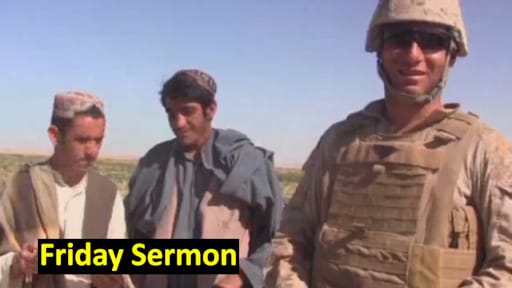
Today I did not have something very important to share with you, so I thought I could comment shortly on this video, which seems to be a CNN report. The report was published around 2011, and it tries to show that most of the people in Afghanistan have never heard of 9/11. Let’s hear part of it.

[A clip from the report is played: the reporter, on patrol with US Marines in Helmand province, shows two young Afghan men pictures of 9/11 and asks what they know about it. They say they have never heard of it.]

From my life experience, I have realized that most people in a position of weakness will mostly lie if they think they cannot get caught. These guys are in a weak position. They are being asked those questions in the presence of soldiers with guns. What does the journalist expect the answer to be? If they said that they know what those pictures are, what could be the next question? The next question would be: what do you think of that event? Do you think that it is a good thing or a bad thing? If they say a good thing, they are afraid of the soldiers. If they say a bad thing, they know that they are being recorded, and eventually their village will hear what they said in the video. So those two guys will probably choose to lie and say that they don’t know what it is.

Now let me show you a soldier who seems to be convinced that they told the truth.

[A clip is played in which a soldier says he is not surprised by their answers and describes how isolated the local people are.]

This soldier is mostly brainwashed from his experience in the United States. He has probably learned that most people will tell you the truth. Most of the things his parents told him, his teachers told him, his commanders, the colleagues around him, they mostly told him the truth, and he thinks that the same situation will be in Afghanistan as well. He fails to realize that the reason people in the US mostly told him the truth is because most of them did not think he could harm them or benefit them, so they mostly had no reason to lie. But in Afghanistan, they see him as a potential source of benefit or as a potential source of harm, so they are motivated to lie. So clearly the rich people are not aware how much the poor people are ready to lie. On the other hand, the poor people are not aware how much the rich people are willing to fool you with promises. People in a position of power usually lie less, but they almost always break their promises.

Let me show you another part from that same video.

[A clip is played in which an Afghan man complains that the Americans promised to help, but destroyed buildings and never delivered the help.]

So this guy is disappointed that the Americans said that they would help, but they did not help. Well, that’s what most people in power usually do. They give promises and do not keep them.

Now let me show you another part of that same media report, where they conclusively seem to prove their point that people in Afghanistan do not know what 9/11 is. But it is actually a triple lie, or a triple manipulation of truth.

[A clip is played citing a 2010 survey which reported that 92 percent of Afghan men in Helmand and other provinces had no idea what 9/11 was.]

So they are saying that 92 percent of Afghan men do not know what 9/11 was. Well, the first manipulation is that the video creates the illusion that the survey was done with pictures, where people could see the pictures. But in fact they are talking about a completely different survey without pictures, while showing another recording which shows the pictures.

Also, a few of the people in Afghanistan would claim not to know what 9/11 is, because in most countries, especially in Muslim countries, they do not say “9/11.” They either say “September 11th,” or they have their own months; they do not necessarily use the Christian calendar. If you ask them, “Do you remember those buildings which were destroyed in America?” they would probably remember. A lot of them actually think that the Americans destroyed the buildings themselves. So maybe the question should be, “Do you remember those two large buildings which the Americans destroyed and then blamed the Muslims for?” They would probably say yes. So whoever did that survey probably lacked awareness of how locals in that region think. They don’t have “9/11” in their vocabulary; they describe it with completely different words.

The first time I heard the term “9/11” in US media, I also did not know what they were talking about, until I realized that they were talking about the attack which was carried out by al-Qaeda on the 11th of September. You see, I know it as the 11th of September. As a European, in Europe we say the day first and then the month. If they asked me about 9/11, I would need to sort of rewire my brain first before I could answer.

Anyway, the third layer of the lie is the intentional spin of this report, as the media usually do. They probably know that the survey was not perfect, but since this report might support one political party with which they are associated, they publish the video report anyway. This kind of manipulation, by reporting unscientific surveys, is done by all sides of the media.

Anyway, what I’m trying to say is that it would probably save us a lot of energy in our life if we realize that most people in a position of weakness will lie, and most people in a position of power will break their promises when they can get away with it. And the point of what I’m saying is not to encourage us to go around trying to find who is lying and who is breaking promises. That’s not the point. The point is that if you don’t want to get fooled and hurt, don’t rely too much on the information which people weaker than you tell you, and don’t rely too much on the promises which people stronger than you give you.

For example, if you go to a job interview, and the people in that company tell you that the salary in the beginning will be this much, and then after several years they might consider an increase, don’t make your decision based on what they promise you, if you don’t think that the lower salary will benefit you anyway. They might be forced to increase your salary if it is in the contract, but if they can find a way not to keep their promise, they will most likely not keep it. Politicians, for example, almost never keep their promises. They will keep them if it is easy and if they think that it will benefit their future career, but not because they gave a promise.

Anyway, I hope you do not take this video as an excuse to become suspicious of everyone. The point of this video is to increase our awareness of how this world mostly works, but not to make us bitter people, people who are suspicious of everything. This is why the Quran mentions the jinns, who are in a weaker position than humans, as liars, and Satan, who is currently in a stronger position than humans, is described in the Quran as a promise breaker.

Gradualism as a Sign of God’s Mercy

Summary:

In this Friday sermon, Alban Fejza explains how we can tell God’s creations from human-made objects by their gradual, rounded shapes, and how this gradualism, in nature and in life’s events, is a sign of God’s mercy, which will be even greater in the next world.

Video Transcript:

Praise be to God. There is no other god except God.

Have you ever wondered why we can automatically distinguish between the creatures which are shaped by God, and creatures shaped by humans? For example, a horse and a car? Or the elephant and the truck? Or a bird and a plane? Or a fish and a ship? Or the sky and the ceiling? Or the grass and the concrete? Or the sun and the lightbulb? Or the moon and the clock? Or the eye and the camera? Or the spring and the bottle? Or the mountains and the pillars? Or the cheek and the pillow? Or the teeth and the knife? If I asked you, which of these were shaped by humans, and which were shaped by God, of course, you could immediately tell me which ones. So, even though, you were not there when they were shaped, you know immediately which ones are shaped by God, and which ones are shaped by humans. Part of the reason is because we heard about them, and we learned and remembered them, and now we know? That’s partly true, but it’s more than that. What if I show you things which you probably did not see before? Do you think that you would be able to tell me which ones are shaped by God, and which ones are shaped by humans? (See video for such examples) You probably don’t know what they are, but you still know which ones are shaped by God and which ones are shaped by humans? Why is that? What are you noticing? How can you know without using any clear cut rules? What is it you are perceiving in them to make you think that one of them is shaped by God and the other is shaped by humans? There are several aspects, but I would like to focus on one today. See, you were able to tell the difference between those two sets of objects, because you subconsciously perceived and felt God’s mercy in one of them, and you felt less mercy in the other ones. They were shaped with mercy, with God’s mercy, and one of the signs of his mercy is what I call gradualism. Let’s take the human as an example. Do you see how my cheek gradually turns into an ear lobe?  How my fingers gradually turn into a palm? They are not attached to my palm with screws. No bolts are used. They gradually turn into a palm, and they are still sufficiently different from the palm to be distinguished from it, but they are not completely separate parts. One of them gradually merges into the other one. But in a car, the wheel is a separate object, and the windshield is a separate object. So in reality the car is not one thing. It’s a collection of things, which we named with one name. It’s an invented name for a group of things. But the human being is one thing in name and in reality. The ear is not an ear unless it is attached to the head. It’s not a thing. It’s a subcomponent. It can not exist separately. The wheel exists separately from the car, but the human ear does not exist separately from the human. The human is all one thing, and every subcomponent of the human merges into another gradually. There are no clear-cut separations, even if they look so. We perceive them as separate sometimes because we have given them names, and we draw them as separate things, but in reality they gradually turn into one another. The eye gradually turns into parts of my brain, at the back of my brain, similar to how the leaves gradually turn into a stem, and the stem gradually turns into a trunk, and the trunk gradually turns into the root. Or have you noticed how the day turns into the night gradually. It takes about 3 minutes on average for the sun to gradually set, and then it takes about 1 hour and a half for the sky to turn completely dark. Compare this to how we turn our light off immediately when we try to put our babies to sleep. In this world, the biggest mercy among humans is the mercy of the mother towards her baby, but that does not even compare to God’s mercy. See, when the mother tries to put her baby to sleep, how gently and gradually does she do it? The light is turned off immediately. When she holds the baby, it takes about 15 seconds to gradually put the baby in the crib or in bed. But God puts us to sleep even more gradually and more gently, with more mercy. He turns the sun off gradually for about three minutes, and then the light gradually fades away for a couple of hours. See, all these gradual changes are sings of God’s mercy. And then in the morning, the songs of birds start slowly, and then get louder and louder, just enough to wake you up gently and gradually. Compare this to an alarm clock. It’s so sudden, and annoying, and it gives you anxiety. It does the job, but without much mercy.

Have you noticed how the valleys gradually turn into hills and the hills gradually turn into mountains. You can walk blind, and you will hardly fall anywhere which would kill you? Usually, the terrain gets gradually rougher and gradually steeper, and it is enough to warn us that it is going to get more dangerous. Now, compare that to modern architecture, with sharp changes. One mistake, and you are gone. Can you imagine a blind person walking on top of tall building? One step, he is completely fine, and the next step he is dead? One step in the pavement, he is completely fine, and the next step in the road, he may be run over by a car. Even the cars are built without much mercy? They drive to speeds higher than a human being can survive. Compare that to horse. If you fall from the fastest horse ever, on natural grass, you would still survive. But if you fall from any car, at a normal car speed, you would probably die. I often hear ignorant people tell stories how someone was driving 100 kilometers per hour without a seat belt and no airbags and had an accident and still survived? At 100 kilometers per hour, everyone dies. What really happened probably was that the person was driving 100 kilometers per hour, he saw the danger in the last couple of seconds, hit the brakes, and the car slowed down to about 40 kilometers per hour, and then he had the accident? But when people ask him, “How fast were you driving when you had the accident?” He says, “100 kilometers per hour.”

So, a car to car accident, can easily kill someone, but a human to human accident does not kill anyone. If you walk without paying much attention and hit another human being, you don’t die. You have soft flesh and soft skin on the outside, while the hard bones are inside, and the other human being also has soft flesh and soft skin on the outside, and it’s like airbag protection. Shaped by God with his mercy.

Now, let’s think about weather. How does it change? It gradually gets colder and colder, or warmer and warmer? I have never seen a weather where it is very cold in one hour and very hot in the next hour. It gradually changes, because God designed it like that with his mercy, to give us time to put some additional clothes on, or go home, or prepare for the change of seasons, collect wood, and so on. Have you seen, how gradually the seasons change? How gradually clouds gather? How gradually they move? How gradually the rain starts? How gradually the flowers bloom, and how gradually they turn into fruits? How gradually the fruits grow? Even their color changes gradually, from green to yellow, if it’s a lemon, or maybe a purple plum, or a blue berry, or a red cherry, or pinkish apple. Even within the same fruit, the colors merge gradually from yellowish parts to dark red parts in a peach for example.

Even the fire, which is a sign of hell and it burns humans, even there, when you approach it, you can feel the heat from far away, and it gives you time to move away or escape. I have never seen a fire burn a human being suddenly. It never does that in nature. It starts gradually, then it spreads gradually, then it gets bigger and hotter, and there is enough time for humans to escape. The only reason it burns humans accidently is because of human made things without mercy, like a gas bottle which explodes suddenly and so on, but in nature, it is very gradual, and warns us in time. Compare this to electricity, which is fire in a way. Electricity is just electrons being detached from their atoms and traveling freely, and the fire is fundamentally the same thing. It’s atoms of the wood being connected to the atoms of the oxygen, and in the middle of it, electrons are being exchanged. So, even though fire is a chemical reaction, every chemical reaction is an exchange or release of electrons, or a sharing of electorns. So fundamentally, there is no big difference between the fire and electricity. However, look how God shaped the fire to turn on and off gradually? And look how we shaped electricity to turn on and off suddenly? Electricity kills people every day, without warning. How much mercy is in that? Can’t you see how God made things gradual, because He was merciful? Gradual shapes are a sign of his mercy? The stars and the planets are not shaped with abrupt sharp edges. Have you ever seen a square shaped star or a triangle shaped star? They are shaped like circles. The circle is the perfect example of a gradually changing shape. The angle of change in a circle is gradual. It’s the most beautiful abstract shape? Our eyes are circles inside? The most beautiful part of our body. The moon is circle shaped? The sun is circle shaped? Don’t blame kids for liking balloons? They are circle shaped and soft. Most fruits basically follow the shape of the circle; they are slightly squashed or slightly elongated versions of a circle. Grapes, olives, pears, strawberries, figs. How about the basics of living? The water droplets? The grains? The sky itself. Do you see any sharp abrupt angles, or do you see smooth gradual shapes? The gradual changing shapes bear witness that God is merciful. By the way, the perfect shape is a circular shape, but the perfect shape which is also a living creature is the shape of a human being. God does not have a shape? You have to have an end, to have a shape. God does not have an end. He is not shaped; He is the shaper. Creatures have shapes. The creator does not need a shape. He creates and shapes, and he shapes things while at the same time being merciful. He shapes with mercy, and he has shaped things of this world with partial mercy. There will be much more mercy for believers in the next world.

Verses 156 and 157, in chapter 7 say that God’s mercy encompasses all things. However, He will specify it for those who lead a righteous life, give the obligatory charity, believe in God’s revelations, and follow the gentile prophet, prophet Muhammad.

So, for the righteous people, there will be much more mercy in the next world. The pearls in the next world will not be quasi circular, or almost circular like in this world. They will be perfectly circular. In this world, the roundest objects are black holes, which are impossible to see, but in the next world the simplest pearl will be rounder than the roundest object in this world. God will shape those pearls with much more mercy. They will be designed especially for us to enjoy.


Friday Sermon by: Alban Fejza, Online Congregation Director