[search-in-place-form in_current_page="1"]

What Does the Quran Say About Marks?

Marks are mentioned in the Quran in these verses:


[2:260] Abraham said, “My Lord, show me how You revive the dead.” He said, “Do you not believe?” He said, “Yes, but I wish to reassure my heart.” He said, “Take four birds, study their marks, place a piece of each bird on top of a hill, then call them to you. They will come to you in a hurry. You should know that God is Almighty, Most Wise.”

[48:29] Muhammad – the messenger of God – and those with him are harsh and stern against the disbelievers, but kind and compassionate amongst themselves. You see them bowing and prostrating, as they seek God’s blessings and approval. Their marks are on their faces, because of prostrating. This is the same example as in the Torah. Their example in the Gospel is like plants that grow taller and stronger, and please the farmers. He thus enrages the disbelievers. God promises those among them who believe, and lead a righteous life, forgiveness and a great recompense.


To learn more, read the Quran in English.

Want to study the Quran every week? We provide online Friday meetings every Friday.

What Does the Quran Say About Markets?

Markets are mentioned in the Quran in these verses:


[25:7] And they said, “How come this messenger eats the food and walks in the markets? If only an angel could come down with him, to serve with him as a preacher!”

[25:20] We did not send any messengers before you who did not eat food and walk in the markets. We thus test you by each other; will you steadfastly persevere? Your Lord is Seer.


To learn more, read the Quran in English.

Want to study the Quran every week? We provide online Friday meetings every Friday.
What Does the Quran Say About Mansions?

Mansions are mentioned in the Quran in these verses:


[7:74] “Recall that He made you inheritors after `Aad, and established you on earth, building mansions in its valleys, and carving homes from its mountains. You shall remember God’s blessings, and do not roam the earth corruptingly.”

[9:72] God promises the believing men and the believing women gardens with flowing streams, wherein they abide forever, and magnificent mansions in the gardens of Eden. And God’s blessings and approval are even greater. This is the greatest triumph.

[21:13] Do not run, and come back to your luxuries and your mansions, for you must be held accountable.

[22:45] Many a community we have annihilated because of their wickedness. They ended up in ruins, stilled wells, and great empty mansions.

[25:10] Most blessed is the One who can, if He wills, give you much better than their demands – gardens with flowing streams, and many mansions.

[26:149] “You carve out of the mountains luxurious mansions.

[29:58] Those who believe and lead a righteous life, we will surely settle them in Paradise, with mansions and flowing streams. Eternally they abide therein. What a beautiful reward for the workers.

[39:20] As for those who reverence their Lord, they will have mansions upon mansions constructed for them, with flowing streams. This is God’s promise, and God never breaks His promise.

[43:33] If it were not that all the people might become one (disbelieving) congregation, we would have granted everyone who disbelieves in the Most Gracious mansions with silver roofs, and stairs upon which they could climb.

[43:34] Their mansions would have impressive gates, and luxurious furnishings.

[61:12] In return, He forgives your sins, and admits you into gardens with flowing streams, with beautiful mansions in the gardens of Eden. This is the greatest triumph.

[77:32] It throws sparks as big as mansions.


To learn more, read the Quran in English.

Want to study the Quran every week? We provide online Friday meetings every Friday.
What Does the Quran Say About Manna?

Manna is mentioned in the Quran in these verses:


[2:57] We shaded you with clouds (in Sinai), and sent down to you manna and quails: “Eat from the good things we provided for you.” They did not hurt us (by rebelling); they only hurt their own souls.

[7:160] We divided them into twelve tribal communities, and we inspired Moses when his people asked him for water: “Strike the rock with your staff,” whereupon twelve springs gushed out therefrom. Thus, each community knew its water. And we shaded them with clouds, and sent down to them manna and quails: “Eat from the good things we provided for you.” It is not us that they wronged; it is they who wronged their own souls.

[20:80] O Children of Israel, we delivered you from your enemy, summoned you to the right side of Mount Sinai, and we sent down to you manna and quails.


To learn more, read the Quran in English.

Want to study the Quran every week? We provide online Friday meetings every Friday.

What Does the Quran Say About Males?

Males are mentioned in the Quran in these verses:


[5:103] God did not prohibit livestock that begets certain combinations of males and females, nor livestock liberated by an oath, nor the one that begets two males in a row, nor the bull that fathers ten. It is the disbelievers who invented such lies about God. Most of them do not understand.

[6:139] They also said, “What is in the bellies of these livestock is reserved exclusively for the males among us, and prohibited for our wives.” But if it was a still birth, they permitted their wives to share therein. He will certainly requite them for their innovations. He is Most Wise, Omniscient.

[6:143] Eight kinds of livestock: regarding the two kinds of sheep, and the two kinds of goats, say, “Is it the two males that He prohibited, or the two females, or the contents of the wombs of the two females? Tell me what you know, if you are truthful.”

[6:144] Regarding the two kinds of camels, and the two kinds of cattle, say, “Is it the two males that He prohibited, or the two females, or the contents of the wombs of the two females? Were you witnesses when God decreed such prohibitions for you? Who is more evil than those who invent such lies and attribute them to God? They thus mislead the people without knowledge. God does not guide such evil people.”

[13:3] He is the One who constructed the earth and placed on it mountains and rivers. And from the different kinds of fruits, He made them into pairs – males and females. The night overtakes the day. These are solid proofs for people who think.

[26:165] “Do you have sex with the males, of all the people?

[42:50] Or, He may have the males and the females marry each other, then render whomever He wills sterile. He is Omniscient, Omnipotent.


To learn more, read the Quran in English.

Want to study the Quran every week? We provide online Friday meetings every Friday.

What Does the Quran Say About the Majority?

The Majority is mentioned in the Quran in these verses:


[3:110] You are the best community ever raised among the people: you advocate righteousness and forbid evil, and you believe in God. If the followers of the scripture believed, it would be better for them. Some of them do believe, but the majority of them are wicked.

[4:46] Among those who are Jewish, some distort the words beyond the truth, and they say, “We hear, but we disobey,” and “Your words are falling on deaf ears,” and “Raa’ena (be our shepherd),” as they twist their tongues to mock the religion. Had they said, “We hear, and we obey,” and “We hear you,” and “Unzurna (watch over us),” it would have been better for them, and more righteous. Instead, they have incurred condemnation from God due to their disbelief. Consequently, the majority of them cannot believe.

[6:116] If you obey the majority of people on earth, they will divert you from the path of God. They follow only conjecture; they only guess.

[12:8] They said, “Joseph and his brother are favored by our father, and we are in the majority. Indeed, our father is far astray.

[12:106] The majority of those who believe in God do not do so without committing idol worship.

[16:83] They fully recognize God’s blessings, then deny them; the majority of them are disbelievers.

[19:73] When our revelations are recited to them, clearly, those who disbelieve say to those who believe, “Which of us is more prosperous? Which of us is in the majority?”


To learn more, read the Quran in English.

Want to study the Quran every week? We provide online Friday meetings every Friday.

What Does the Quran Say About Majesty?

Majesty is mentioned in the Quran in these verses:


[14:14] “And we will let you dwell in their land after them. This is (the reward) for those who reverence My majesty, and reverence My promise.”

[26:44] They threw their ropes and sticks, and said, “By Pharaoh’s majesty, we will be the victors.”

[38:82] He said, “I swear by Your majesty, that I will send them all astray.

[55:27] Only the presence of your Lord lasts. Possessor of Majesty and Honor.

[55:46] For those who reverence the majesty of their Lord, two gardens (one for the jinns and one for the humans).

[55:78] Most exalted is the name of your Lord, Possessor of Majesty and Honor.

[79:40] As for the one who reverenced the majesty of his Lord, and enjoined the self from sinful lusts.


To learn more, read the Quran in English.

Want to study the Quran every week? We provide online Friday meetings every Friday.

What Does the Quran Say About Magic?

Magic is mentioned in the Quran in these verses:


[5:110] God will say, “O Jesus, son of Mary, remember My blessings upon you and your mother. I supported you with the Holy Spirit, to enable you to speak to the people from the crib, as well as an adult. I taught you the scripture, wisdom, the Torah, and the Gospel. Recall that you created from clay the shape of a bird by My leave, then blew into it, and it became a live bird by My leave. You healed the blind and the leprous by My leave, and revived the dead by My leave. Recall that I protected you from the Children of Israel who wanted to hurt you, despite the profound miracles you had shown them. The disbelievers among them said, `This is obviously magic.’

[6:7] Even if we sent down to them a physical book, written on paper, and they touched it with their hands, those who disbelieved would have said, “This is no more than clever magic.”

[7:109] The leaders among Pharaoh’s people said, “This is no more than a clever magician.

[7:110] “He wants to take you out of your land; what do you recommend?”

[7:111] They said, “Respite him and his brother, and send summoners to every city.

[7:112] “Let them summon every experienced magician.”

[7:113] The magicians came to Pharaoh and said, “Do we get paid if we are the winners?”

[7:114] He said, “Yes indeed; you will even become close to me.”

[7:115] They said, “O Moses, either you throw, or we are throwing.”

[7:116] He said, “You throw.” When they threw, they tricked the people’s eyes, intimidated them, and produced a great magic.

[7:117] We then inspired Moses: “Throw down your staff,” whereupon it swallowed whatever they fabricated.

[7:118] Thus, the truth prevailed, and what they did was nullified.

[7:119] They were defeated then and there; they were humiliated.

[7:120] The magicians fell prostrate.

[7:121] They said, “We believe in the Lord of the universe.

[7:122] “The Lord of Moses and Aaron.”

[7:123] Pharaoh said, “Did you believe in him without my permission? This must be a conspiracy you schemed in the city, in order to take its people away. You will surely find out.

[7:124] “I will cut your hands and feet on alternate sides, then I will crucify you all.”

[7:125] They said, “We will then return to our Lord.

[7:126] “You persecute us simply because we believed in the proofs of our Lord when they came to us.” “Our Lord, grant us steadfastness, and let us die as submitters.”

[7:132] They said, “No matter what kind of sign you show us, to dupe us with your magic, we will not believe.”

[10:2] Is it too much of a wonder for the people that we inspired a man like them? He (was inspired to say), “You shall warn the people, and give good news to those who believe that they have attained a position of prominence at their Lord.” The disbelievers said, “This is a clever magician!”

[10:76] When the truth came to them from us, they said, “This is obviously magic!”

[10:77] Moses said, “Is this how you describe the truth when it comes to you? Is this magic? How can any magicians prevail?”

[10:78] They said, “Did you come to divert us from what we found our parents doing, and to attain positions of prominence for yourselves? We will never join you as believers.”

[10:79] Pharaoh said, “Bring to me every experienced magician.”

[10:80] When the magicians came, Moses said to them, “Throw whatever you are going to throw.”

[10:81] When they threw, Moses said, “What you have produced is magic, and God will make it fail. God does not support the transgressors’ work.”

[20:57] He said, “Did you come here to take us out of our land with your magic, O Moses?

[20:58] “We will surely show you similar magic. Therefore, set an appointment that neither we, nor you will violate; in a neutral place.”

[20:59] He said, “Your appointed time shall be the day of festivities. Let us all meet in the forenoon.”

[20:60] Pharaoh summoned his forces, then came.

[20:61] Moses said to them, “Woe to you. Do you fabricate lies to fight God and thus incur His retribution? Such fabricators will surely fail.”

[20:62] They disputed among themselves, as they conferred privately.

[20:63] They said, “These two are no more than magicians who wish to take you out of your land with their magic, and to destroy your ideal way of life.

[20:64] “Let us agree upon one scheme and face them as a united front. The winner today will have the upper hand.”

[20:65] They said, “O Moses, either you throw, or we will be the first to throw.”

[20:66] He said, “You throw.” Whereupon, their ropes and sticks appeared to him, because of their magic, as if they were moving.

[20:67] Moses harbored some fear.

[20:68] We said, “Have no fear. You will prevail.

[20:69] “Throw what you hold in your right hand, and it will swallow what they fabricated. What they fabricated is no more than the scheming of a magician. The magician’s work will not succeed.”

[20:70] The magicians fell prostrate, saying, “We believe in the Lord of Aaron and Moses.”

[20:71] He said, “Did you believe in him without my permission? He must be your chief; the one who taught you magic. I will surely sever your hands and feet on alternate sides. I will crucify you on the palm trunks. You will find out which of us can inflict the worst retribution, and who outlasts whom.”

[20:72] They said, “We will not prefer you over the clear proofs that came to us, and over the One who created us. Therefore, issue whatever judgment you wish to issue. You can only rule in this lowly life.

[20:73] “We have believed in our Lord, that He may forgive us our sins, and the magic that you forced us to perform. God is far better and Everlasting.”

[21:3] Their minds are heedless. And the transgressors confer secretly: “Is he not just a human being like you? Would you accept the magic that is presented to you?”

[26:34] He said to the elders around him, “This is an experienced magician.

[26:35] “He wants to take you out of your land, with his magic. What do you suggest?”

[26:36] They said, “Respite him and his brother, and send summoners to every town.

[26:37] “Let them summon every experienced magician.”

[26:38] The magicians were gathered at the appointed time, on the appointed day.

[26:39] The people were told: “Come one and all; let us gather together here.

[26:40] “Maybe we will follow the magicians, if they are the winners.”

[26:41] When the magicians came, they said to Pharaoh, “Do we get paid, if we are the winners?”

[26:42] He said, “Yes indeed; you will even be close to me.”

[26:43] Moses said to them “Throw what you are going to throw.”

[26:44] They threw their ropes and sticks, and said, “By Pharaoh’s majesty, we will be the victors.”

[26:45] Moses threw his staff, whereupon it swallowed what they fabricated.

[26:46] The magicians fell prostrate.

[26:47] They said, “We believe in the Lord of the universe.

[26:48] “The Lord of Moses and Aaron.”

[26:49] He said, “Did you believe with him before I give you permission? He must be your teacher, who taught you magic. You will surely find out. I will sever your hands and feet on alternate sides. I will crucify you all.”

[26:50] They said, “This will not change our decision; to our Lord we will return.

[26:51] “We hope that our Lord will forgive us our sins, especially that we are the first believers.”

[27:13] When our miracles were presented to them, clear and profound, they said, “This is obviously magic.”

[28:36] When Moses went to them with our proofs, clear and profound, they said, “This is fabricated magic. We have never heard of this from our ancient ancestors.”

[28:48] Now that the truth has come to them from us, they said, “If only we could be given what was given to Moses!” Did they not disbelieve in what was given to Moses in the past? They said, “Both (scriptures) are works of magic that copied one another.” They also said, “We are disbelievers in both of them.”

[34:43] When our proofs were recited to them, perfectly clear, they said, “This is simply a man who wants to divert you from the way your parents are worshiping.” They also said, “These are fabricated lies.” Those who disbelieved also said about the truth that came to them, “This is obviously magic.”

[37:15] They say, “This is obviously magic!

[38:4] They wondered that a warner should come to them, from among them. The disbelievers said, “A magician, a liar.

[40:24] To Pharaoh, Haamaan, and Qaaroon. But they said, “A magician; a liar.”

[43:49] They said, “O you magician, implore your Lord on our behalf (to relieve this plague), since you have an agreement with Him; we will then be guided.”

[46:7] When our revelations were recited to them, perfectly clear, those who disbelieved said of the truth that came to them, “This is obviously magic!”

[51:39] But he turned away, in arrogance, and said, “Magician, or crazy.”

[51:52] Consistently, when a messenger went to the previous generations, they said, “Magician,” or, “Crazy.”

[52:15] Is this magic, or do you not see?

[54:2] Then they saw a miracle; but they turned away and said, “Old magic.”

[61:6] Recall that Jesus, son of Mary, said, “O Children of Israel, I am God’s messenger to you, confirming the Torah and bringing good news of a messenger to come after me whose name will be even more praised (Ahmad).” Then, when he showed them the clear proofs, they said, “This is profound magic.”

[74:24] He said, “This is but clever magic!


To learn more, read the Quran in English.

Want to study the Quran every week? We provide online Friday meetings every Friday.

How to Wear the Ihram

Summary:

In this video, Alban Fejza explains where the Ihram should be put on before entering Mecca for Hajj and demonstrates how men and women wear it.

Video Transcript:

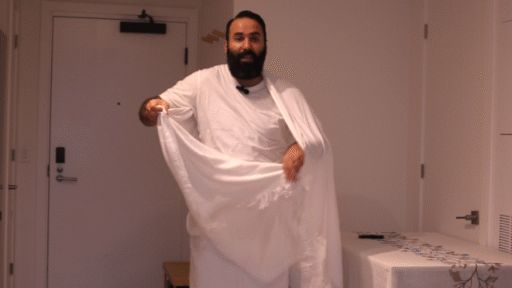
Praise be to God. There is no other God except God. So in the previous Friday sermon titled my 2025 Hajj travel checklist, I mentioned that one of the items that I need to prepare for Hajj is theam. And in this video, I’m going to show you how to wear it. But before I do that, let me first talk about where to wear it. Theam should be worn before you enter the borders seen in this map. These are the borders of the Mecca state. And what I mean by Mecca state is that in a more advanced world, Arabia would be a democratic country like Italy is today. And then Mecca, this region of Mecca will be a religious state separate from Saudi Arabia, just like the Vatican is a religious state separate from Italy. Now, traditionally when you enter this region for Hajj or Umrah from any of these borders, you are supposed to wear the before you enter. However, one of those borders entrances extends all the way to the sea. And there was a general consensus since before, during and after Muhammad that people who come from the sea should first step on land and then wear the am because it would be uncomfortable and unreasonable to change your clothes in a moving ship where you might not even have sufficient privacy. But then the question is where should you wear the Aram if you land in this region from the air with an airplane? Well, we can reach the conclusion about this from the Quran. The Quran in verses 3512, 55:19, and 2553 mentions only two seas. The Quran does not mention five oceans, for example, like they teach you in geography courses because according to the Quran, correctly. So, the so-called oceans are just one continuous body of water that makes just one sea. But where is the other sea then? The other sea according to the Quran and the Bible is the atmosphere. It is called the upper sea which is separated from the lower sea by evaporation. The atmosphere also contains water which is why it can be considered the sea. The Bible in its first chapter also mentions this idea of the two seas. The lower sea the oceans and the upper sea the atmosphere. And once we realize that the atmosphere is one of the seas, we realize that the Quran whenever it mentions ships, it also talks about airplanes as just one of the ship versions because the airplanes float in the upper sea just like ships float in the lower sea. For example, in verse 55:24, God says that to him belong the ships which are elevated high like mountains. Obviously this also refers to airplanes because they are elevated high like mountains and they fly or float in the waters of the atmosphere. So this means that what traditionally applied to ships in in relation to it applies to airplanes as well. And this means that we should wear theam after we land on the Mecca state. Just like for centuries, the people who went to Mecca on ships were their am after they landed in Jedha. Let me use another example to explain why this makes sense. Let’s say if you travel to Moscow, Russia, for example, when the plane enters the atmosphere, the atmosphere above Russia, they do not check your passport up there in the air while still on the airplane. First, the airplane lands and then they check your passport at the airport inside Russian land. But if you travel there with a car through land, first you show your passport and then they they let you enter Russia. And the same logic applies to. If you travel with an airplane or ship, first you land and then you wear theam. But if you travel through land, first you wear theam and then you enter the Mecca state. Unfortunately, the Saudi religious authorities reached the wrong conclusion about this issue without any basis in the Quran or even in their hadith. They apply the rule of the land to the case of the airplanes instead of applying the rule of the ships to the case of the airplanes. So they actually require you to wear theam before you land there at the Jada airport. This is a requirement with no basis, but I plan to obey it regardless because it is such a small price to pay to be able to per perform such an important religious ritual like Hajj. God willing, one day this will be corrected and they will have changing rooms at the Jada airport for people to wear theirs. But for now, let’s just wear the before we land at the Jada airport. You can wear it at home before you leave or you can wear it at the last airport before you fly to Jedha. The airports have bathrooms after you pass security when you wait at the boarding gate for the airplane. So you can just use the bathroom to remove your clothes and wear the air. So here is what I plan to do. I take a shower at home and then I wear the air either at home or at the airport bathroom. So now here is how I wear my ear. I take my pants, my t-shirt, and the undershirt off. I’m not going to do it here on video, of course, because it would not be modest, but you can just imagine that I removed my clothes. By the way, I plan to leave my underwear on and wear theam on top of the underwear. Traditionally, people used to wear the aam without underwear, but this is actually not religious requirement at all. The purpose of the Aram is so that people cannot see the shape of your body. Which is why is supposed to be a simple fabric which has not been sewn together with other fabric because suing them is what enables you or the or the factories to shape them according to the shape of your body. So ultimately what makes theam a trueam is not allowing the others to see the shape of your body and whether you wear underwear underneath the iram or not that should not make a difference in revealing the shape of your body. In fact for people of the modern world it is better to have underwear underneath the aam because we do not have very sophisticated privacy protection habits. We are not as careful in how we sit in different situations for example and we wouldn’t want to flash somebody by accident while we are sitting to eat for example or maybe while we are standing up and someone accidentally steps on our aam and it falls off that would be totally embarrassing for you and for the other person. So to avoid such an accidental situation where the aam might fall off it’s better to have underwear. By the way, even Jesus wore an undergarment. And if underwear was not too unholy for Jesus, the definitely are not too unholy for us either. But bedwins at the time of Muhammad did not have underwear, but they did not have underwear even when they were not going to Hajj. And that is because they had mastered the art of not wearing underwear in the desert since their childhood. They were taught by their parents how to be mindful about how they sit and in what positions they eat when and where they eat and in what positions to sleep and so on. But for people of the modern world like us who typically wear underwear, underwear is a better method of protecting us from the unintentionally from unintentionally revealing our private parts during the whole hutch process. For women, if they wear underwear, it’s important that they do not exaggerate some certain shapes of their bodies. Now, what does the Quran tell us regarding how to wear the Before we go there, let’s first take another example with which we are familiar to understand the logic easier. For example, what does the Quran tell us about how to use a fork? Basically only one verse in the Quran advises us about this. Verse 6 141 tells us not to waste the food. So just don’t drop the food outside of your plate when you use the fork because when because then it might be unclean to eat it and it goes to waste. So basically the only rule in the Quran about how to use a fork is to simply make sure not to drop the fruit. It doesn’t matter if you hold the fork like this or like this or may or like this or with your left hand like this and so on. Just don’t drop the food. In a similar way, the only rule in the Quran about how to wear the is just don’t drop theam. Don’t let it fall off from your body. It doesn’t matter if you hold it with your hands or use this method or that method or use a belt. There are no specific rules as long as you don’t let it fall off. And this rule is given to us in verse 727. It says, “Oh children of Adam, do not let the devil dupe you as he did when he caused the eviction of your parents from paradise and the removal of their garments to expose their bodies. So just don’t let the devil expose your body in public. So which one of the many available methods of wearing the am you use is not important. As long as you do it in a way where you feel comfortable that it will not fall off. So here is one of the methods which I use. I take the aram. Here it is. I put it behind my body. I spread it like this. And then I grab with my right hand all the way to the corner. All the way to the corner. But with my left hand, I don’t need to go all the way to the corner. Just somewhere here. So, I tuck the right side underneath like this. Make sure I pull tight. And then the other side on top. And then I roll it as far as it goes. Like this. And then to make sure that it doesn’t fall, I roll it down on all sides. Like that. If it feels tight, you’re doing it well. And there we go. And then I can test it if if it’s going to fall. Look, I’m pulling really hard. It’s not going to fall. So yeah, that’s the method I use. Or God willing, this time I also plan to use a belt. So, what I can do is put a belt, an inram belt, put it like this, and then for to be extra modest, I’m actually going to cover the belt. I’ll I’ll cover the belt with the ear. There we go. So, yeah, that’s it for the lower ARM. Very simple. Now for the upper body aam there are quite a few methods basically you just do it like a shawl like a winter scarf. You put it around and then you throw one side on top of the other like that at the back of your body. And that’s it. And even though I did it like a scarf because it’s much wider than a scarf, it kind of covers all my upper body. And this method is actually useful when you are not very active. If you are in a situation so when you want to be more active, what you can do is in instead of throwing this up like this, you put your shoulder out and then you throw it. In this way, you have extra mobility or you can do the prayer or you can walk around or even run. This has extra mobility. Or if it’s really hot and sunny outside and you have no protection, no umbrella and let’s say you want to do the prayer and you cannot hold the umbrella and you need your head to be protected from the sun. What you can do is just put it like this and then just put these two sides like that and that’s it. So now you’re protect pro protected from the sun. Some people think that we shouldn’t cover our head during Hajj. However, that rule only applies to you wearing an extra hat or an extra cap. But if you use the Aram itself to cover your head, that is totally fine. You can and if it’s really really hot and and in a dry desert climate, what you can do is sprinkle some water in the it’s actually going to really keep you cool. And that’s it. The upper air and the lower Aram. Now for women, women don’t wear a by the way. women wear a modest dress. For example, my wife plans to wear this dress. It’s a very simple black dress. It can be I would recommend that it is either black or gray or white because those are neutral colors which are more modest. And then so she plans to wear this before we go to Saudi Arabia. And then on the plane when we are about to reach Saudi Arabia, before we land, she plans to wear the headscarf as well. What they call the hijab. It’s a simple it’s a simple headscarf. So she plans to put it on her head. That’s it for women. So this is all you need to know about or the models dress for women.

My 2025 Hajj Travel Checklist

Summary:

In this video, Alban Fejza goes through his checklist of items to prepare for his 2025 Hajj journey, explaining what each item is for.

Video Transcript:

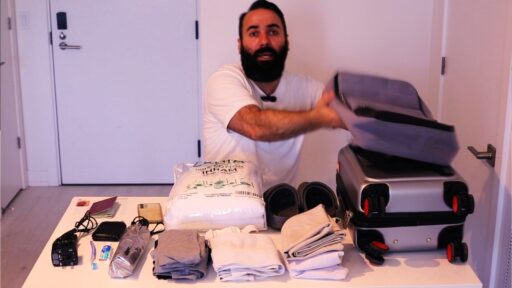
Praise be to God. There is no other God except God. Are you planning to travel for Hajj pilgrimage during this year? If yes, let me give you a helpful checklist about what items to prepare for your travel. I titled this video my 2025 Haj travel checklist because this is my checklist for this year and some of these things might not necessarily apply to you or in another year. So, it’s not a one-sizefitsall type of video, but it’s very helpful to give you ideas about what might apply to you. Then, based on your own circumstances or depending at what time in the future you are going to Hajj or from which place you are going to Hajj, you might have to remove some things or you might have to add some things. Nevertheless, this is a good starting point to just give you a general idea about what you have to prepare for the Hajj travel. So, here is my checklist. You can take a screenshot of it to use it to doublech checkck what you might want to prepare for your Hajj. Now let’s go through all the items in the checklist one by one. Passport check. Umra visa check.

Phone check. Airplane ticket check. I saved it on my phone so that I can access it even without internet. Reserved hotel name and address. Check. I also have it saved on my phone. Very important. So that when you go to Saudi Arabia, you can tell the taxi driver where to send you. Next item, wallet, check, about $300 cash for emergency purposes and food, plus the credit card. You might need more money if you haven’t paid your hotel room or some other payment yet. Iram checkram is basically two very big white towels. Today they mostly come in similar sizes with very slight variations. I’m quite also I went for the ones which are 45 in by 90 in which is 114 cm by 228 cm. But any of the sizes on the market will probably work for anyone. I also got one which is not too thin so that the shape of my body cannot be seen through it but also not too thick because it would take too much space in my luggage. I tell you how to wear the amam in another Friday sermon video titled how to wear theam. If you are a woman, you have to wear a modest dress instead of anam. Next item belt foram. Check. Not necessary, but I wasn’t so comfortable without it last time when I went to Hajj. So, I plan to use it this time because it’s not easy to find it in the market. God willing, I am bringing one for free for each submitting man who is coming to Hajj with us during this year. When we get there, God willing, I’ll give you one. Phone charger, check. Travel adapter, check. In Saudi Arabia, they have type G sockets like this, which are the same as the ones they use in UK. I have an international one here, which includes the UK plug type. That should do the job. If you really can’t find one, you can coordinate with your hotel roommate to see if you can share one or you might have to use your phone less during Hajj to make sure that you have enough battery for emergency purposes. Underwear, check. Undershirts. Check. Three shirts or t-shirts. Check. The one which I’m wearing, of course, and two extra ones. Pants like this. Check. Just the ones which I am wearing should be enough. I wanted to get better ones which I have, but they don’t fit me comfortably anymore. I have gained some weight. So, I’m settling for these jeans. Not the best option, but they are allowed. I only need one pair by the way because most of the time I will be wearing the aam, God willing. Next item, toothbrush, check. Toothpaste, check. They don’t allow toothpaste which are bigger than 100 ml at the airport. I got one which is only 20 ml here. If you can find a small one like this, then you can take chewing gum which refreshes your breath. This is only important because we will be sitting near the other people that are at the sacred masjid and we don’t want to make it unpleasant for others if our breath smells bad. Next item, backpack check. Now I won’t need this when I and it is not recommended when I visit the sacred masjid because it takes too much space in a crowded place. So God willing I will leave it in the hotel room during the visits to the sacred masjid and Safa and Marba which are indoors environments and I will take it when we go to Arafat Musa and Mina which are outdoors environments. It will be very useful there to carry food and water and other necessary things. Next item, carry-on baggage. Check. It’s smaller than 55 cm by 40 cm by 23 cm so that it can fit in the overhead cabin in the airplane. In this way, I don’t have to pay extra at the airport for the luggage. Plus, more importantly, I do not have to wait for my luggage at the airport when I get to Jeda. Next item, sandals. Check. These are my sandals. My Crocs. They are just about within the religious requirements because they do not cover my heel and my ankle. I had these already, which is why I’m taking them. They might not be perfect for stepping on hot pavements in the desert, but I will take my chances this time in case they don’t work perfectly. I can stay more under the shades. Sun UV umbrella check. It’s hard to find this umbrella in the markets outside of the American online markets like Amazon. So for those who do not live in the US, God willing, we will bring a free umbrella for everyone when we meet you there, God willing, we’ll give every submitter an umbrella like this. And last but not least, coupon for animal sacrifice. So the way it is set up today is that I bought the coupon for the animal sacrifice online and then this authorized the agencies which are appointed by the Saudi government to sacrifice a sheep on my behalf and distribute it to the poor. They can do it anytime even before I travel for Hajj and that is fine as long as it is done before I finish Hajj. They already sent me the confirmation that they did complete the animal sacrifice. So I’m good to go in this aspect and that’s it. These are the things which I have prepared for my Hajj travel God willing. And now let me remind you about the most important one. Verse 197 in chapter 2 of the Arabic Quran tells us to take provisions for the Hajj travel which are these or others. But it also tells us that the best provision is righteousness. So righteousness is what you should truly care about when you go to Hajj. Now when I get there to Mecca, I plan to buy food, water, and the prayer mat. I don’t need the prayer mat when I visit the sacred mazjid and Safa and Marva because it is indoors, clean and nicely paved. But the prayer mat will be helpful when I go to Arafat, Musalifa, and Mina because those are outdoors environments. And there in addition to using it for the contact prayer, I can also use it to sit and rest on it to protect myself from the potentially scorching rough ground when I sit. So these were my Hajj preparations for this year and may God bless your Hajj travel if you intend to go.