[search-in-place-form in_current_page="1"]

The Submitters Retreat


Sermon Introduction

Praise be to God. There is no other God except God.

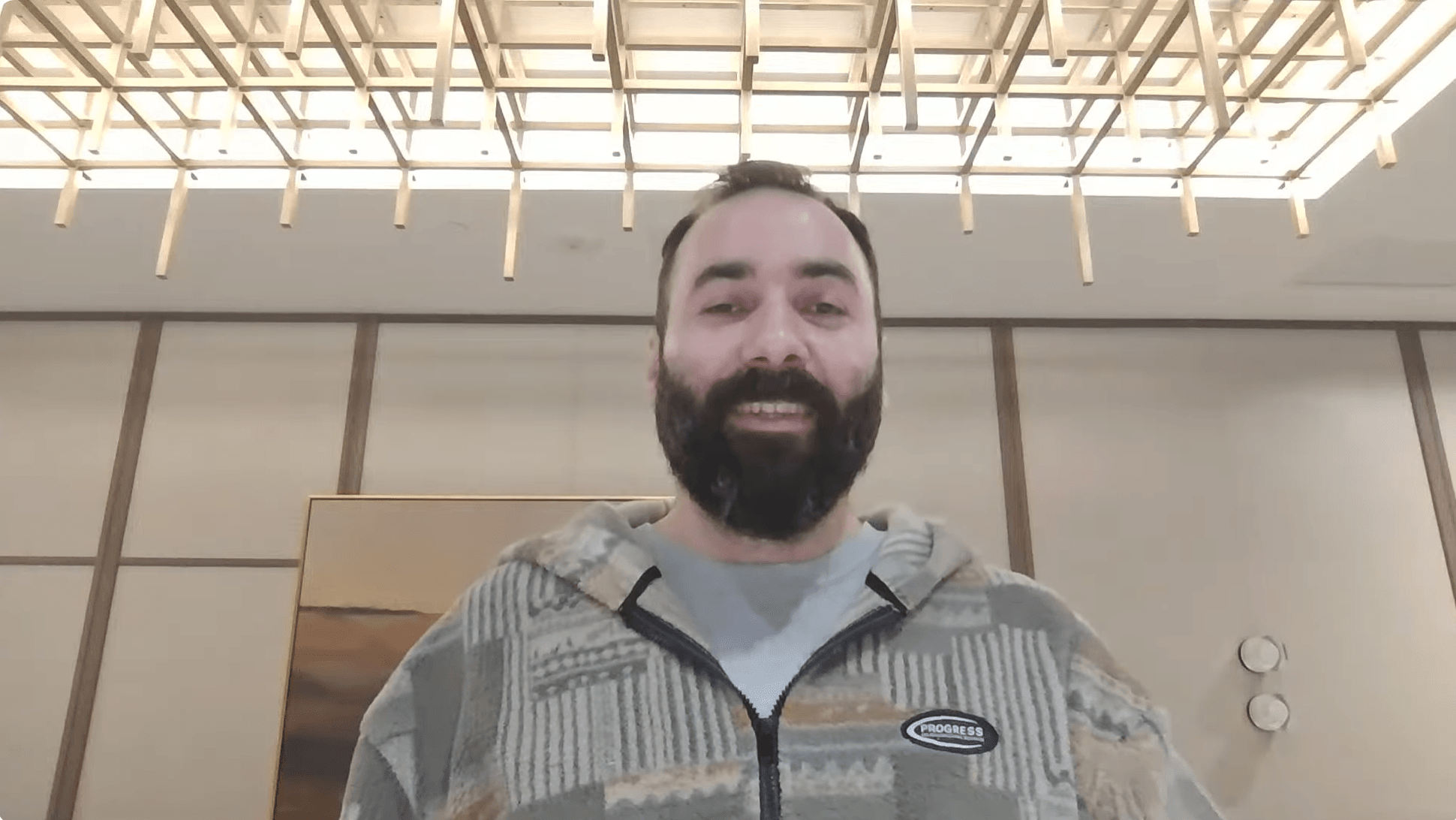
As you guys might be able to notice from the background, I’m speaking from a different place. I came—I mean, we came—to meet with my family in one of my sister’s villas in Montenegro. For those who don’t know where it is, it’s southeast Europe. It’s actually kind of a special place for me because this is where I was struggling once to—by the way, I don’t really believe in special places in the world, it’s just a personal special place—because when I was struggling to, let’s say, decode, if I can call it like that, the Quranic initials. When I was having a busy life with work and stuff like that, after I discovered the H.M. initials and what their meaning is, I thought, yeah, actually it’s possible to do the others as well. But then I was struggling. It’s a story for another time. I was struggling like, what do the others mean? Then, only when I came here to a quiet place did God tell me the meaning of the other Quranic initials. So yeah, for those reasons, when I come here I feel more quiet.

Submitters Retreats vs. Rashad’s Conferences

But yeah, speaking of vacation places, the topic of today is the submitters retreat. And as we concluded—maybe before I talk about the conclusion—I’m quite sure probably most of you know that Rashad also organized what he called conferences. And this is not exactly the same; it’s probably not the same at all.

The difference is that Rashad saw the conferences as a subcategory of fighting or struggling in the cause of God, while I see the submitters retreat as a subcategory of immigration in the cause of God, and those are different.

The reason why it’s different now is because we do the fighting and the striving online. We already do that. We go online, we preach, the Quran is online, the materials, videos are online. So we already do that. Whatever Rashad did with conferences, we do with just having a website. Our website is a replacement for his conferences. The retreat—what I’m calling retreats—are actually a subcategory, of immigration.

And to boil it down, like to the basics. Pretty much, maybe all—but im not sure if it’s all—but maybe all the differences between what Rashad did and what we are doing boils down to the fact that we have the internet. Because we have the internet, things are a little bit different.

The Impact of Geopolitics on Religious Execution

All the differences between Rashad and Muhammad, when it comes to how they executed religion—how they practiced religion, they all boil down to the fact that Rashad lived in a democracy, Muhammad lived in a non-democratic place. You can all boil it down to that:

Why Muhammad did it differently? No democracy.

Why Rashad did it differently? He has democracy.

Why Alban is doing it differently? He had democracy and the internet.

So these are the slight differences. In the end times, it might be different. Democracy might vanish again, even if they still call it democracy. The world is going that way, as you guys know it’s starting to go that way. But towards the end of the world, democracy is going to vanish. But let’s not rush to claim that it has vanished yet; there is still democracy in the world. Most of the world is a democracy, and because of democracy, there’s freedom of religion for the most part. Because democracies don’t guarantee full freedom of religion, they guarantee freedom of religion for the most part. And because of that, we don’t have to fully immigrate in the cause of God fully.

But, as we concluded in the last Friday sermon, even though we have freedom of religion mostly, the part which is let’s say missing, is the opportunities which are being denied to us by the Sunnis and the Shia to enjoy the benefits of the group prayer. A submitters retreat is just that—compensating for the fact that we have been denied opportunities for the group prayer. This is just a summary of what we spoke about last time.

Planning the 2027 Retreat: Timing and Location

God willing, let’s talk about the submitters retreat. When do I plan to organize it?

  • Time: 2027, next year, God willing. The reason for that is because it’s two years after our Hajj, so that would be a nice time to meet.

  • Season: Very likely in the spring. If we don’t do it in spring, potentially in autumn or fall, but very likely in spring, God willing.

What about the location? As I’m saying, I don’t believe in really special locations. Even including Mecca and all of that. I mean, each location has a specific role, but I don’t believe in let’s say—I’ve seen memes and videos online of light emanating from Mecca and things like that, trying to prove how this location is better than that, or Christians saying how Rome is special, or the Jews thinking that Jerusalem—Yeah, they had important roles, but God can organize people even outside of those let’s say, so called, sanctimonious locations, if we can call them like that. But I don’t believe in them. But they do have a special role during history. And that’s why, by the way, God changed the Qibla—first it was Mecca, then Jerusalem, then Mecca again.

Finding the Geographic Center of Submitters

So, I wanted to figure out where should we meet—in which location should we meet. When you guys submitted the zakat, you also reported in which city and country you live in. And that enabled me to just take the cities and put it in AI, ChatGPT and that came up with the coordinates of each city—the latitude and longitude. So, I found the averages for the latitude and the averages for the longitude, that gives you the center, the center of where the submitters are. We don’t have to have a center. It’s more like, how can we minimize the cost. That’s what I mean by center.

Basically, the idea is to spend the least amount of money we can spend, to be able to meet with one another. For example, if we can organize a retreat in Hawaii, but it’s going to be so far from everyone, because that’s too far from everyone. Anyone who would travel there is going to be too far. So that’s why I wanted to see where the center is approximately, so that we don’t spend as much money. We can go to the retreat with less money. So I did that, found the center, and it came up to here—the center of all the submitters who live today.

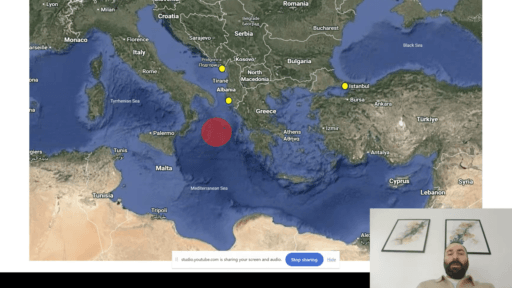
By the way, if we find the center of all the people who live today in the world, it’s actually in Turkey, south of Turkey. It’s not in Mecca. It’s not in Jerusalem. It’s south of Turkey, unlike what the religious people want to tell you. Jerusalem has a specific role. Mecca has a specific role. I think it’s the edge of the center. And there’s a good reason for that, which explained partly in the video clarification the end times. There I tell how Mecca is the edge of the center, but the center came in this place for us, for our group, which is the Ionian Sea. That place there, that red dot, is called the Ionian Sea. It’s part of the Mediterranean and it’s south of Italy.

Travel Restrictions and the Schengen Area

But the problem with Italy is that most of the people, especially those who live outside of Europe, wouldn’t be able to get a visa to travel there. The next closest city is Greece—the same, because Italy and Greece are part of what’s called the Schengen area. Schengen area means it’s a common area within Europe where people can travel without visas. But that means that those countries have much bigger restrictions for people outside of Europe. So Greece is part of that Schengen area as well, both Greece and Italy.

The next country there is Albania, and Albania is not part of the Schengen area, at least not yet. So that means that people from around the world can travel there much easier. So the next closest place is Albania, if we look at it purely from the geography.

The Advantages of Albania

Let’s say one potential very good place to meet is Albania because we would spend less like that. It doesn’t have visa limitations, for most people—I think probably for no people if we justify it correctly. And it also has  electronic visa, so people don’t have to go somewhere to get a visa; they can just do it online. So let’s say it’s a very suitable spot. And it also has a very nice Riviera in the south of Albania. It’s like a beautiful nature, sea, and all of that, and it’s not very expensive. So those are the advantages.

Considering Istanbul as a Contender

But then I said, “Wait a minute. What if I ask ChatGPT? If I put the coordinates and see if there is another way to travel, even if it’s not the center exactly—where we would minimize the costs.” And because Istanbul has lots of flight connections, a lot of people who travel to Albania actually travel through Istanbul. Some people.

Istanbul is here, by the way, this yellow dot here, and here is the south of Albania, this yellow dot here. So because of lots of flight connections, that actually came up also as one of the locations which would be equally as cheap as Albania. So we have these two potential places where we can meet, which I think are the best contenders for now: either Albania or Istanbul. And it’s going to depend on how things change until then—either where people join from, which locations join more, whether the center will shift a little bit, or what we might prefer.

The idea of Istanbul is that we would have a cultural experience in the sense that it’s a big city. Some people like to visit cities; it’s a much different experience. Maybe it’s a little bit too crowded for a retreat. Hotels might be a little bit more expensive, but it has its advantages. Flights have more connections, and the experience would be like—I don’t know if anyone likes baklava, Turkish delights, and stuff like that. So things like that. It does have its advantages. Right now in my mind, they are kind of equal in whether we might organize the retreat here or there.

The Third and Fourth Options: Montenegro and Umrah

And the third place, a third contender, is Montenegro, where I am right now, which is here just north of Albania. The benefit of Montenegro is that we sort of have a base here, and it’s much easier to organize and all of that. But right now, it’s not actually a serious contender because it doesn’t have electronic visas. So for a lot of people, they would have to travel to get a visa. They would have to go to an embassy or something. But in the meantime, if Montenegro creates an e-visa system, which they are about to do, if they do it in time, well, that would also be a serious contender, a place where we could meet.

So these are the three locations. If any of these don’t work for whatever reason, God willing, the fourth location is Umrah—meaning in Mecca.

By the way, why did I go for these locations this time at least? It’s because it’s much more expensive actually to go to Mecca. It was like 40 to 50% more expensive to meet in Mecca because the hotels are more expensive and flights are more expensive. And for some of you who know, the weather is not the best, is it? It’s not easy, especially if we go to Arafat and stuff like that. For those reasons, God willing, because here we’re not trying to do Hajj; we’re just trying to do group prayer with other submitters.

Still, once in a while, we will meet in Mecca so people can do Hajj. Maybe we’ll meet once in another location and then once in Mecca, or twice in another location then once in Mecca, or three times in another location then once in Mecca. It’s going to depend on how well these retreats go in another location. We might just decide that, “Wait a minute, we went to Albania, or we went to Istanbul, or we went to Montenegro, but it was a little bit of a waste of time because we didn’t feel very spiritually fulfilled.” So it’s all subject to change. Or maybe people were not behaving very well, and in Mecca they behave better. So maybe that could be a reason why we might stop this, but let’s try it. I think it’s worth trying. God willing, next year. It’s cheaper than Mecca, so it’s worth trying.

Future Plans for Regional Splits

And this is for as long as we have a small number of submitters, where it only makes sense to meet in one place of the world. Eventually, when we reach a sufficient number of submitters—I don’t know, 200, 300, something like that—then we can split into groups. We can have people in the east and people in the west. Then the center would be somewhere else; it might be the south of France for the western people, and I don’t know where the center of the eastern people could be—Armenia or Kazakhstan, I have no idea, it could be somewhere there.

Then we might split it again into different regions: maybe Europe, Middle East, Asia, Africa, and the US. That would be a nice split so that people can meet only within those regions. During that time, if Americans can meet within a nice place in America—I don’t know, like Mexico for example, or something like that. So these are not permanent locations. We’re just trying it, figuring it out as we go, and trying to do our best. And that’s pretty much it. Let’s repent. Toubou ila Allah.

Interactive Q&A and Community Feedback

Praise be to God. There is no other God except God.

For this second sermon, I just want to see if anyone has anything to say, maybe either about this topic or some other topic—something constructive, not destructive.

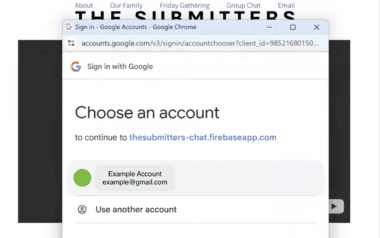
By the way, just so I can explain, there are about 51 submitters online right now, but there are definitely more submitters than that. Some of them might share the group chat, or a couple of them notified me that it doesn’t work on their computer for whatever reason.

Jad is saying: “Lebanon requires a visa for Albania but not for Turkey.”

  • Alban: I don’t understand exactly what you mean. Do you mean to travel to Lebanon, or to travel from Lebanon to Albania or Turkey?

Youssef is saying: “How about Morocco?”

  • Alban: Yeah, Morocco would be a good location, but I think after we split into two groups. I would like to go to Morocco one day; it looks like a nice country to go to. It’s on my bucket list to go to Morocco.

Adnane is saying: “Turkey is visa-free for Morocco.”

  • Alban: Yeah, okay. Turkey is a good option because its visas are easy, but also Albania’s visas are easy. So I don’t think anyone will have problems to get a visa in Turkey or in Albania.

User Chat: “Lebanon?”

  • Alban: We might do one in Lebanon eventually, either when we split into two groups, but even within a group, I think it’s a place with good weather.

Jad is saying: “We need a visa going to Albania.

  • Alban: But it’s an e-visa. It’s an easy visa. You just go online, you just apply—kind of like Umrah. It’s probably even easier. By e-visa I mean like you don’t have to go to an embassy; you just go online.

God willing, I’ll inform people about the information. So yeah, I’m just kind of getting a feeling of what people prefer. Some people seem to prefer Turkey more, but I know a couple of people who cannot travel to Turkey actually.

Mehdi is saying: “The Middle East is unstable. Europe is better.”

  • Alban: Yeah, for now, the Middle East is a little bit unstable. I agree, Lebanon right now might not be the best option, plus it’s not at the very center. In the future, probably it might shift a little bit towards the east if people from Bangladesh join, or more people from India join. The center might shift east, and then if it’s safer, we can do it in Lebanon.

Someone said: “Indonesia”

  • Alban: Indonesia is just too far. This is not about desires; it’s about the centers. So it would be too expensive. We are thinking of locations where it would be the cheapest for the whole group.

Turkey is nice. I like Turkey. I like Istanbul actually, because it’s such a metropolitan city—like you get lots of cultures there. I wouldn’t say it’s necessary to be near the city only for flight connections. In Albania, actually, the idea is not to do it near a city, but to do it close to a sea or mountains. I’m going to have to think about the location because I can see how some people prefer something more than others, but they are thinking of it from their perspective. What about people from the US? What about people from Bangladesh? What about people from Africa?

Fannol is saying: Both Albania and Turkey are good choices”

Faisal is saying: “Yes, I pray we all have it easily accessible. Let’s pick the choice best for everyone as much as possible.”

  • Alban: Yeah, I agree. I think what we should try to do—even though it’s helping to know your preferences—What we should try to do is to find the choice which is, as a total, the best for everyone and not focus on just what’s best for someone.

By the way, even Indonesia might be a good choice someday when we split into many groups, but maybe for East Asia—for countries like Malaysia, Australia, things like that. But that’s far in the future. And then eventually, God willing, we might have just specific countries—let’s say Spain, France, Italy, things like that. Each, when we have many submitters, they can just meet each within their country. Okay, I can see preferences. People are leaning a little bit more towards Turkey. Some are writing about Albania and Montenegro as better choices. I’ll have to think about it definitely. I’m not going to be biased. Honestly, I don’t care about Albania or Turkey as states; I’m just going to try to find a place based on these three criteria:

  1. Travel restrictions: Which country has the least travel restrictions. So, easiest way to get visas?
  2. Cheapest flights.
  3. Cheapest accommodation and hotels.

If we combine those three, in which one can we go in the easiest way as a group?

Faisal is saying something I considered as well: “If both are the same prices, why not see which one is easier to do group contact prayers?”

  • Alban: The easier to do the group contact prayer together would be Albania because we could find a hotel and book a conference room which is nice. Because in Istanbul, that would be much more expensive. However, the advantage in Istanbul is that we can do a few of those prayers in one of the mosques which are occupied by Sunnis, and that would be also an interesting experience just to try it. So they both have advantages. Istanbul would probably give us some cultural advantages; we would be able to see some mosques. They really have beautiful mosques there. But in Albania, we’d have a better conference room, and we would definitely pray together all the time.

    Because in Istanbul, I checked hotels, and the hotels which have conference rooms we can use for prayer are much more expensive. Plus, I would probably have to tell someone to organize it—like to go and ask the hotel, “Oh, we want to use the conference room, but we want to book it for prayer, and we will have to move these chairs and these tables” In Istanbul, that’s not going to be easy for me to organize. In Albania, it is much easier for me. Someone can help maybe there. We’ll see. God willing, I’m aware of a lot of people’s restrictions and preferences. Thanks for sharing more.

    Yeah, some people are preferring it for the mosque. By the way, even if we go to Istanbul, I don’t think we’re going to pray at those mosques often. I would prefer that we do pray the prayer more often together, but we can do that as an additional experience.

Jad: “Wouldn’t there be a religious clash in Istanbul when it comes to doing the group contact prayer in their mosques?”

  • Alban: We’ll pretty much do it similar to how we did it in Mecca. We just join the prayer and then leave. In big mosques, people really don’t care who you are or what you’re doing because there are so many groups of people who go there. And there’s even Christians are allowed in those mosques; they just go as visitors and visit those mosques. So it’s very let’s say, liberal when it comes to that. People just go in and go out.

I’ll probably finish the contact prayer soon just to see if there’s any other chats. Whichever it is, God willing, the important thing is that we meet.

Someone is saying: I think the Submitters from Bangladesh would prefer where the visa restrictions are the least, and the travel and accommodation is the least.”

  • Alban: I agree with that, which is what I’m going to try to maximize—meaning to minimize costs so that it’s as easy as possible for travel, both financially and when it comes to restrictions.

Trevor is saying: “We can take over the mosque with our presence and maybe we will get some converts. Lol.”

  • Alban: I guess I’m old; I’m saying “L-O-L” instead of “lol.” Okay. No, we’re not going to try, by the way, to convert people in the mosques. One of the video clarifications, I say that one of the rules of the mosque is not to try to convert people in there. If you go to worship God, fine. If you want to convert people, just do it outside of the mosque. Trevor was just joking; I don’t think he was being serious.

Muhammad is saying: “We can’t pray in Hagia Sophia because it was built as a church.”

  • Alban: Actually, that’s not true. In the video clarification where I talk about—and it’s good that you brought this up—where I talk about the places of worship, I say that we are allowed to pray in any church which was built before Muhammad. Because before Muhammad, there was no real distinction between mosques and churches; it was just places of worship. So, Hagia Sophia was built before Muhammad, which means that they had not rejected Muhammad. They were not people who had rejected Muhammad; they were early Christians. They might not have been perfect, but it was a legal place of worship which was built by let’s say, believers. So it is allowed to pray in Hagia Sophia, whatever the pronunciation is. It is not allowed to pray in churches which were built after Muhammad.

Fazal: “Are all the Turkish submitters here in Istanbul?”

  • Alban: Yeah, most of the people from Turkey are in Istanbul—the submitters—but a few of them are actually from more south. So not all of them. I think it’s a little bit more than half.

Conclusion

I can see the preferences. God willing, I’ll try to do what’s best for everyone, and I hope no one takes it personally. I know people from Morocco might want to go to Morocco. The issue is we have to find a common solution; it’s about preferences. I also want to go to Morocco someday; it’s a nice place.

And by the way, it might really matter whether we do it in Albania versus Istanbul on the ideas which I have on what to do—like what can we do there, which mosques can we visit, what activities can we do. Of course, everything is voluntary, optional. But once I think of some ideas of what we can do here or what we can do there, we will see which is more preferable and things like that.

Anyway, let’s finish it at this point. Yeah, someone is saying 17 people in Istanbul. Yeah, I’ve counted everyone from every region. That’s how I came up with the center.

Let’s finish the contact prayer now. For those who have to do the contact prayer, Aqim Al Salat, and the rest of you: Peace be upon you.


Friday Sermon by: Alban Fejza, Online Congregation Director
Partial Emigration in the cause of God


Sermon Introduction

Praise be to God. There is no other god except God.

What I want to talk about today is partial immigration in the cause of God. As you might have noticed in a lot of Friday sermons, but also video clarifications, I emphasize that we can partially apply some of the things which the Quran mentions because the conditions under which we are today quite often are partially true for us. So this is one of those examples and, God willing, let’s find out what partial immigration in the cause of God actually means.

First of all, we all agree that immigration in the cause of God is a good deed. This is mentioned many times in the Quran. It mentions how immigrants are a degree higher than non-immigrants, that they will be rewarded by God, and that if anyone dies while immigrating to God, they’ll go to heaven. There are many verses like that, and basically, it’s an easy thing to conclude that immigration in the cause of God is a good deed (3:195, 8:74, 9:20 , 22:58).

But what are the reasons for immigration in the cause of God? When do we have enough reasons to immigrate in the cause of God? Let me go over them.

  • One reason is if we are evicted from our homes and deprived of our properties (59:8).

    • If you don’t have a home and a property, or if you are denied entry to your home, you might be forced to immigrate.

  • Another reason is the fear of big injustice and your life being in danger (28:21).

    • For example, this applied to the case of Moses when he escaped from Pharaoh. He had killed someone accidentally while trying to help, and then the other person accused him the next day. Moses thought that people would not understand and would accuse him, so he felt his life was in danger. People told him his life was in danger.

    • Unfairly punishing someone is different; if someone commits a sin, that doesn’t mean they should immigrate, they should actually get the punishment. But if someone knows that they are unfairly going to be punished, then it’s different. So that’s another reason to immigrate in the cause of God.

By the way, these first two reasons were involuntary because you are just forced and there’s nothing you can do about it. The other ones I’m going to mention are more voluntary.

Redefining Immigration to the Messenger today

These first two reasons were involuntary because you are just forced and there’s nothing you can do about it. The other ones which I’m going to mention are more voluntary.

These reasons of immigration which I am mentioning, in general they just don’t apply to us. (There might be rare exceptions) That’s why I am showing them in red color.

In a democratic country (what they call a «free country») like today where almost all of us are (and in the future it is going to be even more), these reasons for immigration don’t really exist. For all practical purposes, they just don’t exist :

  • Who has kicked you out of your home? 
  • Who has denied us from our properties? 
  • Who thinks his life is in danger in his country so they have to move to another country?

I don’t see any of us being in that situation.

The third case is also like that, and let me explain. Immigrating to the messenger of God (4:100) today is not a reason for immigration. I explained this in one of the video clarifications titled The Clarifying Messenger. There, I explain all the different subcategories of where I am not a messenger of God, where Alban is not a messenger of God. Some people think I’m just being funny or trying to sound smart, but I’m actually laying down when I am a messenger of God and when I’m not.

For example, I say there that :

  • When Alban sleeps, He is not a messenger of God.
  • When Alban eats, He is not a messenger of God.
  • When Alban presents a Friday sermon like this, unless it is a video clarification, Alban is not a messenger of God.
  • When Alban is just walking in the park or staying home, He is not a messenger of God.
  • When Alban is chatting with you in the chat, He is not a messenger of God.

The only time Alban is the messenger of God is when he publishes video clarifications.

I make this clear in The Clarifying Messenger. There, I tell you that I’m not a messenger of God in almost all cases except when I am presenting in English online in a video clarification, and in that case, you can always hear it online. So there is no reason to physically immigrate to the messenger of God, because the messenger of God really is online. You cannot find the messenger of God offline today.

Some people find it strange that one can be a messenger of God sometimes and not a messenger of God at other times. But this was true with Muhammad as well :

  • Until the age of 40 : He was not a messenger of God.
  • After 40 : He was a messenger of God most of the time when he was reciting the Quran, but when he said some stuff which might have been recorded in what they call hadith, he was not acting as a messenger of God.

So this is not a new idea. It looks like a new idea because people have simplified things, but it is really not a new idea.

What this means is that this verse about immigrating to the messenger of God does not really apply in our situation. There’s no reason for you to use this verse to say : “I am immigrating to the messenger of God.” For example, right now I am living in Canada but no one should say : “Oh, I am going to Canada because that is where the messenger is” , because the messenger is online. If you have access online, you have already fulfilled it, so there’s no reason to immigrate for this purpose. This does not apply in our situation either.

Religious Rights and the rightful Maintenance of Mosques

The fourth reason is If you are Wronged (16:41).

(I put this in sort of orange color because it might apply to someone in an individual case, but it does not apply to us at all as a community. Individually it might apply to someone)

Let’s say you’re walking someday down the street in what they call a bad neighborhood and someone beats you. So you decide : “I’m going to sell my home, I’m going to go to another neighborhood or to another city because there’s too much violence in my neighborhood.” Yeah, that can apply, but it does not apply to us as a community. Most of us live in safe neighborhoods, I think. So it might be an isolated incident where it applies to an individual, but it does not apply to us as a community.

Basically, all of these reasons which I presented are not good enough reasons in today’s society, or they don’t happen to us. We don’t have the reasons to immigrate in the cause of God for these reasons. They might apply in The End Times (during the time of the Mahdi or etc.) but today with us, they don’t really happen in practice.

The final reason to immigrate in the cause of God in Surah 4:97. They have translated it in many different ways : some translate it as oppression, some as a weakened state. But actually the literal meaning of that word in Arabic: is basically when you don’t have equal opportunities like other religions.

A way to summarize all of those meanings is probably to say:

If we are denied religious rights (4:97)

If we are denied religious rights, then we have a reason to immigrate in the cause of God. And God willing, I will show why this is a partial reason to immigrate in the cause of God, not a full reason. It’s a partial reason because we are only denied our religious rights a tiny bit. For most of our religion, we are not denied our religious rights.

Let’s go over some basics of our religion and see if they are denied:

The right to say the Shahadah (witnessing) :

The first thing which we believe in our religion is the right to say the shahada, the right to say there is no other god except God, which is called the witnessing in English.

  •  Do we have the right to say that?
    •  Yes, we do. No one has denied this to us. This has not been denied. We are free to do this.

The right to fast during Ramadan : 

  • Has our right to fast during Ramadan been denied?
    • No. Ramadan came and went, and to whomever it applied, we did fast. I fasted. I think all of the submitters to whom it applied they fasted.
  •  Did someone tell you not to fast?
  •  Did the police come to your home and tell you not to fast?
  •  Did they fire you from your job or beat you because you fasted?
    • No. So this religious right has not been denied; we are free in this aspect as well.

The right to Zakat : 

  • Has our right to give zakat been denied?
    • No, because we are doing zakat, and even though it’s online, we are doing it. No police here in Canada has ever come to our home and said : “Oh, you guys are organizing zakat, you will have to report to the police.” No, it has never happened. We are free to do this as well, and I’m quite sure this happens for almost all of you.

The right to do Hajj :

We have the right to go to Hajj. There were a few limitations, but we basically did Hajj. Whoever could afford and wanted to come with us to do Hajj did come, and it went perfectly.

There was a tiny bit of a limitation when we went to Mina, for example; there were some guards or workers who didn’t want to let us go there, but God willing, someday I will show that Mina is not an obligatory part of Hajj anyway. So basically, in that tiny part where they wanted to deny us our right, that was not obligatory for us anyway. Mina is part of Hajj, let me make it clear, it’s part of Hajj, but it’s not an obligatory part, and there’s a difference there. I’ll explain it one day.

To summarize, we have not been denied our right to do Hajj.

The right to do the Contact Prayers :

The right to do the contact prayer also has not been denied to us. I did the contact prayer yesterday, the day before, and the day before that. No one said : “Oh, you’re doing the contact prayer, you’re going to have to report to the police,” or “You’re going to be fired because of this.” There might be some isolated incidents, but maybe you asked a little bit for it, or maybe there’s just not enough space. We’re not talking about that; I’m talking about in general. We as a community are not being denied our religious rights to do the contact prayer, so we are free to do this religious right as well.

There is one thing, however, which we as a community are being denied :

The right to maintain God’s masjids.

In Surah 9, verse 18, it says:

“Only shall maintain the masjids of God those who believe in God and the Last Day, and observe the contact prayer, and give the zakat and do not fear except God.”

If someone fulfills these criteria, they have the right to maintain the masjids of God. These criteria are fully fulfilled by us. We as submitters believe in God, we believe in the Last Day, we observe the contact prayers, we give the zakat, and we do not fear except God. What this means is that we should have the right to maintain the masjids of God.

I can tell you from practice, I tried once and they reported me to the police. I went to a few masjids (not just one masjid). That’s a long story but for the purposes of this, I tried to maintain the masjids of God without permission from the Sunnis or the Shias. By maintain, I mean in that case I wanted to remove Muhammad’s name from the walls because that shouldn’t be there. Those masjids where we are permitted to pray belong to God; we don’t need anyone’s permission. Those belong to God, they don’t belong to the Sunnis, they don’t belong to the Shia. Since the day they were dedicated to God, they still belong to God.

That means that we have the right to maintain those masjids more than anyone else, and here’s why: because actually, the others do not have the right to maintain those masjids : Verse 9:18 says the right belongs to those who observe the contact prayers and give the zakat. However, the Sunnis most of the time don’t give the Zakat in most Sunni countries or Shia countries, and in some countries where they do, it’s not accepted. The reason is that the Quran says that nothing of what they spend, including the Zakat, is accepted because they disbelieved in God’s messenger. Unless they believe in God’s messenger, their zakat is not accepted, and because their zakat is not accepted, they lose the right to maintain God’s masjids.

So the Sunnis and the Shia do not have the right to maintain the masjids of God. We have the right to maintain the masjids of God. However, in practice, we are being denied that right. We are not allowed to do that.

As an example, I wanted to maintain a masjid and when I tried to remove Muhammad’s name, what happened ? They called the police and reported me. It went peacefully, I didn’t go to prison, but I could not maintain the masjid of God. I was denied that right. I did it fully peacefully. And I don’t recommend anyone else do it because it doesn’t work.

Why doesn’t it work?

It doesn’t work because you are not allowed to use violence or to do it by force, which I didn’t do. You’re not allowed to fight people inside the masjid of God. Therefore, you cannot do it by force.

The only way is to defeat those people who have occupied those masjids from the outside and then free the masjid. But in that case, you would have to fight the whole state because all they have to do is call the police. 

Today’s democratic states think that those masjids belong to the Sunnis or to the Shia, so there’s nothing we can do about it. For this reason, we have been denied this religious right. This is the only religious right which I found in the Quran which has been denied to us. We are the rightful maintainers of God’s masjids, but we are being denied that right.

Before I continue further, let’s repent.

Praise be to God. There is no other god except God.

Calculating the Denied Benefits and the Concept of the “Submitter’s Retreat”

So we concluded that the only right which they have denied us is to maintain the masjids of God. When we lost this right, we also lost the benefits which come with it. Had we had the chance to maintain the masjids, it would mean that we would organize the Friday gatherings locally. That would mean we wouldn’t have to do it online at all, because you guys wouldn’t meet me like this, your souls in another body would actually get to hear about this message in a physical masjid, not online. In that case, we would be able to enjoy the extra benefits of group prayer.

In previous sermons (Estimating Group Prayer Values, The problem of establishing mosques today, The Call to the Friday Gathering), we went over the fact that when you do a group prayer, you get extra benefits from it. Because we are being denied the right to maintain God’s masjids, we are also being denied the extra benefits of group prayer during Friday (because we can go at another time, that’s fine)

Someone might say : “Oh, but you guys have chosen not to go, they are not stopping you.” Well, let me give you an example. Let’s say a wife or a husband commits adultery and the other one divorces them. The one who broke the marriage is the one who committed adultery, not the one who decided to divorce them. It’s the same way with the Sunnis. Even though we do not go to those masjids during the Friday prayers, it’s the Sunnis who committed the religious adultery. It is them who made the mistake which forces us effectively to separate from them. So effectively, they have denied our right to maintain the masjids of God.

Let’s estimate the denied extra benefits :

  • Why are we going through this estimation? 
    • It’s because we want to know how much of our religious rights have been denied to estimate how much reason we have to immigrate in the cause of God.

As we concluded earlier, we have a reason to immigrate when religious rights are denied, so we are going to calculate exactly how much it is.

The total potential benefits of Friday group prayer can be calculated as:

Total Benefits = 52 Fridays × 2 rakaats × 4.76 (group multiplier)=495 rakaats

I am using a group multiplier mean of 4.76 because we currently have 65 people. From the calculation method I showed you in the previous Friday sermon (Estimating Group Prayer Values), if there are 65 people, doing one rakaat counts as 4.76 rakaats. So, 495 rakaats is the total we would get if we went to a physical mosque. But we are denied all of it.

However, we found a way to get back part of it through the online Friday gathering. We already found a way to get back some of those benefits (the minimum) by doing the Friday gathering online while doing four rakaats for the individual prayers. What we are doing today is:

52 Fridays × 4 rakaats = 208 rakaats

We are getting this back. However, this is the minimum.

  • What do I mean by the minimum?
    • Because we concluded in the last Friday sermon that doing four rakaats individually is the same value as doing two rakaats with four people. This means that when we organize the Friday gathering online the way we are doing it today, it counts exactly the same as if we were in a village and prayed the Friday prayer with a total of four people. That’s how much it is worth. It fulfills the minimum because the minimum threshold for a Friday gathering is four people. We are fulfilling the minimum, and it is good enough, but we could have benefited much more.

The minimum we are benefiting is 208 rakaats, but we could have benefited 495 rakaats. Let’s calculate the difference:

We are still denied the religious right to :


495 – 208 = 287 rakaats of extra benefits

The Sunnis, the Shias, and the democratic states (or whichever state which support them because they are in power) have denied us the religious right to enjoy 287 rakaats of extra benefits in a group prayer on Friday. Our religious rights have been denied by this much.

  • What did we conclude earlier?
    • Therefore, we have a reason to partially immigrate.
  • Why do I say partially?
    • Because for all the other reasons, we had no right to immigrate; the only reason is this gap. Therefore, we have a reason to partially immigrate to the cause of God up to the amount of reaping these extra benefits of 287 rakaats.
  • How many days of immigration would that be if we want to get back those 287 rakaats which have been denied to us? 
  • How much would we have to travel to get them back? (The Quran says you have a reason to immigrate to get them back)
287 extra rakaats4.76 (group multiplier)

= 60 rakaats denied

  • How many days would it take us to do those 60 rakaats?
60 rakaats17 rakaats per day

= 3.5 days per year

So we have a valid reason to immigrate for 3.5 days per year to get back those 287 extra rakaats of benefits.

We have reason to immigrate but only partially and only for 3.5 days per year.

(Not like during Muhammad’s time when they had reasons to immigrate for 365 days per year, for the whole year, because they were beaten, they were denied some rights, etc. And that is not happening to us.)

The more appropriate word in English would be to call it a “retreat” rather than an immigration. That’s just the word we use in English for short-term, very temporary immigration. I mean, who says : “I’m immigrating for three and a half days”? They would probably say, “I’m going on a retreat,” or “I’m going on vacation.” So very likely, we’ll call this the Submitters’ Retreat

Affordability Calculations for the Retreat

  • Who can afford to come to the retreat?
    • Not all people immigrated with Muhammad to Medina during his time. For example, there were slaves who could not immigrate because they were not allowed to leave their master’s home without permission, so it was just not possible for them. A few of them Muhammad and some believers bought so they could immigrate, but a lot of them could not. It is just not possible for some people; some people are just too poor, and it is okay.

Don’t feel guilty if you cannot do this tiny partial immigration, because it happened to the people of the past and they were still submitters. In my heart for the community, for every one of us, we should still consider those people submitters even if they cannot immigrate, because as long as they do the contact prayer and give the Zakat, they are submitters.

Verse 2:273 reminds us that some people cannot afford or are not wealthy enough to emigrate, or simply might have obstacles to travel. For example, mothers with children under two years old might not find it suitable to travel because they have to feed their baby, or students without an income, or people with prohibitive physical disabilities, or people in extreme old age, and of course, people who do not have enough money. These categories very likely just cannot immigrate, and it is fine if they cannot come to that retreat.

But I want to focus on the last one: the people who don’t have enough money.

  • How much money would you need to have to be able to afford this retreat?
  • How do you know if you can come to the retreat and afford it?

We can calculate that as well :

Because you did not have to travel to a physical mosque every Friday since we made it available for you online, you saved about 40 minutes (0.66 hours) of extra time each Friday. Because a group of people made it possible for you to do it online, you have extra time which you could have used for work :

0.66 hours × 52 weeks = 34.32 hours in a year

You have that extra time, and you could have turned that time into money.

Assuming that we’ll organize the retreat to be partially on the weekend, you might end up with two days of the retreat happening during workdays. Two workdays equal 16 hours of work. Yes, you had all that extra online time, but if you come to the retreat, you’ll lose some of that work time.

By the way, we are not going to repay you or apologize for the time that you lose with your family, because the Quran says the real family is the believers. So I’m not going to say : “I’m sorry that you have to leave your family who maybe are not submitters.” No, I am not sorry, because the real family is the submitters. But I am sorry you might have to leave work for two days, and for that, I am going to discount that lost work time in the calculation of how much you can afford, so it is taken into account :

34.32 hours saved – 16 hours lost = 18.32 hours of net extra work time

Since a standard year has 1,920 hours of work, 18.32 hours of work represents roughly 1/104th of your annual work.

Therefore, to find out if you can afford it, take your annual net income after taxes (whatever it is: $5,000, $10,000, $50,000, $100,000) and divide it by 104:

Affordable Ticket Cost (Every year) =

Annual Net Income104

That result is how much you should be able to afford to buy the ticket to travel to the retreat. If your travel ticket is more expensive than that, you don’t have to come. It’s fine, you simply cannot afford it. If you still want to come despite it being more expensive than what you would naturally afford, you are welcome to come anyway; it’s your choice. All I am telling you is that it is possible to calculate if you can afford it. So I do not want people to use empty excuses. I can know how much you can afford.

To make it affordable for most submitters (because our group is very widespread globally), we will organize it every two years, God willing, in the near future. We’ll start with every two years, and then when we have many subgroups, we will do it every year, God willing.

When you submitted your Zakat, you also used your income to calculate the Zakat, so I used those numbers to calculate who can afford this retreat and who cannot. If we do it every two years, most people can afford it : about 60% of our people. But if we do it every single year, it’s going to be only about 30-40% of people who can afford it, which is not enough. I think at least more than half of the people should be able to afford it. That is why I decided on a schedule of every two years.

This is all a practical solution. It’s not a religious law. We might change it or switch it later, and that’s okay. In practice, I’m trying to give you an opportunity to get back the denied benefits which the Sunnis and the Shia have denied you of. That’s all. It’s an opportunity, not a religious obligation. Because I feel sorry for you and for myself, that the Sunnis, the Shias, and the democratic countries have denied us a religious right, which has resulted in denying us some benefits. I’m giving you an opportunity to reclaim those benefits by coming to a retreat.

If it is organized every two years, your income is twice as much, so instead of dividing by 104, you simply divide by 52 :

Affordable Ticket Cost (Every 2 years) =

Annual Net Income52

That is how much you should be able to afford to buy the ticket to travel to the retreat.

Reallocating Zakat to Fund Accommodations

So take your annual net income after taxes, divide it by 52, and you will know how much money you have to buy a ticket to come to a retreat if we organize it every two years instead of every one year. And as a bonus, we’ll pay for your hotel or accommodation from the collected zakat, God willing.

We have already collected some zakat from different subgroups of zakat. A lot of it was intended to promote the message online, to pay ads. We tried Google ads, we tried YouTube ads, and we tried some other types of ads so that the message of God can reach people, but what happened is I realized it was not effective. So, all I am going to do is redirect that money which a lot of it was not used, redirect it and pay the hotel for people who come to the retreat.

Now, people have paid that zakat, so they might have a question about it. They’ll be like : “Oh, wait a minute. Can you actually do it? Why should I pay the money, and someone else comes to the retreat and gets the benefit, getting a free hotel?”  

Let’s see if that’s actually according to the Quran, Verse 9:60 says: 

“Charities shall go to the poor, the needy, the workers who collect them, the lonely, to free the slaves, and to those burdened by sudden expenses, In the cause of God, and to the traveling alien. Such is God’s commandment. God is omniscent, Most Wise.”

All people who are doing the Friday gathering online are lonely because we are not in a physical group. So, we have a reason to pay the hotel for them. 

What are we doing?

We are gathering in a retreat to pray, to do the contact prayer, and to worship God. That is strictly in the cause of God. The verse ends:

So what we are doing is using this zakat to give it to these three categories. People who come to that retreat fulfill and are a part of all three of those. So basically, they fulfill half of the reasons we have to give the Zakat.

Nature and Schedule of the Submitter’s Retreat

Think of the retreat as a vacation (The Submitters’ Retreat). We are not going to do some kind of conference where we have to present stuff and things like that. The main thing we are trying to achieve there is doing the contact prayer together for three and a half days. That’s it. Other things are optional. Someone might want to meet someone, someone might want to enjoy the views. They can do it separately in groups. It doesn’t matter

We might just share time. You can think of it as a vacation, you can think of it as an opportunity to learn, or you can think of it as an opportunity to do extra group worship (Worshiping God in a group, etc.) .Whatever you want to do. The important part is that we do the contact prayer together.

As we can see, we do have a reason according to the Quran to use a portion from the collected Zakat to pay for the hotel or accommodation. God willing, whoever comes to the retreat gets the hotel for free. And that’s a lot of money, by the way. I’ve calculated it, and it is like tens of thousands of dollars if most people come.

Rewards for Both Immigrants and Supporters

The second verse which has to do with this is 8:74. It says:

“Those who believed and emigrated and strove in the cause of God, as well as those who hosted them and gave them refuge, and supported them, these are the true believers. They have deserved forgiveness and a generous recompense.”

  • Who are those who hosted and supported them?
    • Those who hosted and supported them are the people paying for the hotel for them.

Basically, if you gave the penalty Zakat because you live with a non-submitter and you paid a penalty zakat for that ; if you come to the retreat, you’ll enjoy the benefits of giving that. But if you don’t come, then someone else will enjoy that benefit, and it’s fine because in that case, you are the supporter, you are the host, and the other person is the immigrant. You are supporting someone doing that, and it is fine. It is within this verse; it’s within what the Quran recommends :The verse says they have deserved forgiveness and generous circumstances.

Both those who are giving the Zakat which is being used partially for the hotel) and those who are using the hotel to meet with other submitters to do the contact prayer together, both get a reward from God. They are both considered true believers according to God. It says : “these are the true believers.” It is a sign of true belief.

Concluding Remarks and Q&A

We’ll talk about locations of the retreat (like where, how, and when) on future Friday gatherings, God willing.

Does anyone have any questions or anything to say?

  • Faisal is saying :“Exciting.”
    • Alban says : «Yeah, yeah, I think it’s also exciting»
  • George Parfin is saying : «I can help you make better YouTube videos»
    • Alban says : «George, you’re a young submitter, you need to learn.» 

Any other comments?

By the way, George Parfin joined us as a submitter. May God bless him.

For those who have to do the contact prayer, do the contact prayer. Peace be upon you.


Friday Sermon by: Alban Fejza, Online Congregation Director
Estimating Group Prayer Values


Sermon Introduction

Praise be to God. There is no other God except God.

Let me just inform you that last Friday’s sermon, where I think it was titled “Completing the Friday Gathering,” I deleted it from YouTube. And there are two reasons why I deleted it. One is that the initial intention of that Friday sermon was to solve a social problem, and I ended up creating a rule—a new religious rule—which I didn’t like the way it came out. And God willing, I’ll redo it for that reason.

But also, there is a second reason. The second reason is that I did some calculations there, and I didn’t take into account some other factors. One of those important factors is that the prayers do not have the same values in groups versus when you do them individually. So, God willing, I will redo that Friday sermon completely. So please try just to forget that I did it in the first place. It’s deleted now from YouTube.

The Objective: Adjusting the Calculations

But this is a good opportunity because now I can focus on those two mistakes and correct them in more detail. So today, what I want to do before I redo last Friday’s sermon, today I want to just focus on that adjustment. So I forgot to take into account a specific adjustment which should have been done in those calculations. So I’m just going to focus on that adjustment. The adjustment mainly deals with the idea that group prayers and individual prayers do not have the same value for that particular individual. So let me focus on that today, and then we’ll use this to adjust what I was trying to do in the last Friday sermon.

Okay, so let me share the screen. Okay, so the topic of today is “Estimating Group Prayer Values.” How would we estimate group prayer values?

Individual Prayer vs. Group Prayer Values

We know when you do an individual prayer, let’s say you do the noon prayer, the value of that prayer for you is one prayer. Now, of course, in other videos I do mention that God rewards it 40 times (Reconstructing the Muslim Prayer Completely from the Quran), but that’s for the next world. God rewards every good deed 40 times, but that’s for the next world. God rewards it even more because the hereafter is forever. But I’m talking about how much does God consider it to be—that’s for the next world. For this world, one prayer is one prayer.

However, is one prayer in a group still one prayer, or is it more than one prayer for you? And that’s what I want to focus on to estimate this. And by the way, I’m calling it estimating group prayer values; I’m not calling it calculating group prayer values. The reason for that is because it’s an approximate estimation, and that’s on purpose to keep it simple, because I’m purposefully ignoring a lot of other factors like gender. Gender has an effect, the age of the person has an effect, the setting where they are doing the prayer—all of those have effects. Is it in a mosque, is it not in a mosque? And many other things do, like the faith of the person who’s doing the prayer, the sincerity of the person who’s doing the prayer—all of those do have an effect on the value of the prayer.

However, if you ignore all of those and just focus on the effect of the group on the prayer, then we can simplify it and talk about it. That’s why I’m calling it estimating group prayer, because it’s not exact, because we’re disregarding on purpose so many other factors. And so how do we estimate the group prayer? The idea is actually quite basic. Let’s say that you are doing the prayer alone. That prayer, let’s say that noon prayer, is just one prayer.

The Spiritual Mechanics of Group Synergy

However, now let’s say you add another person to that group—to you—and now you’re doing the prayer together with one other person. The prayer for you is one prayer still. But what’s the value of your prayer for that other person? It does have a value, otherwise you wouldn’t do it in a group. Why would that person join you if there’s no value to joining you? What’s the purpose of joining you? What’s the purpose of doing it together if there’s no value to it? So it does have a value for that person.

So what’s that value, how much value is that? You can indirectly or logically think of it by using the verse in the Quran which says:

“Whoever mediates a good deed receives a share thereof…” [Quran 4:85]

In English, you can also call it: whoever enables a good deed receives a share thereof. Because whenever you mediate, you’re enabling. You’re enabling, you’re making it possible for that person to do the group prayer. So you’re doing the prayer yourself, but also when the other person is there, you’re enabling him to do his prayer in a group. You are the group for that person.

Your one prayer is one prayer, but to that person, the prayer is half of the group prayer because your prayer is half of the group prayer. His prayer is half of the group prayer. So your prayer now has one prayer plus half a prayer, plus 1/2 prayers, because the group has two people. So now the value of your prayer is 1.5, and the value of his prayer or her prayer is also 1.5, because he’s also enabling you to do the contact prayer. So a prayer in a group, the value for each individual has the value of 1.5. In other words, when two people separately do the contact prayer, each of their prayers is just one prayer. But if they do the prayer together, those two people, now the total of those two prayers is three prayers because each of them is one and a half. As you can see, there’s an additional value to it just from the fact that you’re doing it in a group.

Distinguishing Worldly Blessings from Eternal Reward

And let me focus on something actually really important. As you can see, the group—and this in business or in economy is called synergy—there’s an additional value which is being added just from the fact that you’re doing it in a group. But what’s important, so we don’t misunderstand this topic, is that this does not automatically make people who are in groups better than people who live alone. And here’s why: because even though the prayer has a bigger value, that person, because he or she lives in a group, they get the benefits also. Being in a group might enable you to get married, when you need some help, someone might help you, it just feels better and easier to live in a group, someone might give you a ride. So you get the benefits. If you don’t, you’ll get them in the next world.

But almost always, the benefits which come from the group prayer are utilized—are used in this world. Yes, the group prayer has extra value, but almost all of it is used for this world, not for the next one. For the next one, the most important part is your individual prayer—the value of your individual prayer.

So let’s not misunderstand, let’s not think that maybe people who are doing it in a group might be in a higher place in heaven. Well, people who have a chance to do it in a group and don’t do it in a group, yeah, that’s a problem. But if you’re in a group and you do the group prayer, it does have an extra value and you get the benefits of it in this world. But regardless if you get them in this world or the next world, it’s a good thing. It’s a good thing, so it does have an extra value.

The Mathematical Formula: The Harmonic Series

As we said, the value of prayer in a group of two people does have that extra 0.5 because you are half of the group. So you’re enabling that person, you’re half of the group prayer. So your prayer is 1 + 1/2. And with this logic, now we can calculate, what if there’s three people? Well, in a group of three people, then when you add that third person, your prayer now—the value for that third person—is only 1/3 because there’s three people. 1/3 of the group prayer has been enabled by you, 1/3 of the group prayer has been enabled by this other person, and 1/3 of the group prayer has been enabled by that other person. So your extra group value for that third person is 1/3.

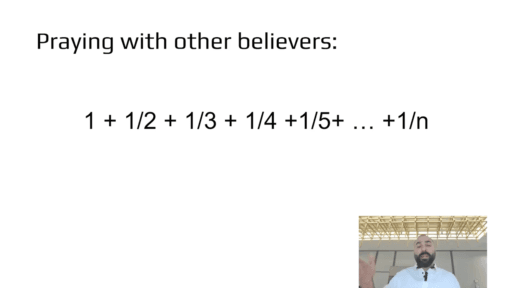
So now, what is the total value of the group prayer for you in a group of three people? In a group of three people, it’s 1 + 1/2 + 1/3, whatever that is. So that’s the formula. Then when you add the fourth person, it’s 1 + 1/2 + 1/3 + 1/4 if it’s a group of four people, and so on. So the formula in math of how to calculate the group prayer value for you—and I am not talking about the value of the total group prayer, all the prayers in the group, I’m talking about the value for you for the fact that you did the prayer in a group when you pray with other believers, of course—takes this form or expression:

$$\sum_{n=1}^{\infty} \frac{1}{n} = 1 + \frac{1}{2} + \frac{1}{3} + \frac{1}{4} + \dots$$

And the “n” here is the group size. So if there’s 100 people in the group, you add these numbers up to 100. If there’s a thousand people in the group, you go up to 1,000. If there’s 50 people in the group, you go up to 50. So you add these numbers up to 1/50.

This is the form in math, and in math, this has a name. It’s called the harmonic series. They named it like this—it’s not really important—because these numbers also are used in musical notes. The notes in music are created by the lengths of chords, of actual wires in a guitar, which are these specific numbers. But that’s just the name.

Convergence vs. Divergence in Group Size

The more important part is to analyze whether this is a convergent series or a divergent series. There’s two types of series. And this is a series, meaning that it’s a list of additions which end up at a certain point or they might never end in some types of math. Is this convergent or divergent?

As you can see all the numbers are getting smaller and smaller—1/2, 1/3, 1/4—they are getting smaller as we increase the group size. Each additional value to that prayer is getting smaller and smaller. Then the idea is, if it gets so small, will it even change anything at the end? Let’s say if there’s 1 million people or 2 million people, will it change anything there at the end, or will the addition be smaller than the increase in the number? If it has a limit to how big this number can be, then it’s called convergent; it converges. Let’s say the limit is 100—no matter how many numbers you add here, you will never get more than 100, the total value will never be more than 100. That would be convergent.

But in this case, this is a divergent series. It’s divergent because if you go up to 100 million, you will still get a bigger number than a specific number. It doesn’t have a limit; it doesn’t have a ceiling to how high it can go. However, even though it doesn’t have a ceiling, it slows so much that for practical purposes, it behaves almost like a convergent series. There’s no limit, but it really slows a lot. So it’s almost like it has a ceiling for practical purposes.

And what do I mean by practical purposes? I mean that we don’t have an infinite number of people in the world. There’s eight billion people in the world. I don’t know what the number would be for 8 billion, but probably if we add this series all the way to the 8 billionth person, we probably will get like 25—the value of 25 or something. Basically, if you do the prayer—I don’t know if that’s correct, actually, you can do it on ChatGPT to calculate it. All you have to do is add the harmonic series up to 8 billion, and it’s going to give you an answer. I don’t know what it is; it’s probably 25, 30, 40—I have no idea. But the number is still quite small, because as you add more people in the group, each person in the group is less and less valuable for your prayer because they are a smaller part of that bigger group. So that’s the idea. Yes, it does increase forever, but it slows down so much to the point that for practical purposes, you cannot really expect a number to be more than 20.

Practical Examples of Group Values

Let’s go through some examples.

  • In a group of one: The value of your prayer is 1.

  • In a group of two people: The value of your prayer is 1 + 1/2, which is 1.5. So there’s an extra value of 0.5.

  • In a group of three people: The value of your prayer is 1.83. So we add 1 + 1/2 + 1/3, that’s 1.83.

  • In a group of four people: The value of your prayer is 1 + 1/2 + 1/3 + 1/4, and that’s 2.

If you do the prayer with four people—being a part of a group of four people—then the value of your prayer is double whatever you did alone. And this is important because this has some connection with the Friday gathering.

But before we do that, let’s repent. Toubou ila Allah.

The Jurisprudential Value of a Four-Person Group

Praise be to God. There is no other God except God.

Okay, so the conclusion is if we do the prayer with four people in a group, then the value of our prayer doubles. And this is important because, as we said in previous Friday gatherings—I think it was early on Friday sermons—we said that when you do the Friday prayer alone, we do four rakaats, four units. But when we do it in a group, if all the submitters join in that group—not if some of them do it and some don’t, if all the submitters join in that group—then we do two rakaats if we do it regularly in a mosque with all the submitters there. So then we do only two rakaats. So we do four when we do it alone, but we do two if we do it in the correct setting with the group.

And as you can see, because we do four when you do it alone, if it was a group of two people and we did two rakats only, that would be less than doing four rakaats. So what this means is that unless there’s four or more people in the group, doing the Friday prayer with two rakaats has less value than doing four rakaats alone. This means, if we go by this logic, that the minimum number of people in a group prayer on Friday must be four or more people. Because if you do it with less people and you do two rakaats—if you do it somewhere outside, if you do only two rakaats—the prayer for you, if you do it with three people, the prayer for you is going to be 1.83. But you would have gotten a bigger value if you just did it alone with four rakaats, because then you would get double value from the four rakaats instead of two on Friday. So this means that we need at least four people to do the Friday gathering.

Clarifying Structural Group Sizes: 4, 20, 40, and 100

Now, some people I think have gotten a little bit confused because I’ve thrown so many numbers in relation to this. I’ve mentioned the number 20, I’ve mentioned the number 100, I’ve mentioned the number 40, and now I’m mentioning the number four. And all of these have different reasons why I mention them, so there’s no contradiction here. I mentioned the number 20 in relation to what is the minimum group size to organize the religion, which is what we’re doing. I’ve mentioned the number 100 in relation to what is the minimum group size to have a separate group, a following group after that. The next generations, they cannot say, “Oh, we’ll just have 20 people and we’ll separate, we’ll have our own separate group.” No, to have a separate group you need 100—by separate, I mean like the same religion but a subgroup. So that’s 100.

But for practical reasons, in an organized religion, to have an affordable way of building a mosque for the Friday prayer, you need about 40 people—and I’ll talk about that another time, about 40 people. But for just doing the Friday gathering in an unorganized group, disregarding the fact that you have to build a mosque, if you just do it anywhere—let’s say outside—then you just need four people. So all of these are separate things. And so the conclusion here is that we need four people.

Quranic Proofs for the Minimum Threshold of Four

Can we find this in the Quran? Yes, indirectly. In the Quran it says when you do a transaction, have two witnesses. So let’s say you’re in a Friday prayer—by transaction a business deal, let’s say someone wants to sell a home to another person. There’s two people: one of them wants to sell the home to the other one. They meet in a Friday gathering. After the Friday gathering, the person says, “You know what, I want to buy your home.” The other says, “Okay, deal. Where’s the witnesses?” You need two witnesses. So those two people plus two witnesses, that’s four people, otherwise the community cannot function.

There’s another verse in the Quran which says if someone commits adultery, you need four witnesses. So you cannot function as a community unless there’s a minimum of four people. And we are here disregarding the fact that if you want to build a mosque you need even more people, and if you want to organize the religion you need 20 or 100 depending on the situation.

But here we’re talking about an informal way of organizing. You need at least four people, otherwise you cannot fulfill some of the laws in the Quran. Because let’s say there’s three people exiting the masjid. On the way out of the masjid, they see two people committing adultery. What can they do? There’s nothing they can do because they don’t have four people. But if there’s four people, they can execute God’s law. I mean, in a democracy that might be dangerous, but whatever, that’s for another day. What I’m saying is it wouldn’t be possible. Let’s imagine in the past, it wouldn’t be possible to have a group with less than four people. And this means one leader and three followers. When they do the prayer, one person leads the prayer and a minimum of three people for the Friday prayer should be following—if we are doing it, of course, if we’re not doing it online like this.

Linguistic Insights from Arabic Plurality

Anyway, so—and by the way, this is why the Arabic grammar has—the plural starts with three rather than with two. Unlike English where we have the singular which is one person and then we have the plural which is two or more, in Arabic, the grammar also has a third version. It has a version for one, which is singular. Then what they call the smaller plural, which is two people. And then what they call the bigger plural, which is three or more people. It’s a different form of words in Arabic. So the way the ancient Arabs thought of it is like you have to have three people to think of them as a group; you cannot think of two people as a group. So you have a group of three, plus the leader is four.

So again I’m repeating, we need four people in an informal setting to have a group Friday prayer—not two, not three, you need four. However, if you want to build a mosque, then the situation changes. Then you have to also estimate: is it efficient to build a mosque with four people? That’s another question. And because we’re doing it online now, the issue is: is it better to build a mosque with, let’s say, 10 people or something? Those are all different answers. Here, I’m just going to focus on what is the value of the group prayer, and then we’ll use this for other conclusions. But please don’t rush into conclusions because there’s other factors to consider. Let’s just learn this as a separate fact.

Mathematical Expansion of the Harmonic Series

Okay, so if we have, let’s say, 10 people, the value of the prayer would be 1 + 1/2 + 1/3 + 1/4 all the way to 1/10 — that would be 2.92. That’s the value of the group if there’s 10 people in the group. If there’s 20 people in the group, the value would be 3.59. If there’s 30 people in the group, the value would be 4. If there’s 60 people in the group, the value would be 4.67. If there’s 100 people in the group, the value would be 5.18. If there’s a thousand people in the group, the value would be 7.58.

So this means that if you pray in a group of a thousand believers—not just any group, it has to be submitters and believers—if you pray in a group of a thousand believers, your prayer is seven times more valuable. So you do one prayer, it counts as seven. If you pray in a group of 10,000 people, the value of your prayer is 9.78. If you pray in a group of 100,000 people, the value of your prayer is 12.09. If you pray in a group of 1 million people, the value of your prayer is 14.39.

For practical purposes, it’s hard to imagine a prayer with a bigger group. In Kaaba they say that the sacred masjid fits about 4 million people, but honestly, do they even pray together sometimes? Like, there’s separate sections, people pray in the yards, they count that as well. I don’t know if that’s a prayer together. So for practical purposes, I don’t think it really makes sense to go beyond a million. You just don’t see who’s there or who’s praying, who’s not praying. So it’s not that you have to see it, but the issue is like, there’s separate sections, they’ve created roads between sections of the masjid—is it really a full group then? So, yeah, but as you can see, it’s kind of like it’s hard for practical purposes to imagine a prayer because of the group effect to have more than 14 times the value of your actual prayer.

Group Values Within Multi-Denominational Mosques

Now, what if you pray in permissible mosques dominated by Sunnis or Shia? Now, then the value is different because, as we know, we are allowed to pray in some mosques which are dominated by Sunnis—in some of them, and I deal with that in another video (Places of Worship) . And in those mosques, if we happen to be there, then there might be Sunnis there and you might be forced to join them in the prayer. And in that case, what is the value of your prayer? In that case, we have to use the idea from that video clarification (Demographics of Heaven and Hell) where I concluded that in each group, whether a state group, religious group, or whatever, there’s always, sort of almost by chance, for every 10 disbelievers, there is one believer. They don’t know that they are believers; they think they are Sunnis, but there’s one person there who’s honest for every 10 people who are evil people. And so that means that among Sunnis, by chance, you’ll get one person who’s a believer. And by the way, even the Quran mentions that there are believers in the groups of disbelievers.

You go into a Sunni mosque, for every 10 disbelievers there’s one believer. You don’t know who that person is, you might never know, but he’s there, he’s probably there. So in this situation, what’s the value of your prayer? Now, to calculate the value of your prayer in that situation, first imagine that all the prayers of these disbelievers go to waste. The Quran says whoever commits idol worship, all his works will be nullified, meaning that his prayer is just nothing, as if he never prayed. It’s like he went to the gym. For all the Sunnis, when they do the prayer, it’s like going to the gym. I mean, when you go to the gym, at least you gain some muscle or whatever, there’s some health benefits, but there you don’t even gain much muscle. It might be good for your health maybe a little bit, I don’t know. What I’m saying is it doesn’t count as a prayer for all those disbelievers—the 10 disbelievers. But for one person among them, for some reason, he probably hasn’t committed idol worship in his heart, and it counts as a good thing.

So in that situation, what’s the value of your prayer? In this case, the value of your prayer is one, but the next person is zero, for the next person is zero, for the next person is zero. Then on average, the 11th person, his prayer does count. So then that 11th person, how much value does he have for you? He’s the 11th person, he’s not the second person. He’s the 11th person in the group. So 1 + 1/11, because now you are one among 11 people. And then for that next person who’s a believer, he’s 1/22, for the next person is 1/33. So that’s how we calculate the value of our prayer in a group setting in a permissible mosque with Sunnis or Shias.

And this is the form, this is the math expression:

$$\sum_{n=1}^{\infty} \frac{1}{n} = 1 + \frac{1}{11} + \frac{1}{22} + \frac{1}{33} + \frac{1}{44} + \dots$$

depending on how many people there are. So let’s calculate that, let’s take some examples. So let’s say there’s 110 people—see, this ends with 110 in a mosque, that’s typical. In a typical mosque, if you go there and pray, it’s usually about 100 people, that’s quite typical. So the value of that would be 1 + 1/11 + 1/22 + 1/33—if you add all those numbers up to 1/110. If you add all of them up, you get 1.26, which is not even enough for a group prayer, for a Friday prayer, because it has to be more than two, otherwise it would be better just to do four rakaats instead of two and that’s it. So it’s not even enough if you do it with Sunnis to count as the Friday prayer.

If there’s a thousand people, if you add all of them up, see now it’s—again, this series is slowing, it’s increasing much slower—it’s 1.46 if you do it with a thousand people. Finally, with 1 million people, it gets the value of 2, and this is probably the setting in Kaaba maybe. Because even in Kaaba they have separated the group, so you can never think of it as 1 million people. So the conclusion here is that if you go into God’s mosques which are dominated by Sunnis, even if the mosque has a million people, it would be better for you just to pray with four submitters separately than to pray in that mosque. I’m not saying that you shouldn’t go there; all I’m saying is there’s more value to praying with submitters than to praying with Sunnis in a mosque. Even if there’s 1 million Sunnis compared to just four submitters, just four submitters gives you more value.

Let me go back to that because here, with just four submitters, we achieve the value of two, and imagine with more submitters. But if you pray in a mosque—in a permissible mosque with Sunnis—you need a million Sunnis to just let’s say have that additional value as much as four submitters, which is a big difference.

The Amplify Effect of Group Actions in Scripture

Yeah, so now what Quranic verses support this idea? Let’s say verse four. By the way, I can prove this specifically, but then I would have to go into taking into account all other factors like gender, age, and all of that, and I don’t want to go too much into it. I don’t think it helps to focus on gender differences, so I’m just going to sort of superficially support the idea. So, Surah 4 verse 85 says:

“Whoever mediates or enables a good deed receives a share of the credit thereof, and whoever mediates an evil work incurs a share thereof. God controls all things.” [Quran 4:85]

So this is the basic idea of why the group prayer has more value than an individual prayer for you—why it has more value for you as well, for each individual in that group.

By the way, this same idea, as you can see from this verse, is also true in an evil group. This is why sometimes people don’t realize how much they are damaging their life by hanging around bad people, because as you can see, the deed is amplified by the group. This is why the gangs, the mafia, all of that are worse than they think. Someone probably just buys the gun, the other one person kills the person—that’s a big deal there. Being part of that group where someone got killed, that’s a big deal.

Oh, by the way, this is also the reason why there’s no contradiction in the Quran when the Quran says if you kill someone—I’m talking about like as a believer—if you kill someone, then yeah, it’s a bad deed. But if you kill in a group setting, meaning in a war, it’s not necessarily bad. The reason is that if a believer kills a believer, whatever was good in that person now becomes a sin for you because you stopped his good deeds. But if that person is half-half, let’s say he’s half good, half bad, then you sort of half killed the person. Yeah, it’s killing, but for 50% of it maybe you had the justification, for another 50% you didn’t have. But this is dangerous because you’re adding sins to yourself.

However, in a group setting—let’s say in war, when Muhammad fought with the believers in actual war—even though you might have let’s say committed a 50% sin, let’s say the group was 100 people. 100 people fought against a thousand disbelievers, let’s say. Yeah, but the reward is five times more. So in this case, even though you did a sin which is prohibited in the Quran—it’s prohibited in the Quran to kill someone—in a group setting in war, the benefits outweigh the costs, because in the group setting your reward was five times more. Therefore, it outweighs the sin. That’s why wars are allowed and killing is not. Okay, so this is one of the reasons, not all the reasons.

The Realities of Associative Responsibility

Okay, so but I want to also sort of focus on the idea that some people think that—you know, you might have heard the expression, and this is important because some submitters don’t fully appreciate this—a lot of times you hear it in English, they say, “Keep your friends close, but your enemies closer.” What they mean by it is like, yeah, he or she might be useful, an enemy might be useful for some situation, so I’m just going to keep them close to me just in case. It doesn’t work like that. Once you’re part of a group, whatever they do, you’re responsible for part of it. And as you can see, it amplifies. Let me go back here: if the group is 100 people, even if you do something not as bad, it’s five times worse. You then become part of that mafia.

The next verse which supports this idea, it says for example in Surah 7 verse 161, it says:

“Recall that they were told, (the people of Moses) ‘go into this town to live and eat therefrom as you please. Treat the people amicably and enter the gate humbly. We will then forgive your transgressions; we will multiply the reward for the righteous.'” [Quran 7:161]

Because they were a group of people, and if they joined the town, there would be a bigger group and the rewards would be multiplied.

Then we have Surah 61 verse 4. It says:

“God loves those who fight in His cause united in one column, like the bricks in one wall.” [Quran 61:4]

There’s an additional goodness in being united.

Surah 2 verse 43 says:

“You shall observe the contact prayers and give the obligatory charity and bow down with those who bow down.“[Quran 2:43]

If there was no additional value to the group prayer, God would never order us to bow down with those who bow down. There’s an additional value to that; that’s why God mentions it. We bow down with those who bow down because it’s better than bowing down alone.

Then Surah 18:28 says:

You shall force yourself to be with those who worship their Lord day and night seeking Him alone. Do not turn your eyes away from them seeking the vanities of this world, nor shall you obey one whose heart We rendered oblivious to Our message, one who pursues his own desires and whose priorities are confused.” [Quran 18:28]


Friday Sermon by: Alban Fejza, Online Congregation Director
Overreligiosity


Sermon Introduction

Praise be to God. There is no other God except God. Some music for teenagers. When I was a teenager, I liked that music. I’m guessing teenagers like that music more. Now I’m not sure if I do like it anymore, but yeah, it’s okay. It made me smile. Today what I want to talk about, is the topic of over-religiosity. Typically, this would be a good topic, where with some topics I find that it’s useful to just be ironic or to sort of almost ridicule, which is always not a nice way to do it, but some things when you step back, they just look ridiculous. Really ridiculous. And I cannot help but take that approach. But this time I’m going to try not to do it. If I do it, sorry. And I’m going to try not to do it, not to be ironic with it or not to use sarcasm to drive the point home about this topic, because there could be reasons beyond our control. There are reasons beyond our control for some of us which make us over-religious.

There are different reasons why people are over-religious. And what do I mean by over-religious? When I say over-religious, I mean like unnecessarily religious or harmfully religious. Yeah, a person can be harmfully religious. Let’s distinguish between righteousness and religiousness. Righteousness is pretty much always good. Religiousness is not always good. Probably Pharaoh was religious. The Pope is very religious. Is it good? Not necessarily good. But still, because for some of us over-religiosity is a little bit beyond our control, I’m going to try to be nice about it and not laugh at it. But at the back of my mind, I’m always thinking, should I laugh at it? So yeah, but I’ll try to be nice. Let me try to be nice.

So yeah, there’s different reasons why people are over-religious. By over-religious again, I don’t mean over-righteous or over-sincere; what I mean is over-religious—the person looks more religious than he really is. There’s something off. And reasons for over-religiosity are a few, and some of them are beyond the people’s control and others are within their control. Because some of those reasons are beyond their control, basically they are not bad reasons. I don’t want to laugh at the over-religious people. Rashad, by the way, did laugh at over-religious people, which made sense, but there are some groups of people who don’t have things under their control, so it’s not good to laugh at them. Okay, so just keep that in mind.

Reasons Behind Over-Religiosity

1. Low Levels of Intelligence

What are the reasons why people become over-religious? One of the reasons is low levels of intelligence. Scientists have done studies; they simply ask people, “Do you believe in God or not?” And it turned out that people who are more intelligent were more likely to say that they don’t believe in God. And they use this as some sort of proof that dumb people believe in God. It’s not actually the case. The reality is that people who are not as intelligent are more over-religious. So basically, only about 10% of people really believe in God. But people who are a little bit dumber are afraid to admit it because they are afraid that society will judge them. And people who are smarter will be like, “Oh, there’s no God.” If they don’t believe there’s a God, they will say there’s no God, if that’s what they believe. So basically, in those tests, the people who are smarter told the truth of what they really believe, and people who are not as smart were trying to hide it because they thought that they were going to be judged. Because of that, you’ll get a slightly larger number of people among the smart people who say that they don’t believe in God. So yeah, one of the reasons for being over-religious, unnecessarily religious, or religious because you think society wants you to be religious, is low levels of intelligence. And a lot of you probably have noticed this. If you go into some cultures, you’ll see, “Oh, wait a minute, these people are really religious.”

Another reason why people—and this is beyond a person’s control, by the way; we never laugh at low levels of intelligence. We don’t laugh at it because intelligence is just mind beauty. Would you laugh at someone who’s not as beautiful? No, it’s not nice. It’s not fair. God created all of us, and God can make anyone ugly or pretty; it’s God’s choice. So, it’s beyond our control. And because of that, we don’t laugh at people who are not good-looking. But at the same time, for the same reason, we shouldn’t laugh at people who are not as smart. They are what they are. It’s okay. Everyone is their own person. It’s fine. Everyone is good-looking enough and everyone is smart enough for their own good. So yeah, we don’t laugh at that. However, it is true that people who are slightly less smart will tend to be slightly over-religious. And again, it doesn’t show anything about their true belief. It shows their level of religiosity; it doesn’t show their level of belief or their level of righteousness or their level of sincerity.

2. Poverty

Another reason why people might be over-religious is poverty. If you go to poor countries, you’ll notice that they are more religious, and they are forced by poverty. Because when you don’t have a job, when you’re poor, when there’s no other option, and there are people like that around you, yeah, you’ll kind of get into religious stuff unnecessarily. Like, for example, the bathroom needs to be fixed, you forget about it, you read the Quran or something. It’s a way to avoid the reality. Yeah, that might be over-religiosity. Yeah, fix the bathroom first, maybe. But whatever. But it’s okay. It’s okay, I’m trying not to laugh because, again, this is beyond people’s control. It’s beyond people’s control. No one can control how rich or poor they are. What does the Quran say? God makes people rich or poor. God gives and God takes. So if God wants to make someone rich, God will make someone rich. If God wants to make someone poor, God can make someone poor. It’s not in our control. And for that reason, if that causes a little bit of more religiosity, over-religiosity, it was beyond the person’s control. It doesn’t mean it’s good. Over-religiosity is first unnecessary and most of the time harmful. It confuses things. People who are not as good will seem better. People who are actually better will not seem as good. So it kind of confuses the situation. But it happens. It happens.

3. Overcompensation for the Past

The third reason of over-religiosity is overcompensation for the careless life of the past. So let’s say—and I’m going to use some really bad examples here—but let’s say someone lived as a prostitute in the past, and then when she becomes religious, she now totally has to wear the hijab. Like, good women do not actually remove the hijab, but her past is like a prostitute, probably. So it’s overcompensation. Or people who might have been, let’s say, really harsh in the past—they beat people, they bullied people—now they’re extra nice, they are the nicest person ever. It’s overcompensation. So some aspects of over-religiosity are caused by overcompensation, especially if the sinful life was too long. Let’s say until their 40s or 50s someone was a bad person—which is okay, anyone can change. I’m not saying it’s okay, but anyone can change. I truly believe people change. They really change. Like, someone really actually can be a prostitute and become a good person; it’s possible. And that’s probably one of the worst cases, but it’s possible. So people can truly change. However, staying in a sinful life for a long time, is going to cause you to overcompensate. Then you really want to be the best of the best, which is not really sort of in your range—it’s beyond your league, but you kind of are trying. That’s because you’re trying to overcompensate. You’re trying to overcompensate for past sins. And this is probably a little bit reasonable, to try to overcompensate, but it also causes over-religiosity, unnecessary religiosity.

4. Ego

Another reason—and this is probably a reason to ridicule—why people are over-religious is ego. They think that they are special. And this is probably the most dangerous form of over-religiosity. They become religious, they think—typically a Jew will do this. A Jew will be religious and be like, “Oh, we’re God’s chosen people. I’m the best. I’m better than others.” So typically, if a Jew is over-religious, it’s because of his ego. He thinks he’s special, he’s better than others, his life is more important than the life of others. So that could be one reason for over-religiosity. One of the most dangerous reasons is ego, thinking that you’re special, that there’s something special about you compared to other people.

5. Hypocrisy

Another reason for over-religiosity is hypocrisy. And this is actually probably not a good reason to mention because hypocrisy can cause both over-religiosity and under-religiosity depending on the circumstance. It will cause over-religiosity when someone reaches leadership positions—let’s say the Pope, some Imams, some leaders. They become over-religious because they are leaders, but it’s because of their hypocrisy. They don’t believe; they want other people to think that they are really special and really religious, so they’ll become over-religious. Even the stuff they wear, you can see the Pope—like, over-religiosity because of hypocrisy, but other religious leaders as well. But I don’t think we should really use hypocrisy as one of the main reasons for over-religiosity because hypocrisy can also cause under-religiosity. Some people want to stay in between; they kind of want to embrace religion, but they think it’s too much. So, let’s take the example of the prostitute again because it’s easier. If she’s a hypocrite, she might be under-religious. She’ll be like, “You know what, I’ll embrace this. I’m going to fix my life, but you know, maybe I’ll still keep my makeup. I’ll still keep my provoking dresses and all of that, and bad clothes. I’ll still keep the photos on my social media; they are there, they’re in the past, but I’ll keep them.” Kind of like under-religious. So, hypocrisy can also cause under-religiosity.

Typically, in our situation, hypocrisy causes under-religiosity. Because it’s very unlikely in the early generations of believers, to have hypocrites among the leaders. Usually, in the very late generations of believers, the hypocrites can become leaders. Fake believers can become leaders; that’s usually towards the end. But towards the beginning, a lot of leaders here know that you always have to give more than you take. It doesn’t benefit anyone to be a leader and a believer in this situation materially. It doesn’t benefit anyone; you always have to give more than you take. All the leaders know this—whoever is helping and whatever, you see that you have to give more than you take. And this keeps the hypocrites out. So this is not really our problem. When I’m speaking about over-religiosity, really, let’s not be concerned about it. Let’s not sort of think that, “Oh, this guy is over-religious because maybe he’s a hypocrite.” That’s actually not very likely until the end of the world. It can happen, but it’s very unlikely. Because hypocrisy typically, in the earlier generations, causes under-religiosity. People kind of want to be religious, but they are always looking for a loophole. “Oh, is it allowed maybe?” you tell them, “Oh, don’t eat pork,” they’ll be like, “Oh, is it allowed maybe a little bit?” or “Don’t drink alcohol,” hypocrites will typically be like, “But what if it’s a tiny bit? What if it’s during the night? What if it’s kind of like…” They seek loopholes. Anyway, so hypocrisy can be a reason for over-religiosity, but usually among the leaders. So let’s sort of forget about it.

6. Hyper-Religiosity as a Medical Condition

And another reason, unfortunately, of over-religiosity is what is called hyper-religiosity. And this is actually a psychological condition, a medical condition. If you search on chatgpt or whatever, what is hyper-religiosity in psychology, it’s a person who is acting really religious to the point of harming themselves and not being functional in society. Typically, this is caused by some types of epilepsy in the brain, or bipolar disorder, or schizophrenia. So really, mental diseases can lead to over-religiosity, and these are easy to tell. They are really not that dangerous because you can tell, but they can be more dangerous online. Typically, these people cannot be—it’s harder to tell online when people are contacting us online, that the person has schizophrenia, or maybe he or she has bipolar disorder, or he or she has some kind of epilepsy which is causing them to be over-religious. So it can be a disease, but it’s not in their control. So it’s unfortunate. It’s unfortunate for them; probably the best thing to do is to just ignore it. But online it can happen more often. You might face some situation like that in your life where someone approaches you online and they want to talk about God or Jesus or whatever, and they are just bipolar or maybe they just have schizophrenia. It happens online more because you cannot tell their behavior—it’s harder to figure it out through typing. But yeah, once you kind of see that there’s something off, you just disregard them. The Quran says disregard the ignorant. By ignorant, that means also the people who don’t know much, but also people who might have a mental disease. Just disregard them. Don’t deal with them. It’s okay. They have their own problems. You can feel sorry for them and that’s it, but you don’t have to get them out of their situation. In many countries, there’s a medical system for that.

So yeah, these are typical reasons of over-religiosity. Some of them are bad—ego, hypocrisy potentially—but others are beyond people’s control. That’s why we should be careful not to laugh at over-religious people. However, over-religiosity is not a good thing. Typically, it’s not a good thing. Let’s repent. Toubou ila Allah.

Alhamdulillah. Ashhadu An la ilaha ila Allah Wahdahu la sharika Lah. Praise be to God. There is no other God except God.

And all of us are victims of over-religiosity. I just did it right now. I didn’t need to say it in Arabic; I should have just said it in English. It’s not necessary online because you guys can say it, but whatever. Yeah, I just said alhamdulillah La ilaha ila Allah. I could have just said it in English, that would be enough. But I was a little bit over-religious, maybe out of habit. But it happens to all of us. I don’t know—am I overcompensating? Maybe I’m a little bit dumb, maybe I’m a little bit poor. I don’t know what’s causing it. But yeah, it can be caused.

Examples of Over-Religiosity

1. Using Expressions in Another Language

But let me now go to some examples of over-religiosity. One example is using expressions in another language. You ask someone, “How are you doing?” “I’m good. Alhamdulillah.” What? Okay, if the person has an Arabic background, fine. But quite often it’s over-religious, just the person trying to be more religious. Would he say it to himself? “Oh, today I feel good. Alhamdulillah.” They’d probably say, “Today I feel good, thanks to God,” when they think. But when someone else asks them, they are like, “Oh, I’m good. Alhamdulillah.” Whatever. And anyway, I’m trying not to laugh at it because it’s a good thing. But why would you say it in another language if that’s not your mother tongue, if that’s not your natural language? Why would you say it in another language? Does it just make it sound more religious? Like having expressions in other—or the Christians will be like, “Oh, praise Jesus, hallelujah, hallelujah.” Do they even know what it means? It’s kind of—it just sounds more religious. There’s some secret symbolism in there which they think is there. So yeah, it’s just over-religious. It’s just trying to act more religious than they truly are. When they exit that church or that mosque or that social gathering, they really are not those people. They are different; they feel different. But they are trying to be more religious than they truly can handle. So that’s one example of over-religiosity: just using expressions in another language which is not your language. Typically among the Muslims, it’s in Arabic. I can understand the Arabs, but not the other people. Why would you go to use an Arabic expression?

2. Naming Children After Prophets

Another example of over-religiosity is, for example, naming the kids after previous prophets. I mean, who would name their kid Jesus? Or naming kids in languages which are not their own. If none of the parents are Arabs, why would they name their kid in Arabic? Or if none of the parents are Italian, why would they name their kid in Italian? So yeah, one of the examples of over-religiosity is naming kids. “Oh, I’m going to name my kid…” Let’s say, what are some of the prophets? John, Jesus… John, why? It’s unnecessary. Or to go even beyond that, naming the kid according to the name of a prophet in Arabic—why not even John, like Yahya, or stuff like that? That’s over-religious. And how do we know it’s over-religious? The prophets themselves didn’t do that. You don’t see any prophet being like, “Oh, I’m going to…” Moses didn’t go like, “Oh, I’m going to name my kid Abraham.” Abraham existed before Moses. Moses never said, “I’m going to name my kid Isaac.” Isaac existed before Moses, and he was a prophet, and Moses had respect for Isaac, but you don’t see that example there. You don’t see that. You see the opposite. They try to name kids according to names which were not found before. I mean, some cultures have respect for their elders; yeah, that’s a little bit understandable. Even if, let’s say, some people named their kid Abraham, it’s because they were recent descendants of Abraham—people who came just after Abraham. So it was because Abraham was their father or grandfather or things like that, but not for religious reasons. So yeah, this is one—I don’t think it helps with anything. Naming your kid after a prophet or using words from the Quran which are actually in Arabic, if you’re not an Arab, it doesn’t make sense. That’s an example of over-religiosity.

And you can see it typically like so many Muslims—I mean Sunnis and Shia—so many of them will name their kid Muhammad. Muhammad. How many Muhammads are there in the world? Can someone help me? Probably a big—I think Muhammad is the most popular name in the UK, I’m not sure, because everyone names their kid Muhammad. Muhammad, what is it? It’s ridiculous. So imagine the kid walking around, “Oh, who are you?” “I’m Jesus.” Does it make sense? It doesn’t make sense. Plus, it’s a little bit against the Quran because the Quran says Jesus was the Messiah. Does it mean this guy is the Messiah? Or the Quran says that Aaron was a prophet, and if someone is named Aaron, does it mean this guy is a prophet? So it is a little bit against the Quran—not fully, but a tiny bit against the Quran. Now, if we have done it or we plan to do it—if we plan to do it, I’d encourage you not to, but if you do it, it’s fine. What I’m saying is, it’s probably because you are over-religious, and it’s probably because you’re trying to overcompensate for your past sins. You’re trying to be more religious than you can handle, and it’s because in the past you were not religious enough, so you’re overcompensating. So yeah, I myself am happy that, let’s say, my mom named me Alban, and my siblings all have Albanian names. Our mom named us; I think. It’s fine. Actually, typically in the Bible, if you look at examples, they had names which had meaning, like Jewish names which had meaning. I don’t know what Moses means; it probably means water or something like that, like the one who is found in water or something. So they had a reason why they named the kid in that way, but not some other people’s reason—their own reason. What’s the reason to name someone Jesus when you’re not living in the time of Jesus? So yeah, that’s an example of over-religiosity. However, it happens to all of us because it’s beyond our control. Some of us have lived different lives, so there could be reasons which are beyond our control which can cause over-religiosity. So I’m not going to judge it. However, I’m also not going to approve it. If you can fix your over-religiosity, fix it. It’s okay. I think it’s better if you’re not over-religious. You have to be practical.

3. Pushing each other for “Religiosity”

Another example of over-religiosity is pushing people. Like, some of us went to Hajj, and there were people pushing other people to go and kiss the Kaaba or touch the Kaaba, or be as close to the Kaaba as possible. That’s not in the Quran, but they try to do that. And why is that bad? Because by trying to be more religious than is possible, what they are doing is they’re pushing, for example, sometimes the opposite gender—men pushing women, women pushing men. How does that work? That’s against the Quran. Why would you touch a woman? Why would you touch a man if you’re a woman? It doesn’t make sense. But over-religiosity causes them to think that it’s okay. “Oh, in this case, it’s okay, we’ll push each other.” It’s never okay to push each other. I think probably in war, maybe in war there might be a reason, but in other cases, I don’t see a reason to push each other—or maybe jokingly, I don’t know if that’s a good reason. But what I’m saying is yeah, that’s an example of over-religiosity: pushing people to get closer to the Kaaba. Why would you push people?

4. Decorating Homes with Religious Symbols

Another example of over-religiosity is, for example—let me check my microphone if it’s on. Okay, it’s on. Another example of over-religiosity is decorating the home with religious symbols. I visited someone’s home once, a long time ago—not a submitter—and his house was full of religious symbols. Kaaba here, a verse there, a verse there, another verse there, another symbol there, the name of Muhammad there… what is it? It almost looked creepy. You know, if you go to a Buddhist home, there’s Buddha, Buddha, Buddha, Buddha. Or if you go to some kind of Hindu home, you have all these idols, symbols, different colors. What is that? That’s just over-religious. It doesn’t help with anything. Yeah, it can be even verses of the Quran. What? Yeah, this is probably an example of over-religiosity. Do you have a favorite verse from the Quran? If yes, then probably you’re over-religious. So if someone asks you, “What’s your favorite verse?” “Oh, this is my favorite verse, and I put it on the wall.” That’s over-religious. There’s no such thing as a favorite verse. All verses are equal in the Quran. God reveals all verses in the Quran; we shouldn’t separate them. But some people will take it, put it on the wall: “This is my favorite verse.” Yeah, we can do that for practical reasons. Rashad put up some papers of the mathematical miracle, kind of like investigating stuff, helping him to memorize stuff—that’s different. But I’m saying, like, people who now that we know the mathematical miracle, why would they even put like the number 19 here and there? It just doesn’t make sense. It’s over-religious. It has nothing to do with righteousness.

By the way, in the Quran, it says righteousness is not turning your faces towards the east or the west. Then it gives you a list of what is righteous. And putting stuff on the wall is kind of like—it’s religious, but it’s not righteous. Similar to how turning towards the Qibla is religious, not necessarily righteous. And by the way, a little bit of religiosity is okay. I’m here talking about over-religiosity. And what do I mean by a little bit of religiosity? Like Contact Prayers are religiosity. Yeah, we do The Contact Prayers, fasting, zakat, going to Hajj—that’s religiosity, but it’s also righteousness. But once you try to go beyond them, it’s probably over-religiosity. You’re just adding it on top; it doesn’t make sense.

5. Outward Appearance and Dress Codes

Another example of over-religiosity is how people look. Typically, women will wear a hijab—it’s just over-religiosity. They think that they are better than they actually are. Or a man will grow a beard. By the way, this beard which I have right now has nothing to do with religion. Let me just make this clear. The story of how this beard came to be is like this: basically, I found online that after I got married, some women—a little bit less than half of women—prefer beards, meaning they think that beards make men look better. And a little bit more than half of women think that if men remove the beard, it makes them look better. So I was wondering which group my wife was in. So I asked her, “Do you think beards make men look better or not?” She didn’t want to sort of admit it, but I extracted it from her—I pressured her. “Which one is it? Which one are you?” And she said, “No, I think beards make men look better.” So I’m like, “Okay, I’ll do this for my wife.” So the beard is just for my wife. There’s absolutely no religious reason for my beard. And the second reason probably is practicality, and in this case, it’s actually anti-religiosity. I heard once—and I’m not an atheist, as we know—I heard once Fidel Castro, I think he’s an atheist but also a non-religious person, they asked him, “Why did you grow the beard?” and he said, “Oh, it’s just easier, it’s more practical because I don’t have to shave.” Yeah. So I satisfied my wife’s desires while also doing something which is easier. It’s easier for me not to shave every day. But either choice is fine. What I’m trying to point out is my beard has no religious reason.

But some people will grow their beard for religious reasons. That’s over-religiosity. And the reason for that is even if it is good—which I don’t think it is—even if it is a good thing to grow your beard, it probably falls on that range of good deeds which is beyond 75%. Meaning that some of you guys probably remember a video which I published called The Global Forced Behavior. In that video, I said that for our generation, the maximum good we can do is 75%. We cannot be 100% good; we can only be 75% good. So anything beyond that is just fake; it’s not possible. And even if the beard or the hijab falls in that range, it’s beyond that, so you’re just faking it. It’s not you. There are so many other things you can fix before that. How about before you wear the hijab, first start with having less glitter in your dress? A lot of those women with the hijab will have lots of glitter. “Oh, I have this design, that design.” How about stop the glitter first, and then wear the hijab? But no, they wear the hijab while still maintaining all the glitter, all the fancy stuff. Yeah, remove the glitter first, and then wear the hijab. So what I think is, even if it’s any good, it’s beyond what would make sense for anyone today. So it’s over-religious. It’s not what they would have done; it’s just them ending up doing it for different reasons which have nothing to do with righteousness—reasons which either have to do with their low IQ, living in a poor country, overcompensating, or ego, or hyper-religiosity, which I don’t think is the case for most of them because diseases are rarer than we think anyway. So that’s another reason.

6. Praying for Sports and Games

Okay, let me give you actually a very good example of over-religiosity. How many of you—probably the younger men or boys will know this—have seen football players (but I’m going to call it the US version, soccer players) or even basketball players? I think with soccer players, they score a goal and then they prostrate, or if he’s Christian, he might actually do the cross before he starts the game or kiss the cross before he starts to play, or pray before the game. “Oh God, please help Arsenal defeat Real Madrid,” or something. “Please help Barcelona defeat Arsenal.” And why is this over-religious? Because even though it looks like it’s a good thing that the person is praying, what is he praying for? For a game. It’s a game. At the end of the day, it’s a game. Why would you pray to God for a game? It’s a game. First you have to realize that it’s a game. So what if one person from one team prays, and another person from the other team also prays, and they are both of the same religion? What’s going to happen? Which prayer is God going to answer? It doesn’t make sense. The only prayers where you pray to God to win is if the believers are fighting the disbelievers. But this is just two teams; it’s a game. Does it make sense to include prayer into the game?

By the way, I don’t agree with some institutions which try to prohibit it. They say, “Oh, sports should unite people, we shouldn’t pray.” Let them pray, whatever. But I’m saying it’s ridiculous. It’s over-religious. Yeah, they can do that, but it’s ridiculous. It’s over-religious. Why would you pray for a game? It’s a game. At the end of the day, you have to realize it’s a game. It doesn’t help the believers, it doesn’t help the disbelievers—it’s just a game. Since when did people start taking games seriously? Okay, has our life changed if Barcelona or Real Madrid won? It hasn’t. So, it’s just a game. And let’s say Ronaldo will go to Saudi Arabia to play, and then there, I think I saw a recent one, he’s like—oh, he says, Bismillah before he kicks the penalty. “Oh, I’m going to shoot the penalty. Bismillah.” Why? It’s a game. Why? So you’re afraid the penalty is going to go wrong. What if it goes wrong? It’s a game. Aren’t we playing to see who’s better? Not to kind of like include God into that. So yeah, that’s just over-religious. It has nothing to do with righteousness. It actually damages religion because it makes religion seem less important. It ridicules the religion by praying for a game. It’s a game.

7. Imposing Extra Dietary Prohibitions

Another example of over-religiosity is extra prohibitions. God, for example, prohibited pork. And they’ll try to be a little bit extra. “Oh, I don’t eat sugars. I don’t eat vegetables. I have a carnivore diet. I’m a vegetarian.” Okay, some of them might have medical reasons, but a lot of them are just over-religious thoughts interfering in your life. Unless the doctor tells you, “Oh, you shouldn’t eat meat,” why wouldn’t you eat meat? Or unless the doctor tells you, “Oh, you should only eat meat,” why wouldn’t you eat vegetables? It makes it difficult, let’s say, for your family. What are they going to cook? So yeah, that’s an example of over-religiosity, kind of those extra dietary prohibitions. “Oh, I’m going to do this. I’m going to do that.” It’s over-religious if you do it for a religious reason, if you do it thinking that it’s going to make you somehow better, function better, and it’s going to bring you closer to God. No, it’s not. God has laid down the laws which are in the Quran, and that’s it. You don’t have to go beyond that.

Conclusion: Be Real

To conclude, typically over-religiosity is when people go for more symbolical things which actually don’t change much, but they disregard the basics. They probably missed the prayer one day, but now they’re going to really focus on the night of destiny or stuff like that. That’s over-religious. God willing, I’ll deal with the night of destiny another day, where you’ll see that the conclusion is that, yeah, it makes sense to do something during the night of prayer, but typically when you have a mosque, not outside of a mosque. Still, what I’m saying is there’s these hints of over-religiosity, and all of us have them. I did it today, but they are not good. Let’s not fool ourselves with over-religiosity and thinking that it’s righteousness. A lot of it has nothing to do with righteousness.

And to conclude, I think we should be real. Be real. Black Americans have a very good saying, “be real.” Why don’t you be real? Let’s be real. And when you’re real, you don’t try to be who you are not. And that helps you prevent over-religiosity.

Anyway, I don’t know if I should conclude or should continue a little bit more. Does anyone have anything to say or some kind of example? Let’s try to keep it quick though. Let’s see if someone is typing. Faisal is saying, “I really like this sermon.” Yeah, I assume so, Faisal, you would like it. I don’t think Faisal is a person who’s over-religious. Some people can improve with over-religiosity. They can improve it a little bit. But again, a lot of that is beyond the people’s control, so let’s not judge it. It happens. It happens to everyone.

By the way, some of the stuff actually makes sense to be practical, to be over-religiously practical. For example, when we went to Hajj, the women had to wear the hijab, but it’s just for practical reasons. Just when you go to the border, you have to show the passport. It just makes it easier for you to do the other good things.

Trevor is saying also “Yes, great sermon.” Thank you very much.

Moneruzzaman is saying, “what about dhikr, some of the verses like last three ayats of Surah ‘Asr?” I don’t know which verses you’re referring to, but first of all, this is an example of over-religiosity. Surah ‘Asr—I don’t know, it’s Arabic. Can you tell me in English, or can you tell me the Surah number? But regardless, yeah, dhikr is good, but let’s not sort of try to package it into, “Oh, we do it during the night of destiny, we do it during this day.” Remembrance of God is good at any time; however, you don’t have to package it. I’m talking about the packaging. When you are over-religious, you package it. You give it a package: “oh, I’m going to package it into Arabic,” or “I’m going to package it into these circumstances,” or “I’m going to combine it with this night or that day. Maybe on Friday it’s better.” You know, remembrance of God is always good. That’s good. But once you package it into some certain forms—”I’m going to do it in Arabic, not English, not my language; I’m going to do this”—once you package it, it becomes over-religious.

Faisal is saying, “Would you say that hadith is over-religious or just as the wrong way to be religious?” It’s both, Faisal. Yeah, it’s both. Hadith is a good example of over-religiosity, but it’s also an example of fake religiosity and also an example of bad religiosity. So, it’s all of those. Also an example of good things gone wrong. You know, people with good intentions having led to the wrong conclusions, but maybe sometimes they were not smart enough sometimes. So, yeah, it’s an example of a lot of those.

Okay, so Adam Fraser is saying that his son’s name is Karim. Okay, it’s kind of a Quran Arabic name, but his wife is Palestinian, so it makes a little bit more sense. I myself wouldn’t probably recommend it, but it’s okay. May God protect your son, Adam. So his wife speaks Arabic, so it makes a little bit of sense to name his son in Arabic. It’s fine. Okay. Everyone is saying congratulations, Adam. Congratulations, Adam, for the son. I hope he’s healthy and I hope he has a good life, God willing.

Okay, so yeah, I’m going to end it here because I don’t want to—or maybe just a couple more minutes. Oh, everyone is saying congratulations, Adam. Okay, so I’m going to end it here and you guys can, if you want to continue to talk, feel free. For those who have to do The Contact Prayer, do The Contact Prayer. The rest of you, Peace be upon you.


Friday Sermon by: Alban Fejza, Online Congregation Director
Elaborating on Quranic Initials


Work in progress.

Sermon Introduction

Praise be to God. There is no other God except God. Uh, sorry guys for starting a little bit late. Uh, the internet disconnected a little bit. I think that was the reason, and uh, I reconnected now.

Um, I just want to do some administrative stuff. Um, if anyone can check if they can see um, if they especially if they can see if they if it’s possible to to to to get the translation immediately, like live on—you should go somewhere on CC if it’s there. I don’t know if it’s there. I tried to change something so that we can enable it, but probably it didn’t work. Maybe it did work. I don’t know. So if someone can inform me about that.

So, it’s not—Fal is saying it’s not available. Okay. Okay. So at least I know uh, and Faisal also is confirming that captions are not available. Um, okay. Sorry. Um, God willing, someday we’ll be able to do that. I I think there is a way to do it if I use some other software, but I don’t want to learn a new software just for this.

Community Updates and Personal personal Notes

What do I want to talk about today? Oh, by the way, maybe I have a short topic. So, does anyone have anything to share? Maybe you don’t have to. Just just in case Y is is typing. You [snorts] I see quite a few people typing. So, I’m just going to wait a little bit.

By the way, there’s probably about a 10-second delay because that’s that’s—it’s only possible like that, uh, between the video and the chat. So, uh, sometimes it takes time until I read something and then until you hear it. It’s not on purpose, the delay—like YouTube has it like it’s not possible otherwise.

Okay, Trevor is saying, “About one more month before my wife is due to give birth.” Uh, congratulations Trevor ahead of time. Let’s—uh, we we are excited to hear about um—I wonder what you’re—maybe you should name it, uh, the baby afterwards, or or maybe you thought of a of a name. Jad is saying, uh, “Glory to God. May God make it easy and successful.” Trevor is saying, “Elijah.” I guess that’s the baby’s name, Elijah. That he’s going to name the baby Elijah. I’m guessing it’s a boy or a girl. Elijah, I think it’s a boy’s name. Yeah. Alhamdulillah. Captain is saying, “Alhamdulillah.” Okay. Yeah.

So, I I’m I’m happy you guys are using the chat actually more more often. I’ve received some more more messages personally, even though most of them could have been sent sent here because others can—would like to know, like, what we talk—but what me and some some other person talk talk about.

The Oral Reality of the Quran vs. “Fake” Writing Systems

Okay, so let me dive into what I want to talk about today. Um, what I want to elaborate on—and I’m not going to give a sort of a final answer, I just want to elaborate on it a little bit more—is the, uh, the Quranic initials.

Uh, there are some, let’s say, some um, some doubts or disputes or disagreements among the different groups of people um, whether how we should count the Quranic initials, uh, how we should write the specific initial, or things like that. And um, the recently one of the submitters actually, uh, I think asked something about the one one of the Quranic initials—the N initial—um, whether whether it should be, whether Rashad wrote it as as one N or two Ns. And the plain, like, the simple answer is: it’s it’s not relevant. And I I want to sort of dive deeper into why it’s not relevant, why it doesn’t matter, or why it can be written both ways.

To understand why it doesn’t matter how we how the Quranic initials were written in the Arabic Quran, I I think probably the best video to start is the the video which I published which is titled um, uh, Explaining Quranic Initials, Predicting the Future. There I say, I explain—and it’s not really only my only my opinion, it’s probably the opinion of quite a few scholars. Um, I’m talking like, uh, scholars of history, not religious scholars. Um, is that we really—so the the idea behind what we have to understand first is—and this might sound, let’s say, um, a little bit biased, but it’s actually not—is that the Arabic language as it is written today—not the lang—not the spoken language, the spoken language is a very pure language, it’s it’s—I I would say it’s the best language, uh, the spoken language—the best, I would say it’s the closest to the perfect language today. But when it comes to the written language, or or the written how they write it, it’s just human-made. It’s just fake. It’s just fake. So it really doesn’t matter.

Um, what do I mean by fake? And a lot of other languages are fake fake when it comes to writing. Um, what do I mean by that? So basically, during the time of Abraham—around the time of Abraham, not exactly then maybe, but around the time of Abraham—uh, the—there was this group of group of people called the Phoenicians. And uh, they lived where Lebanon is today. Uh, they discovered what we today call the alphabet. It’s even today it’s called the Phoenician alphabet.

And what happened after that—and it’s not only my opinion, it’s the opinion of the of the scientists—is that those Phoenicians who traveled from where Lebanon is today in through the Mediterranean, and they spread that that alphabet. So they discovered the alphabet, and that alphabet had a meaning. What do I mean by a meaning? Like the letter A, for example, alif, meant ox, and it was shaped like a like the head of the ox with two horns. Today we have flipped it upside down, and that’s why the A has has that shape. So that’s the original alphabet. Yeah, there were alphabets before that, but they had no connection to anything real. The cuneiform alphabet or the Egyptian hieroglyphs—I think they they just were, again, fake alphabets because they had no connection to anything real. This alphabet had a connection to something real, which was, let’s say, the shape of the ox—that’s the name alif, that’s the letter. So in that language, alif meant ox.

So those—am I pronouncing it right?—Phoenicians, uh, they, uh, they traveled, uh, uh, around the Mediterranean and spread the alphabet. And then what happened is eventually they—this group of people kind of—I wouldn’t say it went extinct because a lot of them probably have—in today’s Lebanon, there’s genes from those people. Um, probably today’s Lebanon is half Phoenician, half Arabic. Lebanese people today are probably half Phoenician, half Arabic about that. Um, but they didn’t go fully extinct, but they sort of—they, let’s say, became less dominant, and they sort of lost it a little bit.

So that was carried—that that was then sort of taken by other by other groups of people, specifically the Greeks, which are just across the sea. They took that alphabet and saved it and preserved it for the most part—not 100%, but for the most part, for the most part. And the reason why they didn’t do it on purpose—it’s just that they had literature. They had philosophers who wrote, they had democracy where they those could interact. So it was—and because a lot of more people wrote than anywhere else on on earth, it was preserved in Greek.

What happened with that alphabet when it traveled to other regions? It got heavily distorted to the point where it doesn’t resemble anything anymore. Like when you go to—even the Arabic alphabet comes from that alphabet, but it doesn’t resemble anything. Like the A is not an A anymore; it’s just a line. Or the L is just a is just a line and a and a and a partly twisted end at the end. What does it have to do with anything? Why should the letter A be—what does it mean? Does alif mean ox in Arabic? No. So see, these letters don’t have any meaning in in the Arabic language—I’m talking about the the Arabic writing. Basically, basically, they distorted them. They lost them to the point where we can just call them fake now because it has nothing—no connection. Like, it’s just a totally new shape, and pretty much all the letters are like that—a totally new shape, heavily distorted. Okay. And historians know how they got distorted gradually, but they got—even that is not very clear because it’s so heavily distorted.

What does this mean? This means—and by the way, when God revealed the scripture to Moses, which which was soon after the Phoenicians had discovered the alphabet, God revealed the the scripture in writing. As we know, God gave Moses what? The tablets, and they were already written. Moses didn’t have to write it; they were already written. It was a it was a scripture. It was revealed as a scripture. Then they read it. And the reason why it was revealed as a scripture is because those letters had still not been changed enough. So it was still within the original authorized, let’s call it the authorized God’s alphabet—let’s call it like that. So God’s—and why would God authorize that? Because it has a meaning. It had it had some reality to it. Probably it had to do something with Abraham; maybe Abraham was part of the group who discovered it. I don’t—I have no idea. But what I’m saying is that’s God’s approved alphabet, which is closer to the English alphabet today. The A is an A, the B is a B.

Uh, of course we can choose to write any way we want; it’s fine. However, only one of them is accepted as, as let’s say, the authorized alphabet, just like only one of them is the the closest language to to how God spoke to Moses, which is the Arabic of today. I know it was not exactly Arabic; it was proto-Arabic, proto-Hebrew, proto-er—like, before Aramaic, but those languages were were similar in the past.

What I’m saying here is that in writing, uh, when God revealed the scripture to Moses, he revealed it in writing because it was—it made sense to reveal it in writing and not lie, and not and not admit, and not fall prey to the fakeness of anyone. Let me give an example. So let’s say let’s say, uh, God called Abraham, “Abraham.” If eventually all the languages get distorted to the point where everyone now everyone decides to call Abraham, “John,” God is still going to call Abraham, “Abraham.” God doesn’t fall to to social pressure. He doesn’t it doesn’t bend to social pressure to the point where he switches, uh, the terms or the words or the writing according to us. No, if we switch it, we lose it. Basically, we lose that connection.

So that’s why, uh, uh, after after, uh, Moses, God didn’t reveal scripture when the alphabet was changed. God didn’t reveal scripture anymore in writing. The reason is that had he revealed it—had God revealed it to the Greeks, they wouldn’t have the correct words because Greek is a different language. Had God revealed it to the, let’s say, Hebrews in writing, like the way he revealed it to to Moses, or to the Arabs—if he revealed it in writing, then they didn’t have the correct letters. So either way, it it was not suitable anymore to reveal scripture in writing. And that’s why all the scriptures after Moses were revealed as—were revealed as, uh, through words, basically in speech, in in oral form, then people wrote them.

Now, that writing is human-made; it’s fine. I’m not saying they shouldn’t do it, but it’s human-made. Once we recognize that it’s human-made, then we can see that people could have chosen to write it any way they want if they they chose to use. Basically, what I’m saying is if today I choose to write the the Arabic Quran in another alphabet—let’s say in the English alphabet where each letter represents some certain sound—that would be just as valid as what they wrote in Arabic 14 centuries ago. They decided to write it like that. Fine, their decision. I’m not saying they shouldn’t have done it. All I’m saying is it’s human-made. It’s fake. Human-made. The writing is human-made. Therefore, I’m a human. They are humans. We both can choose how how we want to write it.

Preserving the “Reminder” Over Human Script

This means that it’s totally irrelevant how we write certain initials—whether we write Noon with double N or with one N. Both of—what matters, what matters, because here we are agreeing what—that what matters is that the the spelling—the pronunciation, the way we say it, is correct, because that’s how God revealed it to to Gabriel and then to Muhammad. So that’s what matters. If in Surah 68 there’s a letter which is which is Noon, uh, and that’s how the Arabs say it, so that is the preserved part. By the way, that’s why the Quran says, “We have revealed this reminder—meaning it’s in the mind, reminder, mind, remind—we have revealed this reminder, and we will preserve it.”

God never guaranteed that he’s going to preserve the scripture. Of course, there’s an original written scripture in heaven, but all the books we have today—all the books—none of them are directly from God. The only Quran which is, let’s say, has a connection to to the original through Muhammad is through through the minds of the believers—and the hearts, of course. But what I’m saying is God guaranteed that he’s going to preserve the reminder, meaning what’s in our mind, but he’s never guaranteed that he’s going to preserve the written aspect.

So you can change it. You can go to any Arabic book scripture which represents the Quran—it’s a representation, it’s a translation of the Quran. That’s why probably the best way to call them is the translation. Does it even matter what how you write the translation? The original is still the original. So, and this is really important to understand: that the writing doesn’t matter.

We can write it in English letters. We can write it now. How would we write Noon? So, this is how we are supposed to say Noon. How would we write Noon? In English, if I want, I can also write N-O-O-N like “noon”—like, you know, the time of the day. That’s still fine. N-O-O-N—that’s how is it written, how is it how do you pronounce it? Noon. If I want, I can write it, I don’t know, like some other way. In Arabic, both ways are read as Noon. If you write N whatever U-N, it’s Noon. If you just write one N, it’s, again, Noon. But someone might want to—but let’s decide which which one should we do. We we don’t have to decide; it’s all fake. It’s all human-made. It’s a representation of the Quran.

What do I mean by fake or representation? It’s like a picture of a person. It’s not the real person. Like, so if someone takes a photo of you and switches it, uses filters, does that change you? No, you’re still you. You—the original you—is still you. You still haven’t changed. So technically, discussing whether Noon should be written with two Ns or one N is just is the same as discussing whether right now in my video—this is a—the video which you guys are seeing is a is a representation of me. It’s not the real me. If I should increase the maybe the the brightness in the in the in the video, or should I, uh, I don’t know, like, change a few pixels, use some kind of special effects, that wouldn’t change anything, and that’s only a few pixels. Should should these pixels—okay, where can I point? Maybe I should change these pixels here. Make them a little bit darker. Would that change anything? No, it’s just a photo. It’s a representation—human-made representation of the actual thing, of the real thing.

Implications for the Mathematical Miracle of 19

Now, so the only implication, the only place where this could potentially matter—so, as you can see, it doesn’t matter. You can write it any way you want as long as there is a way to to to tell people that, uh, this is Noon. If you want, you can completely invent a new alphabet as long as there’s a way for people to figure out that that that letter there, for example, in Surah 68, is written is um is when you speak it, you say Noon.

The case where it it might matter potentially is when it comes to to the mathematical miracle of the Quran, because then, depending on how we write, we might get a multiple of 19 or not get a multiple of 19. And before we go into that, let’s let’s repent. Praise be to God. There is no other God except God.

Okay. So, uh, as we agree, it doesn’t matter how we write the Quran. We can even write it with English letters. It doesn’t matter because the Quran was revealed as a recitation. The Quran means recitation. But depending on how we write it, um, it might have some implications. It might, but it might not. It might have implications when it comes to the mathematical miracle of the Quran and what it means. Does it mean that Rashad made a mistake? Does it mean that Rashad did not make make a mistake? So there it might have an implication, but it might not.

And, uh, here I want to go it—I I just, before I go there, first I want to say that a conclusion does not mean automatic implication. Usually, studies—when people do studies, they they will have a methods, results, conclusions. When they write studies they’ll have, of course, introduction, method, results, conclusions, and some studies—most of the studies—will will just leave it like that with conclusions, because everyone knows that that conclusion has a certain implication, and it’s it’s fine. But some studies will go into discussion or implication: what does it mean? How does that connect to to the previous knowledge we we had? What does it mean for other things? And here, all I I want to say is let’s not rush with implications. Because, God willing—and I’m going to briefly say something here—but let’s not rush with implications. Because if we write the letter Noon with one N, it’s not a multiple of 19—like, the letter N in the total surah is not a multiple of 19. But if we write it as double Ns, then it’s a multiple of 19.

However, what I’m saying is let’s not let’s not rush with implications, because, God willing, I’ll do a video clarification someday where I review the mathematical miracle of the Quran and I show—because Rashad never told never told us the method. Rashad told us what he counted, what the results results were, what the implications were of that sort of in the introduction as well, but he never explained the method. He never explained why he counted what he counted. Why count the letter N? Why count the letter—why count the Bismillah? Why count the name of God? Why count? They—kind of intuitively we know why. But there’s no specific method; he never explained that. And I’ll tell you why he never explained it. But what I’m saying is because he never explained it, God willing, I’ll explain it someday. And when I I explain that, then you’ll see that the implic—this doesn’t have to have any implications to how we count the letter N. It doesn’t have to have any implications. Basically, if it turns out that the letter N is not a multiple of 19 in Surah 68, there there is a reason for it. There’s a method for it. If it turns out that the surah letter F should be a multiple of 19 in that surah, then again, there’s a reason for it. There’s a method for it, and to—and I don’t want to go into the detail because it’s going to be a specific video just for that: the method of how we count the mathematical things regarding the mathematical miracle today.

Complex Systems: Why the Quran Resembles Biology, Not Physics

I just want to use an example to show that we shouldn’t rush and um and go into implications just because we have reached some conclusions. Uh, and let me take an example, and to take this—before I take this example, let me let me explain something. There’s a misunderstanding among the people generally about how they uh understand the mathematical miracle of the Quran. The mathematical miracle of the Quran is a miracle; it’s not a code. Quite often, the people will say, “Oh, the 19 code, the the mathematical code.” No, there’s no code. It’s a miracle. And the difference is that a code has to obey those specific rules, and based on that code, you can extract the scripture. But here we’re talking about a a miracle, which is sort of an exception to what would happen had there had, let’s say, certain mathematical principles been obeyed—statistical principles. So it’s technically an exceptional exception rather than the rule um when it comes to to the mathematical miracle.

And perhaps perhaps the best way to understand it is if I explained it with an example. Okay. So imag—no, wait a minute, before I go to the example, again, let me just say that the math—the the Quran, when we study the Quran, it should resemble more the studies which people do in medicine and biology, and not the studies which people do in physics, or in psychology, or in sports, or so—those studies where where we are dealing with only simple exact sciences. They can—they are only exact because they are very simple. Physics, math, chemistry—they are simple. Actually, technically, people think they are comp—they are hard, but they are really simple. They have simple rules.

$$a^2 + b^2 = c^2$$

That’s always true. It’s a simple rule. And then in some sciences, the rules are really not clear at all. But in biology and medicine, there are generally some rules, but there are so many complications that sometimes you get what look like exceptions. And why why does the does, let’s say, elaborating on the Quran or studying the Quran, uh, resemble medicine or or bi—you know, medical sciences, biology, and things like that, uh, more than the other exact sciences? The reason for that is because the Quran is the most most complicated thing on earth. The most complicated thing on earth after the Quran is human beings. So technically, we’re dealing with systems which are highly complicated, highly intertwined, very complex. The most complex thing besides the Quran, the most complex thing on earth, is the human being.

That’s why it’s really hard to to come up with rules of what what does the blood—blood pressure do. Does it give a heart attack? Does it not? With some people it does, some people it doesn’t. But there are some rules—that doctors know those rules, but not always. No doctor can guarantee you that if you do a heart surgery you will not have complications, or or um that you will not die. No doctor can guarantee you that because for most cases where they which they studied, where there other factors are not, let’s say, affecting that situation, yeah, they can they they can predict a certain result, but not always, because there’s other factors affecting it. It’s not that they that there’s no rule to it; there is a rule, but there’s so many other rules which affect it, so it’s really not—it looks like it’s not clear, or at least there’s many interactions.

So what I’m saying is that because the hum—the Quran is even more complicated than the the human being—even even more complex—then studying the Quran should resemble like, uh, similar—should have some resemblance to studying biology, and in biology they—we never have a code. What what’s that code? Yeah, even DNA, it’s kind of like it it is there a little bit. It’s like we can call it the code of life, but is it is it really? Recently, people have, uh, sort of shown—lots of scientists—that it’s not only the DNA which affects a human being, like how you turn out to be. It’s about 50% uh genetics, 50% uh what they call—50% nurture, 50% nature, 50% genetics, 50% other things—the environment. So it’s not only—you cannot, like, pinpoint a specific thing which where you can find the rules to all biology, to all life, because it’s really complex.

In the same way, when we are studying the Quran, we can notice patterns, but once one small breaking of a certain pattern doesn’t mean that the pattern doesn’t exist, just like in bi—biology it doesn’t mean that the pattern doesn’t exist. For example, I can tell people that, “Oh, if you eat more, you you will gain weight.” That’s true. Pretty much true. But it’s not always the case. You you can eat more and train more; in that case, probably you will not gain weight. You can eat more, but maybe you you are younger—you have a faster metabolism. So, in that case, you don’t g—you might not gain weight. Or you can eat more, but you’re bigger, like taller, so you need more energy anyway. Or you can eat more and you’re less stressed—I don’t know how that affects the weight—or more stressed. I don’t know. So, I mean, we know all of these how they affect the weight a little bit. But what I’m saying is just because there’s a principle that if you eat more you’ll gain weight, it doesn’t mean that it’s always going to be like that, because there’s so many other rules, so many other factors.

In the same way, uh, just because, let’s say, there’s a principle that certain things which matter should be in multiples of 19 in the Quran, it doesn’t mean that it should always be like that. However, if it’s not, there’s a reason for it. There’s a method to it, and which I’ll explain another time.

Analogy of the Mechanical Dog: Spotting the Divine Signature

But here I want to sort of just compare—sort of represent with an example how Rashad did what he did, and and why we shouldn’t rush with what he did and and reach conclusions which he never reached—things which he might have rushed with some conclusions, but even with some other conclusions which he never, let’s say, concluded, we some people go beyond that. Let me give it now—let me go direct directly to the example.

So let’s say where we—and the example, of course, has to be some kind thing biological, some something living, because otherwise any other example would simplify it too much. So let’s say we—we have—some of you guys might might know that China but the US as well have have created robots recently, and some of them actually they’ve created them like life-like. Like there’s a rob—a robot which looks like a dog, a robot which looks like a puppy, some of them look like humans. But let’s take that the robot which looks like a dog. Imagine they dress it up with dog fur, dog skin, and all of—so imagine it looks exactly like a dog, but it’s a machine. Let’s imagine it’s—it looks on the on the outside it looks exactly like a dog.

And then that machine dog—non-living dog, fake dog, let’s call it fake dog—that fake dog they put it in a cage, and then they put a real dog in a cage, and then they say it’s too dangerous to go in the cage because the dogs are aggressive. Um, and in that case, pe—most people would think, “Oh, it’s impossible. It’s impossible to know what the—which one is the real dog, which one is the fake dog,” because, let’s say, they both bark, they both look the same.

And Rashad is just like a kid who discovers how to tell the difference. How can we tell that that dog in that cage is the real dog, and this dog in the the other cage is a fake dog? How would we tell? How would we know? And imagine Rashad just, uh, by sort of by accident—it’s not an accident—took a piece of meat and threw it, and one of the dogs ate it. The other dog didn’t eat it. Oh, wait a minute. That must be the real dog—the one who ate the meat, the one who ate the the food. So there’s some pattern there, some rule. Oh, we established the rule: a real dog eats, a fake dog doesn’t eat.

And this is also in the Quran because, for example, in the Quran there’s—it’s not exactly like this, but in the Quran there’s when the angels go to Abraham to tell him about, uh, some good news, what happens is Abraham notices that they are not human beings when they do not eat. He offers them—he prepares a a calf so that they can eat as guests, and they don’t touch the food. They don’t eat. He’s like, “Oh, wait a minute, they probably are not human beings. Why? Because they are not eating.” Uh, so there’s similarities there.

However, what I’m saying is that there’s a way—in this case, there’s a method through which we could tell which one is the real dog in the cage. We cannot touch them because they’re in the cage, and they told us it’s dangerous. Uh, so there’s a way to to tell which dog is the real dog and which dog is the fake dog. In the same way, the mathematical miracle can tell us which book is real from God—because even the dog is created by God—and which other books are fake, meaning human-made.

Distinguishing Divine Creation from Human Invention

So we can tell the difference between human-made and, let’s say, God-created things—the things which God created. In this case, if you put them in a cage, the test which you would have to do is throw them food, and whichever dog eats the food, that’s the real dog.

Now, how does the Noon initial relate to all of this? It does, because we shouldn’t now rush and say, “Wait a minute, this dog eats the food. The other dog doesn’t eat the food.” Then we throw a tomato: “Oh, this dog ate the tomato, the other dog didn’t eat the tomato.” Then we throw a green salad. Will the dog eat the green salad? Probably not; it doesn’t like it. So then—wait a minute, now there’s an exception to the rule. There’s some food which the dog will not eat. So our principle which we created doesn’t fully work for certain cases. Why? Because dogs don’t like salad. If it was a monkey, maybe it would—I think a monkey would eat the salad. Maybe, I guess, I don’t know, I’m not sure.

But a dog—will the dog eat the salad? Now, someone might say, “Oh, so now we have a new rule: the dog doesn’t eat the salad.” Wait a minute, even that rule is rushed, because if we mix the salad maybe with some oil, maybe the dog will eat the salad because of the oil. So, it’s complicated because it’s a living system, it’s a biological system, and there’s so many principles to it.

However, just because the dog didn’t eat the salad, it doesn’t mean that we did not prove that this is the real dog and that is the fake dog. Because we put the meat, we put a tomato, maybe we put an apple, we threw—I don’t know what else we could throw—maybe we threw a fish, and we established that generally this creature will eat the food and that creature will not eat the food.

Now there might be some some exceptions. Maybe this creature doesn’t eat the salad. Maybe the Noon in the Quran shouldn’t be a multiple of 19. Maybe it’s the salad—it’s that salad. And God willing, I’ll explain. Just like with a dog, just because he doesn’t eat the salad, you first understand that there’s creatures which eat what they call carnivores, meaning that they eat meat. There’s creatures which don’t eat meat; there’s creatures which only eat meat. Dogs kind of mostly eat meat. But what I’m saying is that we would have to explain that there’s different creatures, and some of them prefer meat more than other foods, and this particular one prefers meat—it doesn’t like salads.

Once you explain the method—that there’s differences, but in general all creatures have some kind of food—then you understand that you can tell the difference between a dog and a fake dog. Just like the mathematical miracle can help us tell the difference between a fake book and a book which was revealed by God.

Overlooking Minor Intricacies in the Greater Proof

However, just because there’s some tiny, tiny details which don’t seem to match, that doesn’t change the fact that we have proven that the Quran is from God. Just like with the dog, you throw the salad—it doesn’t mean that it’s not the real dog. It’s just an exception; dogs don’t eat salad.

So that’s the conclusion: dogs don’t eat salad. The conclusion here is, “Oh, if we write it as one N instead of two Ns, it’s not going to be a multiple of 19.” But we have to know why. God willing, I’ll explain why—if it’s not or if it is, why is it? I’m not even going to go into that today, whether it should be or not, because I’ll explain the method for pretty much all the other things—how to count them.

What I’m saying is we should understand the mathematical miracle as proof that the Quran is from God, but as proof which you would use for a biological system, because the Quran is a complicated system just like living creatures—more complicated than a human being. So in a complicated system, you will always have what look like exceptions. They are not really exceptions; what they are is other rules which you didn’t know before—other principles which, when you combine them, lead to another result. So just remember that example.

The Naivety of Pointing Out Unexplained Details

Until you have the answer why dogs don’t eat a salad, it’s a little bit not helpful to point it out. Let’s say I’m a scientist—let’s say one of you is a scientist—and you invite your kid to that presentation: “Oh, I have discovered how to tell a real—how to distinguish a real dog from a fake dog.” And you take your kid with you to that presentation where you’re presenting finally how to tell a fake dog from a real dog. So then you go, you’re like, “Okay, I’m going to show how that’s done.” That day you have, let’s say, a chicken salad, and you have some fish and some meat, and you put it in front of both dogs. One of them eats the chicken, eats the sauce, eats the whatever, but leaves some of the salad. Imagine your kid says, “Hey daddy, daddy, it didn’t eat the salad!” How would that help with anything? It would just point to something which doesn’t necessarily disprove your theory; all it’s going to do is cause some confusion or some doubt.

Now, if the kid already knew why the dog doesn’t eat the salad—if the kid said, “Oh, daddy, daddy, it doesn’t eat the salad, but dogs don’t eat salad”—it’s fine. If it was a monkey, maybe it would eat the salad. In that case, yeah, it’s less naive. But it’s a little bit naive to bring these issues unless you have an explanation, because the world has not even established yet—most of the people haven’t even heard about the mathematical miracle. To go into those details is really not helpful, because it’s like that kid who points out that the dog didn’t eat the salad. Now, some people have doubts: “Oh, maybe that’s the fake one because it did not eat the salad.” Of course, the dog is not going to eat the salad. I mean, it might eat it if you mix it with something else.

So, that’s what Rashad did. Rashad just threw everything at the dog without any specific method. “Okay, I’m going to throw meat. I’m going to throw salad. I’m going to throw this.” And sometimes he might have thrown a salad mixed with some cheese or something, and the dog maybe ate the salad. So, Rashad just put it there—just put it in the conclusions. But maybe it’s not exactly that. Yeah, with cheese the dog will eat the salad, but without cheese, it might not eat the salad.

What I’m saying is Rashad was just like a kid who for the first time discovered that you have to throw food to the dog so that you can know which one is the real one. However, he didn’t know exactly which food the dogs will eat and which food the dogs will not eat. That’s my job. He didn’t know exactly, so he just threw everything at it. He tried any calculation: “Oh, let’s check this. Let’s check that. Let’s check if that’s a multiple of 19. Let’s check if that’s a multiple of 19.” Anything he could think of, he just counted it. If it was a multiple of 19, he presented it. If it was not, he did not.

Now, this doesn’t mean that he was trying to fake it, because he discovered the principle. The principle is that the real dog will eat food, and the fake dog will not eat food. The principle is still there. There are some intricacies—some details where he might have thrown a salad, or maybe he reached the wrong conclusion for a tiny detail. So let’s say he threw the salad, the dog didn’t eat it, and he said, “No, I think the dog eats the salad, but today he’s probably sick.” Maybe that’s the case for the Noon initial: “Yeah, the dog will eat the salad, but later… I think it’s sick because so far every food I’ve thrown to the dog, the dog has eaten it.”

Let’s not jump into implications: what does it mean? What does it imply whether we write the Noon initial with one N or with two Ns? What does it mean for the mathematical miracle? The principle is proven. The real dog does eat food; the fake dog doesn’t eat food. The Quran, as God’s scripture, does have a mathematical miracle based on code 19 in it, and the other books do not. However, there’s some details there. Some dogs don’t eat salad; some things in the Quran do not have to be multiples of 19, but there has to be a reason.

Anyway, God willing, I’ll explain why a certain initial might not—should not—be a multiple of 19 and another initial should be. I’ll explain that, God willing, in the future, but don’t expect it in the near future. I already know the answer, but I don’t think it’s really that important. What’s important at this stage is that everyone knows that there’s a principle there and that there’s a mathematical miracle. The details don’t matter as much.

Analogy of the Swords and Stones: Broad Patterns vs. Minor Details

Let me take another example—maybe I’m delaying this Friday sermon too much, but let me take another example just to make sure that we understand.

Let’s say that we, as scientists, have established that certain objects which have the shape of swords were human-made, and other objects, let’s say stones, were not human-made. The scientist presents: “Oh look, this is a sword. How do we know that a human made it? Because it’s really sharp, it’s shiny, and it has a purpose.” Let’s say they discover in an ancient site that this long object—metals are just like purified stones, this sort of stone is a purified stone—looks clearly like a human made it. And this stone, which looks a little bit like a sword but not exactly—it’s kind of just a triangle or whatever—is probably not human-made.

The scientist presents that, and then points out, “Look at how genius the humans were; they even made the sword with two edges. Some swords have two edges—it can cut this way, and it can cut the other way as well.” The scientist goes to present that conclusion, that finding, and again takes his kid with him. One of the swords doesn’t have two edges; one of the swords has only one edge. The scientist presents everything: “This is how we know these are swords. These humans made these, and these stones are not human-made.” He presents everything, and then at the end, that kid says, “Yeah daddy, daddy, but this sword has only one edge! And I heard you say that swords—look how these swords have two edges and they had a purpose.”

That doesn’t defeat whatever was concluded. It’s just a detail which doesn’t matter much for the main conclusion, because some swords actually do have only one edge. I don’t know why—there’s probably some deep science why some swords have two edges and others have one. Why would some societies build them differently? I don’t know, I can only guess. I’m guessing because they didn’t want to hurt themselves; if it has two edges, if I hit something, it’s going to bounce, hit me back, and it might cut me. Maybe that’s the reason. But maybe other people thought, “Oh, I’m really good at it, so I don’t think it’s going to bounce back, so I’ll do both edges sharp.”

Pointing that out in a study where we are trying to distinguish between swords and stones doesn’t help. It helps only after everyone has agreed that swords are swords, and now we are studying the details of swords. Yeah, it does help then, but even then, it helps when you bring the conclusion along with the question; otherwise, it doesn’t help. I’m not saying we shouldn’t discuss this—I open this for discussion, it’s okay—but it doesn’t help unless we give the method and give the reason. Implying that these details somehow do not prove the previous conclusion about the mathematical miracle is wrong. We can establish the difference between swords and stones, just like the fake dog and the real dog.

Spiritual Maturity and Recognizing the Core Truth

We can know it, and people recognize it. The Quran says that people recognize the truth—the believers recognize it just like they recognize their own children. We recognize that based on many, many different small factors. We know how their eyes look. How would someone recognize their own child? “Oh, the eyes are like that, the nose is like that, the eyebrows are like that.”

Now, if someone is naive—a lot of you might have seen those videos online where the dad shaves his beard for the first time and appears in front of his own baby or very young child. Usually, the children will start to cry because they don’t recognize their dad. To children, all you have to do is cut the beard. It’s still the same human being—just cut the beard, change it a little bit, and they think you’re a different person. They start to cry because they don’t recognize you: “Oh, that’s so different.” They get confused because they are children.

What I’m saying is, even in this case, we recognize the truth that the Quran is true based on many small details, and changing one tiny, small detail from it… if someone is spiritually a child, he’s going to get confused: “Oh wait a minute, is it the same? Is it not?” But if someone is an adult—spiritually an adult, has been a submitter for a long time, has grown, and has realized what’s important and what’s not important—just changing the beard… In the last Friday sermon, I had cut my hair. How many of you—if some of you were too young, you might think, “Oh, is it Alban? Is it not?” But most of you, I think Jad recognized me. He’s like, “Oh, you look good.” Thank you, thanks Jad, for saying that. So Jad recognized, “Oh, it’s the same Alban, he just cut his hair.”

Yeah, what I’m saying is it’s just acting spiritually like a child when we focus too much on those details unless we give the reasons as well. Regardless, it’s good that we talked about this subject. However, because it’s not as important, God willing, I will not just do examples—I will actually give the details and the method of how we make the countings regarding the mathematical miracle in a future video. But I don’t think it’s as important, so I’m going to leave it for the more distant future, God willing.

I don’t think we should go to questions because it’s almost one hour. So, for those who have to do the contact prayer, do the contact prayer.


Friday Sermon by: Alban Fejza, Online Congregation Director
The problem of establishing mosques today


Introduction and the Principle of Questioning Hadith

Praise be to God. There is no other God except God.

I want to connect I want to talk about today to the last Friday Sermon (An Alternative Approach to Dealing with Hadith). What we concluded in the last Friday sermon is that if someone brings us information from the Quran, we should not ask why that rule in the Quran is so. But if someone is bringing us information from hadith or any other human being, then we are allowed to ask why. If they say this rule should be like this, then we ask : “Why is that rule in such a way? What’s the reason behind it?” .There is other ways to deal with hadith, we spoke about them, but this is an alternative way. This is one of the ways, it does not have to be like this every time.

I want to use this principle and apply it to one of the hadiths which is quite well known. It’s the hadith based on which the Sunnis and the Shia (especially the Sunnis), have reached some conclusion that there are three «sacred» mosques, depending on how they express it. Some of them will actually just say it like this, but some of them will express it a little bit differently. But the basic idea according to them is that there are «sacred» mosques :

  • The one in Mecca, the sacred masjid.
  • The other one is in Medina, according to them.
  • The other one is Masjid al-Aqsa, the one in Jerusalem.

And according to them : «All three of these are sacred, and and that’s a good thing to do some sort of pilgrimage in all three of them.»

By the way, this is not even a hadith. his is their conclusion based on a hadith. But let me talk about the hadith about what they call the three mosques.

The Hadith of the Three Mosques and Asking “Why”

The hadith doesn’t say anything about the «sacred» mosques, but the hadith goes more specifically this : that Muhammad said, according to them, that no one should ever travel (he meant overnight or long-distance travel, not just walking five miles or so) to any mosque of the world except to three mosques, and he mentioned the three mosques according to the hadith, which is the mosque in Mecca, the mosque in Medina, and the mosque in Jerusalem. So only to these three mosques is someone allowed to go and visit them through traveling. If you’re already in other mosques, let’s say if you’re in Istanbul already, you can go to another mosque (if it’s allowed of course) but you shouldn’t travel overnight or have a long travel just to go and visit it. So this is kind of the general rule in the hadith, that we shouldn’t travel to other mosques except those three.

And what’s our approach towards this hadith?

All we have to do is ask why. Why are we not allowed to travel to other mosques, but we are allowed to travel to these three mosques according to the hadith? The Muslim scholars cannot tell you why. They can tell you about the sacred mosque in Mecca, which is in the Quran because the Quran says so and God says so; that’s a good answer. But the Quran doesn’t mention the Medina mosque, and the Quran doesn’t mention the Jerusalem mosque as a sacred mosque which we should visit. So then if we ask why, they cannot tell you why.

But let me explain why and show you why those other two don’t apply :

Analyzing the Context of the Three Mosques

Let’s assume that Muhammed did say this : 

The reason why we should be expected to travel to the mosque in Mecca is that we have to go to Hajj. The Quran makes it a rule that Hajj is obligatory at least once in a lifetime to travel there. So that is the reason why we are allowed to travel there, because eventually we will have to go to Hajj if we can afford it. That’s a clear reason; it’s in the Quran, so there is no need to ask why anymore.

Then why did Muhammad also include the Medina mosque?

The reason is because Muhammad was there. There are some verses in the Quran which say you should emigrate to the messenger of God or you should follow the messenger of God. Because the Prophet Muhammad was living in Medina, people could be excused to travel to the mosque in Medina then, because they did not travel for the mosque, they traveled there to meet Muhammad. And that’s a good reason. In the past, they could not communicate online (there was no Internet). If they really wanted to get the message, they would have to travel there.

There are verses in the Quran which discourage the believers from meeting the messenger in his home. So it would be logical for them to meet him in the mosque yard, and then they would talk about the message or ask questions, or maybe they just wanted to hear what he had to say. So that is the reason why Muhammad might have told them that they are allowed to travel to Medina : because he was there. But he is not there anymore, so we do not travel to Medina; we are not allowed to travel to Medina.

(By the way, God willing, I will go to the idea of proving the concept of not traveling to other mosques except for the sacred mosque mentioned in the Quran, but here I am just tackling the hadith)

Then the other question is : Why did Muhammad also include the mosque in Jerusalem?

  The reason for that is because the Quran tells us that Muhammad traveled in one night from Mecca to the furthest place of prostration. So that means if Muhammad excluded that, he would have done a wrong thing to travel there. This doesn’t prove any rule; it just proves that Muhammad was careful not to exclude it for that specific saying because he himself had done it, and basically he did not want to exclude himself from the group of believers when he made a rule about it.

And it’s going to happen, God willing, also during the last days with The Mahdi when he travels from Mecca to the mosque in Jerusalem. That’s also sort of a prophecy. I’m guessing he’s going to travel via an airplane or high-speed train. (I don’t know what the exact method of travel will be then) But it’s going to be doable to travel during one night from Mecca to Jerusalem. But that’s an issue for another day.

What I’m saying here is that the reason to visit the Jerusalem mosque does not exist for us, at least. It existed only for Muhammad and the last messenger, Ahmed. So that reason doesn’t apply to us; therefore, we should not long-distance travel to visit that mosque as some sort of ritual or pilgrimage.

Conclusion

We are left with an excuse to travel to only one mosque, which is the sacred mosque in Mecca (the Kaaba basically). If Muhammad lived today, he would say that there is no reason to travel to visit any mosque except for the sacred masjid in Mecca. We narrowed it down to only the sacred masjid.

Scriptural Proofs Against Traveling to Distant Mosques

The main topic of today, the question is:

  • Why are we not allowed to travel to visit mosques in distant places?
  • Why shouldn’t we do that?
  • Isn’t visiting a mosque a good thing?

Technically it is not efficient. That’s the main reason, but it also goes against some verses in the Quran. There are many verses, but I’m just going to bring two because I want to stick to the topic :

[2:187] :

Permitted for you is sexual intercourse with your wives during the nights of fasting. They are the keepers of your secrets, and you are the keepers of their secrets. God knew that you used to betray your souls, and He has redeemed you, and has pardoned you. Henceforth, you may have intercourse with them, seeking what God has permitted for you. You may eat and drink until the white thread of light becomes distinguishable from the dark thread of night at dawn. Then, you shall fast until sunset. Sexual intercourse is prohibited if you decide to retreat to the masjid (during the last ten days of Ramadan). These are God’s laws; you shall not transgress them. God thus clarifies His revelations for the people, that they may attain salvation.

It’s a good thing to retreat to any masjid during the last ten days of Ramadan while fasting. (They should be fasting, it is Ramadan)

(2:184-185) We should not fast when traveling.

Rashad translated it as we are allowed not to fast when traveling, but if you look it in Arabic, it says we should not fast when traveling. So basically, if you’re traveling long-distance (which includes traveling overnight) then you should not fast. This would create a contradiction.

Let’s say during Ramadan I want to travel to a famous mosque in Egypt because I want to spend ten days in that mosque as a retreat. In this way, I can apply the verse which talks about retreating in a masjid, but then that conflicts with the other verse which says if you travel, you should not fast. The whole idea of retreating to the masjid is an extra method of fasting : (Fasting + Retreating to the mosque). So there would be a conflict here: if you go to a distant masjid, you should stop fasting, but the verse says that if you go to a masjid for a retreat, you should be expected to fast because that is part of the Ramadan process if you decide to do that. Basically, one rule does not allow you to fast, and another rule says if you fast, you cannot travel.

Based on these two verses, this shows that it was never meant for the submitters to travel overnight to any mosque (overnight travel where you stay more than the night) except if you’re doing Hajj, and even then, it’s during the Umrah portion of the Hajj.

There are other ways we can conclude that we shouldn’t travel to distant mosques. One such case is that there would be a conflict during Hajj :

 On Friday during Hajj, we ended up praying in a mosque in Arafat. For those who were there, they know we prayed outside of that masjid because it was really hot that day. But if we were allowed or expected to travel to distant mosques for the Friday Gathering, then technically we should have been expected to go back to the sacred masjid in Mecca to do the Friday Gathering. But no, we just stayed there. If you’re doing Hajj and you’re in Arafat, you don’t travel back to Mecca just because it’s Friday, because that would conflict with the Hajj rites.

Some principles when establishing mosques with money from the community

Why am I specifying “with money from the community”?

If you want to establish a mosque alone with your own money, you don’t have to follow these principles. If you want to build a mosque in a triangle shape, feel free to do it with your own private money. That’s your choice. You can go to the North Pole, if you can, and establish there a mosque in a triangle shape. God will accept it if you do it with an honest heart. When you are using you own money, you can do whatever you want with it. But if you are using community money, you have to use it in the best way possible. Otherwise why would you be the person responsible ? The only reason someone is allowed to collect money and build a mosque is that he probably knows how to do it better. If he does not know how to do it better, then why should he collect it ? There will be no reason to collect the money. Let the people do it themselves.

What’s wrong with a triangle mosque? 

It has physical limitations. How are people in the sharp corners going to pray? When they try to bow down, they’ll hit the wall with their head. But with your private money, you have the freedom to do what you want. But if you are responsible to collect the money and then build the mosque and dedicate it to God on behalf of the community, then you should do it right, you should maximise the utility of that money.

These principles are only important if we are going to establish mosques with community money. If you do with it with your private money, then that’s your choice.

Rashad, for example, rented a place with his own money and did what he wanted. But when establishing a mosque with community money, we must make sure we do it the best way possible, because we do not want to spend other people’s money while we don’t know what we are doing. We should know what we are doing before we collect it, and where we will spend it.

Before I continue with the rest of the points, let’s repent.

Praise be to God, there is no other God except God.

Based on this, I want to establish some principles when establishing mosques using community money :

  • Submitters cannot be expected to travel to there more than a reasonable walking distance

We are not expected to travel to distant mosques. Pretty much the rule is about a one-hour walking distance : if you have to walk more than an hour, it’s probably too distant for you to go to the Friday Gathering. That is the general concept from the Quran : we should not travel to any distant mosque unless it’s the sacred masjid in Mecca, and that’s only when we are visiting it as part of Umrah.

  1. More than 40 submitters should live within walking distance

I think I have explained it but I did not record it. God willing I’ll explain it in the future because it’s a longer point regarding choosing a leader. But the second principle is that at least 40 submitters must live within walking distance.

  1. The mosque should fit at least 100 people

It doesn’t make sense to build a mosque where people don’t fit, because those 40 initial people are going to become 100. That is easier to explain because there is a verse in the Quran which says that 100 steadfast believers can defeat 200. If would you establish a mosque which doesn’t fit 100 people, does that mean we are just going to lose? If you establish such a small mosque, if there is 70 people and the disbelievers come and attack us in the mosque, does that mean we are just going to lose ? We have to make sure when we establish a mosque that it is going to be protected, and that we are willing and that we can fight and win if we had to defend it.

  1. The mosque cannot be a rented space from another owner

 (This is what Rashad did, but he did it with his own private money, that is different) 

We cannot rent a place from another owner and call it a mosque. This goes against the verse in the Quran which says that the mosques belong to God alone.

Let’s say we rent a property from someone named John. To whom that place belong ? That space belongs to John and God. But the Quran says it can only belong to God. If it does not belong to only God then it is not a mosque. It should be only God who owns it. The property owner must be God alone (It cannot even belong to us as a community, as a group). It should be to God alone. Meaning we dedicate it to God and no one can change it, and no one owns it. That’s it. Therefore, you cannot just pay rent for some building and call it a mosque. (at least it is not a mosque if you do it with community money)

These principles make establishing a mosque a major challenge today, making it very unlikely to happen easily. But God willing, we will get closer and closer to the solution.

(There is probably a few other principles but these are the key ones on which I want to focus)

Demographic and Geographic Calculations

Let’s do some calculations based on these principles :

    • The world has about 8 billion people.
  • In a typical city, there are about 300,000 people living within a one-hour walking distance. (I am focusing on the one-hour radius because, as established, we are not allowed to travel to distant mosques)
  • Out of those 300,000 people, at least 40 need to be submitters to make establishing a mosque feasible and logical.

If you combine these three facts, the math dictates that we would need to reach about one million submitters worldwide to begin establishing local mosques. Anyone who knows basic math can calculate this:


8,000,000,000300,000

× 40 ≈ 1,066,667


This sounds like terrible news (but it is not as you will see) because we are an online community that is currently very far away from a million members. However, that calculation is true only under the assumption that submitters are distributed perfectly evenly across the globe. The assumption here is that wherever you go, you would have the same proportion of submitters. But our distribution is not completely homogeneous. We have concentrated pockets of people; recently we have seen pockets of people in Turkey, earlier in Bangladesh, and before that in Kosovo. For example : there are quite a few submitters in Kosovo, but right next door in Bulgaria, there are no submitters who have joined us.

Accounting for this lack of homogeneity yields a more realistic number : 

So we need about 50,000 submitters worldwide to start having solutions through mosques for a meaningful proportion of submitters to worship God together as groups. According to this calculation, it is not very reasonable to expect mosques until we get about 50,000 submitters online. And that’s a lot.

There is a large gap. We are about 60 submitters now, and we need only about 50,000 more submitters to have meaningful solutions through mosques to be able to worship God together. There is a really large gap between where we are, and where we have to be to have meaningful solutions through mosques, because in the past, that is how people were expected to meet to be able to worship God together.

What we can do to solve this problem ?

  • For about 25% of people, there is no problem to solve. (The problem is unsolvable)

In my video titled The Global Forced Behaviour, I explain that for our time, there is no solution for about 25% of the people or 25% of the cases. They might be in a village too far away or in a workplace where the manager does not allow them. I am not saying that is a good reason, what I am saying is that for 25% of them there is nothing you can do about it. They are just too far to reach. That is no problem because that is how people were meant to exist today. For example : In the past let’s say Muhammad did go to the mosque during Fridays, but he also probably met his cousins. When was the last time you met your cousin ? Probably a long time ago. So that means the world has changed. And there is no meaningful solutions for about 25% of the cases. It is what it is. It’s today’s world :we are not fully blessed, we cannot apply the Quran more than 75%. Even if we go crazy and try our hardest, it is not possible. But it’s fine. It is our destiny for today now.

That means we can now reduce that 50,000 to about 37,500, because for the rest of them we cannot even find a solution even if we want to. So now the updated calculation is that we have to reach 37,500 people to have meaningful solutions for a significant number of submitters to worship God together through mosques. So now we have come down from a million to 37,500.

Reducing the gap through Efforts

We have done lots of work to reduce it that even more, reducing the gap through effort. So basically the 37,500 is true only if we do nothing about it. If we just keep preaching like this and we do nothing about it then the 37,500 is true but we can reduce the gap if we make efforts.

Let’s see some efforts we have made :

  • Focusing on English speakers to preach while young people improve their English can reduce the gap from 37,000 to about 8,000 : How?

Right now I am speaking in English. I think about 20% of people in the world understand English. Right now those who only speak Chinese but cannot speak English right now are not understanding us. So if we focus on that 20% instead of all the world, that reduces the number for us so we can focus on areas where there is more English speakers. That means it’s more likely to achieve the goal of establishing mosques for those people earlier. Let’s say we are focusing on the hot zones, the more important zones.

 If you’re young, (let’s say under 40 but especially if you’re under 35) and you are not understanding what I’m saying please learn English. You have time. Someday about 5-10 years down the road you will understand better and you will feel better about it, and you can communicate with other submitters and it’s going to be useful for everyday. If you’re under 35, please try to learn English. And so doing these two things : Focusing on English + Young people learning English, that reduces the 37,000 to 8,000 only. (Some people already know English, even the old people). So see, we are getting closer to achieving the goal. We are reducing the gap.

  • Doing Friday Sermons online (8000 → 4000) :

Doing Friday Sermons online reduces the goal even more because that fulfills half of that expectation, pretty much we do half of what we are expected to do which is the Sermon part, but then we do the the contact prayer separately. So it fulfills half of the need to be together with other people. So basically when people in the past did the Friday Sermon in mosques in Muhammad’s time, they had this sense of fulfillment. They were doing it as a group, it was a celebration, it was nice. It was a good feeling as a group.

We get that feeling for only half of the time when we do it online because when we finish this we are not going to do the prayer together, we are just going to do it separately. So this reduces the goal to about 4,000 people.

By the way, I know these numbers don’t make much sense in this case, because I am using this logic : (I use this logic a lot by the way) 

Let’s say you had two boxes :

  • One of one of them has $10.
  • The other one has zero dollars.

and someone told you : “If I give you $6, would you take the $6 or choose one of the boxes?”  It could be zero or 10, but I would choose six because the average of zero and 10 is five. Six is better than five. I know there’s no $5 in the boxes. I know that one box either has zero or $10. But I can think of them as if though whichever box I choose is going to have $5. That’s the way to think about it : to turn probabilities into an actual expected result.

 So basically here I am turning the probability of 50% into an actual expected number, which makes sense only to answer our fulfillment of the need, it’s not some sort of a logical conclusion. What I am saying is that because of the Friday sermons, we are not in a very big emergency to reach 8,000, 4,000 would be enough because we have already a solution for half of the problem. Let’s say that biggest solution to our problem is doing the Friday Sermon online.

  • Going to Hajj together every 5 years (4000 → 3000) :

 Now going to Hajj together every five years also reduces this problem , it reduces the goal from about 4,000 down to 3,000. By the way if we went to Hajj every year for seven days, the whole problem would be gone. How ? Because we do the Friday Sermons online, and during the year we are naturally expected to pray together 52 prayers, because the year has 52 weeks. So basically we would have to do the two rakaats of prayer 52 times within a year to reach that fulfillment of being part of a group, to be fully fulfilled as a group. But you can do that during Hajj if you stay for 10 days and you do five prayers each of those days, then you get 50 prayers together. So we would be fulfilling that during Hajj.

However, it is not a full solution even though technically we could fully solve the situation through Hajj and that’s it. That would be just enough if we went to Hajj every year. But I don’t want to propose that solution fully because it’s not fair to the people who cannot afford it. We went to during this year and it was about 20 out of 40 submitters then, so only half of the people managed to come to Hajj. But what about the other half ? We wouldn’t have a solution for them.

Even though this would solve the problem completely, it would only solve it if people could afford it or if people were rich enough. So because I care about the poor people as well, I don’t want to solve the gap fully through Hajj. Maybe we can just go every five years, it’s going to reduce the gap a little bit. And we know from the Quran it is obligatory only once in a in a lifetime, but if you do it every five years, it’s going to help solve this problem a little bit. It’s voluntary to go every five years. We just thought it’s sort of a nice middle ground.

 By doing it every five years how many prayers we do together ? You kind of calculate that and it comes to about 3,200. But because rich people are a little bit more important in the community, then the gap is reduced a little bit more than that. So that’s why I estimated it about 3,000.

  • The Marriage App (3000 → 1500) :

 God willing, there’s going to be a Marriage App. And sorry for delaying it. I have promised this Marriage App quite a few months ago, I’ve started it. I have a first draft of it from the freelancer who is doing it, who is helping do it. But it just takes too much time to review, to edit, to propose changes, to make sure it works well and stuff like that. Sorry for the delay. It’s probably one of the solutions we’ll implement first. I don’t know exactly when, maybe in 1-3 months, God willing, but I’m not sure. It depends on how complicated it it gets. The Marriage App is going to reduce this from 3,000 to 1,500 because a lot of those people when they get married they move to to each other’s locations, focusing the community in certain zones.

By the way when you marry a non-submitter, that does not help. It divides the community a little bit more. If you marry a non-submitter, you are stuck in a location where you do not want to be, but It’s fine. Marrying a non-submitter is allowed under certain conditions, but it doesn’t help the community, it makes it more difficult for the community. But if you marry a submitter (God willing, there’s going to be a solution for that through a marriage app), then you actually help the community by focusing the community in certain locations because of that, and if you have children that is going to be focus it even more. So that helps the community reach that goal, and reduce that gap even more. So basically then, we would need to have only 1,500 people to start having meaningful solutions through mosques.

  • An additional new solution coming soon, God willing (1500 → 750) :

 There is an additional new solution coming soon, God willing. I don’t want to go into detail because it’s going to be a long Friday sermon, but God willing I’ll propose this meaningful solution probably after The Marriage App (maybe in about six months, I don’t know exactly). I don’t want to mention it now because I really want to have the details laid down correctly and presentable and all of that, so that we can talk about it.

Conclusion

So in conclusion, we managed to reduce this gap from 1 million down to 750. I think this last solution is going reduce the gap by half, so from 1,500 to 750. What does this mean? This means that if we achieve 750 submitters online, we can have meaningful solutions to worship God together and feel fulfilled as a group similar to how the people used to worship in a mosque in the past and would meet during Friday gatherings and during prayers. So now it has been reduced to 750, and 750 is a realistic number. It’s within what we can achieve in my lifetime. It’s doable. I think you guys all believe that it’s doable. In the past you might think : « Oh this we’re too far from it » or whatever. But it we have been improving recently. Just a few months ago we were 40 submitters. Now we are 60. 750 is doable if we speed things up. So God willing, that new solution is going to reduce this gap even more. And that is good news.

For those who have to do the um contact prayer, do the contact prayer. For the rest of you, peace be upon you.

Friday Sermon by: Alban Fejza, Online Congregation Director
An Alternative Approach to Dealing with Hadith


——————————————Warning: This section is still under construction—————————————-

Sermon Introduction

Praise be to God. There is no other God except God. I hope Ramadan went well for I guess all of us. Hopefully, it’s a month where we hopefully eat less. Most people eat less. Some of them overeat after they break the fast, but most people eat less. And so, less food for the body but more food for the soul. So, it’s a nice package of good deeds which we fulfilled during the last month, the month was just passed, the month of Ramadan.

Now let me get actually to the topic which I want to talk about today. I want to talk about an alternative approach to dealing with Hadith. As we know, the standard approach, the standard approach which we use to deal with Hadith is that we simply look at all the verses—by the way, and this approach is given in the video in the Friday sermon which I titled, I think the title is something like, “What does the Quran really say about Hadith.” So if you find that video which is titled “What does the Quran really say about Hadith,” you’ll see that the Quran actually doesn’t tell us to follow Hadith. It actually speaks against Hadith except for cases when it can be used for historical sources, but not for religious purposes. It might be useful for historians, like as a school for scholars of history, for people who want to maybe study comparative history or things like that. Yeah, that might be useful. But for religious purposes, for us, for pretty much all the people, for our religion, Hadith is not useful at all. It’s actually against the Quran and in most cases is damaging. It damages our life.

The Alternative Approach: The Principle of Asking “Why”

So the conclusion, the approach which we used in that, let’s say in that video, but our standard approach is that we don’t follow Hadith for religious purposes. We do not obey Hadith for religious purposes. We do not believe that Hadith should be used for religious purposes.

But there’s another alternative approach which I kind of want to introduce, especially because there’s so many heated debates which lead to nothing. There’s so many debates online. Hadith, no Hadith. Hadith, should we use Quran alone, should we do Quran and Hadith—the debates are so heated sometimes, it’s not even constructive. Like people will try to talk over each other and things like that. So a lot of times it’s not even constructive. So an alternative approach would be, and it’s not the only approach, but an alternative approach would be to kind of just not deal with it, not try to answer the question. Instead of saying, “Oh, should we follow Hadith or should we not follow Hadith,” we use another verse in the Quran which can sort of let us use another approach to Hadith and sort of reach the same conclusions. And the verse I want to focus on today is in

Surah 21, verse 23. “He cannot be questioned for His acts, but they will be questioned.”

And the verse says He, God, is never to be asked about anything He does, while all others are questioned. So basically, the conclusion is if God says something, He should not be asked why He did it. Why, He should not be asked why. But if others say or do something, they can be asked why. So this is a principle. If God says it, you don’t ask why. If someone else says it, you ask why. If someone else other than God says something, then you are allowed to ask why. And there’s like deep reasons for this.

The basic reason is that when God tells you to do something, let’s say God tells us not to eat pork, asking why, it’s really not that it’s not useful anyway because there are billions of reasons why you shouldn’t eat pork, but all of them are small. It’s only when you combine all of them together can we reach the conclusion that we shouldn’t eat pork. So asking God, “Why shouldn’t we eat pork,” it doesn’t really make sense because I can say, let’s say, “Oh, maybe it has parasites.” Oh, that’s not a good enough reason. Maybe cows sometimes have parasites. Maybe not as much, but they do. So if I say, “Oh, it’s good for the economy,” you might say, “Oh yeah, but there are other things which are not that good for economy, we still do them.” If I say, “Oh, maybe pork has too—I mean pork has too much fat so you’ll get fat.” Oh, but other things have lots of fat. I don’t know, there are other foods with lots of fat. Butter. Should we not eat butter as well? So as you can see, all the arguments I can give if I try to answer the question why we shouldn’t eat pork, none of them are enough.

But only when you combine all of them—and there’s billions of them because God can think about all of them at the same time—only when you combine all of them together can you reach the conclusion that we shouldn’t eat pork. There’s so many other reasons, I don’t even want to go there because we shouldn’t ask God why. God says don’t eat pork. If we ask why, the best answer is because God says so. If God says don’t eat pork, then don’t eat pork. So that’s the answer. The answer is always God said so. And there’s a million, a million, billion reasons for it, infinite reasons for it. So the question why, when we’re dealing with what God said, is really not useful at all. Plus, it questions God’s authority. You don’t ask someone who is higher authority, “Why do you do this? Why did you say that?” God should ask that to us. We shouldn’t ask God that.

So basically, when God says something, we don’t ask why, or does something, we don’t ask why. But when humans do or say something, we ask why. We can ask why, especially if it doesn’t make sense, we should ask why. So then this is sort of the basic idea and we can use this for Hadith. We don’t have—even if we don’t decide about Hadith at all, let’s say we don’t want to go into those debates because sometimes they are very heated, heated, heated debates, sometimes don’t really help. Sometimes they don’t help. So if, let’s say, another way not to have heated debates is that we use this principle in the Quran which says that God should never be asked why, while others can be asked why, or all others will be asked why. Then we use this principle and we say every time someone brings something from the Quran, we don’t ask why, but every time someone brings something from the Hadith, we ask why. And that pretty much shuts the conversation because pretty much almost all Hadiths, the religious leaders cannot tell you why.

Application 1: The Night of Destiny (Laylat al-Qadr)

For example, the night of destiny. According to Hadith, the night of destiny is on the 27th night of Ramadan according to one Hadith. According to another Hadith, the night of destiny is on the 25th. According to another Hadith, the night of destiny is on the last 10 nights of Ramadan. According to another Hadith, the night of destiny is on the odd nights of the last 10 nights of Ramadan. According to another Hadith, the night of destiny is on the 19th. According to another Hadith, the night of destiny is on the 21st. Another Hadith says on the 23rd. Another Hadith says the prophet knew when the night of destiny was, but he forgot. Someone asked him a question while he was thinking about it; someone interrupted him and he forgot. Another Hadith says that the night of destiny changes constantly. Another Hadith says that we cannot know when.

So all of these Hadith—and they are, by the way, if you ask the scholars, “Oh, how come there’s so much contradiction about this?” they all say different things. They’ll probably tell you something like, “Oh, you know, some Hadith are authentic, you know, verified, others are not authentic.” But if you ask them specifically these Hadith which we mentioned, these let’s say 10 probably 10 different Hadith about the same topic, different answers for the same topic, if you ask them, “Are these actually the authentic ones, what they call Sahih, the verified ones, the authentic ones?” They consider all of them authentic or verified according to them.

So then how come they give you different answers? And the way to deal with it is to ask them why. So why, if they say the night of destiny according to Hadith is on the 27th, why? Why should it be on the 27th? Can you give me a logical reason why? Why not 28th? What’s so special about 27? Why not 29? So all you have to do is ask why, and they cannot give you an answer. And you are allowed to ask why because humans are allowed to ask why. You are allowed to ask a human being why because Hadith, at the end of the day, was spoken by a human. They say that it’s the prophet’s word, so we can ask why, but we cannot ask God why. So all we have to do is ask why. Hadith is on the odd nights of Ramadan—why? Why should it be that it changes? Why does it change? Why doesn’t it always stay the same? Why? Just ask why. And it sort of shuts the conversation. They cannot give you an answer. If they give you an answer, then it’s logical, then it makes sense. But all you have to do is ask why.

And it honestly—like, why do—it’s so interesting how they don’t ask why. Millions of Sunnis are told Hadith is on the 27th; they never ask why. They don’t have the guts, the courage to ask why. “Why is it on the 27th?” and they cannot give you an answer. And someone might say, “Oh, but you don’t even know some of the answers.” Wait a minute. So let me give you an example. Ramadan, we say, has sometimes 29 days, sometimes 30. If you ask me why, I can tell you. Anyone can tell you because it’s correct. Why does Ramadan have 29 days and sometimes 30 days? Why is it that specific number of days? Because that’s how long it takes the moon to go around the earth. It’s from a new moon until a new moon. More specifically, like the definition of the new moon, I give it in another video, but it’s basically from a new moon until a new moon. And it takes the moon about 29.5 days to do that, to do that rotation, to go around the earth. It takes the moon 29.5 days, and sometimes it happens to be on the side which is closer to 29, sometimes it happens to be closer to 30. But it’s about 29.5. So depending where we cut, like which day when when the day happens, so it’s either going to lean towards 30 or towards 29. So that’s the reason we can answer it. But if you ask them, “Why is it on the 27th? Why is the night of the destiny on the 27th?” they cannot tell you why because they don’t know. And they still follow it despite not knowing.

And by the way, in the video where I speak about the night of destiny, I tell people why, why is the night of destiny on that specific date. It happens to be most of the time on the 27th, but it has nothing to do with the 27th. There’s nothing special about number 27, or number 25, or number 23 for this matter, not even number 19. There’s nothing special about that. But they don’t ask why. They don’t ask why. So if we just ask them why, “Why is Hadith—why is this specific thing in the Hadith?” they cannot tell you why on the 27th. So all you have to do is ask why. Whenever they bring a Hadith, all you have to do is ask why. “Oh, you are supposed to spit when the devil tempts you or whatever.” Why? If they cannot tell you why, then it’s not good enough. It has to be logical. Anything humans bring up, it has to be logical. But God says it, even if it’s not logical, we have to follow because God has billions of reasons. God can think about all the things at once. Humans cannot think about everything at once. So if there’s some truth to it, they should be able to explain it.

So yeah, all we have to do is ask why. That’s one example, let’s say the night of destiny. If we just ask them why, they cannot explain it. So therefore, we don’t have to follow it. “Oh, I would have followed that Hadith, but you didn’t tell me why. Sorry. Sorry, you said 27th. Why? Oh, you don’t know? Oh, so I don’t follow it. Thank you for your suggestion.” Let let us repent.

Praise be to God. There is no other God except God. Let’s take another example of when we just ask why when someone brings a Hadith, or it sort of solves the issue. By the way, let me repeat again, we shouldn’t ask that when someone brings something from the Quran. We shouldn’t say why. We don’t ask God why, but when someone brings Hadith, which is a human saying, then we ask why. All we have to do is ask why.

Application 2: Zakat al-Fitr and Changing Societal Contexts

So millions of Sunnis and Shia believe in something which is called Zakat—specifically Zakat al-Fitr. Basically, the idea of this Zakat what they call Zakat is that during Ramadan, according to them, you are supposed to give about 3 kilograms of flour, of wheat, or maybe dates. So about 3 kilograms of wheat you’re supposed to give to the poor, and this is what they call Zakat, and it should be done before the end of Ramadan so that your Ramadan is accepted. That’s kind of what they believe in. And all you have to do to tackle this is ask them why. Why? Why should I give 3 kilograms of flour during Ramadan? And they cannot give you a reason. No one. They had 14 centuries to think about this. All the scholars, they cannot tell you why. All you have to ask them is why. “Why should I give three kilograms?” They’ll tell you, “Oh, the prophet says so.” But that’s not good enough because we can ask human beings why. I would even ask why: why 3 kilograms, why during Ramadan, why wheat, why dates, why not rice? So all you have to do is ask them why, and you will see that if they don’t give you an answer, you don’t have to follow it if they don’t give you a logical answer.

So regarding this Zakat, unfortunately, I can give an answer and to show that it sort of doesn’t apply anymore. The issue with this Zakat, what they call the Zakat which is the Zakat during Ramadan, is the idea—let me just tell you the idea behind it and then kind of sort of demolish it, why that idea doesn’t apply anymore. So if there was a reason, which I think probably there was a reason—I don’t think it would remain in history like that—but they cannot explain the reason to us now, so we don’t have to follow it. What I’m saying is, let me actually help them. See, I’m helping their side. Let me help them give a reason because none of the so-called Muslim scholars, the Sunnis and the Shia, can give a reason why Zakat should be done like that or why should it exist. So let me help them first so then I can destroy it. Let me help them with their own arguments.

So here’s the idea. The idea of the Zakat is that in the past, during the prophet’s time, people, unlike today, people would pretty much store the food. They wouldn’t go to shops to buy stuff like—I mean they had a market, but they would buy the material, the food, for the whole year. So basically, they bought the food when it was harvested. If you needed, let’s say, some flour or something, you would buy it when it was harvested from whoever was selling it, if you didn’t harvest it yourself, and then you would store it for the whole year. You’d have, let’s say, a depot in your home, and then you’d have food for the whole year. That’s how they did it typically. Even to this day in some poorer countries they still do it like that, but very rarely, almost never. Traditionally, that’s how it was done. People would buy food for the whole year, and then what would happen is they would sort of try to estimate how much food they need for the whole year for the whole family.

So let’s say this year I estimate—let’s just imagine we live in the past—let’s say I have 20 family members and I’m going to estimate that this year we need this many bags of flour, this many bags of meat—probably they would dry it because it would go bad—they had this much oil, this many bottles of oil. What else did they—like the basics, they would make sure that they had the basics, or milk, but they would probably make it into cheese so it lasts longer. So they had these basics, staple foods. And they would make sure that they have it for the whole year. This was in the past. And then that estimation, let’s say, would be done by the family head, and he would make sure that everyone has food for the whole year. And they would go in the market and buy it, even let’s say how many cows he needed to buy so they can slaughter them at a certain point. So that’s what they did.

Now, at the same time, they didn’t know exactly when Ramadan will start and end because they didn’t have the calculation methods like us, computers and scientists and astronomers. So they would rely on the moon, which is normal. It was normal then to rely on the moon. They didn’t know exactly how to calculate it; they had approximations, but they were not very accurate. Today we have really accurate methods, but then it was not very accurate. So they would just rely on the moon. When the new moon happened, they would start Ramadan—I mean when the new moon of the ninth month happened, they would start the Ramadan. And then when the new moon again happened, they would end the Ramadan. So this was, let’s say, the circumstance. And in that circumstance, imagine they had estimated the whole food for the year, but something which they hadn’t estimated was that part of that food was not used because they had fasted.

And because of the fasting, they ate a little bit less. And the Quran says they tell you what to give: give the excess. Excess meaning what is left.

Format Scripture References: Surah 2:219

“…They ask you what they should give. Say: ‘The excess.'”

So basically, they just realized, “Oh, wait a minute, we have more food than we thought.” So kind of like, it’s just a feeling. They didn’t go into specific calculations, but let’s say the prophet was, “Oh, wait a minute, actually during this month we ate a little bit less, so technically we have more food, and that’s excess, that’s more than we needed, so let’s give it away.” And that’s pretty much how much less people eat. So about three kilograms of flour, of wheat, is about 10,000 calories. And during a month, a person typically eats about 70,000 calories. And so that’s about one-seventh or depending on how people eat, but let’s say about one-seventh or one-eighth. So about one-eighth of the food which you would have eaten in other months, you ate about one-eighth less calories, which means that was left.

And those calories, by the way, why is that approximate? It’s approximate because let’s say you eat one less meal, which would be actually one-third less because you, let’s say, you eat breakfast, you eat lunch, you eat dinner typically, someone might eat that. During Ramadan you don’t eat lunch, but you can eat the dinner and you can eat the breakfast earlier. However, you don’t let’s say eat one-third less because whatever you don’t eat at lunch, you can kind of make up during dinner. You can, but you kind of make up everything because the stomach doesn’t allow to kind of eat two meals at once. You can probably— when you break the fast, you probably eat one and a half meals. So that means that during Ramadan, you didn’t eat 70,000 calories if you estimate it, but you probably ate 60,000 calories. So 10,000 calories less, which means that you have 10,000 calories of food left, and typically that’s left in either wheat or dates or whatever. In that time it was left in that, so they gave it away, the excess. So that’s the logical reason behind it.

So if someone asked me during that time why, I would explain why, and they would probably do it. But I can also tell them that none of these pretty much don’t apply as much. So in some ways it doesn’t apply at all, but in some ways it applies very little. So it really doesn’t apply as much; it’s insignificant today. Why? The question is why now, why we shouldn’t focus or even bother to think about this Zakat. The reason is, first of all, first of all, we don’t store the food for one year like in the past. So our estimation was not really thrown off. We don’t even have enough food for Ramadan stored; we go to buy pretty much every week or every other day. I don’t know how other people do the shopping, but typically I think today, including me, we do shopping every week, every two or three days, so in some places every day, some places every two weeks depending. So there was no estimation in the first place at all, so there was no excess.

Second of all, if there’s any excess—so let me kind of sort of tell you who should do the Zakat, maybe that’s the better approach. If there was any excess, it was the food shops. Here in US we have, in Canada we have Walmart, Costco—I don’t know, in other countries they have different shops. So the food shops did an estimation about the whole year, how much people need, and very likely because of Ramadan they sold a little bit less, so they should give. So my answer to Zakat is we don’t have to give it; big food shops, it applies to them for the most part. So it’s a matter for businesses, for the food shops, if they want to give a sort of presents with flour, it’s their problem. So Zakat today for us is almost insignificant.

Oh by the way, plus in addition to that, in addition to that, in the past they had a really regular sleeping schedule. So the fact that they didn’t eat lunch during Ramadan meant that they ate less food. A lot of people today just sleep during the day, so they still eat the same amount of food. By the way, that’s allowed, because then you pay through worse health. If you sleep during the day during Ramadan, that’s because you don’t have a good sleeping schedule, and because of that you’ll pay through health effects later on in life. You’ll be older faster, or not very healthy, because it’s not a very healthy lifestyle to stay up during the night and sleep during the day. It’s not as healthy. It’s allowed though, it is allowed, but it’s not as healthy. So what I’m saying is it doesn’t even apply to today because it’s not necessary that you ate less food during Ramadan. For them in the past, it was necessary because pretty much for most people, because that’s how they lived. They didn’t use electricity like today. So pretty much Zakat doesn’t even apply for another reason, is because we don’t necessarily eat less food.

And someone might say, “Oh, but are you then—does it does fasting count?” It does. It does because even though you might not have eaten less food, the fact that you slept during the day and stayed up during the night, you have worse health, and so you paid for it. You paid for it in another way through health instead of through food. So for you, it would be to give some health back or to have a, I don’t know, a better diet outside of Ramadan, a better sleeping schedule. That’s Zakat for today. That’s our Zakat. Giving 3 kg of flour—who even uses that flour? I mean, very few people use it today. If you do that what they say you should do, it would probably cost more because you don’t have it at home. They had it at home. We would have to go to the shop, spend probably for some people more fuel than the actual deed. So do more bad than good by turning the car on or walking or whatever, taking the bus, having to go there, buying the flour, and who are you going to give it to? So it just doesn’t apply.

And all we have to do to give an answer to this is when they say you have to do Zakat, all you have to do is ask them why, and they cannot give you a reason. I gave you a reason, but as we can see, it only applies to the past, and today it might apply to the big food brands, big food companies, the companies who store the flour, the companies who store the oil. Those companies, yeah, it does apply to them, but they are companies, they are not people. So who cares if they give it or not? Companies will not be judged during the last day; people will be judged, but not companies, not businesses. The people will be judged.

So yeah, that’s kind of the answer. And by the way, this is the Zakat al-Fitr, it doesn’t apply for—I gave you two reasons, there’s more reasons why it doesn’t apply, but even the parts which do apply are very insignificant, they are so small. So it’s probably not 3 kilograms, it’s probably three grams or five grams or 10 grams. Who’s going to calculate that? Does it even make sense to talk about it? We do so much worse things in other areas. So to all the Sunni Muslims—let’s not even call them Muslims—to all the Sunnis and the Shia who say, “Oh, you should do Zakat or whatever,” I think it would be better for them if they, let’s say, during the year didn’t honk their cars when they drive. That actually they would do better, like they would do better deeds that would be bigger than Zakat, which they give which is kind of almost useless now.

I was to India in a heavily Sunni populated area, so-called Muslim, and they were honking the horns all day long in traffic. Even inside the homes you can hear it. Hear it at home. And they honk the car—like there’s so much traffic, of course, and everyone honks the car all day long. You can hear it all day long. Each individual doesn’t do it all day long, but you can hear it all day long. That’s so stressful. If they just stopped that, that would be better than Zakat. And exactly those people will actually bring the ideas of Zakat, this and that things. They are talking about three grams of flour because today three kilograms don’t apply. As we concluded, there’s no reason for 3 kilograms anymore—let the shops do it—but three grams might apply. So they spend hours and hours talking about it, and even I’m forced to talk about it today. I didn’t even want to talk about it, but I’m kind of forced to talk about it because they mention it so much. They talk about three grams of flour. That would be my estimation how important it is today: three grams of flour. I don’t know, in dollars that’s very little—1 cent, 2 cents, 3 cents, I don’t know, probably 10 cents. Okay. So they talk about 10 cents while honking all year long, giving each other stress.

And by the way, that honking either does some psychological damage or, if it doesn’t, it makes the person more mean because the person has to learn how to how to cut off all the influence from the outside. And so when someone tells them something important, they have learned how to how to block their ears. They can just block their mind. It’s easier for them to block the mind because of all that honking. Or if they don’t, they have some psychological damage. There’s too much pressure. I don’t even know how to make that sound. So they would have been better off if they just didn’t honk and didn’t do Zakat.

The Illustration of the Forest and Ridiculous Rules

And let me give you an example. What do I mean that Zakat today has become very insignificant? Let me just give an example. So let’s say you live—let’s say your mom tells you, “Don’t throw a branch, a branch of wood or whatever, at home on the floor, on the ground. You throw a branch on the ground, your mom will say, ‘Oh, don’t throw a branch on the ground.'” And that’s a good, probably good advice. Don’t throw the branch on the ground, like it’s a clean home, why should you throw the branch? But you go maybe you’re walking in the forest—how significant is it to apply the same principle in the forest? “Oh, don’t throw a branch in the forest.” Why? There’s so many branches in the forest! What is it going to do? It might do a little bit of that, but it’s it’s insignificant. It’s insignificant. How bad can it be to throw a branch in the forest? It’s full of branches. So that’s how Zakat is today. It’s like they are trying to protect, let’s say, the environment in a place where it’s full of that. It’s insignificant. It doesn’t apply in so many ways. But even the part which applies is insignificant. The word insignificant means we shouldn’t even bother to deal with it.

So yeah, and by the way, these—only these survive, these illogical things only survive in places where there’s authorities. Let me give you an example. So let’s say in North Korea, they prohibit the officials from using the word ice cream. They are not allowed to say ice cream or hamburger. In North Korea, if you’re an official, you cannot say ice cream or hamburger because that’s too Western. And these ridiculous rules only make—only can exist when there’s authorities who will make them, because otherwise people have better logic than that. If they use the logic, they probably reach better conclusions.

Let me give you an example where authorities didn’t interfere. So let’s say in the past, people didn’t wear shoes at home. It’s quite logical; you don’t want to make the home unclean. It’s quite logical. But then you go to an office—should you apply the same rule? It’s kind of a home, it’s a building, it’s inside at work. Should you remove your shoes as well, or is working with shoes just fine? I think it’s just fine. So when authorities didn’t interfere, people just naturally realized that, “Oh, wait a minute, it doesn’t apply anymore.” So they told me at home not to wear the shoes, that kind of makes sense. Not always, by the way. People have pets these days—why should removing the shoes be a rule? Or the outside is sometimes clean. Some countries really have a very clean outside, so it’s kind of pretty much like walking inside as well. So even in that case, it doesn’t—it’s not very important to remove the shoes. In a lot of cases though, it is important to remove the shoes, probably in most cases. But when you go to an office, why should you remove the shoes? Do you want other people to smell your feet? Should you smell their feet in an office where you work and sweat all day long or whatever, or sit at the desk? Why should you remove the shoes? So it doesn’t make—so if you let people use logic in that circumstance, they will reach the right conclusion.

They would have reached the right conclusion even about Zakat al-Fitr if they used logic, but unfortunately, authorities tell them something else and people are too afraid to think for themselves. So it’s only authorities which sort of keep the idea of Zakat al-Fitr existing; other than that, people would use logic and they would reach a better conclusion. “Oh, three kilograms of flour, I have to go and buy it,” where it doesn’t—it doesn’t really make sense in today’s world. Yeah, they’d reach the right conclusion if especially if they knew why, why would the prophet say so.

So yeah, all we have to do is ask them why, and I helped them with answering the why. And answering the why also tells us that for today it’s not significant, and in some aspects it doesn’t apply at all. So that’s it about—I just gave two examples of dealing with Hadith in an alternative way by simply asking why. All you have to do is ask why. Why should that—why is that rule so? Why should we spit on our left? Why should we do this? Why should—if you just ask why, then you can resolve the issue of the Hadith. We shouldn’t ask why when it comes to the Quran; we should never ask God why, but we ask the people why.

Administrative Announcements: How to Join the Submitters

So yeah, that’s it. And just another small administrative thing before we leave. A lot of people recently, thanks to God, a lot of people have sent me actually emails about that they wanted to join, and I just didn’t have time. Maybe I had time, but like my inbox is really full, so I haven’t replied to many emails. And as you know, some of you who work, you know when you don’t answer them, they they just pile up—more emails, more emails, more emails, more emails. So yeah, I figured that probably—and a lot of those emails were a lot of people wanted to join the Submitters. So I had delayed this for a while. So God willing, if you’re listening, if you are one of those people who wanted to join the Submitters and I haven’t answered your email, let me answer it through here. So if you go—let me share the screen. So basically, I’ve done it through the website now. You don’t need to send an email. Let me share the screen.

So if you go to our website, to the main page here, in the end I added this part: “How do I join the Submitters?” To become a Submitter, you have to attend the live Friday gathering, which we’re doing right now, and the second part is fill the public Zakat platform. So all you have to do is click this last link in the main page of our website, and then you fill the form. And then when I have time, I’ll check whether you filled it correctly, and if you did, God willing, when I have time I will add you to the group of Submitters. So all you have to do, whoever is listening to the live Friday gathering, all you have to do is go to this link and fill the Zakat form, and God willing, when I have time I’ll check who did it, and then I’ll add you to the list of Submitters on our website. And that’s it. For those who have to do the contact prayer, do the contact prayer. For the rest of you, peace be upon you.


Friday Sermon by: Alban Fejza, Online Congregation Director
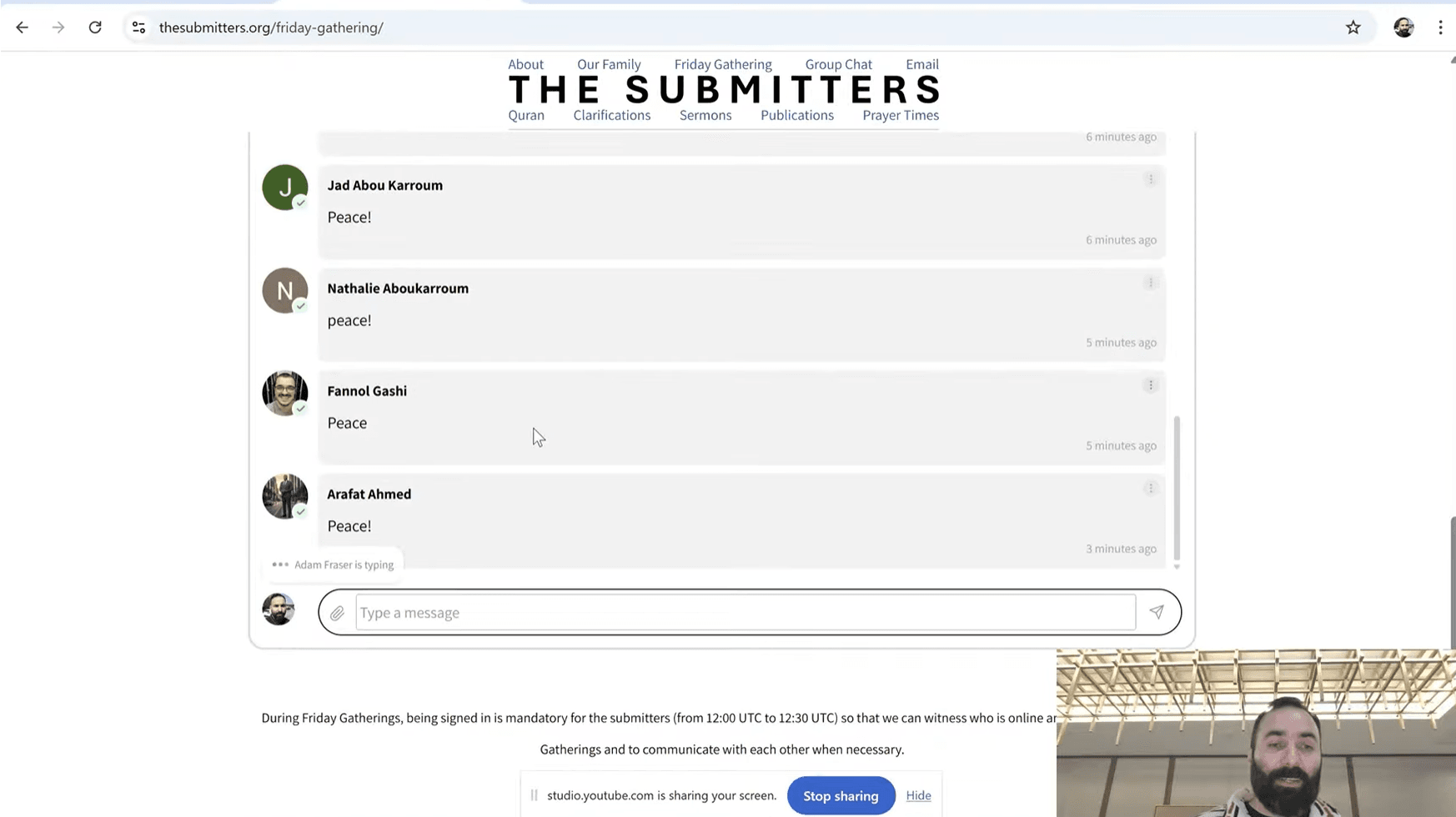
 

For more information:

When is the Night of Destiny?

What does the Quran Really Say About Hadith?

Quran: All You Need for Salvation

Join us to listen to our online Friday meetings every Friday.

The Submitters’ New Group Chat


Sermon Introduction

Praise be to God. There is no other God except God.

Today I would like to introduce the new chatting feature which we have added in our website : thesubmitters.org. Some of you might have already noticed it, others might not have noticed it yet. So I am just going to share the screen and tell you what’s new on in our website. So let me share the screen :

So this is our new chatting feature. It’s below the Friday Sermon. If you guys are watching the video, all you have to do is scroll down and here it says “Sign in with Google.”

By the way, let me just read what I wrote here. It says:

  “During Friday gatherings, being signed in is mandatory for the submitters (from 12:00 UTC until 12:30 UTC) so that we can witness who is online and attending the Friday gatherings and to communicate with each other when necessary.”

This is important so that you guys know among each other who is attending the Friday gatherings, and also so that I know who is watching. It’s important so that we know who is a Submitter. It’s not that we are trying to spy on one another, but we want to know who is a submitter and who is not. We know that doing the Friday gathering is obligatory for submitters and it is done in public. So we should be able to know who is doing it like us and who is not doing it like us.

So for those who haven’t signed yet, if you just go here to “Sign in with Google” it is going to ask you to choose an account:

By the way, we don’t have access to your Google accounts, so this is totally under Google’s control. We don’t have access to it. So when you sign in with Google, Google does not send us any information except your name, which is shown in the website, and your photo, which is taken from Google. But that is a standard signing procedure for most of the apps, it’s not different from other apps.

I kind of like the way it came out. It is a very simple app, but it has some unique features which I think are useful for the Submitters.

Guidelines for Chatting During the Gathering

One good thing about this is that you can both watch the video and see who is online at the same time. Plus, we can chat when necessary online. By the way, you should not chat during the Friday gathering unless the Congregation Director asks you specifically or in general, you should not do that because it distracts the viewers, the listeners.

So this chatting app is useful for outside of the Friday Sermon. You can talk at any time. But during the Friday Gathering, you can talk only if you are asked or if absolutely necessary. So unless you have something absolutely necessary to say or I ask you to say something, then there is no need to say anything during the Friday Gathering because during the Friday Gathering we’re supposed to pay attention to what is being said in the video.

I want to use the opportunity to mention the names because if people are embarrassed to be public about the fact that they are Submitters, I think they should not be Submitters.

So who do we have here right now online?

We have Sinan Abal, Adam Fraser—sorry for mispronouncing the names—Adnane Tidghi, Luna Thabet, Habiba Abdullahi, Seymur İsmayılov, Jad Abou karroum, Munira Sultana, Faisal Ayache, Nathalie Abou karroum,

Elhame Gashi, Matvej Loptev, Nikki Chavis, Başak Urhan, Mhamed Ait Lmaalem, Taliye Alan, Merazul Alam, Fannol Gashi, Gillaume Guy, Arafat Ahmed, Christopher Summers.

Sow Mamadou Oury, Marzia Sultana, Abdul Rasheed Ahmed, Shkronja Berisha, Fatih Alan, Gurgin Tehtap, Trevor Chavis, Ahmed Isa Hassan, Mehdi Akouche,

Fleta Berisha, Kevser Alan, Avdyl Berisha, Alban Fejza, Moneruzzaman Sikdar, Lavdije Berisha, Robert Szilagyi, Arjeta Fejza, Muhammad Rakibul Hasan,

Ruksana Yeasmin, Vlora Fejza, Abdul Hayat Piash, Arlind Fejza, Rayan—I don’t know the last name of this person—Habiba Abdullahi, and Nahida Mili.

So these are the names which are online right now. As we know, there is more Submitters. So others will eventually learn how to do this and they will do it in the next time.

For some of you, if you have signed already, it might show you the older version before the Friday Sermon. God willing, if you have any problems, you can contact Fannol and see how to fix that.

Group Transparency vs. Private Meetings

I want to focus on why is this chatting app different from a typical chatting app. It is different because, first of all, it’s a group chat, so if someone has to say something, it has to be fully transparent.

When I used to work in my previous jobs (most of them in Kosovo), quite often people would have informal meetings over coffee, and then someone would tell someone something and they would actually reach an agreement about what to do at work, and no one else would know. And then I would be surprised : “Oh, you guys reached an agreement already? Like, I was not in the meeting.” They say : “Oh, we spoke about it over coffee.” And that’s actually not the way Submitters do things. For example : we have done a lot of work with Fannol, but that was the only option we had. We had a lot of discussions which were just personal, just me and him. It would be much better if everyone knew. In this way, they would know how much work was put into this chatting app. They would know what the problems were. They would see if there’s something they can help with.

So this chatting app is different because it’s a group chat, so everyone sees everyone’s chat. That’s important, because sometimes people will say something else if it’s sending a message to only one person. But if it’s public, they will probably be more careful about it. So that’s one difference in this chatting app.

The Deletion Feature and Guarding Against Satan

The other difference is that unlike most of the chatting apps, this chatting app allows every Submitter to delete everyone’s message. So right now, even if I don’t like a message, I can just delete it, not just me, everyone. Every Submitter can delete a message.

And why is this important?

This is important to keep the peace within the community.

Let me just give you an example because there’s a verse in the Quran which says try to be with each other the nicest possible because Satan will always try to drive a wedge between you. Satan is always trying to make us fight each other. And one way to prevent that fighting is if we allow everyone to delete the message if he does not like it.

And because you can post here photos as well, let me just give you an example : Let’s say a woman has a new child, and she wants to show the group : “Oh, alhamdulillah, thanks to God, me and my husband have been blessed with a new child. We named the child like this name.” But in the photo, she is kind of not dressed very well. Yeah, it’s a good message in general that she’s telling everyone that there is a new submitter among us. That’s a good message, but the photo might not be very modest. In that case, instead of us telling her : “Oh, you have to change the photo, we don’t agree with this” anyone can just delete it. If you don’t agree with it, just delete it.

Now the question is : What if we delete all the messages? So what?

 It’s okay. We don’t write any message, it’s still fine. God willing, in the future I might change my mind, I might make it so that two submitters have to delete it so that the message can be deleted. But for now, I want to try it like this, and if it works, I will just leave it like this.

Let’s say someone says something which is partly right, partly wrong. Instead of arguing and saying : “Oh, by the way, you’re wrong about this, you’re wrong about that, I have a different opinion,…” In this way, only the positive messages remain. And when only the positive messages remain, there’s less chance for Satan to drive a wedge between us, to kind of make us hate each other. If you don’t like it, just delete it, and it’s not a problem, even my messages.

Only the submitters can delete messages. The non-submitters cannot delete messages : They can delete their own messages but not someone else’s messages.

So let’s say if I go here in any place, I can just delete it.

By the way, every submitter can also block a non-submitter, but not a submitter :

For example : Fannol here has signed it, with a non-submitter email at this «Fannol Public». I can block this account for example. So basically if an outsider comes and says something bad, and we think he had really clear bad intentions to fight our group or to hate our group, then we can just block that person.

So we cannot block submitters. No submitter can be blocked. I cannot even block a submitter, so you have a guarantee that you will not be blocked. However, anyone can delete your message if they don’t like it. And this goes in line with the idea in the Quran which says that submitters reach agreements with consensus. So everyone has to agree. If one person does not agree about the message, they can just delete it.

For example : someone might post a vacation photo which might be fine for most people. But maybe someone lives in a poor country, he thinks that’s bragging, that’s too much. They can just delete it. If they don’t like it, they can delete it. At the same time, no hard feelings. Someone can try and post it and see if it’s deleted, fine. If it’s not, it’s kind of like a way to see if other people are liking what you’re posting. So yeah, you can delete anyone’s message, and please, if you think it should be deleted, delete it, don’t think twice. If you think : “Okay, I don’t like this”, just delete it.

And why is this important again ? This is important for the peace in our group. Let’s say that someone’s message is correct, but it’s not full. So let’s say that someone says : «it’s not Ramadan which brings us closer to God, but it’s fasting». Which is true. It’s not complete, but it’s true. There’s more to it in the Quran, but it’s true if you say that : «It’s fasting, not Ramadan, which brings us closer to God». That is true. However, it’s not the complete truth. There’s some more to it.

What’s more to it is that during Ramadan, the Quran says those who witness the month : they fast. It’s the fasting which brings them closer to God, not just the fact that it is Ramadan. So that’s a more complete truth, it’s totally true but there is more to it, and someone might notice the part which is missing and they mention only the other statement which would complete it. Then they post just a verse to complete that statement.

What Satan can do here (even though both of them are correct), is make one submitter pay attention to one part of the truth, the other submitter to the other part of the truth, and then in this way, if they couldn’t delete the messages, they might start to have an ego discussion : “Oh no, you’re wrong. He’s wrong.” Especially as if other people are involved there is some ego there. The easier option is : if it bothers you, just delete it. So this app enables it, you just delete it, so there is no argument. If there is something you don’t like about the message, just delete it.

Submitter Verification and Zakat

So another feature in this app is that you can tell who is a submitter and who is not a submitter by this tick mark.

So if you have this tick mark, that means you are a submitter. If you don’t have this tick mark, that means you are not a submitter.

(By the way, Seymur İsmayılov, I think he has actually asked us to be a submitter. We haven’t enabled him to fill the zakat yet. There is a verse in the Quran which mentions those whose hearts have been inclined, meaning those who in their heart, they are submitters, but they haven’t officially joined us. Rashad translated this as converts. Because there’s different levels of people. There’s non-submitters, there’s people who are exploring, there’s people who think that maybe this is true, but then there’s people who have decided to join, but they haven’t gotten a chance yet, we didn’t let them report the zakat yet.)

And this is pretty much it. It’s a simple app.

Let’s repent.

Community Testing and Support Feedback

Praise be to God. There’s no other god except God.

Maybe we can just test the app now. So I am asking you to chat and see how it works. By the way, all the chats disappear in seven days, so you don’t have to be embarrassed whether you’ll post something and it’s going to stay there. It’s just going to be deleted in seven days. But this video is public, just so you know, this video is public. So maybe we can just test it and see. A lot of people are writing. I want to test deleting a message.d

    • Faisal is writing in the chat : «I want to test deleting this message.»
  • (The message was successfully deleted)
  • Matvej Loptev writes in the chat : « Hello! »
    • Faisal writes in the chat : «hi»
  • Alban says : «Maybe I don’t like this message, I can just delete it. There we go. » (Alban deletes the message successfully)

Let me give you an example of how this can be useful : So in the last Friday gathering, I introduced The New Call to the Friday Gathering online, and I said that anyone can do it and it’s better if anyone who can should do it and post it online.

  • Is anyone willing to share where they posted the call to the Friday gathering?
  • In which social media, what form?
  • Was it a Facebook story or a Facebook post? 
  • And how many people they think saw it? (Can be an estimate)
  • Merazul Alam is saying : “I posted the photo to Facebook post, 1 people liked it.” 
  • Guillaume posted it on Instagram at The Submitters.
  • Abdul Rasheed made the call to the Friday gathering on WhatsApp.
  • Arafat made it on WhatsApp status and Facebook stories.

I think Facebook stories is useful for this, like it’s probably the right place to do it.

By the way, those who are not submitters yet, who have asked to join, God willing, we’ll enable you to join at least by the end of the year, if not earlier.

(A lot of people from Turkey have joined us recently, so I see some messages from Turkey)

And one more thing, the non-submitters are supposed not to be able to message during the Friday Gathering. They cannot message because we don’t want them to interrupt us.

    • Tasim Ali is saying, “Praise be to God.”
    • Gurgin is showing us like what he posted.
  • Trevor Chavis is saying : “I’m seeing people that don’t have the check mark but are submitters on the website.”

I can see a potential problem. The way the website knows if you’re a submitter or not is the email with which you filled the Zakat. If that email matches, then it considers you a submitter. If the email address doesn’t match, then it doesn’t consider you a submitter. So if someone is signed in with another email, it’s not going to know that you’re a submitter. So that’s probably the problem.

So let me check a name, for example : So Captain Md Nuruzzaman Sikdar is not recognized as a submitter here, but we know heis a submitter. He even came to Hajj with us. Captain, probably this doesn’t recognize you as a submitter because you have signed in with another email.

Taskin and Nuruzzaman. They are submitters, but if they have two Gmail accounts, please sign in with the one which we know, the official email with which you have joined as a submitter, because otherwise the website cannot know if you’re a submitter or not. I hope that answers the question.

Okay, just a few more messages and I’m going to end this stream, God willing.

  • Jad Abou Karroum is saying : “God is great.” 
    • Alban says : «Yes, God is great, Jad.»

By the way, this brings me back to the idea of The Call to the Friday Gathering, which is in English. Some people like it because I have many different styles of it. Some people might like some of them, maybe not others. Some of them are cheesy, I know it. But I just wanted to capture many different versions of what people like. A lot of them I don’t even like myself, like the music style, but it’s okay. People like different styles of music.

  • Erblina is saying : “Peace. After some time, my status becomes offline, but I’m still online, though.”
    • Alban says : « Okay, we need to double check why that is happening. »
  • Faisal is saying : «this chat is available outside of the friday gathering ?»
    • Alban says : «Good question Faisal. This chat is available outside of the Friday Gathering. If you go the Group Chat here in our website, you can still chat within the same app. The only difference there is that you don’t see this video, but you still see the chatting app and you can chat at any time.»
  • Trevor is saying : “[20:14] ‘I am God. There’s no other god beside me. You shall worship me alone and observe the contact prayers to remember me.’”
    • Alban says : « Okay, great point, Trevor.»

Okay guys, I just see that people are typing, that’s why I’m waiting, but I think we should finish it soon.

  • Rakiba Khanom is saying : “Peace be upon you.”
  • Katy Brahim is saying : “God is great.” 

Okay, I don’t want to waste too much time for all the rest of the people. I’m going to end it here. Let me stop sharing.

So that’s it. I hope you guys like the chatting app. You can use it outside the Friday Sermon as well, outside the Friday Gatherings for anything. Even if you have questions for me, please just post it there. If I don’t like the question, I’m just going to delete it, or someone else can delete it, whoever wants can delete it.

In this way, if someone can answer the question for you without me having to be involved, that would be even better. Whoever sees it first and knows the answer, they can answer, or we can have discussions even. You can post about let’s say where you went to vacation last week or things like that.

The most Important Rule on Social Media

This is most important rule. This is the principle on how to use social media. If you are going to post photos for any social media (not just this Group Chat), think about it: 

  • Is this in a private space?
  • Why would you put a private space in public? 
  • What do I mean by private space?

Let’s start with the worst. A lot of girls these days, but even boys, will go and take a picture in the bathroom, even with clothes, and kind of like make a duck face or whatever in the bathroom mirror. Anyone can see that it is a bathroom. 

It’s a bathroom! That’s a private space. Why would you put the private space in your life into a public space?

So don’t mix private and public. Bathrooms are private. Even the bedroom is private. Even the living room is private. So don’t post something : “Oh guys, I want to share how lovely my family is” but you have a photo of you in your living room. So try to post only public spaces. We don’t want to know what your home inside looks like. You can post it from outside, like you can take a picture outside of your home from the outside.

Maybe you want to show your car, (some people like to brag). That’s public, but at least it’s within the rules. But do not post private photos in private spaces in public. And this is for any social media, (not just this Group Chat), any social media.

We should learn how to separate public versus private. What’s inside a home is private. God designed it so that others do not see it. So don’t post the living room, your bedroom, your bathroom, even your kitchen, unless there is an angle where you cannot tell what it is, that’s different. But always try to post only public things in a public internet space. That is the most important rule : I don’t care what your living room looks like. I don’t want to see it.

It’s different if you just send a message to a friend who has been to your home, or to just one person, or a brother or a sister, because it’s already kind of a private conversation, that’s different. This group Chat is a public space. Most social media are public. Don’t post private spaces into a public online space. This is probably the most important rule, and this fixes lots of issues.

You can take a photo while walking in the street, that’s fine, you can post it. But why would you post it from a private space?

The inside of cars are semi-private because the Quran says God has designed homes which move. So the car is partly private, partly public. So there is a gray area. I wouldn’t make a rule about it. If you post a picture from inside the car, that’s semi-private, partly private but also partly public. In that case, that’s the great feature, is that we can delete it. If someone thinks it’s a little bit too private, they can just delete it. If someone thinks : “Oh, this is fine for me”, they don’t delete it. So that’s it.

For those who have to do the contact prayer, do the contact prayer. Peace be upon you.


Friday Sermon by: Alban Fejza, Online Congregation Director
The Call to the Friday Gathering


Sermon Introduction

Praise be to God, there is no other god except God.

As you guys saw this sort of Adhan or Friday sermon intro, let me just tell the story about it. It’s mainly compiled of footage which we did from Hajj as some of you might have noticed. Some of us took some footage from Hajj. And I think it came out nicely, and the background music is taken from one of the movies which Rashad used as well.

I want to focus on today is because the words which are there are :

Allahu Akbar

Allahu Akbar

Allahu Akbar

Allahu Akbar

La Ilaha Illa Allah

So I want to focus on what is known as Adhan, which from now on I’m going to call it in English :The call to the Friday Gathering. And the reason for this is because I have what turns out to be good news. Because what you just heard here online was actually not the Adhan, it was just an intro video which I used to buy some time for the people who have technical difficulties to watch us live.

And the actual Adhan, or let’s call it in English : The Call to the Friday Gathering was actually done when you received the email from me. As you, the submitters, know that you received an email which said :

God is Great !

God is Great !

God is Great !

God is Great !

There is no other god except God.

That was the actual Call to the Friday Gathering.

What I showed here is just an intro to buy us some time. And God willing, during every Friday gathering I will have a slightly different one. And hopefully, this will motivate the people to join in time so that they can see the different intro. It’s going to be the same footage, or similar footage, but it’s going to have a different music every time. Same words, but kind of different music just to make it more festive. I did it with AI, so it wasn’t that much work. It’s not really my work, it’s AI work.

Understanding the Call to Prayer in the Quran

I want to focus now on the actual topic of this Friday Sermon. The actual topic is : 

  • What is actually the call to the Friday prayer?
  • How do we do the Call to the Friday Gathering online? 

The intro that you saw was not The Call to the Friday Gathering. It was the one which you received in the email.

How can we reach that conclusion? This is the key verse for it :

[62:9] “…Oh you who believe. When the call is made for the prayer on the day of Friday, then hasten to the remembrance (or the mentioning of God) and leave (the) business. That is better for you if you know.”

Now the key word in this verse which I want to focus on is the word “call”. Here in the Arabic Quran, it’s not actually using the word Adhan. And when you look in the whole Quran, you do not see the word Adhan at all mentioned for calls to prayer. It is not mentioned at all. Here the word «nudiya» is mentioned. So this word, which means call, is mentioned in another verse where it’s talking about how the disbelievers laugh at the call to prayer, but even there the word Adhan is not used. It’s the word «nudiya» which is used. You do not see the word Adhan used for the call to prayer at all in the Quran. What we see is this word being mentioned, which is «nudiya».

  • Then why did God leave it for thousands of years for people to call it Adhan in Arabic ? (which is translated as the call or the announcement to prayer)
  • Why did God leave the people use a word which is not even in the Quran for their call to prayer ?

That is because the word nudiya : “call”, is bigger than the word Adhan, it includes the word Adhan. I am not saying that the way people have done it traditionally is wrong (the way Rashad taught us : « Allahu Akbar,… ») .I am not saying that is wrong. All I am saying is that there is more to it, meaning the word nudiya  does not include just that version, it includes other versions as well.

And what do I mean by this ? Let me give an example : 

Let’s say that the Quran tells us to wear upper body clothes (it kind of says it anyway). And then imagine in the time of Muhammad that he is telling them : “Wear a shirt.” A shirt is upper body clothes for a warm weather. But in today’s world, someone in a colder weather might say : “Wear a jacket.”  Or “Wear a sweater.” That’s also upper body clothes. So as you can see, the word “upper body clothes” includes both the shirt and the jacket. In the same way, the word nudiya  here includes both the Adhan and what I’m going to call it in English : The Call to the Friday gathering.

And here, probably it’s important to specify something more : The Adhan, as we know, is the call to the « Salat », to the contact prayer. They’ve translated it here as prayer in this context, but actually, as we know, this word actually means connection. And it’s on purpose like that. It means connection with God. So there is another context as well.

Let me be clear, I’m not denying what we know so far. All I’m saying is that there is more knowledge which is included in the Quran compared to what we have known before. So I want to draw the attention to the fact that the word “prayer”, which here it has been translated as prayer, in Arabic it literally to connect. And here in this verse, we can understand the word “connect” in two ways: One way is to connect with God. But it’s also talking on the day of Friday, and jumaa’ in Arabic means gathering, when people gather ; So to connect on the day when people gather. 

What does it mean? 

The word « nudiya » also means to connect with people.

So, in this verse, the word connection is about connecting with God, but also about connecting with people. In our case, because we are doing it online, we have connected with each other. Basically, I am live streaming, and God willing we will add the chat function in the future. So basically, The verse is telling us to connect. It is not specifying what kind of connection. We definitely know that it’s connection with God when we do the contact prayer, but here it is talking about connecting on the day when people gather, so it must be also some sort of other connection, to connect with other people, to connect with God together with other people.

A Human-Made Decision Across History

So, given this additional meaning of the word « salat » in the Quran, then when we talk about the call to connection, it specifically means two things : First meaning is the Adhan which we know traditionally, and the other meaning is The Call to the Friday Gathering, which specifically has to do with the connection online. I think I have explained it partly (Can We Do Friday Sermons Online ?), and God willing I will explain again in future videos that Friday gatherings or Friday sermons are okay to be done online in specific circumstances, which are our circumstances.

It is on purpose that the word Adhan is not mentioned. Because if God used the word Adhan, we would have to assume that it is the traditional Adhan in the way it was done, which was in Arabic : « Allahu Akbar,… » and they do it in the mosques to this day. And by the way, if we have a local mosque, we should do it like that as well in Arabic. But we here we are talking about online, and the question is: 

  • Why did I take the liberty to do it English online? 
  • Who gave me the right to do it in English when we are doing it online? 

No one had to give me the liberty.

The reason is that the Adhan which Muhammad did, which also Rashad did, if we analyze it carefully, it’s actually a human decision. So it’s not that God said : “This should be the Adhan.” God told us about about Nudya, which is the call to prayer, which one version of it is the Adhan, but that version is a human-made decision. Let me go back again to to the same example : If God told us to wear upper body clothes, it is a human decision whether they wear a t-shirt and what type of t-shirt, or whether they will wear a jacket and how thick that jacket will have to be. It is a human decision.

And how do we know that it’s a human decision?

First of all, studying the Quran : If God wanted specifically to tell us that these words are the words of the Adhan, God would tell us, but he did not. And he did not because God knew that people will reach the correct decision about this, a specific decision for every time. During Muhammad’s time, they reached a specific decision and it was correct; it was correct for them in that specific place and time, in those specific circumstances, they reached the human decision. And by the way, if any Sunnis or Shia might think that I am changing something, I just want to remind them that even according to their hadith, this is how Adhan came to be. Their hadith proves that it was a human decision.

Before I tell the story of that Hadith, let me just say that the word nudya, which is the fifth word in 62:9, it actually includes even the human decisions which existed in the past. But of course, here it is talking about the Friday prayer. they did not do the gathering on Friday, they did it on Saturday before Muhammad. It includes even those because it is a human decision.

In the past, during the time of David, it was a human decision, they decided that they are going to use the horn to call the people to the congregational gathering. Then it was Saturday. And then the Christians, after Jesus, use the bell. What I am saying is that even those are legitimate as long as people agree that that is the correct thing to do, as long as they agree and it is a correct decision. It was correct for the time and place. And Muhammad never actually sort of said that they are wrong,  he never said : “Oh, if you call the people with a horn or if you call the people with a with a bell like they do it in the churches that is wrong”  He never said that it is wrong.

What Muhammad said, according to the Sunni hadith and the Shia hadith, is that he wanted to have it different, not that it was wrong. He just wanted a different version so that people can distinguish whether they are being called to a church, to a synagogue, or to a mosque, which shows that he was aware that it’s a human decision. He just wanted to have it different so that people know where they are being called now. So what I’m saying is this : The word nudya includes even the horns and the bells which the church has used (for the past of course) and the Adhan, the traditional Arabic Adhan for circumstances outside of online, but it also includes this word also includes what I have sent in the email earlier. It also includes that because God left it up to us to make a human decision. It does not have to be revealed by God whether we want to wear a t-shirt or whether we want to wear a jacket, God told us : “Wear upper body clothes” . Let’s say that is just an example.

So let me go back now to the hadith which the Sunnis and Shia use. By the way, we do not believe in hadith, we do not rely on them as a source of religion, we know that. However, the Sunnis might say : “Oh, you guys changed it online.” If they say we changed it, we tell them that their hadith, the Sunni hadith and the Shia hadith according to them, tells us about how the Adhan came to be like this. So Muhammad one day wanted to come up with a way to call people to prayer, but he did not want to mix it up with the bells which the churches use or the horns which the Jews use, so he wanted to have a different version, which shows that he was aware that it is a human decision and while he was discussing it with the believers, according to their hadith, a person from the group came, and he said : “I saw in a dream that someone was just saying aloud…  [the Adhan]…, and Muhammad said : “Oh, that’s a good idea, we should do that.” So basically, Adhan was not revealed by God to Muhammad. Adhan is a human decision which Muhammad made for that time in their circumstances. And the idea came in a dream to another person, it was not even Muhammad. And God did it like this so that we can have the liberty to do it in our way, not thinking that we are going against Muhammad, because it was not never revealed to Muhammad, it was never Muhammad’s idea, it was someone else’s idea. Anyone can go and search online how the Adhan came to be, and you can see that someone else proposed it by saying that : “Oh, I saw it in a dream,” and then Muhammad Muhammad liked it and he said : “Oh, let’s do it like that.”

Preserving Unity and Language Online

So they made a human decision how the nudiya, the call to prayer which is mentioned in the Quran, how the nudiya will be executed in Muhammad’s circumstances in the Arabic world in the seventh century. And that is what they called Adhan. We don’t need to call it Adhan. That is the Adhan, the Arabic one which was done in that specific form. But here in the Quran, there is more than that.

So then when Rashad came, he made again a human decision that we should still do the Adhan the same way in circumstances within mosques even in places where people don’t speak Arabic : (US, Canada, Europe,…) . Rashad thought that it’s a good idea if we still do it in Arabic so that we can keep the unity. If we today have a mosque, I would still do it in Arabic. And the purpose and the reason is not because that’s how God revealed it, but because I don’t want to break the unity, that’s how people have done it. 

First of all, there’s a verse in the Quran which says that the believers are united. So if you change it, you are kind of causing disunity. And second of all, there’s a verse in the Quran which says : “Do not betray those who trust you,” we should not betray those who trust us.  Rashad trusted that we will do it in Arabic in a mosque, but he never did it online. So what I’m saying is I do not want to go against the verses which tell us to not break the unity, to be united, and to not betray each other. I do not want to go against that verse. That’s why I still believe that’s how it should be done in mosques. It is not God’s decision, it is a human-made decision, but we respect it. I respect there is nothing wrong with the way Adhan was done during the time of Muhammad, the way Muhammad approved it. There’s nothing wrong with it for that circumstance. There is nothing wrong to do it still in Arabic in a mosque outside of the Arabic world.

But because we are in a circumstance which has never happened before, I would not cause disunity if we decide to do it the way we do it. I know it’s a human decision, just like during Muhammad’s time it was a human decision, just like during Rashad’s time it was a human decision. In our time, because it has never been done online. People publish it online, but they don’t believe in the online Friday Gathering, so it has never been done online.

That means that we get to decide, we have the privilege, we are the lucky ones. God gave us the opportunity to decide how the Adhan should be for the online circumstances. And for the online circumstances, I am deciding. It’s a human decision, but it’s binding, because why would you break the unity? By the way, I am not breaking the unity with the traditional Adhan because this is a totally different circumstance. I still want to do it the way they have done it in mosques. Let them do it in Saudi Arabia. But online they have never done it.  So that means that God gives us the privilege or the chance or the opportunity to decide how the Adhan should be so as long as it is within this nudiya idea, the call to prayer, in a similar way that God gave us the opportunity to decide what type of clothes we want to wear as long as they are within the Quran. 

The reason why I want to do it in English is because there is a verse in the Quran saying that all the messengers are sent in the language of the people, and the language online is English. So from now on, the Arabs are going to have to get used to the online idea of doing it in English, just like the rest of the world was used to the traditional idea of doing it in Arabic. So from now, we are going to do the call to connect for the Friday gathering in English. I am not talking about in mosques, I am talking about online.

The Online Call to Friday Gathering

Why did I decide on those specific words?

Because those specific words are here where it says : “When the call is made for prayer, hasten to the mentioning of God”. So basically, I wanted a call to prayer where God is mentioned, and when we say : “God is Great ! God is Great ! God is Great ! God is Great !”  God is mentioned, so we Are fulfilling that commandment. And then we’re specifying which God: “There’s no other god except God.” So basically, that’s going to be the call to prayer in English now online. Now because online, people don’t hear it unless they go online already. They probably read it first, so it is going to be a written version.

God gives us the liberty to decide about this on our own. I am deciding for us because I happen to be the leader for our group. So as a human being, I am deciding that for our circumstances, the Adhan online, only online, is:

God is Great !

God is Great !

God is Great !

God is Great !

There is no other god except God.

Live Friday Gathering within minutes at :

TheSubmitters.org

Let’s not call it Adhan anymore, because Adhan is that specific Arabic version. Here I’m talking about the English version, which is still within what the Quran says, it’s still that word, the call, nudiya. And it’s easy also to remember, we know the words, so it’s: « God is great, God is Great ! God is Great ! God is Great ! There is no other god except God ». And then every person can add in their own way where the person can connect. Here I said : “Live Friday gathering within minutes at TheSubmitters.org.” In the future, these specific words might be different.

Why did I say “within minutes” ?

  • We are fulfilling the verse in the Quran which says the minimum unit of time is the hour. So the Quran doesn’t mention minutes or seconds, that means that as long as we do it within that hour when the time for the gathering is, as long as we do it within that hour, it’s specific enough.
  • You can send this Adhan 10 to 40 minutes ahead of time, and it is still within that unit of time which the Quran mentions. So basically, it’s specific enough. Some people might have to wait a little bit, but as long as it is within that hour, then it’s specific enough, and that’s why I said : “within minutes,”  because minutes are within an hour, so it has to be within an hour.

It is a human decision, but that is what I am deciding. The call to the prayer for our circumstances online should be :  « God is Great ! God is Great ! God is Great ! God is Great ! there is no other god except God ». And everyone can decide how they put the link there, you can decide on your own.

Let’s repent first.

Utilizing Social Media for Promotion

Praise be to God, there is no other god except God.

So we just included what the call to the Friday gathering should be for live online circumstances, which is our circumstance. We also came up with a photo version which can be posted on social media.

Let me share the photo version :

It is with a darker background. The reason is so that it can stand out a little bit more when you post it on social media. Again, it says : “God is great ! God is great ! God is great ! God is great ! there’s no other god except God.” And my words are : “Live Friday gathering within minutes at the submitters.org.” 

Why is this still within the Quran and kind of like is confirmed that it is within the Quran?

I am not saying that this is what the Quran tells us to do. What I am saying is that the Quran gives us the freedom to do things like this, and all of this is within the Quran. There’s a verse in the Quran which says : « Force yourself to be with those who call God ». And here, we are calling God. This is the best way to call people to us. We do not go there and say : “Oh, can you please join for the Friday sermon? Can you please  guys join in this group ?”  That is almost like begging. You know what they do, half-submitters and traditional religious people, they will go online and they will call people : “Oh, can you please join us?”  That is actually a sign that you should not join them, because God tells us : “Join those who call on God,” not who call you. So here, we are calling God. We are not necessarily calling people, we are calling God. We are saying : “God is great ! God is great ! God is great ! God is great ! there is no other god except God.”  And then there is a verse in the Quran which says to the believers : “Go after those who call God.” So this call to the Friday Gathering is within that verse, it confirms that verse.

And then the other reason why we should do it like this is because there’s another verse in the Quran which says : « If you support God, God will support you ». So basically, we should not go there and call people : “Oh, come here, let’s do this, let’s do that.” The verse says you support God. We support God, God supports us. So this is the best way to promote the message, to have more people join us in the cause of God. The best way is to support God, and then God will support us, God will let other people join us. This is the best way.

This solves one of the most long-standing problems which we’ve had as a community. We have talked about this a lot, especially with people who had marketing backgrounds about what is the best way to promote the message. And finally, I think we have found most of the answer. As you guys know, we have tried many methods, I compiled an email, we tried Facebook ads, we have tried many different things. And finally, I think this is the answer. This is the answer to how we should promote the message, and it is simple. It has been all along in the Quran. All we have to do is saying in front of others : “God is Great ! God is Great ! God is Great ! God is Great ! There is no other god except God.”

And because it’s online, we tell them where the link is. In this case, I’m saying : “Live Gathering within minutes at TheSubmitters.org.” By the way, the reason why they did not add this part in the past (they actually added it in certain circumstances) but the reason why they did not add it because they would call it from the mosque, everyone would know where the sound is coming from, so they would go there. Here they would not know where the message is coming from, they have to know where the message is coming from, where they can join, so we had to add that.

And again, this is a human decision just like in the past it was a human decision. There is historical sources which say that Muhammad, when it was raining, he would say : « Allahu Akbar, … » and then he would say : “Pray in your homes.”  He would add that because the circumstances were different in that day. Let’s say it was raining too much, he didn’t want people to get all muddy, so he told them : “Pray in your homes” at the end. And in the same way, we are adding this because it is a necessary information where to join us. Today we are doing it in this website, which I do not think we will ever change it God willing. But if we ever change it, that link is going to be something else, some other information. But the actual Call to the Friday Gathering is : « God is Great ! God is Great ! God is Great ! God is Great ! there’s no other god except God ».  This solves one of our biggest problems because we could not figure out how to promote the message to other people. We just could not come up with the best way to promote the message, to call the people to God’s cause, and finally I think this answers most of it. It solves one of the biggest problems we’ve had as a community.

The Role of the Community

  • What is your role in this?
  • Who is supposed to do the Call to the Friday Gathering ?

The answer to this is similar to the Funeral Prayer. Both the funeral prayer and the call to the Friday gathering, are mentioned in the Quran but not as an individual obligation. They are mentioned that they exist. For example the Quran says : “Do not do the funeral prayer for the disbelievers, for those who were believers once and now they are disbelievers, do not do the funeral prayer for them.” That is what the Quran says.

It is not giving a rule that every individual should do the funeral prayer, but it is mentioning it. The fact that the Quran is mentioning it assumes that at least someone is doing it. So basically, the rules of the funeral prayer are that at least someone in the community should do it. It could be one person, but more people is better. As long as one person does it, the obligation is fulfilled, but if more people do it, it is better. In the same way with the Call to the Friday Gathering : If one person does it, the obligation is fulfilled, but more is better. If other people do it as well, it is better.

And in the traditional circumstances, that is why many mosques have many minarets. If you go to so many mosques in the Middle East, you will see that some mosques, the big ones, have more than one minaret. Some of them have six minarets. Minarets are the places where they make the call to prayer. So why six minarets? The reason is that they understood that more than one person can do the call to prayer. When someone does the call to prayer, some other people don’t hear him, then another person does the call to prayer. This is even according to historical sources : Muhammad would tell someone to do the call to prayer, and if others did not hear it, someone else who heard that first person then would call the others. So it’s a way to call the people to the Friday Gathering.

Now in this case, I wrote it once and the computer sent it automatically, but God willing, it is going to be sent automatically by the computer. Once you received that call, let’s say you are on Facebook at that time or some other social media : Did the people to whom you are talking or socializing with hear the call? No, you heard it, they did not hear it. So in that case, the best thing you can actually do is to make that same call to other people, on Facebook, or Instagram, or other social media, or even direct messages.

Especially the ones where you can delete it later, because this is a call for a specific time. We are calling God, but indirectly the people are supposed to join at a specific time, which in our case is 12:00 UTC. It does not have to always be like this, but in our case, it is at 12:00 UTC. So it is for a specific time that we are calling them, let’s say 20-30 minutes ahead of time, so that they can see the message or the post. This is actually most suitable for social media, not emails, because emails you cannot delete them later. If you call them at a specific time and they see it later, what are they going to do? It is not very useful.

But it is very useful if you post it on social media, God willing. This is the best way you can help. You do not have to try with old methods we have done, or that others have done, or traditional Muslims and Christians do. God willing, you will see this will work the best. That is all we have to do.  You decide based on how fast people see the messages on social media : You decide whether it’s going to be 10 -40 minutes ahead of time, or 5 minutes if it is a direct message, etc.

  • You take those words.
  • You copy-paste them from the email.
  • You post them where you want to post them.

Just post that, and you don’t have to engage. If they say : “What is this?”  you do not have to engage, because now we are doing the Friday sermon. You do not have to engage with them. When the Friday sermon is finished, you go and delete it, because it is not applicable anymore. Next Friday, you can do the same thing, call them again. In this way, they do not get bored as much, in the sense that the post is not going to stay there all the time. So this is how you can help.

So God willing, from now on, the way I am going to do the call to the Friday Gathering online is through an email with those words. That is the call to prayer, that is the call which is mentioned in the Quran. But because most people who are communicating with you do not hear it, it would be best if you share it. It’s not an obligation, because as long as one does it, it’s done, but it would be better just like in the funeral prayer. It is better if more people do it within practical reason. I would say it is actually an obligation within practical reason, meaning : Do it if it makes sense. In most cases, it makes sense.

Let’s say you know the Friday prayer is going to be 20-30 minutes later, if you have some time and you’re out of work and you receive the email, you copy-paste the message and post it on social media. You can post it as a photo or as text depending on the social media. In this way even the non-submitters can join and check what the message is.

The additional reason why this method is good is because you can also post it in groups of other religious groups. You can post this message at a specific time. The reason why this method is so good is because the administrators or leaders of those groups do not have time to delete it so quickly. So within minutes, some people might join and listen. And then after that, you delete it. The leader might not even see it. It’s fine; if two or three people see it, you’ve done a good job. It is okay as long as you do it.

Now, not everyone uses social media, and that’s okay. What I’m saying is within reason. Whatever social media you use, if you use it, why not use it to call God, which indirectly calls people to the cause of God?

I hope I did not forget something about this. It is quite an important Friday Sermon because I think it is going to resolve a lot of issues.

For those who have to do the contact prayer, you can do the contact prayer at this time if it is the due time. For the rest of you, peace be upon you, peace.


Friday Sermon by: Alban Fejza, Online Congregation Director