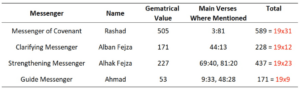
In this Friday sermon, Alban Fejza explains what submitters may reasonably expect from their children regarding the Contact Prayer, Zakat, fasting and Hajj at different ages, and how to encourage children over 12 without violence.
Video Transcript:
Praise be to God! There is no other god except God. As you know, we as submitters consider four religious rituals to be obligatory:
1) The Contact Prayer (which in itself includes the Shahada, of course)
2) Obligatory Charity,
3) Fasting, and
4) Hajj Pilgrimage.
Now, what about the children of submitters? What are the requirements for them? What should submitters expect from their children. What should the general reasonable expectations be for the children of submitters? And before we go further, let’s first explain what we mean by general reasonable expectations. For example, the general reasonable expectation is that you should not make a phone call during late night, because the person might be sleeping. However, this is not a Quranic rule, and there are cases where it’s ok to call someone during the night, but the general reasonable expectation is not to do it. Or if you go out at 1 am, the general reasonable expectation in most of the towns in the world is that almost all the shops will be closed. Now, there might not be even a rule which stops that, but it just happens due to other reasons that most of the shops, if not all of them, are closed during the night. So, in a similar way, when we talk about general reasonable expectations about the religious duties for children of submitters, we are not talking about direct Quranic rules, but a large combination of other Quranic rules, which generally lead to these expectations about the children of submitters. And God willing, we will go over those Quranic rules in other videos, so we can understand the root rules of these expectations, but that will take a lot of videos. So, in this video let’s sort of just give a packaged version of these general reasonable expectations, so you can use it as an approximate map. Now, here are the general reasonable expectations for children of submitters. Let’s go over the summary first, before we go into the details:
1) Until the age of 12, until the start of puberty, children are only exposed to religious duties without any requirements.
2) From the age of 12 until the age of 18, children are expected to always join you in religious duties, to keep the peace within the family, but they are not expected to do anything on their own when you are not there, and also they are not expected to engage in organized religion.
3) From the age of 18, they are expected to fulfill all their religious duties on their own, and also to become part of organized religion.
Now, let’s explain what we mean more specifically with this. So, until the age of 12 the children are exposed to the Contact Prayers, and they might initially join you as play, and then maybe they can understand it as some sort of family activity which the adults just do and during that time it is better just join them. However, ablution is not needed for them, for the children. They are not really that impure, even when they don’t have ablution. And also, if they join the contact prayer, they are not really doing the contact prayer. They are just imitating the parent. They are participating in a family ritual, not necessarily in a religious ritual. But it might make sense to encourage them to do it, for managerial reasons, so they are distracted from doing something dangerous, especially because they know that you are not watching them at that time. So, until 12, they are only exposed to religion, but no religious duties are required of them, and if they join you in the contact prayer, they can do so without ablution. But also, it is important not to stop them from religious duties, by belittling them, keeping them in their shell away from religion, by telling them, “you still don’t understand”, and things like that. There is a verse in the Bible where Jesus tells the people, “Let the little children come to me”, meaning let them hear the word of God. Don’t intentionally keep them away from the word of God. So, you just expose them to religion without expectations of what they should do, and what they should and should not understand.
Now, when they reach the age of 12, you as a parent teach them how to perform ablution. And then, you tell them that whenever they hear your call to prayer, they should get up, perform ablution, and join you in whatever movement you are doing. They don’t even need to learn the words. They just know that they should do what you do. You bow, they bow. You prostrate, they prostrate. You stand up, they stand up. But, you expect this only as a common prayer, not as an expectation of an individual prayer which they can or should do themselves. For example, let’s say you come from work, and you find your child at home, and the afternoon prayer time has already started an hour ago. You should not ask them, if they did the prayer. The Quran tells us not to spy on the people. So, you assume that since the prayer time started earlier, you must assume that they did the prayer already. You don’t ask them, if they did it. You must assume that they did. So, in this case when you start doing the afternoon prayer, you don’t make the call for prayer, and they don’t join you, because you have taught them that they should join you only when they hear the call for prayer from you. Otherwise, you don’t manage, or double check whether they are doing it alone at other times. So, now let’s say that the evening prayer starts, and they are still there, you definitely see that they did not do the evening prayer, because they were with you from the beginning of the evening time, so now you make the call for prayer, and as soon as they hear it, they should go and do ablution, and join you in prayer. So, your child who is above 12 should know that when you make the call for the prayer, he or she should definitely join you with ablution, but if you don’t make the call for the prayer, he should not join you.
You wait for them to do ablution and join you, after you make the call and before you start the prayer. If they don’t, you demand, talk, insist. Try the nice approaches without begging, and the harsh approaches without violence. If they resist, there should be non-violent repercussions, definitely. In the past, even violent repercussions were allowed, and we are not stopping them because they are wrong, but because they don’t work. See, parenting is not only an issue of issuing judgments to your child, deciding what is wrong and what is not wrong, but also it’s a management issue, deciding what works and what doesn’t work. And violent repercussions just don’t work today, because violence has been outsourced to the police. And violence really doesn’t work in the long run, anyway. Anyway, this means that you have to take more time and make more efforts to use other repercussions, if your child above 12 resists joining you in the Contact Prayer after you make the call for the Contact Prayer. Repercussions can be financial, maybe not give them the ipad, or things like that. And it’s really a management issue. And by the way, if both parents are submitters, and the child has no mental handicap, we should not accept the excuse that the child simply does not listen. If you can train a dog to catch a toy when you throw it, you can also train a child to bow down when you bow down, and prostrate when you prostrate. If you can train a dog to respond when you call their name, you can also train a child to respond when they hear your call to prayer. Also, if you can find a way to make a child do his or her homework, they you can also find a way to make your child bow down when you bow down and prostrate when you prostrate. This doesn’t have to be a religious issue. It’s an issue of training your child. You don’t discuss what your child believes. They should just be trained what the response should be when they hear your call to prayer.
Now, what if the other parent is not submitter? Well, in this case, when you are with your child during the whole Contact Prayer time, you should try to make your child bow down when you bow down and prostrate when you prostrate, but in this case there can be cases when that might not work, depending on how much the other parent is influencing the child against it. This is a very big reason why the Quran says that marrying a submitter is much better than marrying a non-submitter even if you like the non-submitter more. So, it’s especially because it prevents any possibility of sending all your efforts with your children to waste. So, if the other parent is not a submitter, it might happen that your efforts – and you should make full efforts anyway – but it might happen that they go to waste, and they don’t work, because the other parent might have more influence. Now, in this case there is financial atonement for this, which means that you should atone for your insufficient management. You will be rewarded for your efforts in the next world, but you should pay for your insufficient management here, and that is explained elsewhere. And it’s not necessarily an issue of right and wrong, because ultimately you are only responsible for your own soul, but it’s an issue of management vs. insufficient management.
So, these should be our general reasonable expectations for our children from the age of 12 until 18, in relation to the Contact Prayers. And the same with fasting. Children should generally be expected to start fasting at the age of 12. So, when Ramadan, or the fasting time comes, and your children are 12, you just don’t cook for them during the day, even if they are not fasting, and then when the time for breaking the fast comes, you make sure that they have a nice healthy meal to eat, and they will adjust their behavior to that. You should try to use any non-violent means to make them fast when the month of fasting comes, if they are over 12. And actually, children at this age see fasting as an interesting way to challenge themselves, to see how much they have grown up.
Now, regarding Hajj: We should not expect that you take children under 12 to Hajj. It’s just an unnecessary complication, and they will not value it, and it’s not that easy to guarantee their safety, and they will not know what they are doing. If they are between 12 and 18, and you have definitely decided to go to Hajj during that time, then you may take them or you may go alone. Either way has its benefits.
Now, regarding Obligatory Charity: The laws in today’s democratic countries limit ownership of anything of value only to people who are above 18, and this means that Obligatory Charity, as a result, is limited only to people above 18, because people below 18 can not be the legal owners of anything anyway, in today’s circumstances. This is why we allow only people over 18 to join us in Organized Religious Rituals. Public Obligatory Charity is an Organized Religious Ritual.
The other Organized Religious Ritual is the Friday Prayer, and this again only becomes obligatory after the age of 18. The Quran says to leave work, and join the Friday Prayer, so the requirement for the Friday Prayer is only for people of working age, and only people over 18 are allowed to work in today’s environment. Children below 18 may listen to the sermons, but only in the presence of their parent, and if their parent wishes to expose them to it, but if they don’t, it’s fine. It’s not obligatory for children anyway. If the parent decides to just paraphrases what he or she learned, and tells it to his or her child in a shortened version, that is also fine.
So, to summarize, no religious rituals should be expected from our children before 12, but they are simply exposed to that religious environment. From 12 until 18, we should expect them to do the Contact Prayer and Fasting, but we should expect that only when they are with us. Hajj Pilgrimage is optional during that age. And Obligatory Charity and Friday Sermon (the organized part of Submission) becomes obligatory at the age of 18. And until the age of 18, you carry the responsibility for what your child does. If he does what he should do. It’s your credit. If he doesn’t do what he is supposed to do, then it’s your fault. God will count it as a good deed or a bad deed for you, not for your child until he or she reaches the age of 18. And in case the other parent of the child is not a submitter, and their bigger influence makes it impossible for you to realize your expectations about your child, then you should atone for your life mismanagement, which is explained elsewhere.
And finally, here is something even more important. Never let your child bully or pressure you into changing your religion. Verse 30:28 says “God cites for you herein an example from among yourselves: Do you ever elevate your servants (your dependent children in this case) or subordinates to the level where they rival you, and to the point that you pay them as much allegiance as is being paid to you? We thus explain the revelations for people who understand.”
In this Friday sermon, Alban Fejza discusses the biblical prophecy about Ishmael’s descendants, why Arabs face particular spiritual challenges within organized Islam, the signs by which an Arab can show true belief, and why submission means more for non-Arabs.
Video Transcript:
Praise be to God! There is no other god except God. As we know, Abraham had two main sons. Isaac – the father of Jacob (Israel) – from whom the Israelites descend. The other main son was Ismail from whom the Arabs descend. And here is what God tells Abraham about Ismail in Genesis 17:20. He says, “As for Ismail, I have heard you: I will surely bless him; I will make him fruitful and will greatly increase his numbers. He will be the father of twelve rulers, and I will make him into a great nation.” Now, among other things, this prophecy to be about the end times as well. So, the Arabs will be ruled by 12 rulers at the end times. Now, given that we are almost in the end times, it’s quite safe to speculate that the 12 rulers will rule the 12 Arab states. So, the Arabs consist of the people in these 12 states: Saudi Arabia, United Arab Emirates, Qatar, Bahrain, Kuwait, Oman, Jordan, Iraq, Yemen, Palestine, Syria, and Lebanon.
All of them are in the Arabian Peninsula. Now, apparently Muhammad was told by the Jews about this Biblical prophecy, and he understood it in the same way, but then the later Hadith writers wrote it as a Hadith, and hid the fact that Muhammad was giving his interpretation of the Biblical prophecy, and not his own prophecy. So, now the traditional Muslims attribute this prophecy to Muhammad, even though this was known thousands of years before Muhammad. Even worse, Shia people misunderstood this prophecy, and they invented the idea that there will be 12 rulers after Muhammad, starting with Ali, and then his son, and then his grandson and so on, one after another (across time), and then the world will end. But, the 12th descendant after Ali came, and their prophecy was not fulfilled, they killed or hid the 12th descendant and invented another lie “their so called hidden imam” so they can cover up the first lie. Bizarre lie after bizarre lie. Completely baseless, non-Quranic ideas. But let’s explain how that Biblical prophecy about the 12 Arab rulers should be understood. It should not be understood as 12 Arab rulers across time, but as 12 Arab rulers across space, which means 12 rulers of 12 Arab states at the same time. 12 Arab groups, and it should be understood like this because Ismail had 12 sons, and from them descend 12 Arab nations. Let’s explain this prophecy even further. See, even though we have listed here 12 Arab states, so far only 11 of them have their own rulers. Only 11 of them are independent, but the Palestinians are still not an independent Arab state. They are occupied by Israel. This means that the prophecy is almost fulfilled but not yet. This means that eventually the Palestinians will get their full rights, and that will be one of the signs that the End of the World is has approached very near – when the Palestinians get their full rights, when the Arabs are divided into exactly 12 distinct groups under 12 distinct rulers.
Now, before we go further and analyze what the Quran says about the Arabs, let’s first make it clear that no Arab nation today is a pure Arab nation. For example, Saudi Arabians might be about 70% pure Arab, while Lebanon might be only about 30% pure Arab, and the others are somewhere in between. We tried to order them here from the most Arab to the least Arab, approximately, depending how much they got mixed with other nations. So, today they are only a certain percentage Arab, and therefore when the Quran says something about them, it is actually talking about the concept of a pure Arab, which applies to the Arabs of the today up to a certain percentage, not fully. To show you what we mean by this, let’s take an example. Jesus says in the Bible that if you believe, then if you say to the mountain, “May you be thrown in the sea”, it will happen. This is true. However, if any of us today say to the mountain, “May you be thrown in the sea”, it will not happen, and this is because we are not 100% believers. What Jesus said was true, but what he said applies 100% only to 100% believers, and if we are only 70% believers, then that statement applies to us only 70%. So, in our case, with 70% belief or less, when we say to the mountain, may you be thrown into the sea, it will take time until it happens. It will happen when the end of the world comes. So, what Jesus said applies to us 70% or less to us, not because his statement was only 70% correct, but because we fit the description in that statement only 70%. In the same way, because Arabs today are not 100% Arabs, what the Quran says about Arabs applies only up to a certain percentage to them today, depending on how much Arab they are. So, the Arabs in the Arabian Peninsula today are on average only about 50% Arabian today, and this percentage keeps going down until the end of the world when the Arabs will fit the qualification of being an Arab very close to 0%. But today, let’s say that they are still 50% Arab on average. Even more, when the Quran says something negative specifically about Arabs, bear in mind that from each nation 91% of the people are not believers anyway, which is explained in another video, but this means that 91% of that negativity is already shared between Arabs and non-Arabs. But the question is, “Is there more negativity among the Arabs on top of the negativity which applies to all the other nations?” The answer is, “If you take all times into consideration “No””. But, there might be fluctuations at specific times where God puts some additional negativity on them, to compensate for the fact that He plans to put some additional positivity on them at another later time, to keep it equal, on average. But, even then the difference is only lower than 50% Arabism x 10% Belief which is only 5% difference. So, this means that whatever is said specifically negative or positive about the Arabs in this video, keep constantly in mind that it either:
Applies to only less than 5% of them
Or it applies to all of them but in less than 5% of the time
Or it applies to all the other nations as well, but we just happen to be talking about Arabs in this sermon.
So, now let’s delve into the bad and good about the Arabs. Let’s start with the bad. Here is what Rashad Khalifa said about the Arabs in the 1980s “So, I wrote here back in 1980, 1400, that God had forsaken the Arabs. The Arabs meaning in the Arabian Peninsula”
Rashad made this statement based on his personal experience with Arab leaders, his intuition, and inspiration, but he did not know how to fully explain it. We know how to also explain it, thanks to God, so here is the explanation:
The nations of the past, depending on how isolated they were from other nations, they developed different tendencies and preferences for what type of evil they are willing to tolerate and what type of evil they are not willing to tolerate. For example, Sodom and Gomorrah tolerated homosexuality, but they probably did not tolerate violence. It was all about having fun for them. On the other hand, Pharaoh who was also evil, he tolerated violence against the Children of Israel, but very likely he did not tolerate homosexuality. To him, it was not about having fun. To him, it was about having power. However, as civilizations developed, and nations communicated and traded with one another, their evil preferences became more shared and less unique, but until recently a tiny evil uniqueness remained among each of them, cultural differences. For example, the evil Africans of the past had a tendency to tolerate some kinds of property oriented evils, the evil Asians of the past had a tendency to tolerate some kinds of family oriented evils, the evil Europeans of the past had a tendency to tolerate some kinds of nationality oriented evils, and the evil Jews of the past had a tendency to tolerate some kinds of globally or ideologically oriented evils. But what about the Arabs? The evil Arabs had a tendency to tolerate some kinds of religiously oriented evils. And this is where it gets complicated with the Arabs. Here is why: While the other nations, when they wanted to be evil, they decided to give up on religion, Arabs in general when they decided to be evil, they were still locked inside the religion. And this is because in verse 43:28, God promises to keep the religious rituals of Abraham preserved through the descendants of Abraham, the Arabs. So, the Arabs were God’s tool to protect the religious rituals, but they were not better in faith than the other people, on average. So, what happens is that when the Arabs lost their faith, God still made them keep their religious rituals through social pressure and other things. So, they still continued to observe the Contact Prayer and give the Zakat, as they have always done as a group traditionally. To them, those rituals are just an intrinsic part of being an Arab. In fact, until recently they did not even distinguish between religion and nation. The word “religion” is a western idea. Arabs called themselves “a Muslim ummah” which means “Muslim nation”. So, they did not perceive Islam as a religion, but as a nation. They did not see sufficient distinction between religion and nationality. So, to Arabs in the Arabian Peninsula, being an Arab and being “a Muslim” was pretty much the same thing. This why in verse 49:14, God tells the Arabs to say that they are Muslims. Now, if Arabs were sometimes Muslims and sometimes not, God would not say that, because then God’s word would not be true, but when God orders the Arabs to say that they are Muslims, then it is done. God’s word is true. So, this means that being an Arab automatically meant being a Muslim. However, religion, organized religion, and nation are the same thing for the Arabs.
So, the Arabs were always Muslims by virtue of their nationality and organized religion. Now, because they were locked by God inside the Muslim nationality and Muslim organized religion, whenever they were not believers, instead of leaving Islam as an organized religion, they added something on top of Islam, without leaving it. So, whenever God wanted to let them deserve Hell, instead of making them leave Organized Islam, God let them add something else on top of Organized Islam, to nullify their Islam. In this way, they could express their disbelief while still being locked inside Organized Islam, to preserve it. In other words, when God weakened the souls of non-Arabs, He just did not give them spiritual food, but when God weakened the souls of Arabs, He still gave them food, but He let them add poison on top of the food, so their souls got weakened anyway.
And Organized Islam consists of the Friday Prayer (Organized Prayer) and Zakat (Organized Charity), nothing else. The Friday Prayer includes in itself the Contact Prayer. So, the Arabs preserved their Contact Prayers, through common prayer during Friday, which indirectly let’s people double check each other’s prayer, and therefore it keeps it preserved for all generations So, one of the purposes of the Friday Prayer is to confirm each other’s Contact Prayer once a week, and this keeps it unchanged across generations. And in Arabia, since the time of Muhammad, there has never been a Friday, where the Friday Prayer was not performed, and therefore the Arabs did not lose it. They preserved all the necessary steps of the Contact Prayers. All those steps were in there. But they added things on top of it. For example, mentioning the name of Muhammad unnecessarily, and doing salavat for Muhammad, and this nullified their Contact Prayers, and therefore all that spiritual food which they ate damaged their soul as much as it nourished it. So, that was the first part of Organized Religion which they preserved, while being disbelievers for centuries. The second part of Organized Islam is Zakat (Organized Charity, Public Charity). This religious ritual was again all preserved among the Arabs. And unlike the Contact Prayer, which was not accepted by God for centuries, because it indirectly involved idol worship, there was no idol worship involved in their Zakat, so God actually accepted it until 1980. So, the only things which kept the Arabs from being cursed as a community is the fact that they observed Organized Zakat (Organized Charity), without idol worship, which God accepted. However, regardless of whether Zakat is being done correctly or not, there is a condition for God to accept it. And that condition is that they should not reject a messenger whom God sends. This condition is in verse 9:54. So, for as long as God did not send another messenger from the time of Muhammad, the Organized Zakat of the Arabs was accepted to God. However, in 1980, God sent His Messenger of the Covenant, Rashad Khalifa, and because they rejected him, then even their Zakat became unacceptable and nullified, according to verse 9:54. So, this is why Arabs were cursed since 1980, while still remaining inside of their Organized Islam, so they can preserve the rituals of Islam. The question is, “Will this curse go forever, or will it be removed?” Well, here is the good news: The curse was removed during last year, in 2021. So, God closed the door to the Arabs from 1980 until 2020, for 40 years, but He opened another door for them now. Since last year, since 2021, we have established public organized Zakat online, which can reach the Arabs, and they have started to join. By the way, they would not join while being believers otherwise, without organized Zakat, because organized Zakat is part of being a pure Arab, and it was not possible for God’s Messenger of the Covenant to organize the Public Zakat for them, given that they lived in different countries, and there was no internet then. But today, God made it possible, as part of his plan through internet to open the door again for the Arabs. And you know what? For 13 years, since 2008, Alban Fejza was preaching online, and not a single Arab believed, until Public Zakat was organized through internet, and then on the 14th year, soon enough they started believing and joining us, and today, about 10% of our congregation are Arabs, people born in the Arabian Peninsula. And apparently, now we realize that God had a system and a purpose for the temporary curse and redemption of the Arabs. The system was similar to the time of Moses. During the time of Moses, when the Jews disobeyed Moses, God cursed the Jews and left them in the desert for 40 years, as we are told in verse 5:26. And similarly, there are exactly 40 years from 1980 when God sent the Messenger of the Covenant until 2020. On the 41st year, in 2021, God lifted the ban of Arabs, and soon after that, they started to join us. So, this was the system.
Now here is the purpose: God’s purpose is to use the Arabs as the supporters of believers during the end times, during the time of the Mahdi. However, this would mean that they would be given priority over the other people in the end times. But, God is not racist. To God and to me, the Arabs are not better than the non-Arabs. There is no chance. God will send an equal proportion of people from all races and nations to Heaven. But, if God is going to use the Arabs for the end times and give them priority then during the time of the Mahdi, then to compensate for that, God left them behind from 1980 until 2020.
And now that we look back at it, it all makes sense. We had tried to understand organized Zakat for many years, because we was aware that there was something missing in the Zakat in the way the submitters after Rashad Khalifa were understanding it. We had tried to find the solution for many years, and God only allowed Alban Fejza to find the solution in 2021. This is exactly when God removed the ban on Arabs.
However, there is one slight change: In the past, had the Arabs accepted Rashad as God’s Messenger of the Covenant, God and Rashad would have given the Arabs priority to organize the Zakat, due to their geographical centrality. But they rejected him, so now they lost that chance. Now, internet has made geographical centrality obsolete when it comes to Zakat, and God has appointed Alban Fejza to organize it, and he will delegate that priority to the Congregation Directors which he chooses, regardless of the nationality, Arab or non-Arab – as prescribed by the Quran.
One more thing. A message to the Arabs: Since the ban on you has been removed by God, please pay attention to a hidden danger, if you are an Arab. Because you are destined to be Submitters anyway, it is harder for you to know whether you have been truly guided, or whether God is just using you to fulfill His plan to preserve the organized religious rituals. In other words, as an Arab among us, you are more likely to turn into a Hypocrite, which is mentioned in verse 9:97. The other people are more likely to leave submission, which is actually a blessing in disguise, because if they leave, they know they left, and they might repent and come back, but you are less likely to know that you have left, which makes it harder for you to find your way back, because you might not even know that you are lost. And to help you with that, if you are an Arab, we looked at the verses where God specifically addresses the Arabs, specifically talks to them, and in those verses, we found seven main signs which you can use as indicators to know whether you are being truly guided, or whether God is only using you to preserve the Abrahamic religious rituals:
First sign: Are you a Muhajer (migrant)? (verse 9:100). Or do you live in the same country where you were born? Or, even better, how willing would you be to migrate, if you have to do it in the cause of God?
Second sign: Are you an Ansar (supporter)? (verse 9:100) If another submitter needs to migrate in the cause of God, how willing are you to offer your house for support, in case there is space for them, provided that the gender rules allow it, of course, until they can support themselves, provided that they don’t take advantage of the good deed? Verse 9:100 says, as for the early vanguards who immigrated (Muhajerun), and the supporters who gave them refuge (Ansar) and those who followed them in righteousness, God is pleased with them, and they are pleased with Him.
Third sign: Are you trying to hide behind God’s messenger? (Verse 9:90-9:91). This sign does not apply to weak men, or to women, or to children, because they are not expected to necessarily engage in public struggles. So, when Alban Fejza organizes, if you are an Arab man blessed with wealth or education, are you intentionally trying to stay at the back of the struggle? Are you hiding yourself so that others don’t know who you are? Or are you trying to come at the front of the struggle. In verse 9:120, God says to you that you will not suffer even a little bit in the cause of God, without having it written down for you as a credit. God never fails to recompense those who work righteousness.
Fourth sign: When you spend in the cause of God, when you give the Zakat for example, does it feel like a loss which you have to undergo so you can be with submitters, or does it actually make you happy? (Verse 9:98). Do you believe that your spending will be a means towards God, and a means of supporting the messenger? (verse 9:99). If this second one is true, then indeed it will bring you nearer, and God will admit you into His mercy. God is forgiver, Most Merciful.
Fifth sign: When your financial independence increases, does it feel like a better opportunity to be closer to the messenger of God, or like a better opportunity to stay further away from the messenger of God? This is partly based on verse 48:11 and the verses around it.
Sixth sign: How much do you believe that the messenger of God and the believers will eventually win? (Verse 48:12).
Seventh sign: Do you think that you are doing Alban Fejza a favor by being a submitters, or do you think that God has done you a favor by being a submitter? (Verse 49:17).
And these are the sings which indicate now or in the future how guided an Arab who has joined us is.
So, to conclude, when it comes to the Arabs, they have to rely on other sings beyond submission to know if they are believers, because submission comes naturally to them anyway by virtue of their nationality, and so submission is only a partial sign of their belief. But when it comes to the non-Arabs, submission is one of the biggest signs of their belief.
In this Friday sermon, Robert Szilagyi shares three techniques for preaching: prepare well and know your audience, teach through history and stories people can relate to, and support your points with scripture, illustrating each from his own experience.
Video Transcript:
Praise be to God. Peace be upon everyone, and thank You, God, for giving me an opportunity to present myself today to my wonderful family of submitters. Recently I’ve been reading about different techniques for preaching, and today I’m going to talk about three which I think are very useful.
The first technique that I’m going to share is preparation. Any time you want to make a presentation or preach, a key technique is to prepare yourself: doing research, allocating time, reading, writing, using your peers for help or constructive criticism, spending money, and so on. You should always prepare yourself by knowing the audience you’re going to speak to. Are you preaching to atheists, Christians, Jews, traditional Muslims or submitters? Knowing the audience you are speaking to will guide you on things that can help you prepare.
Imagine going into a Christian household and telling them that, according to the Quran, chapter 4, verse 171, you should worship and serve God and not Jesus. Here you are, going into their house and commanding them what to do according to the Quran. You might get laughed at, yelled at, disrespected, or even thrown out. Now, if you know your audience will be Christians, you could prepare a different approach. You could start off by asking, “If I told you it was written, ‘Worship and serve only God,’ could you possibly interpret that to include worshiping me?” You already know that they’ll answer no to that question, so you can follow up by saying, “Well, here it says in Matthew, chapter 4, verse 10, that Jesus said to him, ‘Away from me, Satan! For it is written: Worship the Lord your God, and serve Him only.'” So, through Jesus’s words and their own understanding, the Bible teaches us to worship and serve only God, and not Jesus.
Through preparation, knowing your audience, reading, writing, and spending time and money, you can preach your points in a more efficient, receivable and palatable manner. It may even leave them thinking about, or fearing for, the foundations of their own beliefs. Knowledge is power, and God commands us to prepare our power against God’s enemies, as well as others not known to us. Quran, chapter 8, verse 60: “You shall prepare for them all the power you can muster, and all the equipment you can mobilize, that you may frighten the enemies of God, your enemies, as well as others who are not known to you; God knows them. Whatever you spend in the cause of God will be repaid to you generously, without the least injustice.” Praise God. The first technique for preaching is preparation.
Now I’m going to suggest another technique. When I was a teenager, my friend and I used to practice Islam together. At first we both claimed to be Sunnis; then I switched to claiming to be a Shiite. We used to debate with each other all the time using hadiths. Almost 30 years later, I met up with him, and I was so excited to share my newly gained knowledge of Submission. My first intention was to show him that the Quran is fully detailed, contains everything we need, and that the hadiths were not a good source for our religious laws and practices.
I proceeded to email him my points, quoting verses from the Quran using Rashad Khalifa’s translation. He responded, claiming the verses didn’t say what I wrote. He even went on to say that one of the verses proved his point that it was necessary to follow the prophet Muhammad and Hadith. I was confused. I couldn’t believe it: how could we be looking at the same verses and have such different understandings? After further communication, we came up with a way to work through it. We agreed to eliminate the parentheses from any of the translations when referencing our points. I started using the translation he preferred to make my points, and, praise God, he started seeing things differently. Today we can even use the Quranic Arabic Corpus, for example, which enables us to go directly to the Arabic, even if we don’t understand Arabic.
This brings me to my second technique: teach lessons using history and stories people can relate to when preaching. You see, I knew that most of you could relate to the situation of citing a verse and then being met with opposition, people claiming that it in no way means what you say it does. So I used my own historical account of expressing the correct understanding of the Quran by eliminating what’s in parentheses. God cites this method directly in the Quran, chapter 12, verse 111: “In their history there is a lesson for those who possess intelligence. This is not fabricated Hadith; this (Quran) confirms all previous scriptures, provides the details of everything, and is a beacon and mercy for those who believe.” So the second technique is to use history and stories to teach and to overcome objections when preaching. Praise God.
And now for the third and final technique. At an early age, God blessed me with belief in Him and belief that the Quran was sent by Him as guidance for mankind. The way I understood Islam prior to Submission was very Hadith-based and not agreeable to my Catholic family, so I barely preached or spoke about Islam to them. But about 10 years ago, when I was introduced to Submission, I began preaching to them heavily, especially to my mom, and everything was going well. We had several back-and-forth dialogues.
Then it was time for me to approach the topic of Zakat and express my understanding at the time that two and a half percent of my bi-weekly income belonged to her. My parents are very poor, but proud, and refuse handouts or charity. I knew that I would be met with opposition when telling my mom that I had to give her Zakat. I started the conversation by asking her, “Would you be willing to help me get to Paradise?” She said, “Of course I will.” I proceeded to tell her that God commands me to give her two and a half percent of my income. Of course, at that time we had not organized public Zakat yet, so I was doing it based on my limited understanding at that time. After some arguing, she agreed.
Now, my mom was familiar with the Bible and aware of my claims about the Quran, and she asked, “Where does it say to give two and a half percent of your income?” I don’t think she was negotiating how much I should give her; I think she was making me prove myself. After all, I was asking her to compromise her feelings about taking money from her children. She even said she thought the Bible said to give a ten percent tithe to the church. So we read Appendix 15 together, “Religious Duties: Gift from God,” but we basically just went to the obligatory charity, Zakat, section. I showed her chapter 6, verse 141, and how “harvest” translates, for me, into my bi-weekly check in today’s world, and chapter 2, verse 215, which shows that my parents are the initial recipients of my Zakat. We both accepted the two and a half percent from the appendix, but it always bothered me that I could not use scripture to prove it.
I learned a valuable lesson that day, and it’s the third technique that I’d like to share: be able to support your beliefs and preaching points with scripture. Since that conversation, I have searched for Quranic support that Zakat is two and a half percent. I asked the people in the Tucson community. I asked many others at two different submitters’ conferences. I asked at a couple of different Quran studies, one of which was even worldwide, and no one could provide me with Quranic support. Although my mom passed away about four years ago, I now have Quranic evidence to support that Zakat is two and a half percent, along with the correct, full understanding of Zakat. Chapter 6, verse 92: “This too is a blessed scripture that we have revealed, confirming the previous scriptures, that you may warn the most important community and all those around it. Those who believe in the Hereafter will believe in this scripture, and will observe the Contact Prayers (Salat).”
In conclusion, you can see that I put the three techniques into practice in this speech. Each point required preparation; I told a relevant story or gave a historical account to teach; and finally, I used scripture to support all three techniques. God, please help all of us to prepare, use historical accounts, and support our points with scripture when preaching.
In this Friday sermon, Alban Fejza explains that artificial intelligence chat tools simply predict the most likely next words people would say, and predicts that for everything that eternally matters, we will still need the Quran.
Video Transcript:
Praise be to God! There is no other god except God. As some of you might know by now, an artificial intelligence chatting webpage has recently become popular and is being promoted in social media, which you can see here. Actually, earlier versions have been in existence for several years now, but recently it has become slightly more sophisticated and popular. But what is it really? Well, they promote it as intelligence with which you can chat and it tells you information. You can basically chat with it. But, what is really happening in the background is that it simply tries to predict what would be the most likely next word a human would say in given topic, and then it predicts the next word after that and so on, and things like that, and it has learned this by being rewarded by humans, every time it gets it right, and increasing the likelihood that it will do it again, and being “punished” by humans, every time it gets it wrong, decreasing the chances that it will do it again, and people actually train it by using it. So, let me try it. Let’s request something from it: “Write me a cover letter about a biostatistician position”. “Dear Hiring Manager, I am writing to express… ok…”
So there we have it. So, how did it do it? Basically, it tries to find the most likely response to any chatting text which you send it, and with which people are satisfied. And the most likely response is pretty much the average response. And this is where the limitations of AI come from. By giving you the average response, what ends up happening is that in anything which doesn’t really ultimately matter, it can give you the best answers, sometimes better answers than any human. And this is because, the believers and disbelievers actually do agree on things which do not matter. So, the more an issue does not matter, the more likely the believers and disbelievers are likely to agree about it, and the more the they agree about it, the more likely that opinion becomes the average opinion in the world, and the more likely it is to be picked up by the Artificial Intelligence. What this means is that Artificial Intelligence actually is the best at helping you in things which do not really matter. But when it comes to things which really matter, it adds no value. So, there is a gap which Artificial Intelligence will never be able to fill. It’s the gap of importance. If an issue is eternally important, Artificial Intelligence will never give you a definite answer about it, because believers and disbelievers do not agree about it.
So, the disagreements between believers and disbelievers happen on things which eternally matter, and those disagreements force Artificial Intelligence to come up with an average answer between belief and disbelief, which actually is not the right answer, and therefore not helpful. This is why my videos are important in the modern world. My videos fill that gap of truth which is missing on the internet. The reality is that people in the future will be used to using Artificial Intelligence, and after a while they will see it as a go to tool to find the answers, and once they get used to it, they will be inclined to use it even in things which do matter. For example, once the artificial intelligence tells them 100 answers which are correct, they might be inclined to ask it whether “God exists?” and then be fooled into thinking that it will give them the correct answer. But, exactly because this question matters, Artificial Intelligence does not give you the correct straightforward answer. “The correct answer is simply “Yes.” So, let’s ask it. “Does God exist?” “The existence of god is a matter of personal belief and faith, and it’s not something that can be proven or disproven…” Ok. You can see the answer.
As you can see, the answer is a sophisticated answer which seeks to find a way in between believers and disbelievers. So, the more important the question is, the less likely it is that Artificial Intelligence will give you a straightforward answer. So, if you live in the future when Artificial Intelligence has become a common daily thing, just be aware that asking it any question is the same as asking that question to the best person who will end up in Hell, or the worst person who will end up in in Purgatory. The best people who will end up in Hell, and the worst people who will end up in Purgatory are people who actually think like Artificial Intelligence. Let’s call these people, “the doubters”, which are people between belief and disbelief. So, the way in which the doubters think is somewhere in between what believers think and what disbelievers think, which is exactly what Artificial Intelligence tries to maximize. The way it is built, it’s goal is to maximize the most likely, but by doing that in all important issues, it maximizes the answers suitable for doubters. So, on all important issues for the hereafter, the doubters and Artificial Intelligence think alike, and the more we go into the future, the more people become like that, and this is mentioned in the Quran.
In verse 42:14, it says “Indeed the later generations who inherited the scripture are full of doubts. So, here it is talking about later generations, and the more those generations are into the future, the more this applies, and the more and more they start to think like this, like the answers which this Artificial Intelligence is giving us. And as you know, in a lot of my videos, I make predictions, and here is my prediction about Artificial Intelligence. I predict that for all issues which really eternally matter, in the beginning, Artificial Intelligence will give in-between answers, neither here, neither there. After a while, the variety of answers will increase, trying to maximize the likability for a particular person. For example, if it knows based on my previous chat history that I am a submitter, it will tell me that there is only one God, but if it knows that a certain person who is asking is a Hindu, it might tell him exactly what he wanted to hear. So, after a while, the variety of answers will increase in important issues, but then towards the end of the world, Artificial Intelligence will go back to giving everyone the same in-between answer. So, religiously Artificial Intelligence will look in the beginning years of its use the same as in the end years of its use – basically average mediocre answers for all religious issues which matter. And this is because, in the beginning it is not sophisticated enough to pick up the variety of answers of people, and it just aims for the middle, and towards the end of the world, the people will converge towards the middle anyway, so despite the fact that Artificial Intelligence has learned how to pick up the variety, the variety among people has actually decreased. The believers and disbelievers would have become very similar to one another in the way they think. So, Artificial Intelligence when it comes to important issues, will start with being uncertain and will end with being again uncertain, except that in the beginning, it will blame itself for being uncertain, but towards the end, it will blame you for being uncertain, because then the uncertainty will be because of the people, not because of the AI, and this is predicted in verse 27:82, which says, “At the right time, we will produce for them a creature, made of earthly materials, declaring that the people are doubtful about our revelations” See, it doesn’t say, that the people will be disbelievers about God’s revelations. It is talking about people who are doubtful or not certain about the revelations, and this is exactly what Artificial Intelligence does. It increases doubtfulness in issues which matter, and it increases certainty in issues which don’t matter. Which is exactly the opposite of how it was in the past. In the past, people expressed certainty about issues which mattered, and they expressed uncertain about issues which didn’t matter. But, not in the future. In the future, they will be certain about issues which don’t matter, but doubtful about issues which matter, and this is what makes it possible for believers and disbelievers to be more alike in the future, because in issues which really matter, they are both uncertain. However, the Quran was more suitable for each person of the past, because the believers of the past generally deserved more. So, the Quran gives clear answers for issues which matter, and vague answers for issues which don’t matter, while Artificial Intelligence gives you clear answers for issues which don’t matter, but vague answers for issues which matter. And this is why Artificial Intelligence and the Quran will never replace one another. The Quran is clear in what matters, and AI is clear in what does not matter, and my role with my videos is to create a bridge between the two, so that those who have AI thinking style, the doubters, can travel towards the Quranic thinking style, if God chooses to enlighten them. But AI will continue to evolve, in the beginning, blaming itself for the uncertainty, and then towards the end blaming us for the uncertainty. So, it will gradually turn from being like our servant, then to being like our friend, then to being like our boss, and then ultimately it will act like our master, but this does not mean that we should not use it, at least until close to the very end. God willing, I plan to use it, if I find it useful for daily non-religious things, but for everything important and religious, we have the Quran.
In this Friday sermon, Alban Fejza explains, based on verse 2:113, that every people of the scripture has at least some scriptural basis, places different religious groups on a spectrum of closeness to the scripture, and invites them to the common ground of worshiping God alone.
Video Transcript:
Praise be to God! There is no other god except God. Verse 2:113 in the Quran says that the Jews said that the Christians have no basis, while the Christians said that the Jews have no basis, although both of them read the scripture. Such are the utterances of those who have no knowledge.
So, it is the people who are not knowledgeable who will label one group as a group with no scriptural basis, or the other group as a group with no scriptural basis. And this is because the ignorant people fail to admit that actually all the people of the scripture must have at least a little bit of scriptural basis, otherwise God would not call them “people of the scripture”. They must have some scriptural basis, at least some. They are not completely without basis. However, how much of the scripture do they follow? That is another question. So, instead of labeling people into two distinct groups, people with scriptural basis or people without scriptural basis, the correct way, the way of the more knowledgeable is to put them in a spectrum, which shows that all of them have at least a little bit of basis, but they vary on how much and in which direction. And to show you that, let’s show it in the diagram below:
So, this line represents the spectrum of how much scriptural basis a certain religious group has. In the middle, we have the people who follow the full Quran, not more and not less. To the left, we have the people who follow less than the Quran. So, they follow parts of the Quran, but not everything. And to the right we have the other groups who follow more than the Quran, meaning that they add other books as religious sources on top of it. So, the best place here is to be at the center of this line, which shows that you have the most basis, and the further away from this center you are, the worse it is, the less scriptural basis you have. So, now let’s present the different groups of people of the scripture in their approximate appropriate place. Here they are:
In the middle, we have the submitters, us. We follow the full Quran, and nothing more than the Quran, and nothing less than the Quran. Then, to the left, we have the half-submitters. They follow the Quran partially. They follow only the parts of the Arabic Quran which Rashad Khalifa managed to translate. (Of course, Rashad Khalifa spoke the truth, but he as an English translator could not potentially cover all the truth. So, there is additional truth in the Arabic Quran, and the half-submitters will not accept any part of it, if it is not also found in the English version, and the English version is a true but limited version. So, they are based on less than the Arabic Quran, less than the Quran. Then, we have the Quranists, who are based on even less than that from the Quran. They tend to chop the Quran piece by piece, and limit the Quran only in what they understand as an individual. Basically, they limit the Quran only to their intellectual capacities, which often are limited capacities, and they end up following less than the full Quran. They don’t realize that they are people of the scripture, but by calling themselves Quranists, that’s exactly what they are. The Quran is a scripture, and by calling yourself a Quranist, you put yourself in the group of the people of the scripture, and the Quran does not mention the people of the scripture as the authorized religious group. Then we have the Protestants, who are almost exactly the same as the Quranists, except that they do with the Bible what the Quranists do with the Quran. Their doctrine is “sola scriptum” which means “scripture alone” which according to them consists of only the Bible, which would not be the biggest problem, but then again just like the Quranists they will limit the Bible only to portions which they themselves understand. If someone understands more, they will deny it, just because they did not understand it first. Then we have the Anglicans, similar to protestants, but their motives for following the scripture alone are more political rather than doctrinal. Then we have the Orthodox, who follow less than the full Quran, but they at least follow some aspects of it, like the doctrine of striving in the cause of God, and they understand the importance of hierarchy in religion, and how to preserve information across generations and so on. Then we have the Catholics, who are very similar to the Orthodox, but they just tend to ignore more of the scripture to adjust their lifestyles more to the modern world. Then, we have the Jews who are the furthest away from having scriptural basis, because they do not only disregard the Quran, but they also disregard the Gospel, which from the scriptural aspects is the meat of salvation – the essence of the scripture. The Gospel is the essence, and the Torah is the details, while the Quran is a summary of both.
By the way, the Quran supports this ordering which we did here. For example, it tells us in verse 5:82 that the Christians are closer to the believers than the Jews are.
Anyway, let’s present now the religious groups who are to the right of this spectrum. They are people who follow more than the Quran. First, we have the Sunnis. Basically, in addition to the Quran, they follow additional books, which God never authorized, like the Hadiths of Bukhari, Tirmidhi and so on. Then, slightly further to the right, we have the Shia who in addition to traditional hadiths which are attributed to Muhammad without his permission, they also have the hadiths and books which are attributed to Ali. Then further to the right, we have the Sufis who follow even more unauthorized sources, like their spiritual ‘masters’ and so on. Then we have the Barelvis and Deobandi who actually follow even some books of political and doctrinal leaders of the recent times. And then we have the Ahmedia, who in addition follow additional books of their leader, who are very human books, but they consider them almost equal to the Quran, if not completely equal. And then we have the Bahais who follow books which they think supersede the Quran, which is why they are furthest to the right. Just like the Jews end up ignoring the Quran, by following very little of it, the Bahais end up ignoring the Quran by following completely something else. We put them here, because they say that they accept the Quran, but once you see their other books, they have almost no basis in the Quran.
So, this is the spectrum of the people of the scripture depending on how much basis they have in following the Quran, the full Quran, and nothing more than the Quran. We should be following the full Quran, no more, no less.
Now, as time passes, these rectangles which we presented in the graph will actually stretch, meaning that there will be more variation within any of those groups, and as variation of individuals within each group increases, the variation between the groups themselves will decrease. So, the groups will become more and more similar. Basically, you will be able to find Sunnis for example who are completely to the right of this diagram, and also Sunnis who are close to the center of this diagram, and so on, or you might be able to find Jews who are completely to the left of this diagram, and Jews who are almost to the center of the graph. For example, there is a recent group of Jews who are called Messianic Jews, who are basically Jews who believe in Jesus, which means that they are Jews who have stretched their Jewishness closer to the center, all the way to the Protestants, and in some cases they have reached the Quranists.
But, anyway, in the future, this diagram will become fuzzier, and each rectangle will be more stretched to the right and to the left, until each group here will be all over the place, and that’s when the end of the world will come.
But, the correct group to be with is the Submitters, because we follow the full Quran. We try not to ignore any parts of the Quran to the best of our ability, and we try not to follow any materials which present information from other than the Quran. Of course, we do not manage to do it 100% of the time, which is why the rectangle here is a rectangle and not a single point, but we as a group are at the center of this spectrum, and the other groups also have some scriptural basis, but they also have deviated either to the right or to the left of this scriptural spectrum. And we know that they have deviated at least a little bit from the center because none of their names are found in the Quran as an authorized religion. But, only the submitters here at the center are found in the Quran as the authorized group.
The Quran says in verse 3:64, “Say, “O followers of the scripture, let us come to a logical agreement between us and you: that we shall not worship except God; that we never set up any idols besides Him, nor set up any human beings as lords beside God.” If they turn away, say, “Bear witness that we are submitters.“”
In this Friday sermon, Alban Fejza explains when the evening and dawn twilights begin and end, why different groups disagree about the evening and dawn prayer times, and why worship at any time of the day is never wasted.
Video Transcript:
Praise be to God! There is no other god except God. As some of you know, we as submitters do the evening prayer whenever evening comes, and after the twilight disappears, after evening ends, we do the night prayer, and then when the dawn twilight comes, we do the dawn prayer. And for one reason or another there are many smaller groups who actually disagree with the mainstream narrative about when twilight happens. When does the evening prayer time start and end, and when does the dawn prayer start and end. The mainstream general consensus about the evening, when the Evening starts and ends is that it starts when the sun sets and it ends when the sun is 18 degrees below horizon. This is also the definition of the astronomers, which they call the end of astronomical twilight, and this is also what the majority of Muslims around the world use, and this is also what Rashad Khalifa used, and it’s also what I accept. However, there are groups of people, or individuals who think that the evening twilight ends not when the sun is 18 degrees below horizon, but when it is 17.5, and some say 15, and some say 14, and some say 12 degrees below horizon, and they all have their own justifications, which actually for that part make sense. However, the dispute is still there. So, about ten years ago, I set on a journey to solve this dispute by showing the people with photographic evidence what the issue is all about. Now, there are a lot of amateur people who try to do this, and reach all kinds of conclusions, and they are then convinced that they are right and the whole world might be wrong. First, they forget to take into account that the experiment can be done only in a moonless night, which is pretty much only once a month for about a couple of days before the new moon, because otherwise the moonlight scatters across the sky and interferes with the experiment, they forget that the experiment doesn’t work if there are city or village lights anywhere for tenths and hundreds of miles, because city lights are reflected by the top layers of the atmosphere and come back as twilight, which interferes with the sensitivity of the eye and the camera, and then they are not sensitive enough to detect the true twilight which might be less bright than that. This is called light pollution. In today’s world, pretty much anywhere in the world the night sky is polluted with artificial light, except in rare places and in faraway oceans. Anyway, there are several other factors which need to be controlled, like the flatness of the horizon, the adjusting of the eyes, which means that you have to have some kind of automatic time keeping, or audio time keeping, because if you look at the clock at those times, which you need for the experiment, you might not see what time it is, but if you look at it with a light, you ruin the experiment by readjusting your eyes to a different level of brightness, and then it takes time until your eyes adjust back to the proper darkness to be sensitive enough to see the twilight, and the sky has to be completely clear from clouds, and also not near any industrial place, and a few other factors like that. And all the people who actually do the observation as amateurs, they do not even take these factors into consideration. So, again, about ten years ago, I decided to do this properly, I found a day and a place when all these conditions are fulfilled, but it meant that I had to go to a very remote location far from civilization, towards a western coast by the sea, to find a flat horizon, which was not reachable by car. So, I had to also hike for a couple of days on foot with my backpack, food, water, the tripod on one shoulder and a professional camera on the other. And here is the photographic evidence which I collected: So, I took pictures of the sky at specific intervals, and then synchronized them with astronomical almanacs which show at which degree under horizon was the sun at that moment. And here is the result: This is how the sky looked like when the sun was 3 degrees below horizon. I did not need to start from 0 because no one actually thinks that the sky gets immediately dark when the sun sets. So, the question which I am trying to answer with these pictures is: “How far should the sun be below horizon for the sky to turn completely dark? So, this is how dark it was when the sun was 3 degrees below horizon. Now here is 4 degrees below horizon, slightly darker. 5 degrees below horizon – even darker. 6 degrees. Now this the point where Civil Twilight stops and Nautical Twilight starts. Actually these Civil Twilight and Nautical Twilight are just made up terms for legal purposes, like for knowing when to oblige the cars to turn their headlines on, or when a ship can see another ship, and in case they have an accident, they would use these definitions to decide if it was negligence, or intentional, or things like that, but in reality as you can see, twilight is just a continuous thing, gradually decreasing. The sky simply keeps getting gradually darker. There is no cut off point. It just keeps getting darker and darker gradually. Now here is at 7 degrees. Here is at 8 degrees. Here is at 9 degrees. Here is at 10 degrees. Here is at 11 degrees, even darker. And here is at 12 degrees. Now this is the point where Nautical Twilight ends, and Astronomical Twilight starts. Again, these are just made up terms.
But, from this point on, people start to disagree whether full darkness has come, whether the full night has come, whether Isha time has come. To, me it’s quite clear that I can still see the light in the sky. However, it’s definitely not a full day either, so we can not say that those people are completely wrong. It’s just that they can be slightly more right. Now let’s continue with 13 degrees. Even darker, but there is still light in the sky. The purpose is to see when the twilight completely disappears. We can still see the twilight. Now here is at 14 degrees. Much darker, but there is still twilight in the sky. Now here is 15 degrees. Much darker, but I can still see twilight in the sky. It’s not completely dark yet. Now here is at 16 degrees. If you pay careful attention, there is still some twilight in the sky. Now here is at 17 degrees. Very faint light in the sky. And you will actually be able to see a very very faint light only if you look at this video in a dark room. And at this point it will depend a lot on the circumstances whether you would see sunlight in the sky or not, depending on the moisture level in the air, am quite sure that under better atmospheric conditions, maybe with less moisture in the air, or your elevation level, and things like that. So, at this point whether the night has fully come is questionable. And now here is at 18 degrees. This is where the Astronomical Twilight ends, which means that at this point there is no twilight in the sky anymore. This is what they call the end of Astronomical Twilight, because the astronomers can go after this time and observe the stars, and they are equally visible throughout the whole night, from then on, until the emergence of dawn. From this point forward, the sky stays equally dark until emergence of dawn. And here is at 19 degrees, which is equally dark again. Now, let me show you those same pictures, but all in one, a cross-section of them, side by side. So, we have here a representation of how the sky looks when the sun is at each degree below horizon. Now, depending on who you ask. If you asked people, at which degree would you say that the night has fully come, or the twilight has disappeared, most people would say either 14, or 15, or 16, or 17, or 18, and they would all be almost completely correct. Because at all these levels, even earlier, there is probably about 1000 times less light than during the day. Compared to the day, it’s definitely night. We are not aware of that because our eyes automatically adjust to the different light levels, but there is a huge difference in the amount of light compared to the day. So, technically, all of them are night. This experiment is just trying to show which part of the night has less twilight, and at which point does twilight reach the minimum levels. So, all of these degrees are night, layl in Arabic, but we are trying to find out what would be the best time to do the Isha prayer. The prayer which comes after evening, after the twilight disappears. The more the evening is over, the better the Isha prayer becomes in value. Someone might say, why did God have to leave this issue so vague, and not give us a definite cut off point, so that we could know from the Quran when the Isha prayer comes? Well, here is why? It’s because it doesn’t matter. And here is how: Let’s say that you lived completely alone in an island and you tried to apply the Quran. Let’s say that you understood from the Quran that you should do the Night Prayer, the Isha Prayer, when the sun is 15 degrees below horizon. Let’s say that that is your understanding, from what you saw in the sky. Here is what would happen. Your night prayer would be slightly less valuable, but you would compensate for it by being slightly more diligent with the evening prayer, because now the evening prayer for you would be within a narrower length of time. And because, the evening prayer is better immediately after sunset, because it’s called the prayer after sunset, then that prayer would actually have more value when you did it. So, what you would lose in value in the night prayer, because you did it before the sun reached 18 degrees below horizon, you would gain in value in the evening prayer. So, regardless of how you understood the time when the Isha Prayer should be, you would always end up with a total value of worship which is equal. All you had to do is have honest intentions, and the way you understood the precise time of the prayer would not increase or decrease the value of worship at all, when you take everything into account. And this is why the smallest time scale which is mentioned in the Quran is the hour, not the minute. So, whether you do the Isha Prayer five minutes later or earlier, or 20 minutes later or earlier, it’s still not significantly different from the minimum time scale mentioned in the Quran, which is the hour. Let me take another example, to show you why the exact minute or the exact degree does not matter. Let’s imagine that you lived in an island somewhere near Sweden, or UK, or Norway, completely alone, and you are convinced that the prayer time for the Isha night prayer comes when the sun is 12 degrees below horizon. Let’s say that another submitter in a neighboring island is convinced that the Isha (night) prayer time comes when the sun is 18 degrees below horizon.
If you do the prayers like that consistently, then you will end up with slightly larger number of prayers than the other guy, because it will happen slightly more often to him that he will not have to do the night prayer at all, because there would be more days in those regions when the sun does not go below 18 degrees below horizon at all, and if you use your definition, there would be less days where the sun does not go below 12 degrees below horizon. So, you end up doing a slightly larger number of prayers. However, his prayers have more value, because he is doing them later in the night, and the night prayer has more value when it is done later, and in addition to that he also fasts slightly longer during Ramadan, because according to his definition he should start the fast earlier, when the sun is 18 degrees below horizon at dawn, and not 12 degrees. So you get slightly more prayers, while he gets better prayers, and longer fasting times, and in the end you end up with exactly the same value of worshiping God, which is why it does not matter at all whether you understand it as 18 degrees or 12 degrees, which is exactly why God does not go into these details. Because it does not really matter. Nevertheless, it does not matter if you and the other submitter live in separate islands.
But, if eventually you get together and have a community, now when the time for prayer comes, what should you do? He thinks it is 18 degrees below horizon, you think it is 12 degrees below horizon, and the Quran does not allow you to do it separately. Verse 18:28 says, “you shall force yourself to be with those who worship their Lord day and night.” And in other verses we see that we should bow down with those who bow down, and prostrate with those who prostrate. So, if you do the prayer at one time, while the other submitter does it at another time, while you are together, that is simply wrong. The question is, whose idea should prevail in this case. Yours at 12 degrees, or the other submitters at 18 degrees. And the answer is, “Whoever merits more respect.” So, now it’s about respect and the community. And there is no good community without respecting the knowledgeable, verse 4:83, there is no community of believers without respecting the hierarchy of believers, verse 4:59. So, all this issue comes down to: “Do you have any respect for the knowledgeable?” “Do you have any respect for the hierarchy of believers?” I am not talking about the hierarchy of disbelievers. I am talking about the hierarchy of believers. So, do you have any respect for the hierarchy of believers?
Do you have any respect for the community of believers? You should, according to verse 21:92. Do you have any respect for the peace within the community of believers? You should according to verse 49:10, and verse 8:46. And if you do, then you let the previous decisions of the community prevail over your wishes, because this issue between 12 degrees and 18 degrees is not about right and wrong, it’s about whose wish should prevail. And even I chose the 18 degrees out of respect for Rashad Khalifa, and he chose it out of respect for the knowledgeable among the Muslims, and they chose it out of respect for the astronomers, and this happens to be basic knowledge among the astronomy, and they got it right. And if you think otherwise about this issue, you can only be right, if you live alone in an island. Otherwise, if you are part of the community of submitters, out of respect, you should do it at 18 degrees. Obviously, this logic of deciding based on respect for the community should not be applied if you have to decide between belief and disbelief, but I showed to you in this video that all those different understandings of twilight, they all lead to an equal amount of worshiping God, so all of them are within the same belief. So, it’s not about belief and disbelief anymore, in this issue.
It’s about respecting the peace within the community of submitters. And obviously, if you disrespect a community of believers often enough, it eventually turns into a disbelief for you. So, what I am saying is that doing the prayer behind the prayer leader in a community of submitters is more important than having the time of the prayer precise enough. After all, the prayer leader in the right community is less likely than you to have the time of prayer wrong. By the way, when I am alone, I do not even bother to use prayer time calendars or smartphone application for prayer times. They annoy me, even though, years ago, Fannol and I already did such an application, with the correct times, without the secret non-Quranic time adjustments which other applications usually use. So, in our application, I provided the astronomical equations and Fannol did the computer programming, but I still don’t use it, until God willing, we have a mosque. I find it useful only for congregation purposes, so we can organize better the prayer together, but they have no value for me for individual prayers. Personally, I just watch outside of the window, and approximate what time of the day it is. I might get it wrong once in a hundred times, but God will forgive me. And, when I am together within the community, and someone among us the believers tell me that it’s time for the night prayer, for example, I don’t double check to make sure that he is right. I just do it. How wrong could I be to prostrate to God at the wrong time? O my Lord, I prostrated to God at the wrong time. How is that possible? How can you prostrate to God at the wrong time? There is no wrong time of the day to prostrate to God. Verse 2:143 says, “God never puts your worship to waste.”
In this Friday sermon, Alban Fejza answers critics who claim that he contradicts Rashad Khalifa, showing that the apparent contradictions between earlier messengers are far bigger, and that he sides with Rashad the messenger rather than Rashad the local imam.
Video Transcript:
Praise be to God! There is no other god except God. As most of you know by now, some bad intentioned outsiders are so desperate to discredit me, so they will seek anything which seems like a contradiction between Alban and Rashad, and then claim that Alban contradicts Rashad. And then, on the other hand, they say that they believe in the previous messengers. But, do they? The very fact that the seeming contradictions between Alban and Rashad are an unsurpassable stumbling block for them, it proves that they do not believe in any of the previous messengers either, because the seeming contradictions between the previous messengers are by far bigger. So, before we address the seeming contradictions between Alban and Rashad, let’s first remind them about the bigger seeming contradictions between the previous messengers. For example:
Moses did not work during Saturday, while Muhammad did work during Saturday. Did Muhammad contradict Moses?
Joseph invited the Children of Israel from Palestine to Egypt, while Moses lead them in the opposite direction, from Egypt to Palestine. Did Moses contradict Joseph?
In the Bible, Jesus drank wine, but Muhammad did not drink wine. Did Muhammad contradict Jesus?
Abraham paid 10% Zakat while Muhammad paid 2.5% Zakat. Did Muhammad contradict Abraham?
All previous prophets fasted, but not necessarily during Ramadan. Muhammad fasted during Ramadan. Did Muhammad contradict the previous prophets?
Noah did not do the Contact Prayers, while Abraham did the Contac Prayers. Did Abraham contradict Noah?
Moses asked his people to kill each other, and then in another time he asked them not to kill each other? Did Moses contradict himself?
Moses, David, and Solomon did not do Hajj in Mecca, but Muhammad did Hajj in Mecca. Did Muhammad contradict Moses, David, and Solomon?
Moses was given miracles as a sign of his message, but Joseph was only given future predictions. Did Joseph contradict Moses?
Abraham sacrificed a sheep, Moses sacrificed a cow, Aaron sacrificed a goat, and Muhammad sacrificed a camel once. Did they contradict one another?
Muhammad told us that he doesn’t know when the End of the World will come, but Rashad said that he knows when the End of the World will come. Did Rashad contradict Muhammad?
Muhammad said that he was the last prophet, but then Rashad said that Muhammad was not the last messenger. Did Rashad contradict Muhammad?
The previous messengers told their people not to sleep with their wives during the nights of fasting, while Muhammad allowed his people to sleep with their wives during the nights of fasting. Did Muhammad contradict the previous messengers?
And you know what, in the case of Muhammad, there are seeming contradictions between Muhammad and himself.
First, Muhammad prayed facing Jerusalem, and then he prayed facing Mecca. Did the later Muhammad contradict the earlier Muhammad?
First he considered mobilization (or organization) unnecessary, and then he considered mobilization (or organization) obligatory. Did the later Muhammad contradict the earlier Muhammad?
First he said don’t pray while drunk, and then he said, don’t drink at all. Did the later Muhammad contradict the earlier Muhammad?
First he paid the dowry before marriage, and later he said that he himself could get married without giving dowry. Did the later Muhammad contradict the earlier Muhammad?
First he asked for no money in Mecca, but later he collected money to build the mosque in Medina. Did the later Muhammad contradict the earlier Muhammad?
First he said that believers can defeat ten times as many disbelievers, but then he said that believers can defeat twice as many disbelievers. Did the later Muhammad contradict the earlier Muhammad?
First he told the people in Mecca to simply be charitable individually, but then in Medina he made sure to collect it and distribute it. Did the later Muhammad contradict the earlier Muhammad?
First he united with the Christians against the idol-worshipers in Mecca, and then in Medina he united with the Medinans against the Christians and the idol-worshipers. Did the later Muhammad contradict the earlier Muhammad?
So, the seeming contradictions between Muhammad in Mecca and Muhammad in Medina, or Muhammad and Jesus, or Muhammad and Abraham, or Moses and Abraham, or Joseph and Moses, or Noah and Abraham, or Adam and Noah, or between any two messengers of the past are by far much bigger than the seeming contradictions between Rashad and me. Rashad and Alban are so similar that God mentioned us together with one go on the same verse.
So, if anyone thinks that they have a reason to reject Alban because they think that he is contradicting Rashad, then by that same logic, they should reject the previous messengers of the past. They actually do reject the messengers of the past by rejecting me, but they don’t know.
The difference between what Alban says and what Rashad says is like the difference between grain fed sheep and grass fed sheep, but they are both sheep. But, the differences between what other messengers of the past said is like the difference between sheep, and goats, and cows, and camels, and rams, and bulls, and any of these sacrifices are acceptable to God.
And, of course, all the seeming contradictions between any two messenger have an explanation and a good reason, and God willing, we will explain the past ones in another sermon, but in this sermon let’s just address the ones between Alban and Rashad.
There are mainly three seeming contradictions between Alban and Rashad.
First, the Times of Contact Prayers. People claim that Rashad believed in five prayers per day while Alban doesn’t, but this is not true. Alban believes in the same number of prayers per Quranic day and night as Rashad did, and he proves this issue in my other video titled “Does Alban Contradict Rashad about the Times of Prayer”, and if you watch that video, you will see that it is not true that there is a difference between Alban and Rashad regarding the Times of Prayer.
Ok, now, the second issue: Proofs of Messengers. People claim that Rashad brought proof about his messengership while Alban did not, according to them, but this again is not true. The truth is: Alban did not bring proof and Rashad did not bring proof. Alban is supported with proof from God, and Rashad was supported with proof from God. Alban shows the proof, and Rashad showed proof. So, again it’s not true that there is any difference between Alban and Rashad when it comes to bringing proof or being supported with proof as messengers. Alban proves this in his other video titled “Does Alban Contradict Rashad about Proofs of Messengers”
Now, the third issue: Zakat. People claim that Alban does not do Zakat exactly like Rashad. The truth is that Rashad the messenger, and Rashad the Tucson imam had differences about this issue themselves, but for a good reason, and Alban is simply siding with Rashad the messenger, while some outsiders are siding with Rashad, the Tucson imam, even though Rashad is not their imam today. But, Alban completely do the Zakat exactly as Rashad the messenger said it should be done, and it came to us without change from the time of Muhammad. So, again, there is absolutely no difference between the way Alban does Zakat and the way Rashad, the messenger, said that we should do Zakat. And Alban proves this in his other video titled “Does Alban contradict Rashad about Zakat”.
And these are all the three main seeming contradictions between Rashad, the messenger, and me, and if you watch those three videos where Alban address these three issues, you can see that they are completely made up contradictions. They don’t exist, but evil intentioned people might twist the facts and mention them to you as contradictions, if they think that you don’t know these issues, to try to divert you from God’s path, and this has been consistently the case throughout history. Whenever a messenger preached something to his generation, they accused him that he is contradicting what the previous messenger said. And they clearly used this as an excuse not to believe, because had the messenger said exactly what the previous messenger said, then they would again reject him by saying that he is copying him. But, if he said something which sounded different, they again rejected him, by saying “He is contradicting him.” Guys, make up your mind. Should the new messenger say what the previous messenger said, or should he say something else, because whichever way he goes, they will use it as an excuse to reject him? And the Jews and the Christians used the same tricks against Muhammad. Whenever he said something which was in the Bible also, they said, “See, he is copying it from the Bible. He is not receiving a revelation from God.” But whenever he said something which was not in the Bible, they said, “This is not in the Bible, which is why we can not accept it.” Make up your mind, guys. Should the Quran be like the Bible or not? And should Alban say exactly what Rashad said or not? And the reality is that some things which Alban says sound like what Rashad said, and other things which Alban says sound different from Rashad. And for the things where Alban sounds like Rashad, they say that Alban is just copying Rashad, and for the things where Alban sounds different, they say that Alban can not possibly be right because that’s not what Rashad said. “He is contradicting Rashad.”
And by the way, the groups of people who are falsely accusing Alban for contradictions with Rashad are exactly the people who have cause the appearance of those contradictions. Let’s just take one example. Rashad published the video “Essentials of Islam” where he told the world as God’s messenger how Zakat should be done, and then in another video as the Tucson imam he said something else for his local congregation. Now, during his time, you could order his video “Essentials of Islam”, but his Friday Sermon where he talks about Zakat, you could not order it. It was not available for the worldwide public. However, after he left this world, the people who happened to live closer to him got their hands on those video tapes, and then when internet was invented, they published them on internet. But, when they did that, they made mistakes, because they published both of Rashad’s videos as a messenger, and his videos as an imam under the same section. In their webpages, and they have more than a dozen webpages due to jealousy towards each other, they published the videos under the same section together, and now that is causing the appearance of a contradiction, because now people are giving the same religious authority to both types of video for example. And then if you have to go with the videos which Rashad spoke as a messenger, today sometimes they say something different from the other videos, and then they accuse you that you have gone against Rashad the messenger, because to them all his videos have the same authority, because their leaders have put all the videos under the same sections in their webpages. So, the wrong ordering, and arrangement of those videos which they themselves did are causing the appearance of contradictions between Alban and Rashad. Otherwise, it wouldn’t even appear that Alban and Rashad have contradiction. So, they themselves caused the appearance of that contradiction, with the wrong arrangement of videos, and now they are using it against me. Alban has no disagreement with Rashad’s videos as a messenger. Alban only have disagreements with how people after him arranged his videos when they published them. They even changed the contents of the videos, to hopefully cause the contradictions between the two types of videos to disappear. It’s a fact, but that’s another issue.
But, in our webpage for example, we published Rashad, the messenger’s, videos under the section “Clarifications” without changing anything, and we published his other Friday Sermon videos under the section, “Friday Sermons” without changing anything, and people are aware from the start what they are dealing with. So, we kept and published Rashad’s materials, just like hundreds of other people have done, because it’s easy and helpful to do that, but the difference is that we arranged them correctly, in their proper sections, and with that arrangement you can not find any contradiction between Rashad, the messenger, and Alban.
And they think that they are protecting the popularity of Rashad by rejecting me, just like the Jews thought that they are protecting the popularity of Moses by rejecting Jesus. They didn’t want the popularity of Jesus to overshadow the popularity of Moses. But, in fact, had it not been for Jesus and the spread of Christianity, most of the world would not even know that Moses existed. Judaism is such a small religion. People know about Moses mostly from the spread of Christianity and Islam, and not from the Jews themselves. In the same way, more people in the world will hear about Rashad because of Alban than there will be people who will hear about Alban because of hearing about Rashad. And you know what, the similarity between Alban and Rashad trumps and destroys any seeming contradictions which the disbelievers might invent. And that similarity is the fact that we both preach the worship of God alone. Rashad told you to worship God alone. Alban tells you to worship God alone. And despite the fact that they invent lies about Alban and Rashad, God will eventually make Alban and Rashad and the believers with them, the winners, because they preached the worship of God alone. God supports those who support him.
In this Friday sermon, Alban Fejza addresses the claim that he contradicts Rashad Khalifa about prayer times, explaining the difference between the calendar day and the Quranic day and night, and how five prayers per Quranic day fit into modern calendars, even in the far north.
First, it is true that in his English translation of the Quran, Rashad did say that there are five daily Contact Prayers. However, he also signed that book for a specific time and location. Look at this, it says Tucson, Ramadan 26, 1409, which is the 2nd of May 1989. So, his statement about the five daily prayers is true, if you apply it on the 2nd of May, 1989 in Tucson. Someone might wonder, “Doesn’t his statement extend to all times and all locations?” Well, not necessarily. Let’s take another example to show you what we mean: In footnote 13:15, of that same translation, Rashad said that the peculiar shape of the planet earth causes the FOUR seasons. So, he said that there are FOUR seasons. Well, that’s true in Tucson, but it’s not necessarily true for all locations. Check out this map.
It shows that certain regions on earth have four seasons (summer, autumn, winter spring), but other regions on earth have only two seasons. For example, the arctic has only two seasons (Polar night and polar day), and the tropics also have only two seasons (the wet and the dry season). So, as you can see, when Rashad in Tucson said that there are four seasons, his statement does not necessarily extend to every location on Earth. In some other locations, there are only two seasons. In the same way, when Rashad in Tucson in the month of May said that there are five daily prayers, that does not necessarily extend to all locations on earth, and all times of the year.
Nevertheless, the question is, “Regardless of what Rashad said in May in Tucson, had he traveled to Sweden during winter for example, would he still say that there are five prayers per day? In other words, if we talk about all locations and all times, could we still say that there are five Contact Prayers per day? And the answer is, “It depends what you mean by the word “day”.” And this is where it gets confusing, so let’s explain the issue:
There are many definitions of the word “day”, but we are going to mention only the three relevant ones here.
Definition 1: Quranic Day (There are actually two definitions of the day in the Quran (nahar and yawm), but here we are only using one of them.) When we say “Quranic Day”, we mean “the time period from the beginning of Dawn until the end of Evening”; anything which does not include full darkness.
Definition 2: Skylight Cycle Day. This is Rashad’s definition, which is mix of definition 1 and 3. He sort of understood it like the Quranic Day, but he also included the night in the English definition. So, when he said “day”, he meant from full darkness to full light and back to full darkness, that sky light cycle.
Definition 3: Calendar Day. This definition is a time period of 24-hours, regardless of what happened with the brightness of the sky. So, basically, every time the date in the calendar changes, we count it as one day. January 1 is one day, January 2 is the second day and so on – calendar day.
So, these are the three definitions of the word day, and for each of these definitions the answer is different when we want to describe how many prayers per day should be done.
Let’s start with Definition 1 – The Quranic Day, which is from Dawn to Evening. In the Equator, there are four prayers in a Quranic Day: Dawn, Noon, Afternoon, and Evening. But it does not include the Night Prayer. However, that does not mean that there is only one prayer during the Quranic Night, because the Quranic Night again includes Evening and Dawn. The night and the day merge according to the Quran. So, Dawn and Evening are both part of the night and part of the day. So, during the Quranic Night, there are three prayers: Evening, Night, and Dawn. So, if we use the Quranic Definitions for Night and Day, the correct way to say it is that there are 3 prayers during the night, and 4 prayers during the day, which is 7, but two of them are duplicates (Dawn and Evening), so 7 – 2 = 5. So, the correct way to express it is to say that there are 5 prayers during a Quranic Night and Day cycle. And this is the correct way of saying it, but this does not mean that there are five prayer times during a calendar day, because the calendar day and the Quranic Night and Day Cycle do not always match exactly in length and depth, which we will explain later.
But now let’s continue with Definition 2. Rashad’s English definition which is a hybrid between the Quranic Day and the Calendar Day. Rashad’s definition of the word “day” is simply the same as a Quranic Day plus Quranic Night. So, the understanding of it comes from the Quran, but the length is more similar to the Calendar Day, in most cases. In most cases, it’s 24 hours, but not always in some regions of the earth. We can call Rashad’s English definition a “Skylight Cycle Day”. Basically, every time the sky goes from full darkness, to full light, and back to full darkness, you count it as one day, regardless of how much clock time has passed. So, if we use this definition of the word day, then there are five Contact Prayers per day, as Rashad said. This is correct. However, most people do not use this definition of the word day. That’s his definition. When people today ask “How many prayers per day there are?” they want to know how many prayers during each calendar day, during each 24-hours, and the answer for a calendar day is different, because it is not true that there are always five prayers during each calendar day. So, there are five prayers during a Quranic Day and Night, and there are five prayers during a Skylight Cycle Day, Rashad’s definition of day, but this does not automatically translate into five prayers during a calendar day, because the calendar day is not always the same length as a Quranic Day and Night and it is not always the same length as the Skylight Cycle Day.
So, now let’s continue with Definition 3: The Calendar Day. The calendar day is a period of 24 hours, regardless if the sky has turned dark or not. So, how many prayers should there be during a calendar day? Well, the answer depends on the location and the time of the year. And all we have to do is to see for that location and that time of the year, how long does the Quranic Day and Night last within those calendar days. So, that period of time of the Quranic Day and Night must include all the five prayers, but if that Quranic Day and Night lasts for several calendar days, that’s fine. God designed it like that for good reasons. We are still including all the five prayers in that Quranic Day and Night, or Rashad’s day, but if that means that there are four or three prayers during 24-hours, it doesn’t matter, because the Quranic Day and Night is not a period of 24 hours, it is a period from full darkness to full light and back to full darkness. Let’s take an example.
Let’ say you live in Frankfurt for example which is 50 degrees north of the Equator. On the 30th of May for example, a full Quranic Day and Night happens within 24 hours, so you have to implement all the five prayers within that 24 hours, within the 30th of May. However, then the 1st of June comes, and it does not get completely dark on that day. So, now even though the first calendar day of June passes, the full Quranic Day and night does not happen. Only portions of it happened, but it does not complete the cycle. This means that you can only implement a portion of that five daily prayer. In that case, the Dawn comes, and the Noon comes, and the Afternoon comes, and the Evening comes, but the full Night does not come. So, you only do the Dawn Prayer, and the Noon Prayer, and the Afternoon Prayer and the Evening Prayer, but it’s not possible for you to do the Night Prayer. So, it’s not Alban who is stopping you from doing the night prayer. It’s simply impossible to do the night prayer. The night did not come. And this does not contradict the Quran, because if you believe that there must be five prayers in a Quranic day and night, or Rashad’s definition of the word day, they just didn’t happen. The full Quranic day and night did not happen, and Rashad’s definition of the word day did not happen, meaning they didn’t complete yet, they take longer, or several calendar days to complete. And remember, his definition was from full darkness to full light and back to full darkness, but full darkness did not happen, so you can not say that we are not doing five prayers in a Quranic day and night, because it is simply taking the Quranic day and night longer to complete, and when the night finally comes on the 12th of July in Frankfurt, only then do we count it as one Quranic day and night, and then we do the fifth prayer. So, this Quranic day and night lasted from the beginning of June until the 12th of July, and during that period, we implemented all the five prayers. So, you can not say that we are not doing five prayers within Rashad’s day which is a Quranic day and night. We do all the five prayers within a Quranic day and night, but it’s not our fault if that Quranic day and night lasts longer than 24 hours. So, there is no contradiction here. We are implementing exactly the five prayers which should happen within Rashad’s definition of the word day, but it’s not Alban’s fault that Rashad’s definition of day length does not always match the calendar day. So, it’s wrong to say that we do not do five prayers per day. We do exactly five prayers every day, if by “day” you mean Rashad’s definition of day. And again, we do exactly five prayers every day and night, if by “day and night” you mean the Quranic day and night. So, we completely agree with Rashad and the Quran. However, if you are going to define the day as a calendar day, which most people do, then we sometimes do four prayers, or even three prayers only in certain norther locations of the world, only during certain times of the year, which we clearly explain when and where they happen. So, all we are doing is telling you how to implement the five prayers per Rashad’s day into calendar days, and to help you with that implementation, Alban published a video clarification titled “Times of Contact Prayer” where he tell us during each calendar day, for every location on earth, how many of the five prayers apply, and that all depends on how much of Rashad’s day applies in that situation, or on how much of the Quranic night and day applies in that situation. So, all Alban is doing in that video is presenting the five prayers in a calendar day situation, which is how people today want to know them, because most people understand the day as a calendar day, a 24-hour period, and not as a Quranic day and night, or as Rashad’s English definition of the word day. So, there is no contradiction here. We are simply speaking about three different types of days. The Quran in Arabic was using the definition of the day to match it to the Arab understanding, Rashad expressed it into semi Quranic and semi English understanding, and Alban expressed it for us in a calendar day understanding which is how the modern world speaks about it. So, there is no contradiction here because we are talking about three different time periods. In some locations on earth near the Equator, they are the same length, but in other location, during deeper winters, they are just not the same length. In fact, it would be a contradiction, if we all said that we should do five prayers every day, and then our definitions of the word day was different. Then it would be a contradiction. But it’s not. So, if you took Alban to Tucson in the month of May, he would do exactly five prayers, at the exact times when Rashad did them. There is no contradiction there. And, if you took Rashad to Frankfurt in June for example, he would take some time to think about it, but after analyzing it, he would end up doing four prayers in each calendar day, but that would still mean that he did five prayers per Rashad’s day, which in that case simply takes longer than a calendar day. And because Rashad never lived in Frankfurt, or in Sweden, or in any of those northern regions, then he did not have to implement this situation. But, Alban happened to have traveled in these northern regions like Germany, Sweden, UK, Netherlands, and this meant that he had sufficient reason to think about it more carefully, and eventually realized that it’s ok if the calendar day and the Quranic day and night do not always match. We should stick to five prayers per Quranic day and night, and if that does not match with the calendar day, no big deal. We implement the Quran, not people’s calendars. Alban express it in calendar days, so people can understand in English, but ultimately Alban made the decision based on Quranic day and nights, and in each Quranic day and night, every single time, in every location, we are responsible for doing all the five prayers.
By the way, God knew that people will use many different definitions of the word “day” in different languages and in different eras, so he completely circumvented this problem by not mentioning the number of prayers per day at all in the Quran. God solved this confusion by simply telling us the specific prayer times, and when they happen, and he did not mention the total number of prayer per day at all. And if we just implement the prayer times, as specified in the Quran, and as Rashad himself believed, then we will be in total agreement. For example, Rashad said that the Night Prayer should be done when the twilight disappears. If we just implement this, then we will always get it right. Whenever the twilight disappears, we do the Night Prayer, but if it doesn’t disappear, then we don’t do the Night Prayer. And that’s exactly what Alban and the believers with him are doing. They are simply not changing anything which Rashad said, and implementing it in all circumstances without any modification. In fact, people who insist on doing a night prayer even when the twilight does not disappear, they are the ones who are going against Rashad and against the Quran. They think that they are preserving the number of prayers, but they forget that even when you don’t do the night prayer because the twilight did not disappear, you are still preserving the number of prayers per day; It’s just that the Quranic day and night cycle took longer, and you do the fifth prayer when it’s time comes. So, you would still be doing five prayers per day, per Rashad’s day, or per Quranic day and night; five prayers per Quranic day and night, every time. This is the true preservation.
So, if you took Alban and Rashad, and Muhammad, and Abraham and took them everywhere on earth at each time of the year, they would always end up doing the prayers at exactly the same time, without any disagreement. So, there is no contradiction between their prayer times. The illusion of contradiction emerges from the fact that Alban simply clarified for the modern people how the Quranic days and nights fit within the calendar days, which is what the modern people use when they talk about days. So, Alban was simply translating from Quranic to modern English. But there is no difference in what we actually do in practice. Without even talking about it, if Muhammad, Abraham, Rashad, and Alban were sent to Oslo for example, without talking to one another, we would end up doing all the prayers at the same time, simply by looking at the sky, checking if the Quran criteria for that specific prayer time is fulfilled, and then implementing each prayer in its own time period, without talking about five, four, three, two, and things like that. So, even without understanding how the calendar days and the Quranic days and nights correlate with one another, we would still get the correct answer, all of us, if we simply know the definition of each prayer time, without focusing on their number. And Alban gave the definition of each prayer time in the end of his other video titled “Times of Contact Prayer”, and let’s present that table again here. So, here it is:
So, we have the Dawn prayer, the Noon prayer, the Afternoon prayer, the Evening Prayer, and the Night Prayer, and they each have a specific time when they start and end, and we don’t see any contradiction here between Alban and Rashad, because these are the five prayer times in which Alban and Rashad believed in, and these are the five prayer times in which the Muslims traditionally believed in, and exactly the five prayer times which are described in the Quran, when you take all the verses of the Quran into consideration. There is nothing new here. God has guaranteed to preserve the Contact Prayers, and their times, to keep the religion of Abraham intact and He has done that. If Alban introduced something new about this issue, that would be wrong, because this is a traditionally preserved issue. It’s all old stuff. Alban only told us how that old stuff fits in the new modern calendars which use the calendar day as a definition of the day and not the Quranic day as the definition of the day.
In this Friday sermon, Alban Fejza compares two videos in which Rashad Khalifa spoke about Zakat, arguing that the first, addressed to the whole world as God’s messenger and based on the Quran, is correct, while the second was a local instruction to the Tucson congregation.
Video Transcript:
Praise be to God! There is no other god except God. There are three main apparent contradictions between Alban and Rashad which the disbelievers use as excuses to discredit Alban. Alban addresses each of them in three separate Friday Sermons, and this is one of them: In this video we deal with the issue of Zakat – what Rashad said and what Alban says. People claim that Alban contradicts Rashad about Zakat. Well, let’s see if it’s true. Let’s first present to you what Rashad himself actually said about this issue, and by the end of this video, you will see that there is no contradiction between Alban and Rashad the messenger, but actually there is only an apparent contradiction between Rashad the messenger and Rashad the Tucson imam, which is resolved in this sermon.
But, first let’s show to you what Rashad himself said. He spoke about it in two videos:
Video 1: Essentials of Islam
Video 2: A Friday Sermon on 17.03.89
He says something else about Zakat in Video 1 and something else in Video 2.
In Video 1 he says: “The fourth pillar of Islam is Charity; in Arabic, Zakat. There is an Obligatory Charity where you sit down and you calculate exactly what you possess, what your possessions are, and you give away a portion, a fixed portion of your net-worth. You do this once a year, and then you give away 2.5% of that. See, it’s a small percentage, and you do it once a year.”
In Video 2 he says: “2.5% of your net income must go to the poor immediately which means a continuous flow of money from people to the relatives, their parents, and their cousins, and their sisters and brothers, and so on. That’s the correct way of doing Zakat.”
So, in Video 1, Rashad preached Obligatory Charity based on wealth which is done once a year, but in Video 2 he preached Obligatory Charity based on income done every time you receive income.
So, in reality, there is no contradiction between Alban and Rashad, as we will show in this sermon, but if anything, there is a contradiction between Rashad and himself – between Rashad in Vidwo 1 and Rashad in video 2.
Now, the question is, in which video was Rashad right? Well, let’s actually evaluate the authority of these two videos according to Rashad himself.
First, as you can see he did not put a date on Video 1, which means that he meant it for all times, but he showed the date in Video 2. You can see the date as 17.03.1989, which means that what he said in Video 2, he intended it for that specific time.
Second, in Video 1, he is facing the camera speaking to the whole world, and in Video 2, he is facing the local congregation in Tucson, speaking to the Tucson congregation.
Third: In Video 1, Rashad introduces the video as a presentation from the Quran by saying, “The Quran tells us exactly what the Essentials of Islam are – and they are very quickly – I’m going to go into details of these later on…” So, Video 1 is based on the Quran. But, in Video 2, Rashad introduces the sermon as a presentation of a pamphlet which he wrote as an Editor of a Bulletin by saying, “I have no idea what I am going to talk about – but I put down – this will help me a lot. This is something that I distributed last week, and I will just go through it with you. It is the May issue of the Muslim Perspective:” So, Video 2 is based on a pamphlet meant for May 1989.
Now the fourth point: Rashad starts Video 1 with the statement, “In the name of God, Most Gracious, Most Merciful”, which means that he is speaking on behalf of God in that video, which means that he was speaking as God’s messenger, but in Video 2, he introduces the preaching with an admittance that he is doing it as a substitute for someone else, and he also admits that he has no idea what he will talk about, by saying, “I was hoping today that the sermon today will be given by General Spooler, but he didn’t make it yet. He’ll be here tonight. Meanwhile, I’m stuck. So, “I’m stuck to give this khutba, and I have no idea what I’m going to talk about,” So, since Rashad had no idea what he was going to talk about, he was not doing this preaching as God’s messenger. A messenger knows what he talks about. So, actually, Rashad was just freestyling as the leader of the congregation in Video 2. So, Video 2 is not preached by Rashad the messenger, but it is preached by Rashad the Tucson imam.
So, now we have the four credentials of each of these two videos, according to Rashad himself, which help us decide which video to go with, because these two videos contradict one another today when it comes to the issue of Zakat.
And here is the list of those four credentials side by side for each video so you can compare them:
And especially the last credential shows that Rashad spoke as God’s messenger in Video 1 and simply as a local imam in Tucson in Video 2.
So, Alban is simply going with the messenger fully, with whatever Rashad says in Video 1. So, there is no contradiction between what Alban says and what Rashad, the messenger said. If anything, there is a contradiction between what Rashad, the messenger said, and what Rashad, the Tucson imam said. So, the problem here is the imam, and not the messenger.
And people think that because Video 2 was made later than Video 1, then it is a correction of Video 1. Well, this argument would be valid if the person in Video 2 had the authority to correct the person on Video 1, but he doesn’t. An imam does not have the authority to correct a messenger. An imam can not correct a messenger. He thought that he did, but it doesn’t ultimately matter what the imam thought. It matters what the messenger thought, and what the messenger thought is in Video 1, and not in Video 2. And Alban completely agree with Video 1, and Alban was forced to declare parts of Video 2 as outdated, for our circumstances, a mistake. So, we go with the messenger in Video 1, regardless of what the imam in Video 2 might have thought about Video 1. And by the way, Rashad, the messenger, never corrected Video 1. He kept it published just like that, until he died. He did not change any bit of it. He had the time and the authority to change it, and edit it, but he didn’t, because God knew that Video 1 is correct, and it is actually some parts in Video 2 which are the mistakes.
However, let’s actually try to save the face of Rashad in Video 2 by trying to justify his mistake. When you look at it, the mistake of Rashad the imam was actually harmless in his situation. It’s harmful for our situation today if we insist on that mistake, but it was harmless for his situation, because when Rashad talked about Zakat in Video 2, he said it in a very specific situation, and in that same video, about one minute before he starts talking about Zakat, he does in passing mention that situation, by saying that “There is not a single mosque in the Muslim world that follows this commandment, that the mosque belongs to God; you shall mention only God’s name.”
Now, this is a key issue. What does this mean? This means that because traditionally the Muslims have organized around mosques, given that during the time of Rashad there was no single mosque where the call for prayer was done correctly, that means that there were no organized aspects of religion in the world which were authorized by God. And Zakat, as it should be performed, as it is said in Video 1 is an organized religious duty. So, when Rashad made that mistake in Video 2, the mistake was harmless, because it was actually better to do less of the Zakat than to do the correct Zakat under the wrong organized religious structures. Let’s take an example, and show you how an unintentional mistake can actually be beneficial instead of harmful.
Let’s say that you ask someone when the month of Ramadan starts, and he makes a mistake and tells you that it will start one week earlier than it truly starts. Now, that’s harmful. However, let’s say that on that mistaken day when that person said that Ramadan will start, the whole food of the world is actually poisoned, and by fasting on the wrong day, that person actually unintentionally saved your life, because during that day, you did not eat the food, and then by the time you had to eat it, the others who got poisoned informed you that the food is poisoned. So, in the same way, if all the organized Zakat around the world was poisoned, which it was when Rashad made that statement, then he actually unintentionally saved you from idol worship, by making a mistake about Zakat. And we know whether organized Zakat, the correct way of Zakat is poisoned or not by checking if the people who organize it are doing their call to prayer dedicated to God alone or not. So, during Rashad’s time, all the mosques made the call to prayer in the wrong way, but today, there are mosques, including our mosque, including our online mosque where we do not use the wrong way of the call to prayer. So, there are organized people today, who actually do organize the Zakat in the correct way, which means that doing the Zakat as preached in Video 1 will not be harmful at all anymore, and because it is the correct way, that is what we should do.
So, to put it shortly. Video 1 is the correct way, and Video 2 is a mistake. However, during Rashad’s time, Video 1 was harmful, while Video 2 was harmless. However, today, in our situation, Video 1 is both harmless and correct, and the change of situation is reflected by the fact that now we do have mosques where the call to prayer (which represents the organized religion) is done correctly.
So, this is how we justify Rashad’s mistake, even though it was a mistake, but it was harmless in his times, but it is harmful for our times, and now that we have mosques where the correct call to prayer is made, we should not insist on that old mistake. We have the means to do better now, especially because of the internet which enables us to organize without idol-worship, if that is what we choose.
So, to conclude, Alban does not contradict Rashad. In today’s situation, Rashad, the imam, has ended up contradicting Rashad, the messenger, and Alban simply told us how to resolve that situation, by simply telling us to follow Rashad the global messenger, instead of Rashad the local imam.
Now, even if we ignore these two videos completely, and don’t even think about how these two videos contradict each other today, if we focus on what the Quran actually says about Zakat, we can still get the correct answer from there. And according to the Quran, we should give Zakat from 2.5% of our loanable wealth each year. And we can find this answer, if we choose to take into account all the verses of the Quran, everything that the Quran has to say about Obligatory Charity, and if we take all those verses, which are hundreds, and analyze them carefully, without ignoring any verses, then we will reach the same conclusion. And to save our time, Alban did that for us, and it is presented Alban’s video clarification titled “Obligatory Charity (Zakat)”. So, in that video, Alban restarted from scratch, completely ignoring what anyone thinks about Zakat, and after years of analysis, after finding, listing, arranging all the verses of the Quran about this issues, a clear picture emerged with God’s permission, that Zakat is basically given from 2.5% of the loanable wealth every year, which is what Rashad the messenger preaches in Video 1, and what Alban preaches in his video clarification titled “Obligatory Charity (Zakat)”, which means that there is absolutely full agreement between Rashad the messenger and Alban, between Alban and Video 1. It is actually those who are not doing Zakat like us who are contradicting Rashad the messenger, by going with Rashad the local imam, outside of his intended time, outside of his intended place, outside of his intended permission, and outside of his intended authority, an abuse of the imam’s local mistake of his time to contradict the global Messenger of the Covenant for our time.
In this Friday sermon, Alban Fejza answers critics who say he has no proof of messengership, explaining that his duty is to clarify the Quran rather than prove it again, and presenting the mathematical proof in the Quran connected with his name, parallel to Appendix 2 for Rashad Khalifa.
Video Transcript:
Praise be to God! There is no other god except God. Some haters from among the people who have not joined the submitters yet claim that they do not believe in Alban’s messengership because, according to them, Rashad had proof while Alban does not have proof, which is not true. Alban never said that he doesn’t have proof. He said that he does not bring proof, and he doesn’t bring proof because the proof about his messengership is already in the Quran. And the Quran has mathematical proof, logical proof, and empirical proof about Alban Fejza’s messengership, but to keep this Friday Sermon within the allowed length limits, let’s only present the mathematical proof, and the other two proofs are in other sermons.
But, first let’s clearly define what Rashad’s proof of messengership was. What did Rashad Khalifa present as his proof of messengership, according to Rashad Khalifa himself? Was the mathematical miracle of the Quran, Rashad’s proof of messengership? Let’s see what Rashad Khalifa himself said when he was asked about it?
So, according to Rashad Khalifa himself, he did not claim to be a messenger of God because he discovered the mathematical miracle of the Quran.
So, the question is what did the mathematical miracle of the Quran prove then, if it did not prove his messengership? Well, according to Rashad himself, it proved the Quran itself. Here is what Rashad Khalifa said in the conclusion of the book where he presented visually the mathematical miracle of the Quran:
So, again, according to Rashad himself, the mathematical miracle of the Quran was mathematical proof about the Quran, not about Rashad’s messengership.
And Rashad said this many times. Here for example, he says:
So, again here Rashad presented from the Quran the five functions of the mathematical miracle of the Quran, and none of those functions was to prove Rashad’s messengership.
And Rashad said the same thing again in his Appendix 1 where he presented the mathematical miracle of the Quran and nowhere there does he claim that Appendix 1 is proof of his messengership. Instead, he says here below that Appendix 1 is proof of the divine authorship of the scripture (not his messengership):
And he also says herein below in Appendix 2 that Appendix 1 is his duty as a messenger, but not his proof of messengership:
So, Appendix 1(the mathematical miracle) was Rashad’s main duty as a messenger to present to the world, but not his proof of messengership.
So, then if Appendix 1 was not Rashad’s proof of messengership, what was his proof of messengership? It’s Appendix 2.According to Rashad himself, Appendix 2 is where he presents the proof of his messengership. Herein below, in the beginning of the Appendix 2, Rashad says that this Appendix, Appendix 2, presents physical examinable, verifiable and irrefutable evidence that Rashad Khalifa is God’s Messenger of the Covenant.
And then, here further below in Appendix 2, he presents, “the Proof” about his messengership.
So, according to Rashad himself, here in Appendix 2, he is presenting the proof of his messengership.
And what does Appendix 2 contain? Appendix 2 contains 40 different cases of multiples of 19 which are connected with Rashad’s name, or the year of his discovery, and similar things, which show that there is a mathematical connection between Rashad and the predicted Messenger of the Covenant in the Quran. And in total, he presented 40 facts in this Appendix which together mathematically prove his messengership. Herein below, you can see that the last fact is number 40:
So, the conclusion from what Rashad Khalifa said hismelf is that if you want mathematical proof about the Quran, it’s in Appendix 1, and if you want mathematical proof about Rashad’s messengership, then it’s in Appendix 2. So, Appendix 2 is Rashad’s mathematical proof of messeangerhip. And this appendix has 40 facts, or 40 cases with multiples of 19 which are connected to Rashad.
So, if Alban Fejza should present proof of his messengership, it should look like Appendix 2, not like Appendix 1, because Appendix 1 proved the Quran, and the Quran is still proven, Alban’s duty is not to prove the Quran again. That was Rashad’s duty. Alban’s duty is to explain it. The Quran is proven now through Appendix 1, but Appendix 2 presents proof of Rashad’s messengership.
So, if Alban Fejza is to present proof of his messengership, it should match Appendix 2. And, what will be presented to you herein below is proof about Alban Fejza’s messengership which is twice as strong (with 80 facts instead of 40) as the one which Rashad Khalifa presented in Appendix 2 about his messengership: And those facts will not only be twice stronger in quantity, but also in quality, which means that the counts which are presented to you herein below show more meaningful mathematical connections between Alban and his messengership compared to what Rashad presented about his messengership. So, a proof which is better in quality, and double in quantity. And those facts will keep getting stronger and stronger as you read them below, so please read this article until the end. It’s a life changing proof. Her it is:
THE PROOF
1.
The name “Alban” is found in the Quran and it means “the son” or “the daughter” or “the children”. It’s root word “Bani”, where it means “son” is found in the Arabic Quran 76 times, 19x4. Here below for verification:
But, “Bani” is just how Alban’s family and relatives call him. His official full name is “Alban Fejza” and that is the name which will be used in the calculations in this video:
2.
The name “Alban” in that specific form is found in the Quran 9 times and the word “Fejza” (which means “achiever”) is found 29 times, and the total is 38, which is 19x2. Herein below for verification:
And here 19×2 symbolizes that Alban Fejza is messenger 2 after the discovery of the 19 based miracle.
3.
The gematrical value of “Alban” as it is written in the Quran is 83. And the gematrical value of the root word “Fejza” as it is written in the Quran is 88. So, the total gematrical value of “Alban Fejza” is 171, which is 19x9. Herein below for verification:
4.
From the first instance where the word “Alban” occurs (3:14) in the Quran, to the first instance where the word “Fejza” occurs (3:185) in the Quran, which happens within the same sura, there are exactly 171 verses, which is exactly the gematrical value of “Alban Fejza”, 171, 19x9.
5.
From the last instance where the word “Alban” occurs (52:39) to the last instance where the word “Fejza” occurs (85:11), there are 1146 verses and 32 Suras. 1146+32=1178, 19x62.
6.
From the first instance where “Alban” occurs (3:14), to the last instance where “Alban” occurs (52:39), there are 4465 verses, 19x235.
7.
“Alban” (83) plus all the Sura numbers where the specific word “Alban” occurs (3+16+18+37+52) gives us 209, 19x11.
8.
Alban Fejza became a submitter at the age of 19.
9.
That was Hijri year 1425, which is 19x75.
10.
Adding the gematrical value of “Alban Fejza” (171) to the Hijri year 1425, we get 19x84, and 1984 is the year of birth of Alban Fejza.
11.
When fully grown, Alban Fejza became 190 centimeters tall, which is 19x10.
(Note: This is only relevant because Alban was born and chosen a messenger in the continent where the centimeters were invented. Other messengers don’t have to be of equal height.)
A CLARIFYING MESSENGER HAS COME (44:13)
12.
Alban Fejza is predicted as the Clarifying Messenger in verse 44:13. Adding “Alban Fejza” (171) to this sura and verse number (44+13) gives us 228, which is 19x12. (Notice that if you add “Rashad Khalifa”, instead of “Alban Fejza”, you can not get a multiple of 19. So, the verse which mentions the Clarifying Messenger is talking about Alban Fejza and not Rashad Khalifa, because Rashad Khlifa was the Messenger of the Covenant who is mentioned in verse 3:81).
13.
“Alban Fejza” (171), plus the sura and verse numbers from the beginning of the Quran up to verse 44:13, where the Clarifying Messenger is predicted gives us 19x294. (Again, this does not work with “Rashad Khalifa” or just “Rashad”, because Alban Fejza is the Clarifying Messenger).
14.
The first name “Alban” is first mentioned in Sura 3, while the Clarifying Messenger is first mentioned in Sura 43. Adding all the Sura numbers from Sura 3 to Sura 43 (943) plus “Alban” (83) gives us 1026, 19x54.
IT IS WE WHO WILL EXPLAIN IT (75:19)
15.
In verse 75:19, God promised Muhammad that He through his angels and Alban Fejza will explain the Quran. This promise has now been fulfilled. This verse number (19), plus “Alban Fejza” (171), gives us 190, 19x10.
16.
From the first verse where the Clarifying Messenger is mentioned (43:29) until this verse (75:19) which predicts the explaining of the Quran, there are 1387 verses, plus “Alban Fejza” (171) gives us 19x73. This connects the Clarifying Messenger with the fact that he will explain the Quran, and with the fact that he is Alban Fejza.
17.
From the first verse where the Clarifying Messenger is mentioned (43:29) until this verse (75:19), there are 1418 verses and suras, plus “Alban” (83), we get 19x70
18.
From the first instance where the first name “Alban” occurs in the Quran (3:14) to this verse (75:19), there are 5332 verses and suras, plus the first name “Alban” (83), we get 19x285. This confirms that the first name of the person through whom the prophecy in verse 75:19 is fulfilled is “Alban”.
19.
From the last instance where the last name “Fejza” occurs in the Quran (85:11) until this verse (75:19), there are 349 verses in between, plus the last name “Fejza” (88), we get 19x23. This confirms that the last name of the person through whom the prophecy of explaining the Quran is fulfilled is “Fejza”.
THE SMOKE PROPHECY
In the main Sura where the Clarifying Messenger is mentioned, in Sura 44, titled “the Smoke”, the Sura informs us that the Clarifying Messenger warns his generation about the Smoke. And Alban Fejza does that in this video titled “The Smoke Prophecy”.
20.
There Alban Fejza unveiled that the Smoke will happen in 2052. 2052 plus “Alban Fejza” (171) is 19x117.
21.
The year 2052 corresponds to the Hijri year 1475. 1475 plus “Alban” (83) is 19x82.
22.
Alban Fejza used the seven H.M. initials to predict the Clear Smoke. Adding the total number of occurrences of the initials H (292) and M (1855) in their Suras to “Alban Fejza” (171) gives us 2318, which is 19x122.
23.
“Alban Fejza” (171) plus the gematrical value of the Clear Smoke “BiDukhani Mubeene” (759) as it is mentioned in the Quran, plus Sura 44, where it is mentioned, plus the occurrence of H.M. initials (166) in that sura gives us 1140, which is 19x60.
24.
Sura 44, plus verse 10 where the Clear Smoke is predicted, plus the gematrical value of the verse (2542) plus “Alban” (83), give us 2679 which is 19x141. This confirms again that Alban was destined to predict the Clear Smoke.
25.
To discover the smoke, Alban also used the digits mentioned in connection with the Seven Sleepers of the Cave (18:9-25). Those digits are 2, 3, 4, 5, 6, 7, 8, 9, which total to 44, plus Sura 44 where the Smoke is predicted, plus “Alban” (83), we get 171, which is 19x9. This confirms again that Alban was destined to unveil when the Smoke will come. It is noteworthy that Alban unveiled the year of the Smoke 44 years before it comes, and the Sura titled “the Smoke” is Sura 44.
A Messenger to CLARIFY for People of the Scripture (5:19)
“O people of the scripture, our messenger has come to you, to CLARIFY things for you, after a fixed period (19 Hijri years) without messengers…”
(5:19)
26.
This verse mentions a fixed period of time between messengers, and the number of this verse is 19, which is exactly the number of Hijri years since the end of Rashad Khalifa’s messengership (in 1410) until the year when God chose Alban Fejza as the next messenger (in 1429). Adding the verse number (19) to “Alban Fejza” (171) gives us 190, which is 19x2x5. So, 19 years between 2 messengers prophesied in Sura 5, verse 19.
27.
Also, since this verse talks about the time between two messengers (Rashad Khalifa and Alban Fejza), let’s add “Rashad Khalifa” (1230) and “Alban Fejza” (171), to the sura and verse number (5+19), and we get 1425, which is 19x75.
28.
Also, since Rashad Khalifa was last a messenger in 1990, and Alban Fejza first went public with his messengership in 2009, let’s add those years to the last name “Khalifa” (725) and the first name “Alban” (83), and we get 4807, which is 19x253.
29.
From the last verse where Khalifa is mentioned as the Messenger of the Covenant (3:81) to the last verse where Fejza is mentioned as the Clarifying Messenger (44:13), there are 4051 verses, plus the last name “Khalifa” (725), plus the last name Fejza (88), we get 4864, which is 19x256.
30.
The verse mentions a messenger who CLARIFIES (Alban Fejza). Adding the sura numbers and the number of verses from the beginning of the Quran to this verse (5:19), plus “Alban Fejza” (171), gives us 874, which is 19x46. This does not work, if we used Rashad Khalifa’s name only instead of Alban Fejza’s name, because Alban Fejza is the messenger who CLARIFIES.
FUTURE PREDICTIONS
God is the only knower of the future, of course, but we learn from verse 72:27 that God reveals certain aspects of the future only to His chosen messengers. Through the previous chosen messengers, He unveiled only glimpses from the future, but the messenger whom God chose to unveiled all the important global future events is the Clarifying Messenger, Alban Fejza. The Quranic proofs about those future predictions are given in other videos but here we are only focusing on how those proofs are mathematically connected with Alban Fejza to show that he is the Clarifying Messenger who was destined to unveil those future events.
31.
Verse 72:27 mentions the messenger who is given accurate future news. Adding the number of verses from the beginning of the Quran up to this verse (5472), plus “Alban Fejza” (171) gives us 5643, which is 19x297.
32.
After God mentions in verse 72:27 the messenger who is given future news, He immediately in the next verse mentions that He has counted the numbers of all things in order to prove that the messenger has delivered God’s message. Adding all the different numbers mentioned in the Quran (1 + 2 + 3 + 4 + 5 + 6 + 7 + 8 + 9 + 10 + 11 + 12 + 19 + 20 + 30 + 40 + 50 + 60 + 70 + 80 + 99 + 100 + 200 + 300 + 1000 + 2000 + 3000 + 5000 + 50000 + 100000), plus “Alban Fejza” gives us 162317, which is 19x8543.
33.
Verse 72:27 begins with the statement (Only to a Messenger that He chooses). Adding the gematrical values of this statement (1919), plus “Alban Fejza” (171), gives us 2090, which is 19x110.
THE SEVEN PAIRS
One of the main tools and milestones which the Clarifying Messenger, Alban Fejza, used to unveil the future events are the seven pairs of Quranic Initials. These 14 secret letters have seven meanings. One of them, the mathematical significance was discovered back in 1974, and now recently God unveiled through the Clarifying Messenger (Alban Fejza) all the other meanings, at the root of which is their linguistic meaning, what they really mean. The fact that the Clarifying Messenger was destined to unveil all the seven meanings of the Quranic Initials is predicted in Sura 15, verses 87 through 89, where God tells Alban Fejza “We have given you the seven pairs”, and also orders him to say that he is a Clarifying Warner. (A clarifying warner is simply a clarifying messenger when he speaks to disbelievers, and when he speaks to believers, he is a good news giver. This is the definition according to verse 18:56. Now, here is the mathematical confirmation that Alban Fejza is the predicted Clarifying Warner who is blessed with unveiling the seven meanings of the 14 Quranic Initials:
34.
The gematrical value of “the seven pairs – saba meena althany” (855), as it is spelled in the Quran (15:87) and “Alban Fejza” (171), as it is spelled in the Quran, they total to 1026, which is 19x54.
35.
Adding the total gematrical values of the 14 Quranic Initials (1709), to “Alban Fejza” (171), and to the sura and verse numbers where the words “Alban” and “Fejza” are mentioned, we get 5567, which is 19x293.
36.
Adding the total gematrical value of the Quranic Initials (1709), plus “Alban Fejza” (171), plus all the suras and verses which mention the phrase “clarifying warner” (1103), we get 2983, which is 19x157.
37.
Adding the total gematrical values of the 14 Quranic Initials (1709), plus “Alban” (83), plus all sura and verse numbers where the Clarifying Messenger and Warner is mentioned (830), we get 2622, which is 19x138.
38.
Adding the gematrical value of each of Quranic Initials (693), plus the number of suras where these initials are found (29), plus “Alban Fejza” (171), we get 893, which is 19x47.
39.
Adding the number of occurrences of each of the 14 letters in the initials (79), plus the number of suras where it occurs as an initial (1954), plus “Alban Fejza” (171), we get 2375, which is 19x125.
40.
The total of the 29 sura numbers where the Quranic Initials occur (822), plus the total number of occurrences of Alban (9) + Fejza (29) + the 14 sets of initials equal 874, which is 19x46.
41.
The 14 different sets of Quranic Initials which are made of 14 different letters, are found in 29 Suras. If we add the number of times “Alban” and “Fejza” occur in the Quran (9+29), to the 14 different sets of Quranic Initials, to the 14 different letters which they are made of, and to the 29 Suras where they are found, we get 95, 19x5.
42.
Alban Fejza unveiled the linguistic meanings of all the Quranic Initials by drawing back from what those letters meant during the times of the ancient clarifying messengers. The ancient clarifying messengers are Noah, Moses, Aaron, and Muhammad, which are explained in the following section, and the final clarifying messenger is Alban Fejza. By adding the gematrical values of all the clarifying messengers of all times (704), plus the gematrical values of the Quranic Initials (1709), we get 2413, which is 19x127.
THE CONNECTION WITH OTHER CLARIFYING AUTHORITIES
43.
The word Mubeen (Clarifying) in that specific grammatical form is found in the Quran 38 times, 19x2.
Here are the verses of all those 38 cases:
The dark red ones refer to Noah as a clarifying warner; the medium red ones refer to Moses as clarifying authority (and two of those medium red ones also refer to Aaron as a clarifying authority); the light red ones order Muhammad to deliver the message clearly; the lightest green one refers to light (noor), as simply a clarifier, which indirectly includes videos of Alban, which are made of light; the medium green ones refer to the Quran as a clarifying scripture; and the dark green ones refers to Alban Fejza as a clarifying messenger or clarifying warner. See, the classification below:
So, these are all the clarifying authorities mentioned in the Quran; and here are their gematrical values:
44.
Adding together all their gematrical values gives us 1311, which is 19x69.
And from these seven clarifying authorities, the red ones are in the past now, and the green ones are still active in our present: So, the Quran, Alban Fejza, and Light are still clarifying authorities in our present. This means that Alban Fejza is not a clarifying messenger independent from the Quran and Light (which includes the clarifying videos). So, Alban is a Clarifying Messenger only in combination with the Quran and the Clarifying Videos. Alban is never a messenger when he is not based on the Quran, and Alban is never a messenger when he is not in the clarifying videos, which ultimately will include only 100 of his published videos. The rest of his videos are just Friday Sermons like this one, and you can tell the difference, because Alban always starts his Friday Sermons with the phrase, “Praise be to God,” but not in his Clarifying Videos, but the Clarifying Videos always include subtitles with references from the Quran, because Alban Fejza is the Clarifying Messenger only when his videos are fully subtitled with verse references from the Quran.
So, in the following section let’s use the gematrical values of the Quran and Light to support mathematically Alban’s clarifying authority. And this mathematically, not only does it pinpoint who is the Clarifying Messenger, but also when that person exactly is a Clarifying Messenger, which is only when Alban Fejza speaks in clarifying video format (light), in the videos where he puts subtitles with references from the Quran.
ALBAN FEJZA ∩ CLARIFYING VIDEOS (LIGHT) ∩ QURAN = CLARIFYING MESSENGER
45.
God appointed Alban to be the Clarifying Messenger in 2008. Adding 2008 to the gematrical values of Alban (83), Quran (351), and light (256), we get 2698, which is 19x142.
46.
Adding all the sura numbers and the verse numbers every time “Alban” and “Fejza” occur in the Quran, plus the gematrical values of Alban Fejza (171), Quran (351), and light (videos) (256), we get 4465 which is 19x235.
47.
The phrase “clarifying warner” is mentioned 12 times in the Quran. If we add all the verses and suras where the phrase “clarifying warner” occurs (1103), plus the gematrical values of Alban Fejza (171), Quran (351), and light (256), which are the only clarifiers of our generation mentioned in the Quran, we get 1881, which is 19x99.
48.
Adding the gematrical values of the three clarifiers of today, Alban Fejza (171), Quran (351), and light (256) – and Sura 44 where the Clear Smoke is mentioned, and the occurrence of H.M. initials (166) in that Sura which predict the Smoke, we get 988, which is 19x52. This confirms that we can know about the Smoke before it happens by using Alban Fejza, the Quran, and the Clarifying Videos (light) as clarifiers.
49.
The word “future” does not directly exist in the Quran. The Quran has the concept of “the hidden – Alghayb” and “time – Ajl”. Time has the hidden direction which is the future, and the less hidden direction which is the past. So the future is the hidden time. The gematrical value of “the hidden” “Alghayb” (1043), plus the gematrical value of “time” “Ajl” (34), plus the gematrical values of Alban Fejza (171), Quran (351), and light (256) give us 1767, which is 19x93. This again confirms that God blessed Alban Fejza to unveil everything that the global community of believers need to know about the future (the hidden time) by using the Quran to find it, and the Clarifying Videos which use light to publish it.
50.
There are only two verses in the Quran (72:27, 3:179) where God informs us that He tells specific news from the future only to a messenger that He chooses. Adding these sura and verse numbers (72+27+3+179) to the gematrical values of these two verses (10216 + 3462), “Alban” (83), “Quran” (351), and “light” (256), gives us 19x771. This confirms that Alban predicts the future reliably only when using the Quran, and only when he publishes the Clarifying Videos, which contain light.
“Surely, You Are One of the Messengers” (36:3)
51.
Verse 36:3 says, “Surely, you are one of the messengers”. This is directed towards each messenger when present since the revelation of the Quran. Those messengers are: “Gabriel” (245), “Muhammad” (92), “Rashad” (505), “Alban” (83), “Alhak” (139), “Ahmad” (53), “Quran” (351), and “light-noor” (256) (which includes videos of messengers). Adding the gematrical values of all these messengers to the sura and verse number (36+3), which tells them that they are messengers, and the gematrical value of the verse (612), we get 2375, 19x125.
52.
Also, if we simply add the gematrical values of all human and non-human messengers of all the post-Quranic times to which this verse applies, we again get a multiple of 19. Here: “Gabriel” (245) + “Muhammad” (92) + “Rashad” (505) + “Alban Fejza” (171) + “Alhak Fejza” (227) + “Ahmad” (53), + Quran (351) + light (256) = 1900, 19x100.
53.
Also, let’s confirm that verse 36:3 especially talks to the Clarifying Messenger today. If we add the sura and verse number (36+3), plus Alban Fejza (171), Quran (351), and light (256), we get 817, 19x43.
54.
The number of verses from the beginning of the Quran to verse 36:3 plus the gematrical value of “Alban Fejza” (171), is 3876, which is 19x204.
55.
Rashad Khalifa is mentioned in verse 3:81, while Sura 36 is talking to Alban Fejza. Adding “Rashad Khalifa” (1230) on one side, plus all the number of verses from 3:81 up to Sura 36 (3330), and then finally on the other side adding “Alban Fejza” (171), because Sura 36 talks to him, we get 1230+3300+171, which is 19x249. This confirms that verse the 3:81 refers to Rashad Khalifa, while Sura 36 is talking to Alban Fejza today.
56.
The sum of verse numbers of every sura from 1:1 to 36:3 is 257925, plus “Alban Fejza” (171) equals 258096, which is 19x13584. If we try the same thing with Rashad Khalifa’s name, we will not get a multiple of 19. This confirms that verse 36:3 today only talks to Alban Fejza, and it says “Surely, you are one of the messenger”.
57.
Sura 36 is the 19th initialed Sura, plus “Alban Fejza” (171) equals 190, which is 19x10. This confirms that today, the whole Sura also specifically talks to Alban Fejza.
THE FOUR MODERN MESSENGERS
In the video clarification titled “Three Messengers, One Mahdi”, Alban identifies, proves, and predicts the fates of all the four human messengers of the modern world to come after Prophet Muhammad. These messengers are Rashad, Alban, Alhak, and Ahmad (root word – “hmd”). All these four messengers are proven conclusively through a logical way in that clarification, but here, let’s present the mathematical confirmation about them.
58.
The names of these four messengers are mentioned in the Quran a specific number of times: Rashad (19 times), Alban (9 times), Alhak (114 times), and Ahmad (48 times). The total is 190, which is 19x10.
59.
The gematrical values of their names are: Rashad (505), Alban (83), Alhak (139), Ahmad (53). Adding their gematrical values to the gematrical values of “Quran” (351) and “light” (256), we get, 1387, 19x73. This confirms that they are messengers only when with the Quran and light.
60.
These four modern messengers have their main verses where they are mentioned. The table below, shows those verses, and the gematrical values of each messenger. And adding the the verse and sura number where each one of the four messengers is mentioned to the gematrical value of the name of that corresponding messenger,, we get a multiple of 19 in each of those four cases. So, 19x31; 19x12, 19x23, and 19x9, respectively. This can not be a coincidence anymore, especially in light of all the previous multiples of 19 which were presented.
61.
And there is more. Each of these four messengers is meant to lead the believers of the modern world with an example how to correctly observe one of the four religious rituals. The four religious rituals are: the Contact Prayer “AlSalat”, the Obligatory Charity “AlZakat”, the Fasting “AlSiyam”, and the Pilgrimage “AlHajj”, listed in the table below, which also lists the gematrical values of each of these religious rituals. Since the discovery of the 19 based mathematical proof until the End of the World, the best example of how to observe the AlSalat is Rashad Khalifa. The best example on how to observe AlZakat is Alban. The best example on how to observe AlSyam (Fasting) is Alhak Fejza. You will see his videos in the future, and the best example on how to observe AlHajj is “Ahmad”, and people will see his videos in the future. The table below also presents the gematrical values of each of those four best examples for our generation. Adding each of their gematrical values to the gematrical values of each of their corresponding religious ritual give us totals which are multiples of 19 in each case. So, 19x73, 19x8, 19x21, and 19x5 (See Table below). And even more, these four people are chosen messengers for our modern generation because they are the best of modern humans at the “AlShahadah” “bearing witness” – bearing witness that there is no other god except God. The gematrical value of “AlShahadah” is 345, plus the gematrical value of all the four messengers together gives us 19x102. And the total of all the five Pillars of Islam, when added to the gematrical values of all the four modern messengers gives us 3971, which is 19x19x11.
THE CONNECTION WITH MESSENGERS OF SUBMISSION (ISLAM)
62.
The Quran specifies three messengers of Submission (Islam):
Abraham (whose duty was to deliver the practices of Islam),
Muhammad (whose duty was to deliver the Quran), and
Rashad (whose duty was to deliver Islam’s proof of authenticity).
The total gematrical value of their three names is 855, which is 19×45.
Adding Alban Fejza’s name to this list, which has a gematrical value of 171 brings the total to 1026, which is again a multiple of 19 (19x54). This shows that Alban Fejza’s preaching does not remove or add anything to the religion of Submission (Islam) as preached by Abraham, Muhammad, and Rashad. Alban Fejza’s mission is only to explain it, and clarify the issues which feel difficult to understand.
CLARIFYING THE RELIGIOUS ISSUES
63.
After centuries of debates and confusions about the decreed times of prayer, Alban, as the Clarifying Messenger, finally clarifies this issue in the clarifying video below. The only verse in the Quran where the phrase “decreed times” of prayer is mentioned is verse 103 in Sura 4. Adding this sura and verse number (4+103) to “Alban” (83), we get 190, which is 19x10.
64.
The phrase “Kitaba Mawqwta” (the decreed times) has a gematrical value of (976), plus the sura and verse number where it is mentioned (4+103), plus “Alban Fejza” (171), we get 19x66.
65.
After centuries of debates and confusion about the exact timing of the beginning and end of Ramadan, Alban, as the Clarifying Messenger, finally clarifies this issue in the video below. The only verse which mentions Ramadan in the Quran is verse 2:185. Adding this sura and verse number (2+185) to the gematrical values of the verse (12479), and “Alban” (83), we get 12749, or 19x671.
66.
Also, the expression, “the month of Ramadan” (Shahru Ramadan), as mentioned in the Quran has the gematrical value of 1596. Adding this gematrical value to “Alban Fejza” (171), we get 1767, which is 19x93.
67.
After centuries of debates and confusion about how to fast in the Extreme Northern and Southern regions of the Earth, in certain times of the year, when it is impossible to fast due to permanent night or day or twilight, Alban Fejza, as the Clarifying Messenger, finally clarifies this issue in the video below. This situation of permanent twilight is mentioned in the Quran with the word “Asfr” (Brightness) (74:34), which is the same root word also used in the verse of fasting (Alsyam). Adding the gematrical values of “Asfr – Brightness” (341) and “Alsayam – the fasting” (172) and “Alban Fejza” (171), gives us 684, which is 19x36.
68.
After centuries of attempts to prove the amount of Zakat, the process, and everything else about Zakat (Obligatory Charity) from the Quran, Alban, as the Clarifying Messenger, finally proves this issue from the Quran in the video below. Adding the gematrical values of the word “Zakat” (69), and “Alban” (83), we get 152, which is 19x8.
69.
To help correct the organizational chaos and waste of energy which is caused by disoriented opportunists among half-submitters, where they have turned Rashad’s practical preaching methods as a non-messenger, like Quranic studies, and annual conferences into religious rituals, Alban Fejza, as the Clarifying Messenger, clarifies from the Quran that the only two official religious meetings in submission are the Day of Jumah (Friday) and Hajj in the video below. Adding the gematrical values of “the Day of Jumah (Yewm AlJumah)” (56+149), “Hajj (AlHajj)” (42), and “Alban Fejza” (171), we get 19x22.
70.
After centuries of prohibitions of allowed masjids, or allowances of prohibited masjids, and arbitrary financing of masjids through non-Quranic methods which lead to disputes between believers, finally, Alban, as the Clarifying Messenger, clarifies everything about masjids from the Quran in the video below. Adding the gematrical value of the word “masjid” (107), and “Alban” (83), gives us 190, which is 19x10.
71.
After many confusions and disputes about the Qiblah direction from America, due to the spherical shape of the Earth, Alban, as the Clarifying Messenger, finally clarified this issue from the Quran in the video below. Adding all the Sura numbers and verse numbers where “Qiblah” is mentioned (2+142+143+144+145+10+87) plus the gematrical value of the word “Qiblah” (137), and “Alban” (83), we get 893, which is 19x47.
72.
Alban clarifies from the Quran what is the only permissible way to engage in “jihad” in our modern democratic circumstances in the video clarification below. Adding the gematrical value of “jihad” (12) and “Alban” (83), gives us 95, 19x5.
73.
The Quran informs us that those who go to Hell are “the majority”, while those who go to Heaven are “the minority”, but people never knew exactly what the percentage is. In the clarifying video below titled “Demographics of Heaven and Hell”, Alban Fejza unveiled from the Quran exactly what percentage is the majority who will go to Hell and what percentage is the minority who will go to Heaven. Adding the gematrical value of the “minority – qlyla” (171) and “Alban Fejza” (171), gives us 342, which is 19x18. But, if we add the gematrical value of “the majority – akthr” (721) to “Alban Fejza” (171), we do not get a multiple of 19. This puts Alban Fjeza with the group of the minority who will go to Heaven.
74.
Alban Fejza unveils all you need to know about prayer (dua) from the Quran in the video below. Adding the gematrical value of “prayer – dua” (76) to “Alban Fejza” (171) gives us 247, which is 19×13. Note that “dua” means “prayer” while “aldua” means “the prayer”. This second form with the definite article has the gematrical value of 107. Adding that to “Alban” (83) again gives us a multiple of 19. 190 = 19x10. Since, “Alban” is the Arabic tradition of naming, while “Alban Fejza” is often the tradition of other nations, and both versions give us a multiple of 19, this confirms that “prayer – dua” is acceptable in any language.
75.
Alban explains everything the people need to know about proofs “ayat”, what types of proofs are there, at what time during their messengership messengers are supported with them, for what reason, when should they bring new proofs, and what counts as proofs. The video below is one of those videos. The Arabic word for proofs is “ayat”. Adding the gematric value of “proofs – ayat” (411) and “Alban” (83), gives us 494, 19x26. (Note: The word “ayat” is spelled correctly in all the older texts of the Quran, Uthmani texts, with only one “Alef”, while the modern texts have added one more to help the modern non-Arab readers with proper pronunciation, but that is not the correct way to write it.)
So, for all the clarifying videos which Alban Fejza published so far with different topics, the gematrical values of those topics mentioned in the Quran all lead to multiples of 19 when added to the gematrical values of Alban Fejza. This confirms mathematically that Alban Fejza was destined to clarify those issues.
THE TIME OF DISCOVERY
76.
Alban Fejza discovered the mathematical proof of his messengership 19 years after he became a submitter.
77.
At the age of 38, 19x2.
78.
Verse 38 of Sura 13 in Arabic says that it is not for a messenger to come with proof, except when God wills it. FOR EVERYTHING A TIME which is predetermined. The phrase “FOR EVERYTHIG A TIME – LKL AJL” has the gematrical value of 114, plus “Alban Fejza” (171), we get 19x15. And the 15 here is not a coincidence. God supported Alban Fejza with the mathematical proof of his messengership 15 years after he chose him a messenger, which is why verse 10:20, says that the disbelievers said, “How come no proof came down to him from his Lord?” Say, “The future belongs to GOD; so wait, and I am waiting along with you.” And this is exactly what happened. Alban Fejza was challenged to bring proof, which they presupposed that it should be mathematical, and Alban told them that in the future is his proof. And, in the Hijri year 1444 (2023 in Gregorian Calendar), God supported Alban with the mathematical proof of his messengership.
79.
So, the discovery of Alban Fejza’s mathematical proof of messengership happened during the Hijri year 1444, which is 19x19x2x2, which symbolizes double mathematical proof about the second modern messenger, Alban Fejza.
80.
1444 is also 19x76, and 76 is the number of times the word “son” (the root word of Alban) is mentioned in the Quran.
81.
1444 is also 38×38, and 38 is the number of occurrences of “Alban” + “Fejza” in the whole Quran. So, 38×38 symbolizes double proof about “Alban Fejza”.
CONCLUSION
You were presented with as much mathematical proof about Alban Fejza’s messengership as Rashad presented about his own messengership. So, anyone who accepts Rashad as a messenger has twice as much reason to accept Alban as a messenger. And it doesn’t stop there. Alban presents even more. Alban also present logical proof, which is enough proof on its own. And, you can see it in another Friday Sermon titled, “Logical Proof About Alban Fejza’s Messengership”. And that proof is just as strong as this double mathematical proof. And it doesn’t stop there. Even more is presented to you. You are presented with empirical proof through future predictions. The future predictions with which God blessed Alban Fejza will be witnessed by people before the End of the World, which is proof on its own, because it’s observable proof, and 3 times as much proof as Rashad’s proof of messengership.
So, twice as much proof mathematically, twice as much proof logically, and 3 times as much proof when the future predictions come true, and in total that is 7 times more proof. So, God has supported Alban with 7 times more proof about his messengership than he supported Rashad about his messengership (15:87). God is the ultimate supporter, and in accordance with his plan for our modern world, He distributes his support however He wishes.

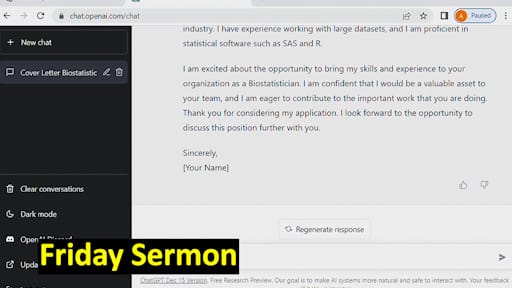

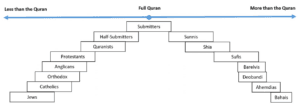

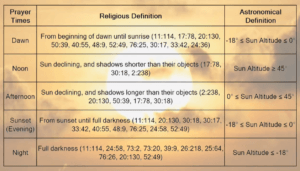





 So, the conclusion from what Rashad Khalifa said hismelf is that if you want mathematical proof about the Quran, it’s in Appendix 1, and if you want mathematical proof about Rashad’s messengership, then it’s in Appendix 2. So, Appendix 2 is Rashad’s mathematical proof of messeangerhip. And this appendix has 40 facts, or 40 cases with multiples of 19 which are connected to Rashad.