In the name of God, Most Gracious, Most Merciful. Our dear lucky viewers, peace be upon you. This page will present to you how to observe The Contact Prayers, the salat. And you are very lucky because you are trying to learn how to make contact with your creator. Which is the greatest of all worships. In this step I will explain to you the meaning of the word salat.
You already heard me call it contact. The word salat is an Arabic word derived from the root “sila”, which means connection or contact. So when you observe the salat prayers, you will make contact with your creator. It is wrong to translate it as “pray”. As a Muslim, when you tell somebody, “I pray five times a day”, that is the wrong expression because other people can tell you, “I pray all day”. The correct expression for the Muslim is “I make contact with my creator five times a day”. This is the meaning of salat.
In this program, I will present to you where the salat commandment comes from. The Contact Prayer is mentioned in Quran more than 70 times. And I will show you the crucial verses like where the times of contact prayers are mentioned in the Quran. Then I will go on to explain to you the source of The Contact Prayers. When was the first time when the contact commandment came to us from God, and how did it come to our generation? I will explain this to you. Then I will move on to explain why does God want us to establish contact with Him? Why did God command us to observe contact prayers five times a day? What is the reason? Does God need The Contact Prayers? Or do we need The Contact Prayers? After this, I will go on to explain every aspect of the contact prayer. I’m going to start with the call for The Contact Prayers, the athan. I will go through the details, even the historical development of it. I will show you how the words are written in English, the religious transliteration. Then I will go on to the preparation for The Contact Prayers, which is called wudu’ or ablution.
The Source
And of course, our sources are always the Quran. There’s only one source, and it is this book right here, the Quran. God’s message to you, to me, and to the whole world. This is God’s final message to the world. And this is our source. The only source.
The Wudu’ + Contact Prayer
I will show you where the wudu’ is mentioned in Quran and what the details are, then I will demonstrate for you how to do the wudu’, and I will move on from there to demonstrate for you and describe in detail how to do The five daily Contact Prayers, The Morning Contact, The Noon Contact Prayer, The Afternoon, The Sunset and The Night Contact Prayer.
I will explain also some of the fine details. For example, what happens when you will miss part of The Contact Prayer in a group. You’re going to the mosque and you see a group of people praying, you come in late, what to do? And some other fine details. So I hope this will cover everything you need to know about The Contact Prayer. The most important worship in Islam.
Times of Contact Prayer
You heard me say that The Contact Prayers must be observed five times every day. Okay, where in the Quran do we find these five times? They are specifically defined in the Quran. For example, In sura number 11, verse number 114, we see three times of Contact Prayers. This is what the verse says: “You shall observe The Contact Prayers at both ends of the day and at night.” So here you have three prayers. At both ends of the day, this is the morning prayer and the sunset prayer. The morning prayer is before sunrise, and the sunset prayer is immediately after sunset. And of course, the night prayer is the last prayer of the day. So here in this verse we have three prayers. We are commanded to do these three prayers. The morning, the sunset and the night. Now the noon prayer is mentioned in Surah number 17, verse number 78, where it says: “You shall observe The Contact Prayer when the sun begins to decline from the highest point (at noon)”. This is a very specific description of the time of The Contact Prayer at noon. As soon as the sun begins to decline from its highest part of the day, at noon, you observe the noon contact prayer. This is sura 17, verse 78. It says exactly the time of The Contact Prayer at noon. So now we see the morning prayer, the noon prayer, the sunset prayer, and the night prayer. Well this accounts for four of the prayers. Where is the fifth one? We find the fifth prayer mentioned in sura 2, verse number 238. It says “You shall observe all The Contact Prayers, especially the middle prayer.” The middle prayer has to be the afternoon prayer because we have the morning prayer, the noon prayer, the sunset prayer, and the night prayer. The middle prayer would be the afternoon prayer. So there you have it, all 5 contact prayers mentioned in the Quran. By the way, the morning prayer and the night contact prayer are mentioned by name in verse 58 of Surah 24. It talks about Salat al-Fajr, this is The Morning Contact Prayer, and Salat al-Isha, this is the Night Prayer. So, all five times of The Contact Prayers are decreed in the Quran.
The Original Source of The Contact Prayers
And now I would like to discuss with you the source, the original source of The Contact Prayers. When you look in the Quran, you will notice that before Abraham, there was no mention of The Contact Prayers, the salat. You notice that Noah was telling his people to just believe in God and ask His forgiveness, but there is no mention of The Contact Prayers before Abraham. The original source of The Contact Prayers is the prophet Abraham, who is the father, the founder of Islam. And we see this very clearly in sura 22, verse 78. The last verse of Surah 22. We also see it in sura 21, verse 73, where we learn that The Contact Prayers were given to Abraham as the original founder of Islam.
We see in sura 16, verse 123, that the Prophet Muhammad followed the ways of Abraham. And then we see in sura 8, verses 33 to 35, and sura 9, verse 54, we see that The Contact Prayers were practiced before the Prophet Muhammad. A lot of people are under the erroneous impression that the Prophet Muhammad brought these practices. But they came through the prophet Abraham. And this is why we do not see the details of how many units per prayer in the Quran, although the Quran is complete, perfect, and fully detailed. So the reason the details of the contact prayers are not in the Quran is because they were already in existence when the Quran was revealed.
I can tell you to go and buy Crest toothpaste, and I don’t have to explain to you what Crest toothpaste is because Crest is already in existence, all you need to do is go out in the market and buy it. When the Quran came down, The Contact Prayers, the salat, were already in existence. And this is exactly why in one of the very early suras, surah 73, Al-Muzzammil, we see the commandment to observe The Contact Prayers and the zakat, because they were already in existence. Abraham, being the founder of Islam, what did he contribute to the religion? He contributed all the practices of the religion.
- The Contact Prayers,
- The Zakat charity,
- The fasting of Ramadan (In fact we see the fasting of Ramadan was slightly modified in the Quran, in sura 2, verse 187),
- Hajj (in Sura 22, we see that it is directly decreed through the prophet Abraham).
So Abraham contributed all practices in Islam. You must correct that impression. The Prophet Muhammad contributed the Quran, that’s it. But all the practices existed before the Prophet Muhammad, they were in existence before the Quran came down.
Why do the Contact Prayer?
Now we get to the question, “Why should we pray?” Why should we make contact with our creator every day five times, repeating the same thing five times a day? The obvious answer first is that we do it because our creator commanded us to do so in the Quran. But what is the mechanism? Why does God ask us to contact Him five times a day? Does God benefit from it? Do we benefit from it? And the answer immediately is God does not need our contact prayers. We need The Contact Prayers.
And we fully understand the reason for decreeing The Contact Prayers if we know who we are. Most people do not even know who they are. You ask a person “who are you?” and they look in the mirror. They say “this is me” and they are wrong. The body is like a garment that we are wearing temporarily. The real person is invisible to us. The real person, the soul, is in another dimension that is not visible to our eyes. So what does the real person look like? This will lead us to understanding, why should we observe The Contact Prayers? You see, you can consider The Contact Prayers, the meals for the real person, the food, the nutrition. When we are born our mother feeds us milk and we grow. Then we eat all kinds of food, rice, meat, potatoes, and so on, and our body grows until it becomes 5 feet, 6 feet, whatever. And that is the limit of the body’s growth. Meanwhile, what is happening to the real person, the soul? Is the real person nourished just like the body? This is why most people don’t realize the importance of making contact with their creator.
Making contact with our creator is the most important nutrition for the soul. We need it to grow and develop. The real person grows and develops by contacting our creator daily. Five times everyday constitute five meals for the soul. Every time you do a contact prayer, your soul grows and develops. This is why we are commanded to do the contact prayer. You can imagine the person who does not feed his/her soul. At the end of living in this world, they are still babies because they never feed their souls. But the Muslim, the person who observes the duties and practices of worship, this person feeds the soul and the soul grows and develops immensely. We end up our mission in this world grown and developed and healthy and fit for the real life, the eternal life that comes after this life.
The Contact Prayers therefore are very important. Think of them as the meal for the soul, for the real person. The morning prayer is the breakfast for the soul, for you, the real you. Just like you give your body breakfast, lunch and dinner, you need for yourself, the real person, you need meals also. The noon prayer is the lunch for the soul, and the afternoon prayer is another meal, and the sunset prayer is a meal, nutrition for the real person. And the night contact prayer is the dinner for the soul. Nourishing, developing, and growing the soul is the reason for observing The Contact Prayers, and we are the ones who need it. God does not need it.
The Strength of the Soul
All practices of worship in Islam, without exception, are designed to cause the soul to grow and develop. The Contact Prayers therefore, are very important. They are all designed to make you the boss over your body. A lot of people, in fact the majority of people are enslaved to their body, their outer garment that is temporary. Someday this garment is going to vanish and you, the real person, will remain forever, for eternity. So most people, unfortunately, are unaware of nourishing and strengthening and developing their soul, the real person. But all practices of worship in Islam are designed to cause the soul to grow and develop, nourish the soul. For example, let’s take the morning contact prayer. Before sunrise, what does your body want? Your body wants to sleep, right? But your soul, you, the real you, the real person, needs to get up, do the ablution, and observe the contact prayer. Make contact, the first contact of the day, with your Creator. So immediately you can see that there is a fight. The body wants to sleep, and the soul needs to get up and nourish itself, and have breakfast. Now who’s going to win? If your body wins, you continue to sleep, and the body is the temporary garment. It is not very smart to let the body win, right? If you win (you, the real person wins), your body will obey and will say “yes sir”. It will listen to you, obey you, get up out of bed, do the ablution and observe the contact prayer. So you can see that the first contact prayer is a struggle between you and your body. By the way this struggle becomes less and less as your body becomes more and more obedient to you, as you become the boss. As you develop and become stronger, your body becomes more and more obedient, and with time, when you say “get up and do the morning prayer”, your body will say “yes sir”, obediently.
As a matter of fact, eventually you will actually enjoy getting up in the morning and doing the contact prayer. And this is because the soul has grown and developed and became the boss and enjoys observing the contact with our Creator. You look at the fasting for example, one of the important practices in Islam is fasting during the month of Ramadan. And in Ramadan your body of course wants to eat and drink, but you tell your body when you fast you’re not to eat or drink until sunset. So you can see that you are practicing, exercising your soul. And this causes your soul to grow and develop, and this is exactly the whole idea of our being here in this world. We want to grow and develop as much as possible in order to enter the real life, the eternal life, the hereafter, in a state of fitness, strength, growth and development. Because in the hereafter, you cannot hold a responsible position in eternal real life if you are weak, unnourished, and still a baby. Will you hire a baby as a pilot or an engineer? Of course not. So God wants you to develop yourself and to be strong enough to hold a responsible position, a high rank in the hereafter, the eternal real life. And all practices of worship in Islam are designed towards this end.
For example, the zakat charity, what is it? The zakat charity is simply taking money away from your body and giving it to the poor. So you can see that you are being the boss, because the body loves money. And you take something that the body loves and give it away. So all practices of worship in Islam are designed to make your soul grow and develop, make you the boss over your body. And The Contact Prayers are the most important tool to do so. You’re going to notice it the first time you do the morning contact prayer before sunrise.
How to do the Contact Prayer?
Let us now get to the details of The Contact Prayers and how to observe them. There are a billion Muslims in the world today, one thousand millions throughout the world, in every country of the world. But in the area that is recognized as the Muslim world, you hear the call for the prayer five times every day. The morning, noon, afternoon, sunset, and night. And you hear the “Muadhin”.
Adhan
“Muadhin” is the name of the person that delivers the Adhan, or the call to contact prayers. And before I get into explaining the Adhan, I wish to remind you that in the last 1400 years, lots of customs, innovations, prejudices, superstitions were added into the Adhan. And what I’m going to present to you now is the Adhan of the Prophet Muhammad that he approved. And I’m going to remove all the additions and the superstitions and nonsense from the Adhan, and I will give you the pure Adhan. I am going to show you, so you can see how it is pronounced. Now at the beginning of Islam, the people went to the Prophet Muhammad and they said, “how can we call the people to come to the prayer? The Jews have the horn, and the Christians use bells, what are we going to use?” And with time, the Prophet’s companions studied the matter, and finally, it was suggested that somebody stands on top of the mosque and make the announcement “Allahu Akbar”, which means “God is Great”, four times. Allahu Akbar, Allahu Akbar, Allahu Akbar, Allahu Akbar, La Ilaha Illa Allah. There is no God except the One God, which is the message of all God’s messengers to the world. There is really one message from all the messengers that God sent to us, and this message is La Ilaha Illa Allah. There is no god except The God, Allah. So the Adhan consists of Allahu Akbar four times followed by La Ilaha Illa Allah.
This Adhan that has been approved by the Prophet consisting of Allahu Akbar four times then La Ilaha Illa Allah, with time it got so long that in around 1953, the Minister of Religious Affairs in Egypt issued a law to reduce the Adhan. It got so long and so ridiculous it took 10-15 minutes to deliver the Adhan and it had foolish things, praising the Prophet and his red cheeks and silly things. I mean the Adhan got really ridiculous. After a few years, some people added to the Adhan “Ash-hadu an La Ilaha Illa Allah, Wa Ash- hadu Anna Muhammadan Rasool Allah”. This was added to the original Adhan. Some years later they added the expression “Hayyu Ala Salah”, which supposedly means “come to the prayer”. But it really doesn’t mean that. Apparently some new foreign Muslims, that is non-Arab Muslims, added that expression “Hayyu Ala Al-Salah”, which is not typical. The Arabic should have been “Hayya Ila Al-Salah”, but they said “Hayyu Ala Al-Salah”. Then many years later somebody added “Hayyu Ala Al-Falah, which supposedly means “come to the success”. And some other people added “Ash-hadu Anna Aliyyan Waliyyu Allah”, in some parts of the Muslim world. And until now they use these, all these additions are being used in different parts of the Muslim world. Later on some people added, “Ash’hadu Anna Ahlul Bayt Hujuj Allah”, and so on. So the adhan kept getting longer and longer, as I told you, until the minister of religious affairs in Egypt issued a law reducing the Adhan to its present form in the Muslim world. But here at Masjid Tucson, and hopefully you will go back to the original Adhan that the Prophet Muhammad approved. Allahu Akbar, Allahu Akbar, Allahu Akbar, Allahu Akbar, La Ilaha Illa Allah. This is the Adhan that we use here in Masjid Tucson and hopefully it will spread all over the world. We have it done like this in many mosques around the world that have seen the light and decided to take the Adhan and the prayers to the original Adhan and prayer of the Prophet Muhammad.
Ablution
You know the same thing is true with the Wudu’. Wudu’ is the ablution or preparation for Salat. When people hear the Adhan or the call to The Contact Prayer, they prepare for The Contact Prayer. And they do this by observing ablution. And ablution is decreed in the Qur’an, in surah number 5, verse number 6. And it is very specific, it gives you four steps. Remember that, four steps of ablution. The average Muslim today has eight or nine or ten steps, which constitutes actually, in reality, some other God that added these steps, because they do it religiously, and it constitutes idolatry. So please be careful and observe what the Quran says. The Quran, the whole Quran, and nothing but the Quran. And the Quran gives us four steps.
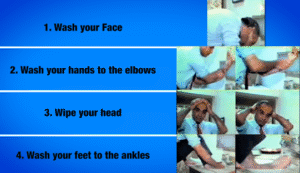
- The first step is washing your face.
- The second step is washing your arms to the elbows.
- The third step is to wipe your hair.
- And the fourth step is to wash your feet.
These are the four steps decreed in the Quran, and it is actually a gross transgression to add anything to the four steps or reduce anything. Some people will say, what is wrong with washing my nose and my mouth and my neck and all this, my ears and so on. Of course there is nothing wrong with extra cleanliness. Go take a bath or a shower if you want to, but when it comes to religious practices we must adhere to what our Creator dictated exactly. We cannot increase it, reduce it, or increase it by anything. So it is very crucial that we follow what our Creator said in the Quran. These are the words that came out of the Prophet Muhammad’s mouth. Ironically, those people think that they are following the Prophet Muhammad by increasing the number of steps in ablution. And you and I know that the Prophet Muhammad could never disobey God. So, if God said four steps, this is it. The ablution is four steps. So now let us demonstrate for you the four steps of Ablution; The Wudu’. We find this commandment in Surah number 5, verse number 6, it says:
“O you who believe, when you get up for the Salah prayer, you shall:
|
Four steps. And these are the words that came out of the Prophet Muhammad’s mouth. These are the words of God. And God is saying you shall observe the ablution four steps. Washing the face, arms to the elbows, wipe your head, and wash your feet. These are the four steps as dictated in Quran. However, like everything else, innovations, superstitions, traditions, crept into God’s commandment and Satan distorted the commandment. Now the vast majority of Muslims observe something like nine or ten steps in ablution. And this is very serious, because it simply means that there is some other God who told them to do the ablution nine steps. They wash their hands, their mouth, their nose, their face, their ears, their neck. They have all kinds of innovations and additions. And I would like to warn you that you must never increase the steps or decrease them – the steps of ablution. You must obey exactly what God told you in Quran. If you want to wash more more you might as well take a shower or do whatever you want but outside the ablution. If you are taking a shower or a bath you can do the ablution after the shower or the bath while you are still in the shower, but you have to go through the motions of ablution as I will show you now. So let me demonstrate to you how to go through the motions of ablution as I will show you now.
We are now demonstrating the ablution. You should make an intention, that is, you say, “I intend to observe the wudu or the ablution”. And you say, “Bismillahir Rahmanir Rahim”, and you commemorate God in any way you want. You say, Alhamdulillah, Subhanallah, Allahu Akbar, anything you want to commemorate God. But if you want to say it in Arabic, the intention should be “Nawaitu Al-Wudu. Bismillah ar-Rahman ar-Rahim”. So here we go, “Bismillah ar-Rahman ar-Rahim, Nawaitu al-wudu”. And then the first step, you wash your face. There is no set number of washing your face. The second step, the arms to the elbows. Right arm and then the left arm. And this takes care of the second step. The third step is you wipe your hair. So what I will do is I’ll wet my hand and then I will wipe my hair, my head. The final step is wash your feet to the ankles. That’s it. There you have it. The four steps of Wudu’. Very simple. Don’t add any more steps and don’t reduce the steps. Now that you finished the four steps of wudu, you are ready for the Salat prayer. So now let’s go back to the masjid and show you how to observe the Salat prayers, all five of them. Here is a visual demonstration of the steps:
The Contact Prayer
The innovations, superstitions, prejudices, customs, and traditions did not hit the Adhan and the Wudu only, brothers and sisters, it also hit the Salat itself, The Contact Prayers. There is so much garbage that we had to remove from The Contact Prayers to make it pure and make it exactly The Contact Prayers that the Prophet Muhammad preached and practiced. So what I am going to present to you is The Pure Contact Prayers without any innovations or additions that happened in the last 1400 years. We are trying to take The Salat, The Contact Prayers, all the way to the Prophet Muhammad, the way he preached it, and the way he practiced it.
The Contact Prayer is for God Alone: Do not mention any other name!
And the most important point, please pay attention, the most important point is never to mention any name other than the name of Allah, the name of God, in your Contact Prayers. This is dictated upon us in the Quran. But you probably know that the average Muslim today adds the names of Muhammad and his family, Abraham and his family, and so on, in The Contact Prayers, and this nullifies The Contact Prayers, it makes it absolutely useless, if not harmful. So you must be very careful, and this is our responsibility to tell you that, you must be very careful never to mention any name other than the name of Allah, the name of God, in The Contact Prayers. We see this in the Quran in Surah 72, ayah or verse number 18, where it says, the places of worship belong to God, do not mention any other name besides the name of God. This is a Qur’anic commandment. And in surah 20 verse 15, we see the commandment, Aqimu Al-Salata Li Dhikri, observe The Contact Prayers to Commemorate Me; singularly. God is telling us that we must commemorate him alone in the Salat, in The Contact Prayers. So I will give you the details of The Contact Prayers and we will go to the mosque now and give you a demonstration. But before I do this I want to clarify that the Tashahhud (Testification of Faith), or the recitation while sitting down, should be only:
- Ash-hadu An La Ilaha Illa Allah, Wahdahu La Sharika Lah. (I testify that there is no god except God, He is One, and Has no partners)
- Or just Ash-hadu An La Ilaha Illa Allah. (I testify that there is no god except God)
- Or just La Ilaha Illa Allah. (There is no god except God)
This is enough. There is no god except The One God. And forget about all these names, Muhammad and his family, Abraham and his family, Muhammad and Abraham will be the first people to denounce this use of their name in The Contact Prayers. And you know something, all the Imams of Sunni and Shia, all of them, unanimously agreed that this mentioning of Muhammad and his family, Abraham and his family, while sitting down in The Contact Prayers, is not an obligatory part of the prayers. You heard me right. Unanimously, they agreed that this is just a desirable part, but it is not. It actually kills your Contact Prayer, makes it useless, and actually does harm to you. Because God will be offended to have other names mentioned besides him in the daily worship, you’re worshipping God alone. So just be careful. And this by the way led to the conclusion that you must recite only al-Fatiha, the opening Surah of the Quran while standing up in The Contact Prayers. Do not recite any Quran after al-Fatiha. And on the surface this looks like abandoning the Quran, it is not, it is the exact opposite. Because in The Contact Prayers, a lot of people end up memorizing the short Surahs, Qul Huwa Allahu Ahad, and Qul A’udu, and that’s it, and they think they know Quran. But I must tell you to read Quran every day. You must read the Quran every day. This is a commandment from our Creator, to read His message, the Quran, every day. The whole Quran, not just the short Surahs. But in The Contact Prayers, please, you need only recite al-Fatiha. And this is a unifying force of all the Muslims in the world. I was praying in Mecca one time, and the imam read al-Fatiha, and then he read the whole Surah number 32, Surat Al-Sajdah, after al-Fatiha. And I was thinking, you know, there are a few thousands of people in there around the Kaaba, praying behind this imam, and the vast majority of them didn’t know any Arabic. What is their fault? They just stand through all this recitation in Arabic that they do not understand. What is required is only recite al-Fatiha. And this will unify all the Muslims of the world. They will do the same thing in all the prayers. In Japan they know al-Fatiha, they read it in the contact prayer. In Sweden, in America, in Canada, in Australia, in Mecca, in Pakistan, all the Muslims of the world will do the same thing. But this business of reciting long portions of the Quran is wrong. It actually ruins The Contact Prayers. God wants things to be easy for us, but Satan wants to make things difficult for us, so he adds old things. Besides, when you recite the Qur’an, you mention Moses and Jesus and Muhammad and Pharaoh and the devil and all these things, you mention other names besides the name of God in The Prayer, and this is forbidden by commandment from God. We are not to mention any name. When you recite the Quran in the mosque and you mention other names, it’s because God says so in the Quran. It says, Wadhkur Fil Kitabi Maryam (Mention in The Book Mary), for example. this is God’s command, we say you can mention the name of Mary in the Quran in order to learn from the lessons of previous prophets, messengers, and so on. And it is a commandment from God to mention, so when we read the Quran, we mention these names only because God commanded us to do so, but in The Contact Prayers, in The Salat, we are commanded never to mention any other name but the name of Allah, the name of God.
Find a nice clean place
After you have done your Wudu’, and you are ready for the prayer, you go to a nice clean place. You don’t necessarily need a prayer rug. This is one of those innovations. You can pray in any clean place, even bare ground, as long as it is dry and clean.
Find the direction of Mecca
So you go to a nice clean place and you find the direction of Mecca, the direction of The Sacred Mosque, because this is a commandment in Quran that you must face. This is an organizational point. There is no other significance to it except an organization. You can imagine people going in a mosque and facing in different directions, it will be a mess. So this organizational point dictates on us that we must face the direction of Mecca, wherever we might be. So, in the United States, the direction generally is slightly south of east, slightly south of east, southeast.
Intend your prayer
So find the direction of Mecca, you face that direction, and then you make your intention. This is the first step. You must say, I intend to do the morning prayer, in any language you like. If you want it in Arabic, you can say, “Nawaitu Salat Al-Subh”. This will be the niyyah, or the intention, for The Morning Prayer. Or if it is for the noon prayer, you say in your heart or in an audible voice, I intend to do the noon prayer; in Arabic “Nawaitu Salat Al-Zuhr”. If it is the afternoon prayer, it is “Nawaitu Salat Al-’Asr”. And for the sunset prayer, the niyyah or intention is “Nawaitu Salat Al-Maghrib”. For the night prayer, the intention or the niyyah is “Nawaitu Salat Al-’Eshaa’”. So, but you can do it in any language you wish, secretly or loudly.
Extol your Lord in Jubilation
Now after you do the niyyah, now you’re facing the direction of Mecca, you make your intention or niyyah, then you open the salat by raising your hands to the side of your face and saying Allahu Akbar like this. Allahu Akbar.
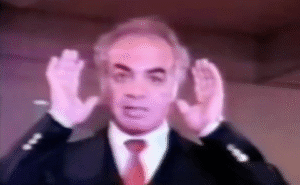
There is your opening of The Salat. Once you say Allahu Akbar in this manner, you have started your Contact or Salat, your
Contact with your Creator. Now after you make the opening Takbeer, Allahu Akbar.
Hand Positioning
You can either put your hands on the side, or you can choose to hold them like this, with your left hand on your stomach, and your right hand on top of your left hand.


It doesn’t make any difference. Some people make a big deal out of it, but there is no difference. Either way is correct. So this is the opening of The Salat, The Contact Prayer. Allahu Akbar. Now you are ready to recite Al-Fatiha, the opening Surah of Quran.
Transcribing the Arabic words
Ablution Intention
The easiest way for you is to have me write the words in English transliteration, English letters. So before you do the Wudu’, the ablution, you can say your intention. I intend to make the ablution or Wudu’ either in English or in Arabic. So I intend to do the ablution in English, the Arabic would be Nawaitu Al-Wudu’ and you write it like this Nawaitu Nawaitu Which means I intend. Nawaitu Al-Wudu’. Al- means the. Ablution. Wudu’. Al-Wudu’. Nawaitu Al-Wudu’.

Adhan
Below is the Adhan written down for you. So in the Adhan we say Allahu Akbar 4x. Allahu Akbar, Meaning God is the Greatest. Allahu (God) Akbar, Allahu Akbar 4x. Then, La Ilaha Illa Allah. La means no. Ilaaha, meaning god with a small g. Illa means except. Allah means God. So this is the complete Adhan, the original, without any innovations or additions or traditions:
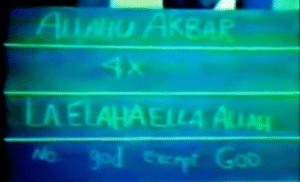
A lot of people think that Allah is the name of God, but it is not. Allah simply means God. The English word for it is God. The non-Muslims in the Arabic world say Allah, because this is the Arabic word for God, even though they are not Muslims. They will say InshaAllah, say Allah, because simply that is the language. It is not the name of God. This is why I use the English word God for Allah.
Prayer Intentions
I’m going to write the niyyah or intention for every prayer for you, so you can see how it is spelled.
1. Dawn Prayer
Here’s the niyyah or intention for the morning prayer. Nawaitu, which means I intend. Salat. Salat Al-Subh. Al-Subh. I intend to do the morning prayer. Nawaitu Salat Al-Subh.
2. Noon Prayer
Now, to make it The Noon Prayer, you just say the same thing except you change Al-Subh to Zuhr, which means noon. Nawaitu Salat Al-Zuhr. This will make it The Noon Prayer. Al-Zuhr
3. Afternoon Prayer
For the afternoon prayer, you just make it Al-’Asr. Salat Al-’Asr. You write it like this, Al-’Asr. Nawaitu Salat Al-’Asr.
4. Sunset Prayer
The sunset, you make it Al-Maghrib. Nawaitu Salat Al-Maghrib. This is the sunset prayer.
5. Evening Prayer
And the night prayer is Al-Ishaa. Nawaitu salat Al-’Eshaa’. Nawaitu Salat Al-’Eshaa’.
Reciting Al-Fatiha (The Key) in the Prayer
And by now you know how Allahu Akbar is written. The opening of the contact prayer, Allahu Akbar, this is followed by Surat Al-Fatiha which in Arabic is:
“Bismillah Al-Rahman Al-Raheem.
Alhamdulillahi Rabbil ‘Alameen
Al-Rahman Al-Rahim
Maliki Yawm Il-Diin
Iyyaka Na’budu, Wa Iyyaka Nasta’in
Ihdina Al-Sirata Al-Mustaqeem
Sirata Al-lathina An’amta ‘Alayhim, Ghayr El-Maghdubi ‘Alayhim, Wela El-Dalin”
The translation in English is:
“In the name of God, Most Gracious, Most Merciful.
Praise be to God, Lord of the Universe.
Most Gracious, Most Merciful.
Master of the Day of Recompense
You Alone we worship, and you alone we ask for help
Guide us in The Right Path
The Path of those whom you blessed, not of those whom have incur wrath nor the strayers”
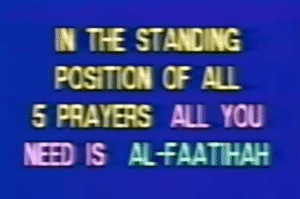
After every change in movement Exalt God: from Standing to Bowing
After you recite al-Fatiha, then you make Ruku’ bowing. And as you bow, you say Allahu Akbar. And you know what that looks like. I wrote it for you. Then during ruku’ you say Subhana Rabbiyal Azeem. About three times. It doesn’t matter two, three or four times. Subhana means Glory be to. Subhana, Subhana, Rabbiya, means Glory be to my Lord, Rabbiya, Al-Azim, means the Great, Al-Azeem. Subhana Rabbiya Al- Azim. Glory be to my Lord The Great. Then you stand up and in this position only you say Sami’a Allahu Liman Hamidah. Means God hears anyone who praises him. And it is written like this. Sami’a Allahu Liman hamidah. Anyone hamidah, who praises him. Hamidah. Sami’a Allahu liman hamidah. سَمِعَ اللَّهُ لِمَنْ حَمِدَهُ As you stand up, then you make the first prostration, sujood. And when you do that, you say Allahu Akbar as you go down in prostration, and during prostration you say Subhana Rabbiya Al A’alaa. Subhana rabbiya. Then during sujood and prostration you say Subhana Rabbiya Al A’alaa. About three or four times. Al A’ala. Means Glory be to my Lord The Most High. Al a’la, the most high. And this takes care of all the words of The Contact Prayers. Now you know how to say all the words, and if you play the tape over and over, you can see how exactly they’re written down and how they are pronounced.
After every 2 units (Rakats) and at the end of the prayer we sit back from the second prostration and testify that there is no god but God
In the sitting position you say, Ash-hadu An La Ilaha Illa Allah Wahdahu La Sharika Lah. Which means I bear witness that there is no god except Allah, The One God. He is One. La Sharika Lah. He has no partners. And this is how I write it. Ash-hadu. Ash-hadu means I bear witness. Ash hadu. An La. Ilaha means god with a small g. Ilaaha. I bear witness that there is no god, Illa except, Illa Allah. The One God. Wahdahu. He is One. Wahdahu; He is One. Wahdahu, La Sharika Lah, He has no partner. La means no sharik means partner. La Sharika Lah. And this takes care of the Tashahhud. In the sitting position. Ash-hadu An La Ilaha Illa Allah Wahdahu La Sharika Lah.
Returning The Peace to The Angel on the right and left
And then of course to end The Prayer you look at the right side and say Al-Salaamu ‘Alaykum and then on the left side saying Al-Salaamu ‘Alaykum and this ends The Contact Prayer. So, let me write Al-Salaamu ‘Alaykum for you. Al-Salaamu ‘Alaykum. There you have it, the complete words of The Contact Prayers.
Additional Details and Advice for The Contact Prayer
Now let me explain a few fine details about the Salat, The Contact Prayers. One of the most important points is that there is a myth among the average Muslims that a woman who has her period or the menstruation cannot Pray. Now this has to be from Satan, because Satan is the one who does not want you, the Muslim woman, to pray. God did not say in The Quran at all, do not pray during menstruation. There is nothing in the Quran that says that. Even the Hadith, we learn from hadith that the Prophet’s wives used to pray during their menstruation. One hadith even says they put a bucket under one of his wives as she prayed. Ridiculous as this may be, but it demonstrates that the Muslim woman should pray during her menstruation. If a Muslim woman does not pray during menstruation, this means one week in the month without prayer. And this is like four years every ten years. Four years without any prayer. Imagine that. So this will be a satanic innovation to stop the women from praying during menstruation. So, please, menstruation or not, the contact prayer, the salat prayer, is the only worship that must go on, there is absolutely no excuse for not doing The Contact Prayer.
Conditions for Shortening or Lessening The Contact Prayer
Even God provides that you can pray walking or riding in a car or riding in a plane or in a bus or even if a person is very sick, very ill, cannot move, that person can pray with his or her eyelids, just or even mentally. If you are working in a crowded place and you cannot find a place to pray, you can pray at your desk sitting down just mentally going through the motions and the words. So there is absolutely no excuse for missing any Contact Prayer.
So whether the person is ill, unable to move, or riding, trapped in a car or a bus or a plane or in a working place where there is no place available for prayer or during menstruation or the after birth bleeding, any of these conditions cannot, nothing stops you from performing, observing The Contact Prayers.
Another point that I wish to mention is The Group Prayer or The Jama’a. In The Jama’a, one person leads The Prayer, and the rest of the group stand behind him, behind the Imam, and do exactly what he does. You do not have to recite Al-Fatiha or The Quran after the Imam. Remember, all that is required in The Contact Prayer is Al-Fatiha, the first Surah of The Quran. So you just mentally follow the Imam as he recites Al-Fatiha during The Contact Prayers. And then of course in Ruku’, The Bowing position, you say Subhana Rabbiya Al-’Azim (Glory be to my Lord The Great) as usual, and in the Sujood or Prostration you say Subhana Rabbiya Al-A’laa, as usual. So you only listen to the imam when he recites Al-Fatiha in the Standing Positions. If a person comes late and finds The Jama’a, the group, already did one or two or three Rak’ahs, Units, if you come late, you just join the group in whatever position they are in, and then after they finish, when they say Al-Salaamu ‘Alaykum, the first one, you stand up and you complete the part that you missed. So this is how you make up for missing Units or missing Rak’ahs when you join a group.
What happens if you miss a prayer
What happens if you miss one of The Prayers, one of The Contact Prayers? You’re supposed to do all Five Contact Prayers during each one of the five periods. The Morning Contact before sunrise, The Noon between around 12 and 4, The Afternoon between 4 and sunset, The Sunset Contact immediately after sunset, and The Night prayer after all the twilight disappears from the horizon, about two hours after sunset. Now what happens if you miss one of these Prayers? There is a myth that you can make it up or combine Prayers, and it is just an innovation, you cannot make up missed Prayer. If you miss The Noon Prayer on any day, you just cannot bring yesterday back, you missed it and it is too bad. So you just ask God for forgiveness, repent, and promise God that you will never, to the best of your ability, miss any more prayers, and you just go on doing The Prayers. See, the idea of The Contact Prayer is to contact our Creator within a certain period of every day. And when you miss that, it is gone, you cannot bring it back, and you cannot make it up. But you can ask forgiveness and repent.
Demonstration of The Contact Prayers
And now, the best way to describe The Contact Prayers to you is to demonstrate exactly how it is done. So now I will demonstrate for you The Morning Contact Prayer, The Noon Contact Prayer, The Afternoon Contact Prayer, the Evening Contact Prayer, and the Night Contact Prayer.
Do you remember the first thing you have to do in order to observe The Contact Prayers? That’s right, The Intention. You declare your intention, in Arabic, Niyyah. I will proceed with the prayer and you just watch everything I’m doing, and this will be the correct way for observing the contact prayer. So, first I face the direction of Mecca, and I am going to make my intention.
Below is the demonstration of 1 unit of the Contact Prayer.
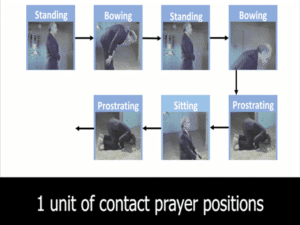
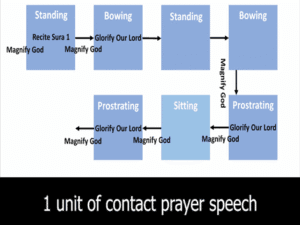
| Contact Prayer Timing | Number of Units |
| Dawn | 2 |
| Noon | 4 |
| Afternoon | 4 |
| Evening | 3 |
| Night | 4 |
You must say “La elaha ella Allah” at the end of the first 2 units of each prayer, and also at the last unit of each prayer. And then you exit each of the 5 prayers by giving “salam” to your right, and then to your left.
By: Rashad Khalifa, the Messenger of the Covenant
For more information:
Reconstructing the Muslim Prayer Completely from the Quran
Join us to listen to our online Friday meetings every Friday.